DD
MM
YYYY

PAGES

DD
MM
YYYY

spot_img

PAGES

Home Blog Page 2647

Afreximbank Delivers Strong financial results for Q3 2024, Amidst Challenging Economic Landscape

0

Afreximbank, a Pan-African multilateral financial institution recently released its consolidated financial statements, and that of its subsidiaries, announcing robust financial performance in the third quarter (Q3) 2024, for the nine months ended September 30.

The bank delivered a solid performance, evidenced by its healthy liquidity levels, better asset quality, and robust capital adequacy levels.

The Group’s profitability for the nine-month reporting period met expectations and showed significant improvement over the previous year, underscoring its resilience and operational efficiency.

Net Interest Income for 9M’2024 grew by 22.05% to US$1.3 billion, compared to US$1 billion for 30 September 2023 (prior period or 9M’2023). The increase was largely driven by a 24.62% increase in interest income to US$2.2 billion, on the back of the growth in the Bank’s interest income and effective management of borrowing costs. The Net Interest Spread was maintained despite declining interest rates.

Despite inflationary pressures, increased business activities and increased staff numbers to support the growing business and implement strategic initiatives, the Group demonstrated resilience by sustaining its operating efficiency with a Cost-to-Income ratio of 17.16% in 9M’2024, compared to 16.79% in 9M’2023.

The Group’s total on-balance sheet assets and Contingent liabilities closed 9M’2024 at US$36.3 billion (FY’2023: US$37.3 billion). Cash and Cash Equivalents’ balances closed 9M’2024 at US$3.9 billion (FY’2023: US$5.6 billion). The decrease in Cash and Cash Equivalents arose from the Bank’s deliberate strategy to meet maturing obligations using internal resources while also controlling the costs associated with holding excess liquidity.

The Group’s Shareholders’ Funds rose by 7.96% to reach US$6.6 billion as at 9M’2024, compared to the FY’2023 position of US$6.1 billion due to a combination of retained profits and fresh equity contributions.

Commenting on the Bank’s Q3 2024 financial result, Mr. Denys Denya Senior Executive Vice President said,

“Afreximbank delivered a strong set of results for the first nine months of 2024, despite challenging macroeconomic conditions, particularly across Africa. The Group’s gross revenue grew by 24% year-on-year to reach US$2.3 billion while Net income also saw a 23% increase compared to the same period in 2023, totalling US$642 million. This solid performance was underpinned by growth in business volumes and healthy spreads, while maintaining a low cost-to-income ratio. Additionally, we maintained a healthy and strong balance sheet with robust liquidity position to drive the expected growth in the fourth quarter.

“Our subsidiaries continued to grow and expand, with FEDA achieving a 26% increase in funds under management, rising from US$770 million in FY2023 to US$970 million as of September 2024 while also expanding its member countries with five new members joining this year. AfrexInsure doubled the value of its insured portfolio to over US$4 billion, with premium insurance volume growing more than fourfold. Likewise, PAPSS saw an increase in the number of banks connected to the platform, and with the launch of the African currency marketplace, the outlook is increasingly promising.”

Looking ahead, the Group remains committed to achieving its strategic goals set out in its 6th Strategic Plan, which were reaffirmed during our recent mid-term strategy review.

Traders Scooping Up Large Amounts Of Cardano, XRP And New DeFi Coin As Prices Moon, Will The Buzz Continue?

0

A Cardano maxi surprised the crypto community recently, with considered reasons why ADA might not be a good coin to invest in. XRP is another coin that has recently mooned, due to regulatory relief in the form of the upcoming pro crypto US government. Meanwhile, a new coin Cutoshi that combines DeFi with Memes was trending on X and is now attracting a lot of new investment.

The Issues With Cardano

Cardano’s idealistic vision and innovative technology have won it loyal supporters, but deeper analysis reveals potential flaws that could deter long-term investors.

As Flantoshi, a Cardano maxi explains: One critical issue is Cardano’s reliance on Africa as its primary growth market. While the continent has immense potential, it faces significant challenges, including limited internet access (only 24% penetration) and low purchasing power.

Cardano’s focus here may delay broader adoption and squander opportunities in regions like Southeast Asia or Latin America, where internet access and remittance needs are present for more immediate wins.

Another risk is Cardano’s tendency to prioritize long-term scientific research over practical implementation. While its contributions to blockchain innovation are undeniable, competitors like Polkadot have already integrated Cardano’s research into their frameworks, potentially capitalizing on Cardano’s intellectual groundwork while outpacing it in market adoption.

Also, the Cardano community’s strong idealism often translates into resistance to compromise, as seen in debates over stakepool centralization. This could lead to fragmentation, weakening its position against more cohesive competitors, especially since the community now holds more governance power than before.

In a market increasingly favoring immediate utility over speculative potential, Cardano’s long timelines and focus on philosophical ideals could leave investors waiting too long for tangible returns.

The Case Against XRP (And We Don’t Mean The SEC!)

XRP’s recent 111% surge to $1.13 has been driven by optimism surrounding a pro-crypto shift in the U.S. administration, potentially putting an end to its long-running legal battles with the SEC. While this regulatory relief is encouraging, years of resources have been tied up in courtrooms, leaving the technology behind as competitors have continued to innovate. Much like Cardano perhaps.

XRP’s utility as a bridge currency for cross-border payments was groundbreaking when first introduced, but the industry has evolved. Modern blockchain solutions now offer faster and cheaper alternatives, raising questions about XRP’s relevance in a rapidly advancing market.

Another concern lies in its tokenomics. Only about 50% of XRP’s total supply is in circulation, meaning significant inflation could occur as the remaining tokens are released.

XRP’s fully diluted valuation (FDV) exceeds $112 billion – comparable to Solana, a coin that powers an entire blockchain ecosystem. In contrast, XRP serves a more limited function, which could make sustaining such a valuation challenging in the long term.

In the short term, people remain bullish about XRP, but for new entrants, these issues are worth pondering on.

Is Cutoshi The Answer To Today’s Needs?

Cutoshi combines the playful energy of memes with meaningful utility, bridging the gap between entertainment and decentralized finance. Its cross-chain DEX is designed to simplify blockchain interoperability, making DeFi more approachable for casual users and seasoned investors.

Meanwhile, the learning academy demystifies complex DeFi concepts, ensuring users can get involved and make the most of decentralized finance.

Cutoshi’s tokenomics are good too. The current FDV is just $11 million, a fraction of Cardano and XRP FDVs. A burn mechanism is built into the system to ensure long-term scarcity and marketing funds have been allocated to sustain visibility and growth.

And because there aren’t big Venture Capitalists who got a special rate not available to the public, this means there won’t be large sell-offs, as we have seen with other projects.

Cutoshi also has a wider appeal than XRP or Cardano. The Lucky Cat memes give the project a fun side, making it more accessible than projects like Cardano, which can feel overly academic.

And yet the project still has a serious focus, attempting to live up to the ideals of Satoshi Nakamoto, by empowering ordinary people rather than propping up existing TradFi systems like XRP.

Although only time will tell the future for these three projects, Cutoshi’s mix of fun and fundamentals could position it for sustainable long-term growth and that’s likely what is behind the recent $900k milestone in investment.


For more information on the Cutoshi (CUTO) Presale:

https://cutoshi.com/

Join and become a community member:

https://twitter.com/CutoshiToken

https://t.me/cutoshi

Donald Trump Talks with Crypto Community Leaders on Cabinet Appointments

0

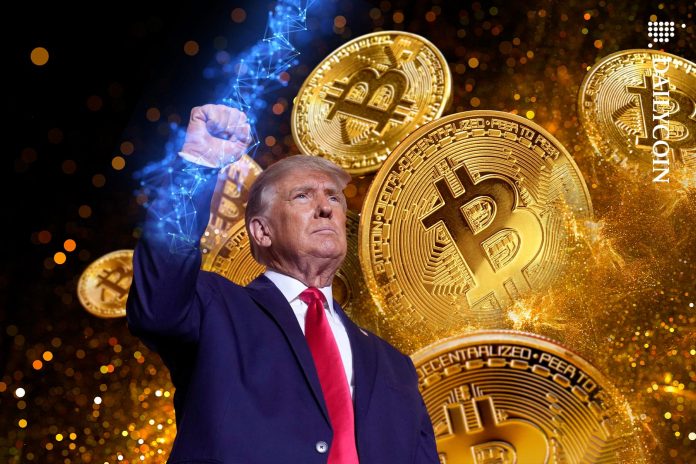
The political landscape is undergoing a transformation as the intersection of technology and governance takes a new turn with the recent developments in the United States. President-elect Donald Trump’s discussions with leaders in the cryptocurrency sector regarding cabinet appointments have sparked a wave of interest and speculation. This move signals a potential shift towards a more crypto-friendly administration, which could have far-reaching implications for the industry and the economy at large.

The involvement of prominent figures such as Brian Armstrong, CEO of Coinbase, in these discussions is particularly noteworthy. Armstrong’s presence hints at the possibility of a future where the lines between technology and policy are increasingly blurred. The creation of a Department of Government Efficiency, humorously acronymized as DOGE, under the guidance of visionaries like Elon Musk and Vivek Ramaswamy, suggests a commitment to innovation and efficiency in government operations.

Moreover, the appointment of pro-crypto candidates to key federal positions could position the U.S. as a global leader in the cryptocurrency space. The potential inclusion of individuals like Scott Bessent and the consideration of crypto-friendly leaders for the SEC chairmanship, such as Hester Peirce, Mark Uyeda, and Paul Atkins, indicate a proactive approach to embracing the benefits of digital currencies while navigating the regulatory landscape.

Recently, rumors have circulated that Larry Fink, the CEO of BlackRock, is in the running for the Treasury Secretary position under President Trump’s administration. However, these rumors have been clarified by recent reports which state that while Trump’s team has reached out to Larry Fink for insights on their search for a Treasury Secretary, Fink himself is not a candidate for the nomination.

The implications of such appointments are manifold. A cabinet that understands and appreciates the nuances of cryptocurrency could lead to more informed policymaking, fostering an environment conducive to growth and innovation. It could also mean a more favorable regulatory framework that balances the need for oversight with the industry’s need for freedom to explore and expand.

This development is not without its challenges, however. The integration of cryptocurrency into the fabric of government policy will require careful consideration of security, equity, and economic stability. It will necessitate a dialogue between technologists, economists, and policymakers to ensure that the benefits of cryptocurrency are realized without compromising the foundational principles of governance.

As the world watches these developments unfold, the conversation around cryptocurrency and its role in society is sure to intensify. The potential for a more crypto-centric policy framework under the Trump administration could be a turning point for the industry, heralding a new era of digital governance and economic strategy.

The coming months will be critical as the new administration takes shape and begins to implement its vision. The crypto community, along with the broader public, will be keenly observing how these cabinet appointments influence the trajectory of cryptocurrency in the U.S. and beyond. With a pro-crypto Congress and a president-elect who has shown a willingness to engage with industry leaders, the stage is set for a fascinating chapter in the intersection of politics and digital currency. The future of crypto governance is now, and it promises to be a journey worth following.

Starlink Suspends Residential Orders in Nigeria, Pending Regulatory Approval For Price Hike

0

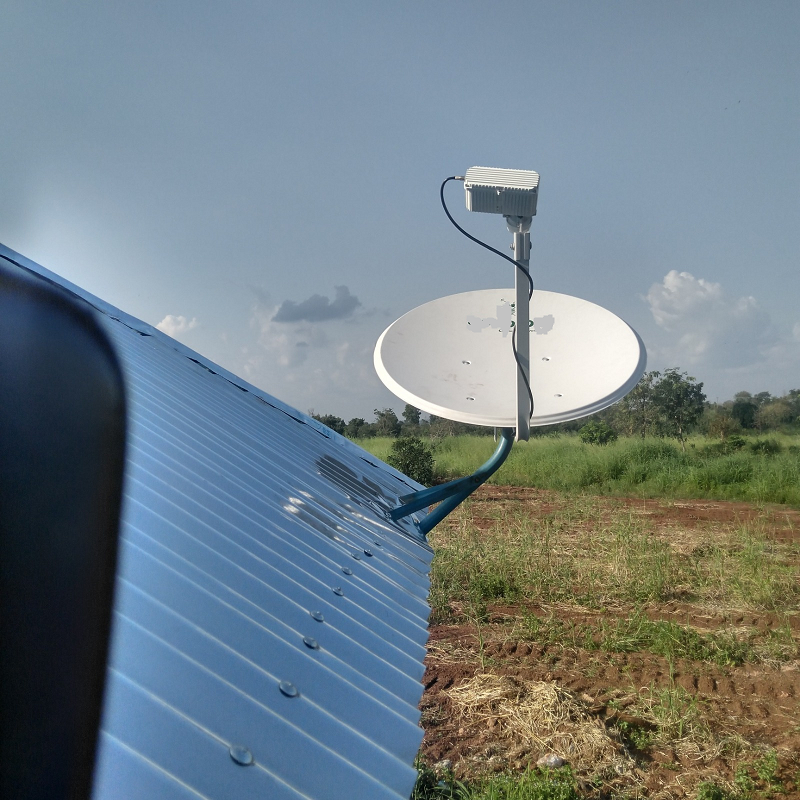
Elon Musk’s satellite internet service, Starlink has temporarily suspended orders for its residential internet kits across Nigeria.

This decision comes as the company awaits regulatory approval from the Nigerian Communications Commission (NCC), for a proposed price adjustment.

Starlink’s residential plan, previously priced at N38,000 per month, is currently on hold. However, customers can still access the company’s Business Plan, which costs N159,000 per month.

In a statement, Starlink emphasized its commitment to improving internet services in Nigeria while pursuing regulatory clearance for the proposed pricing changes. “Until these changes are approved, we are placing new Residential orders on hold,” the company stated.

Backstory

Starlink suspension of kit orders in Nigeria stems from the company’s attempt to increase its residential subscription fees by 97%. Recall that the Elon Musk-owned satellite internet in October 2024, increased the monthly subscription for its service in Nigeria from N38,000 to N75,000. For new users, the company also increased the kits of its hardware by 34% from N440,000 to N590000.

While Starlink had reviewed the price of its hardware in Nigeria upwards and downwards several times, this increase made it the second time it has increased subscriptions. The company in a message to its customers cited excessive inflation as the reason for the increment.

In a message to its customer, the company said,

“Due to excessive levels of inflation, the Starlink monthly service price will increase from current rates to the respective rates below: Standard (Residential): N75,000; Mobile- Regional (Roam Unlimited): 167,000; Mobile – Global (Global Roam): N717,000.

“As a current customer, your monthly service price will increase in 1 month, beginning 31 October 2024. For new customers, the price increase is effective immediately. If you do not wish to continue your service, you can cancel at any time.”  

However, Starlink later reversed its decision to double its base subscription prices in Nigeria three weeks after Nigeria’s communication regulator blocked the increase. The NCC noted that Starlink’s action contravened “Sections 108 and 111 of the Nigerian Communications Act (NCA), 2003, and Starlink’s Licence Conditions regarding tariffs.”

The NCC’s decision reinforced its stance against price increments without following due process, ensuring that international companies comply with Nigerian laws.

This development comes at a time when local telecom operators, represented by the Association of Licensed Telecommunications Operators of Nigeria (ALTON) and the Association of Telecommunications Companies of Nigeria (ATCON), have been advocating for a tariff review to reflect the economic realities of rising inflation and operating costs. 

Launched in Nigeria in January 2023, the country became the first African country to receive the Starlink internet service, after SpaceX met with the Nigerian Communications Commission to outline their deployment plans.

As of September 2023, just eight months after its launch, Starlink gained 11,207 active subscribers in Nigeria, according to data from the NCC for the third quarter of 2023.

This rapid growth positioned Starlink as the fourth largest Internet Service Provider in the country. By the fourth quarter of 2023, Starlink’s active customer base in Nigeria surged to 23,897, elevating the company to the third leading ISP in Nigeria.

Mastering Branded Content in the Facebook-Newspaper Era

0

In today’s digitally intertwined world, branded content has emerged as a crucial tool for communicating brand messages. As traditional platforms like newspapers converge with digital giants like Facebook, brands have the opportunity to tap into a vast audience, blending credibility with accessibility. However, creating branded content that resonates with diverse audiences requires strategic thinking, particularly in interpreting audience responses to fine-tune messaging. Using insights from Stuart Hall’s encoding/decoding model, our analyst notes that brands can better navigate the dynamics of this convergence for impactful communication.

Understanding Facebook-Newspaper Convergence

The convergence of newspapers with Facebook offers brands a dual advantage: the authoritative tone of traditional media combined with the interactive, far-reaching nature of social platforms. For example, Nigerian newspapers like The Punch and Vanguard frequently use Facebook to disseminate branded content, ranging from skill acquisition programmes to corporate social responsibility (CSR) initiatives. While newspapers lend a layer of trust, Facebook amplifies reach and fosters engagement through likes, shares, and comments.

This convergence transforms branded content from one-way communication to an interactive dialogue, where audience feedback becomes a vital tool for refining strategies. Brands must now move beyond merely broadcasting their messages to actively interpreting how audiences decode and respond to these messages.

Leveraging Stuart Hall’s Model for Branded Content

In any communication setting, senders craft messages with specific meanings, hoping their audience will interpret and accept them as intended. However, audiences often bring their own cultural, social, and personal experiences into play, leading to diverse interpretations. For writers and sponsors of branded content on newspapers’ official social media accounts, particularly Facebook, it is essential to critically assess how audiences react to their messages. This evaluation helps ensure the content resonates effectively and aligns with the audience’s expectations and perspectives.

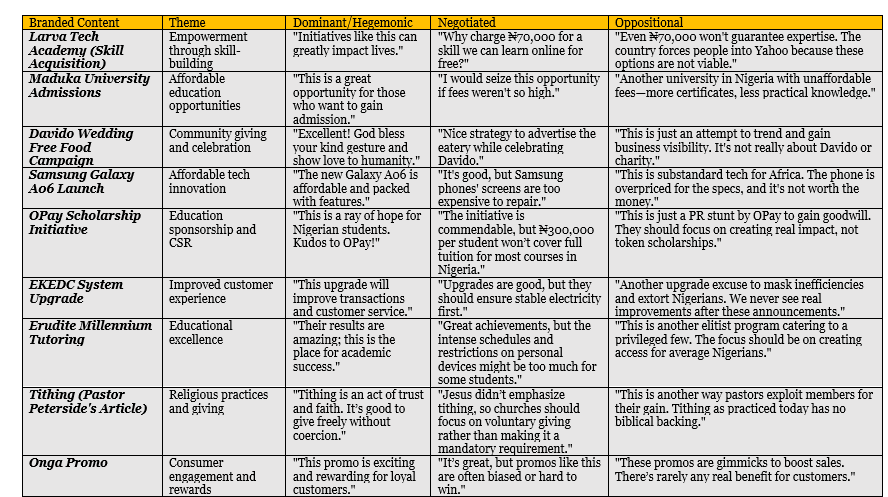
The first type of audience response is dominant/hegemonic, where the message is received exactly as the sender intended. In this case, the audience fully agrees and aligns with the message’s meaning. However, not all interpretations are so straightforward. Some audiences take a negotiated position, partially agreeing with the message but adapting it to fit their circumstances or viewpoints. Then, some adopt an oppositional stance, actively rejecting or critiquing the message, often challenging its assumptions or intent.

By examining these diverse responses, sponsors of branded content gain valuable insights into how messages are received. This feedback enhances the opportunity to assess the impact of campaigns and adjust the approach to better connect with the audience, ensuring communication is heard and understood in the intended way.

Insights from Nigerian Branded Content

An analysis of audience comments on Facebook posts by Nigerian newspapers (The Punch and Vanguard) reveals how branded content is received across different themes:

  1. Skill Acquisition Campaigns: A post promoting Larva Tech Academy’s discounted courses for skill development received a mixed reception. While some applauded the initiative’s potential to empower youth, others expressed concerns about affordability or the quality of training. This highlights the need for brands to balance aspirational messaging with practical realities.
  2. CSR Initiatives: OPay’s scholarship program was well-received for its societal impact, but many commenters questioned whether the financial support was sufficient to cover tuition costs. This reflects a negotiated position where audiences recognize the value but critique its scope.
  3. Product Launches: Samsung’s launch of its Galaxy A06 was celebrated for its affordability but criticized for perceived substandard specifications. Such oppositional decoding emphasizes managing expectations and ensuring product features meet audience demands.
  4. Community Engagement: A post about free food honouring a celebrity wedding was lauded for its generosity but also seen as a calculated marketing strategy. This negotiated response underscores the need for transparency in blending community goodwill with brand promotion.

Exhibit 1: Advertisers versus audience in the branded content era

advertisers versus audience in  branded content era
Source: The Punch, 2024; Vanguard, 2024; Infoprations Analysis, 2024

Strategies for Effective Branded Content

Prioritize Audience-Centric Messaging. Tailor content to reflect the aspirations and realities of the target audience. For instance, skill acquisition campaigns can resonate more if affordability concerns are addressed upfront or if flexible payment options are offered.

Encourage Authentic Engagement. Actively respond to audience comments to demonstrate brand authenticity. Engagement builds trust and allows brands to clarify misconceptions or highlight overlooked benefits.

Balance Emotional and Rational Appeals. Successful branded content often combines emotional resonance with practical value. For example, CSR initiatives can pair feel-good messaging with clear, measurable outcomes to enhance credibility.

Leverage Data for Refinement. Use tools like Facebook Insights to track engagement metrics such as reach, shares, and sentiment analysis. This data provides valuable feedback for optimizing future campaigns.

Align with Cultural Contexts. Messages must be culturally sensitive and relevant. Content that acknowledges local challenges—such as unemployment or education costs—can foster stronger connections with the audience.

Speaking to versus Speaking with

In the age of Facebook-newspaper convergence, branded content is no longer about speaking to audiences but engaging with them. By leveraging the insights, brands can decode audience responses to refine their messaging and foster deeper connections. As noted earlier, effective branded content blends authenticity with cultural awareness, offering value that aligns with audience expectations. As the digital and traditional media worlds continue to merge, brands that master this balance will lead the conversation, not just follow it.