
DD
MM
YYYY

PAGES

DD
MM
YYYY

spot_img

PAGES

Home Blog Page 2651

WebViewer Integration for Landing Pages

0

A WebViewer, which allows users to view, annotate, and collaborate on documents directly within a webpage, is an excellent tool for adding value to your landing pages. By incorporating a WebViewer, you provide visitors with a seamless experience that encourages interaction, exploration, and a deeper understanding of your offerings.

To effectively integrate a WebViewer into your landing pages, ensuring an enhanced experience for your visitors and improved overall performance, implement the best practices.

Why Integrate a WebViewer?

Adding a WebViewer to your landing page creates a more dynamic and interactive user experience. Visitors are able to view, navigate, and interact with documents without needing to leave your webpage or download additional software. This kind of integration reduces friction and increases the likelihood that users will stay longer and engage more deeply with your content.

Offering an intuitive way for users to explore documents, such as product manuals, presentations, or marketing brochures, gives you an opportunity to provide more detailed information in a visually appealing manner. This can make the difference between a visitor merely browsing and one taking the next step toward conversion.

Build Trust and Transparency

When potential customers are deciding whether or not to take action, transparency is key. A WebViewer enables you to share comprehensive documents, contracts, or detailed information directly on your landing page. By offering clear and easily accessible information, you build trust with your audience, which in turn encourages them to take the desired action.

For example, sharing product specifications or customer testimonials in an interactive format allows prospects to review key details at their own pace. This transparency helps them feel informed and more confident in their decision-making process.

Improved Engagement Metrics

Integrating a WebViewer into your landing pages has the potential to boost key engagement metrics, such as average time spent on the page and interaction rate. By offering rich, interactive content, you provide visitors with more reasons to stay on your landing page longer, which can ultimately improve your site’s overall performance.

Additionally, visitors who engage with interactive content are more likely to remember your brand and take the desired action, whether that be signing up for a newsletter, downloading a guide, or making a purchase.

Greater Conversion Opportunities

With a WebViewer, you create additional conversion opportunities by presenting information in a format that is easy to understand and interact with. Whether you’re sharing a product catalog, a technical manual, or customer success stories, a WebViewer allows your prospects to easily access the information they need to make informed decisions.

Providing transparent, interactive content increases your chances of converting visitors into leads or customers. It shows that you are invested in delivering a valuable, user-friendly experience that prioritizes their needs.

Choose the Right WebViewer Solution

Before integrating a WebViewer, you need to choose a solution that aligns with your needs and goals. Several WebViewer options are available, from open-source libraries to premium solutions with advanced features. Consider the types of documents you want to share, the level of customization you require, and the user experience you want to deliver.

Look for a solution that is easy to implement, works across devices, and offers the capabilities that your target audience will find useful. A WebViewer that can handle a variety of file formats and provide annotation tools is ideal for most use cases.

Embed the WebViewer into Your Landing Page

Once you’ve selected the appropriate WebViewer, embedding it into your landing page typically involves adding a few lines of JavaScript code to your webpage, and a JavaScript PDF library can be useful if you need more control over PDF functionalities and document rendering. Most WebViewer providers offer straightforward documentation to guide you through the process, making it easy for you or your development team to integrate the tool.

Ensure that the WebViewer fits seamlessly with the existing design of your landing page. Customizing the WebViewer’s appearance to match your branding helps maintain a cohesive look and feel, providing visitors with a consistent and professional experience.

Best Practices for Using a WebViewer on Landing Pages

When integrating a WebViewer, make sure you highlight the features that will be most valuable to your visitors. For instance, if the WebViewer includes search functionality, mention that users can easily find specific information within the document. If annotation tools are available, explain how users can add comments or highlight important sections for future reference.

By guiding users on how to effectively use the WebViewer, you enhance their overall experience and increase the chances that they will engage meaningfully with the content you provide.

Keep Load Times in Check

One crucial aspect of using a WebViewer is ensuring that it doesn’t negatively impact your landing page’s load time. A slow-loading page can lead to higher bounce rates and frustrated users. To prevent this, optimize your documents for quick loading by reducing file sizes and ensuring that your WebViewer is configured efficiently.

Consider loading the WebViewer content asynchronously or only when requested by the user. This approach helps keep your landing page responsive while still providing the added value of an interactive document viewer when needed.

Conclusion

Integrating a WebViewer into your landing pages is a strategic way to boost engagement, build trust, and improve conversion rates. By providing a seamless and interactive way for visitors to explore content, you create a landing page experience that not only keeps visitors interested but also encourages them to take meaningful action.

Choosing the right WebViewer solution, embedding it effectively, and following best practices for its use are essential steps in maximizing its impact. With a well-executed integration, your landing pages can become powerful tools for educating, engaging, and converting your audience.
The Untapped Gold in Nigeria’s Rice Husks

0
biochar

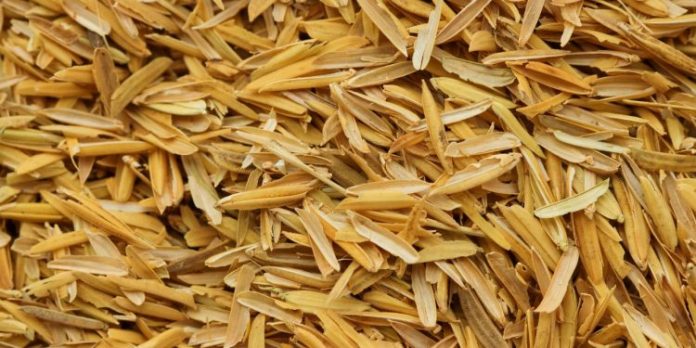
On a humid afternoon in Bida, Niger State, Amina sat on a stool outside her rice mill, watching heaps of rice husks pile up around her. For years, these husks had been a nuisance—too much to dispose of, yet seemingly useless. Farmers occasionally took some for animal feed or bedding, but most of it ended up burned, sending plumes of smoke into the air. “There must be something better we can do with this waste,” she often thought. Little did she know, Amina was sitting on an untapped goldmine: biochar.

A Nation of Rice and Waste

In 2020, Nigeria was Africa’s largest rice producer, with annual production exceeding 8 million metric tons. Alongside this bounty comes a challenge—over 1.6 million metric tons of rice husks, most of which are discarded or burned. While many see these husks as agricultural waste, innovators and entrepreneurs see potential. Biochar, a charcoal-like substance made by heating organic materials in a low-oxygen environment, offers a sustainable solution. Not only does it turn waste into a valuable product, but it also addresses critical issues like soil degradation, carbon emissions, and renewable energy.

The Power of Biochar

Biochar isn’t just another by-product; it’s a multi-purpose tool for sustainable development. Farmers who use biochar to improve their soil notice better water retention, enhanced fertility, and higher crop yields. In a country where agriculture contributes 23.7% to GDP, these benefits are game-changing. Beyond agriculture, biochar has applications in renewable energy, water purification, and even livestock farming. It absorbs pollutants, stores carbon, and can generate energy through its by-products like syngas. In short, it’s a solution tailor-made for Nigeria’s challenges—and opportunities.

A Market on the Brink of Transformation

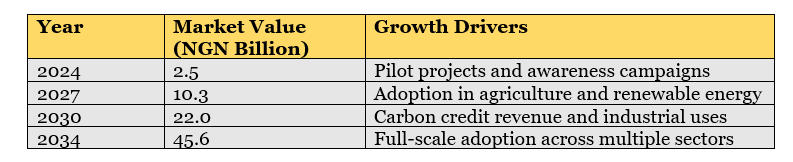
Nigeria’s biochar market is still in its infancy, but the potential is staggering. Over the next decade, the market is projected to grow exponentially. With over 70% of Nigerians engaged in farming, the demand for soil enhancers like biochar will only rise. Nigeria aims to reduce greenhouse gas emissions by 47% by 2030. Biochar’s carbon-sequestration properties align perfectly with this goal. As Nigeria diversifies its energy mix, biochar’s by-products can contribute to biomass and bioenergy solutions. In 2024, the biochar market is estimated to be worth ?2.5 billion. By 2034, this could surge to ?45.6 billion, creating jobs, improving livelihoods, and reducing environmental pollution.

Exhibit 1: Projections for Biochar Market in Nigeria (2024–2034)

biochar
Source: Multiple media reports and academic publications, Infoprations Modeling, 2024

Amina’s Journey: From Waste to Wealth

For Amina, the turning point came when a local entrepreneur introduced her to a low-cost pyrolysis kiln—a simple drum that could convert rice husks into biochar. Skeptical at first, she decided to give it a try. Within weeks, she was selling biochar to nearby farmers eager to improve their yields. Word spread, and soon Amina wasn’t just a rice miller; she was a key player in a new value chain. She partnered with others to collect husks from nearby mills, scaling up her operations. Today, Amina employs 15 workers, has contracts with local agribusinesses, and is exploring carbon credit opportunities.

Challenges on the Horizon

Despite its promise, the path to scaling biochar production isn’t without obstacles. Advanced pyrolysis systems can be expensive, limiting access for small-scale producers. Many farmers and millers remain unaware of biochar’s benefits. Collecting and transporting rice husks from dispersed locations is inefficient. But these challenges are not insurmountable. Low-cost pyrolysis systems, regional collection hubs, and government incentives can pave the way for widespread adoption.

Building a Sustainable Future

The Nigerian government, through programs like the National Agricultural Technology and Innovation Policy (NATIP), is already laying the groundwork for sustainable practices. Private sector players, NGOs, and research institutions have a role to play, too—investing in technology, educating farmers, and funding small-scale producers. Imagine a Nigeria where rice husks are no longer a burden but a resource. Where rural entrepreneurs like Amina lead the charge in transforming waste into wealth. Where the biochar industry not only improves agriculture but also drives progress in energy, environmental conservation, and job creation.

The Next Decade: A Call to Action

The biochar revolution is Nigeria’s opportunity to lead in the waste-to-value movement. Over the next 10 years, this industry could create over 10,000 jobs, boost food security, and contribute significantly to Nigeria’s climate goals. As Amina looks out at her now-organized operation, she no longer sees waste. She sees possibilities. And she’s not alone—Nigeria is full of innovators ready to turn problems into opportunities, and waste into wealth. The question is: Will you join them? Will you be part of this transformative journey, unlocking the untapped potential of Nigeria’s rice husks and beyond?


Editor’s Note: Amina’s story is a fictional illustration crafted to highlight the significance of tapping into the opportunities presented by biochar production from rice husks. While not based on real events, it serves as an example of the transformative potential this innovation holds for entrepreneurs and communities in Nigeria.

What Smart Money Investors Don’t Want You to Know About Solana (SOL), Shiba Inu (SHIB) and Rexas Finance (RXS) This Bull Run

0

As the bull run continues, Solana (SOL), Shiba Inu (SHIB), and Rexas Finance (RXS) are gaining traction, but what do smart money investors know that the ordinary trader does not? While retail investors pursue hype, experienced players make calculated movements behind the scenes. Understanding their strategies may be the key to navigating this rally—and avoiding potential pitfalls. This is what they aren’t telling you. 

Rexas Finance (RXS): The Hidden Gem Designed to Disrupt Traditional Finance The Bull Run

The bull run has arrived, and Rexas Finance (RXS) is confident. The Smart Money Investors are trying to hide the fact that it’s not only another token; RXS sets out to tokenize real-world assets (RWAs)—real estate, gold, and everything in between—to challenge established finance. Within an estimated $500 trillion market, Rexas Finance realizes the potential in these and further assets and seeks to fractionalize them by securing them on a blockchain. RXS is now valued at under $0.10 and is poised for spectacular growth, particularly following its successful presale, which earned more than $8.8 million and sold out $157 million in tokens in the current stage 6.

With a Certik-verified security model, a $1 million giveaway that promises 20 people $50,000 RXS tokens each, and its listings on CoinMarketCap and CoinGecko, Rexas Finance is gaining traction among investors. Its revolutionary platform—which includes the Rexas Token Builder, Launchpad, and Estate—bridges the gap between traditional finance and blockchain by allowing for fractional ownership of high-value assets. As market analysts predict a tenfold price increase to $0.20 by 2025, Rexas Finance is ready to open up trillions of new markets, making it a great investment for experienced investors wanting to capitalize on the next big thing in crypto. 

Solana’s Road to $1,000: What Smart Money Investors Do Not Want You to Know This Bull Run

What Smart Money Investors Don’t Want You to Know on Solana This Bull Run is that its path to potentially attaining the aggressive $1,000 price goal is more on skillfully harnessing market fundamental developments than dramatic, overnight gains. With the U.S. taking a pro-crypto posture following the elections, regulatory clarity is paving the way for institutional adoption, discreetly fuelling Solana’s expansion. The blockchain’s fast transaction speeds and low costs have garnered it a significant market share, drawing developers in the dApp, DeFi, and NFT industries, thereby increasing its utility and attractiveness. Meanwhile, significant relationships in web3 gaming and DeFi are building a strong ecosystem that enhances Solana’s value proposition. Even during gloomy periods, Solana’s community and market sentiment remain positive, allowing it to capitalize on momentum. If these factors play out, Solana’s price should progressively rise toward $1,000. 

Shiba Inu’s Hidden Potential: What Smart Money Investors Don’t Want You to Know About This Bull Run

This bull run is when smart money investors see value where most will only view SHIB as a meme coin. After several days of steady gains, the Shiba Inu finalized the week with a 51.6% increase in value, reaching a price of $0.00002447 currently. This surge has certainly increased the interest and positivity of investors towards Shiba Inu. The emergence of strong Shiba Inu buy orders signals the likelihood of uninterrupted demand due to the recent successful breakout above significant resistance. This should continue as the Shiba Inu ecosystem becomes further developed. The community-driven development of companies like ShibaSwap and Shibarium is providing genuine utility to the coin, eventually changing it from a meme to a contender in the larger crypto market.  As these advancements progress, SHIB’s expanding ecosystem may outperform many other coins, enticing retail and institutional investors during the next bull run. The mix of community strength, ecological expansion, and commercial confidence implies that Shiba Inu is more than a fad—it’s a force to reckon with. 

Conclusion

Although both Solana (SOL) and Shiba Inu (SHIB) have their merits, Rexas Finance (RXS) comes out on top as a true disruptor. By offering tokenization of real-world assets such as real estate and gold, Rexas establishes a $500 trillion market, which is more liquid and accessible. With Certik-verified security, big listings, and a $1 million giveaway, RXS is gaining considerable investment interest. As the platform expands and democratizes high-value assets, Rexas is poised for rapid expansion, making it the standout pick for this bull run.


For more information about Rexas Finance (RXS) visit the links below:

Website: https://rexas.com

Win $1 Million Giveaway: https://bit.ly/Rexas1M

Whitepaper: https://rexas.com/rexas-whitepaper.pdf

Twitter/X: https://x.com/rexasfinance

Telegram: https://t.me/rexasfinance

Crypto Analysts Announce Solana Among The Best Cryptos To Buy Now, Avalanche And New ETH Token Trending For November

0

Most investors embark into cryptocurrency to make massive returns, and crypto’s like Solana and Kaspa are showcasing their potential as the bull run picks up steam. While these large caps could net 20x gains at most, most savvy and ambitious investors are turning to presale gems in lucrative sectors like Cutoshi.

As a meme coin that’s inspired by Satoshi Nakamoto and the Lucky Cat, Cutoshi is set to take advantage of the massive hype surrounding memes in this cycle. With hefty goals to become one of Ethereum’s leading meme mascots, Cutoshi is currently positioned for monumental returns in this bull run.

Solana On The Verge Of New All-Time-High

Solana has surpassed expectations in Q4, breaking past the $200 barrier with relative ease while solidifying its position as the fourth-largest cryptocurrency. With a remarkable 50% monthly increase, Solana’s network growth has outpaced Ethereum’s in 2024, fueling optimism for further gains in this cycle. Currently priced at $240, Solana has rebounded strongly from bear market lows of $10-30, showcasing its resilience and potential for substantial growth.

Speculation is mounting around Solana’s ability to reach $300-400 in the coming months. While a range of $260-280 appears more realistic on the surface, another Bitcoin rally by December could propel Solana past these targets. Solana is now just 6% away from achieving a new all-time high, a milestone that seems inevitable as the bull run accelerates and new money starts to trickle into the market.

Kaspa Rebounds Following Brief Stint Of FUD And Declining Price Action

In this cycle, Kaspa has been heralded as one of the greatest opportunities for moderate returns as a safety net play. Harnessing a decentralized proof of work consensus and blockDAG technology that arguably solves the trilemma, Kaspa’s positive trajectory was hijacked and interjected with momentary FUD that has since faded, though Kaspa has recovered with a 20% upsurge this week.

The announcement of Kaspa’s listing on the Kraken exchange has diminished concerns over the lack of tier-1 listings for Kaspa, partially fueling Kaspa’s recent growth to $0.17. While Kaspa’s KRC-20 ecosystem remains undeveloped, future tier-1 listings and interest from Bitcoin whales could propel Kaspa to the $1 milestone in 2025.

Utility And Hype Merge With Cutoshi: Potential Massive Gains On The Precipice

Cutoshi is swiftly emerging as a standout in the meme coin sector by combining viral appeal with real-world DeFi functionality. Drawing inspiration from Satoshi Nakamoto’s principles and symbolized by the Lucky Cat, Cutoshi champions decentralization, financial freedom, and prosperity for its community.

Central to the Cutoshi ecosystem is its decentralized exchange (DEX), which enables efficient and seamless cross-chain trading. Users can swap assets across multiple blockchains, such as Ethereum, Solana and Kaspa, all while benefiting from enhanced security and privacy compared to centralized platforms that rely on centralized intermediaries.

For those new to the space, the Cutoshi Academy serves as a valuable hub of educational content. Offering in-depth resources on decentralized finance and blockchain fundamentals, the academy empowers beginners to navigate the crypto landscape with confidence and sets them on the path to long-term success in the digital economy space.

Currently in the third stage of its presale, Cutoshi is priced at just $0.0259. With stage four approaching rapidly, the price is expected to rise dramatically as the bull run picks up steam. By merging meme culture with advanced DeFi utilities, Cutoshi is positioning itself as a leading meme coin project with substantial growth potential and appeal to a broad audience. Don’t miss out!


For more information on the Cutoshi (CUTO) Presale:

https://cutoshi.com/

Join and become a community member:

https://twitter.com/CutoshiToken

https://t.me/cutoshi

NNPC And The Rehabilitation of Nigerian Refineries: The Story of Broken Promises and a Nation’s Frustration

0

For years, the Port Harcourt Refinery has stood as both a symbol of Nigeria’s oil wealth and its enduring mismanagement. Built in 1965, it once hummed with activity, refining crude oil into valuable products and fueling the economy. Today, however, it tells a different story—one of neglect, delays, and unfulfilled promises.

Barely two months after missing yet another deadline to revive the refinery, the Nigerian National Petroleum Company Limited (NNPCL) is once again scrambling for answers. The latest explanation comes from the company’s Chief Corporate Communications Officer, Olufemi Soneye, who blamed the missed September 2024 completion target on the complex challenges of working with a brownfield project.

“Mechanical completion of the PHRC revamp was successfully achieved several months ago, marking a significant milestone,” Soneye said, referring to the mechanical aspects of the rehabilitation. “However, as is common with brownfield projects of this scale and complexity, we encountered unforeseen risks and challenges.”

This technical jargon may mean little to Nigerians who have been fed a steady diet of assurances. What they know is this: the refinery is still not working, and there is no clear indication of when it will.

A Familiar Cycle

It’s not the first time the Port Harcourt Refinery’s revival has faltered. In fact, this latest setback marks the seventh time the government and NNPCL have failed to meet a self-imposed deadline. Yet again, Nigerians are told to wait—this time indefinitely—as Soneye cautiously offers “shortly” as the new timeline for completion.

Promises of a functioning refinery have been as plentiful as they are hollow. Since December 2023, when the NNPCL triumphantly announced that the facility had achieved “mechanical completion,” deadlines have come and gone with little to show for it. In January, testing was reportedly underway, and crude oil supplies from Shell were secured in February to facilitate production. By March, hopes soared when NNPCL’s Group CEO, Mele Kyari, confidently told the Senate that operations would begin in April.

Then came July, another month filled with optimism. Independent marketers hinted at an imminent start, while NNPCL blamed regulatory approvals for the delay. By September, however, silence from the oil giant spoke volumes.

A Nation Left Waiting

The refinery’s endless delays are more than a technical issue—they are a human one. Nigerians have waited patiently, believing that domestic refining would bring relief from skyrocketing fuel costs. Instead, they remain saddled with high pump prices, reliant on imported fuel, and vulnerable to the volatility of global markets.

Against this backdrop, the $1.5 billion loan secured in 2021 for the refinery’s rehabilitation is now under scrutiny. Critics, including human rights lawyer Femi Falana, have demanded transparency. Falana’s formal request for the project’s completion timeline, filed under the Freedom of Information Act, was met with a curt denial from Maire Tecnimont SPA, the contractor overseeing the work.

As Maire Tecnimont’s legal counsel explained, the company is a private contractor and not bound by FOI obligations. While legally sound, the response left Nigerians in the dark, fueling suspicions of mismanagement and inefficiency.

Broken Promises, Growing Skepticism

The saga of the Port Harcourt Refinery is a microcosm of broader dysfunction in Nigeria’s oil and gas sector. The NNPCL’s repeated assurances have done little to stem the tide of public frustration. From Mele Kyari’s bold 2019 promise to restore all four of Nigeria’s refineries before the end of former President Muhammadu Buhari’s tenure to his more recent declaration that Nigeria would soon be a net exporter of petroleum products, each proclamation has crumbled under the weight of reality.

The irony is not lost on Nigerians: a country blessed with abundant crude oil is unable to refine enough for its own needs. Meanwhile, fuel imports continue unabated, with the NNPCL recently confirming it is not the sole off-taker of products from the Dangote Refinery.

A Clouded Future

The question now is not just when the Port Harcourt Refinery will begin operations but whether it will live up to expectations when it finally does. Initial plans projected the refinery would refine 60,000 barrels of crude per day upon completion—a modest figure compared to its full capacity of 210,000 barrels.

For now, the refinery stands as a monument to what could have been, its fate shrouded in uncertainty. As the year nears its end, Nigerians are left to wonder: How much longer must they wait? How many more promises will be broken before the country sees the benefits of its own resources?

In this endless cycle of delays and dashed hopes, the Port Harcourt Refinery has become more than a project—it is a test of faith, resilience, and the government’s ability to deliver on its word. For a nation hungry for progress, the wait has been far too long.