DD
MM
YYYY

PAGES

DD
MM
YYYY

spot_img

PAGES

Home Blog Page 3115

S-1 Drafts Fall On Deaf Ears As SEC Delays Spot Ethereum ETFs Decision

0

The US Securities and Exchange Commission (SEC) has continued to delay its decision on the S-1 filings for the Spot Ethereum ETFs, with recent developments showing that the SEC doesn’t plan to approve them until sometime after July 8. Crypto investors have remained undeterred by this development and see it as an opportunity to accumulate more ETFSwap (ETFS) before its price skyrockets after the Spot Ethereum ETFs launch.

SEC Delays Decision On Spot Ethereum ETFs S-1 Filing

Nate Geraci, the President of the ETF Store, recently cited sources that revealed that the SEC had delayed its decision on the Spot Etherem ETFs’ S-1 filing. Instead of approving these funds, the SEC made more comments on the S-1 filings and informed fund issuers that they have until July 8 to file their amended S-1s for their respective Spot Ethereum ETFs.

These sources also mentioned that there might be an additional round of S-1 filings after this one. However, the Spot Ethereum ETF issuers remain optimistic that the SEC will approve these funds by mid-July. They mentioned that the back-and-forth with the SEC has remained constructive, suggesting that the regulator isn’t acting ill-intently by withholding its decision on these Spot Ethereum ETFs.

In line with the mid-July timeline, Geraci predicted that the Spot Ethereum ETFs could “theoretically” launch the week of July 15. This is based on the belief that the SEC would approve the Spot Ethereum ETFs after the next round of amendments, which could come following the July 8 deadline. Bloomberg analyst James Seyffart also shared a similar sentiment, predicting that the Spot Ethereum ETFs could launch the week of July 15.

Crypto Investors Are Using This Opportunity To Accumulate More ETFSwap (ETFS)

While the SEC delays its decision on the Spot Ethereum ETFs, crypto investors are using this opportunity to accumulate more ETFSwap (ETFS) tokens. These tokens will be used to access the tokenized Spot Ethereum ETFs and other crypto ETFs on the ETFSwap trading platform when these funds launch.

Crypto investors have also been accumulating more ETFS because ETFSwap’s beta platform is expected to launch soon enough. The decentralized finance (DeFi) platform will witness an influx of users looking for an easier and more secure way to invest in exchange-traded funds (ETFs).

The decentralised platform enables permissionless ETF trading, whereby investors invest in ETFs without needing authorization from financial institutions or third-party systems like brokers. ETFSwap’s (ETFS) Know-Your-Customer (KYC) requirements are no-mandatory, allowing users to access these ETFs in seconds, unlike when using centralized trading platforms.

The trading platform boasts other exciting features. Its user-friendly interface allows users to convert their ETF holdings to cryptocurrencies and vice versa using the ETFSwap (ETFS) token. Investors can also convert the ETFS token to various commodities like gold, rubber, silver, and crude oil, among others.

The DeFi platform has also introduced futures trading for ETFs, meaning that users bet on the future price of an ETF without owning it and make significant returns from such trades. Additionally, the trading platform’s perpetual trading services allow users to hold derivative contracts without an expiration.

ETFSwap (ETFS) plans to launch its own ETF in 2025, allowing investors to maximze their gains at the peak of this bull run. It is also worth mentioning that users on the trading platform can also stake their ETFSwap (ETFS) tokens and other crypto assets to earn juicy staking rewards. Those who stake their ETFS tokens can earn up to 75% annual percentage yield (APY).

Conclusion On Buying ETFSwap (ETFS) At This Discounted Price

Crypto investors who have yet to buy the ETFSwap (ETFS) token need to hurry if they intend not to miss out on the crypto token while it sells at a discounted price of $0.0183. Given the crypto token’s role in ETFSwap’s financial revolution, ETFs could easily witness unprecedented growth once the bull kicks into full gear.


For more information about the ETFS Crypto Presale:
 Visit ETFSwap Presale

Join The ETFSwap Community

Why Nigeria Continues To Borrow And Will Continue To Borrow

1

Question: I enjoyed your lectures at Tekedia Institute. But Sir, could you explain why Nigeria keeps borrowing money? Is this ever going to stop in this decade?

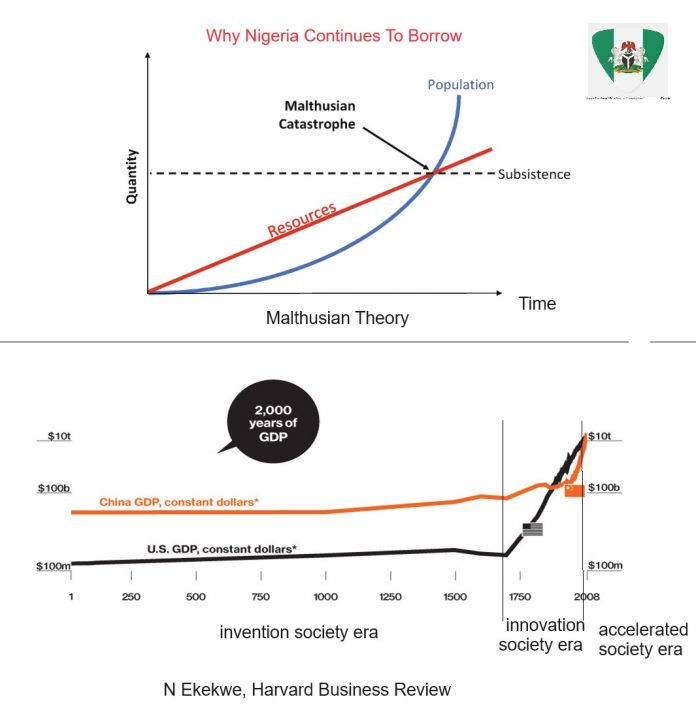
My Response: I will respond as a teacher; you can of course reach out to your senator for a political response. I understand there is a new $2 billion oil-backed loan that the nation will be picking.  Please read the lecture notes on how I have classified the invention society, innovation society and accelerated society eras

Let me add one more thing, drawing from my junior secondary school lecture in agricultural science on Rev Malthus postulation. Malthus noted that resources (say food production) were growing in arithmetic progression and the population was on a geometric progression (more rapid and faster in multiples). He came up with an inflection point – called the Malthusian catastrophe –  and that happens when the population has overtaken the resources required to support the people. 

Typically, every great nation unlocks innovation to “create” more resources so that you will keep having more resources to support the growing population. At the basic state, all nations begin in the invention society era. The plot below shows how the US and China expanded the resources (here GDP) to support the rising populations. In other words, they shifted the equilibrium and avoided the Malthusian catastrophe via the parabolic growth which reversed centuries of economic stagnation.

For Nigeria, our unlocked resources via GDP, aggregate of all economic activities, have shrunk over the last few years due to many factors, including energy price, currency loss, etc. As that was happening, the population continued to grow, creating a double whammy where more people have to share lesser resources, seeding an imbalance where policies have moved from tactical to operational (Nigeria abandoned strategic policymaking many years ago), as every week is a crisis!

In my thesis as noted in the lecture material, Nigeria is still at the invention society era. So, to overcome this paralysis, it needs to move to the innovation society era.  In the lecture note, we explained the pillars and enablers for innovation. Unfortunately, for Nigeria, that transition has not happened. 

Consequently, it has to borrow hoping to “create” more resources to support the population. This is typical in most African economies as they remain stuck in the invention era and are unable to expand opportunities by moving into the innovation era. Loan provides that operational support and that is why Nigeria will keep taking loans.


Africa’s Start-Up Funding in H1 2024: Big Four Dominant as Kenya Leads The Pack

0
Fund, money cash dollar

According to a report by Africa: The Big Deal, in the first half (H1) of 2024, the “Big Four” countries Kenya, Nigeria, South Africa, and Egypt dominated the funding rounds, with 79% of all investments directed towards ventures headquartered in these nations.

However, there was a slight decrease from the five-year average of 83%, which is notably lower than H1 2023, which saw the Big Four attract a record 92% of regional funding since data collection began in 2019.

Among the investments attracted by the ‘big four’, Kenya emerged as the front-runner for the third consecutive semester, securing $244 million, which represents almost a third (32%) of the continent’s total start-up funding in H1 2024. This figure signifies a 5 percentage point increase from 2023. East Africa, bolstered by Kenya’s performance, attracted $285 million, or 37.5% of the total funding on the continent.

Lately, Kenya has solidified its position as a premier destination for startup investors, earning recognition as a leading hub of innovation and entrepreneurship in Africa. The country has developed a robust tech ecosystem, particularly in Nairobi, often referred to as “Silicon Savannah”.

Kenya’s strategic location in East Africa makes it a gateway to the broader regional market. The positioning has attracted investors looking to leverage the country as a launchpad for expansion into neighboring East African countries.

In the startup funding report for H1 2024, Nigeria, long hailed as a powerhouse of startup innovation and the premier destination for venture capital in Africa, has recently seen its position slip. Once the leading magnet for startup funding on the continent, the country has recently been displaced by Kenya.

Nigeria’s slip from the top spot as the leading destination for startup funding in Africa highlights the dynamic and competitive nature of the continent’s tech ecosystem. However, Nigeria regained its position as the second most attractive market, with start-ups raising $172 million, accounting for 23% of the continent’s total.

This is a significant rebound from 2023 of 14%, though it hasn’t quite returned to its peak from 2021 and 2022. Nigeria’s share of the region’s funding stood at 64%, slightly lower than 2023’s 68%. Western Africa followed closely behind Eastern Africa with $270 million (35.5%) in total funding. Noteworthy deals in Western Africa included Benin’s $50 million (primarily through a single deal with Spiro), Ghana’s $29 million, and Senegal’s $11 million.

Egypt saw a noticeable decline in its share of start-up funding, attracting $101 million or 13% of the continent’s total, down from 22% in 2023. However, it still commanded 87% of Northern Africa’s funding. Morocco was the only other Northern African country to exceed $10 million in investments, raising $14 million. Tunisia and Algeria, which had shown promise in 2021 and 2022, saw limited activity since 2023.

South Africa experienced a significant drop, falling to fourth place with less than $100 million raised ($85 million), accounting for 11% of Africa’s total start-up funding in H1 2024, down from 21% in 2023. Despite this decline, South Africa continued to dominate its region, capturing 98% of the funding, an increase from 96% in the previous year. Overall, the Southern African region claimed 11.5% of the total funding.

In total, 22 African countries reported at least one $100k deal in H1 2024. This implies that the majority of the continent’s nations, or almost 60% did not register any significant start-up funding activity during this period. However, the concentration of funding in a few key markets highlights the disparity in investment distribution across Africa.

Africa Must Go Beyond Remittance from Its Diasporas to Advance

0

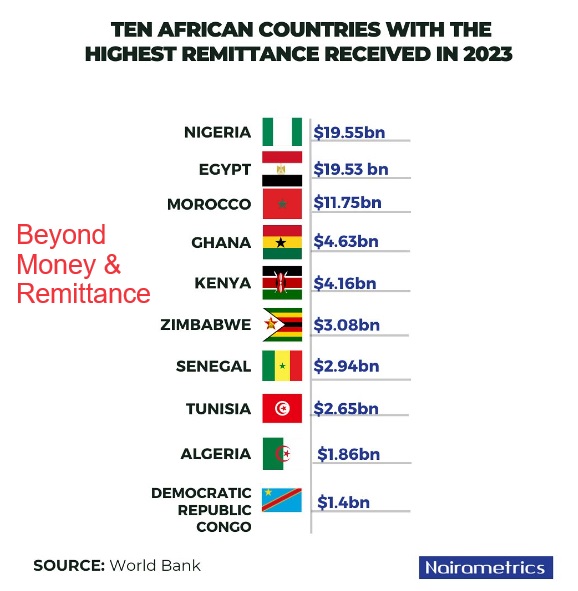
At close to $20 billion, the Nigerian diaspora group is the largest investor in Nigeria. It sends more money into the Nigerian economy than any organization. Yet, it is also the least consequential “group” before the Nigerian government. If the World Bank plans a $2 billion loan, it will send us a sermon. If the IMF wants to ship a $1 billion loan, it will ask for reforms. Yet, a group of people wire close to $20 billion, and cannot get a simple shift on how the leaders and the governments act or behave. That is unfortunate!

The funds to rebuild Africa are already available. The lineage of the first generation African diasporas (Robert Smith, Tiger Woods, etc)  and the recent diasporas have the capacities to fund Africa. The challenge, unfortunately, is that no one has a vehicle, on how that could be executed at scale.

We like to quote these “monetary figures” as success. Sure, remittance is great. But it is a limited gain. About 90% of my Chinese PhD school mates in Johns Hopkins are now in China (using their LinkedIn profiles). The government has this secondictor fund which is now worth about $100 billion, and if you have ideas, you can apply and the government will fund your mission.

So, what do they do? You work for AMD, Nvidia, ADI, Intel, etc for 4-6 years, you send a proposal to the government, and within months, the government will help you relocate with $10m in the bank to build products!

Our continent needs to explore how to build such enablers even as the diasporas drop their leftovers for their homelands. Get me right: remittance is great, but it has to go beyond that. There needs to be a framework around this money in the homelands.

Comment on Feed

Comment: “Remittance is not investment.”

My Response: Noted, but you can remit money and the receiver can invest it.  People build houses and the funds are remitted and counted as remittance. So, while it is not an investment in the typical sense, the funds are also invested. That said, in my usage, while it cannot be classified as an asset class in the typical investment framework, when you send money into an economy, you are investing in that economy.

That is why cities compete to host sports games because when people come, they help the local economy. If you agree that customers are investors, you can extrapolate that when you sell to that person, that person is investing in your business. So, when diasporas send funds into Nigeria, they’re investing in the Nigerian economy but that would be spent!

Colonial Estates vs. Contemporary Modern Homes

0

The architectural landscape is a canvas that reflects the evolution of society’s tastes, technological advancements, and cultural heritage. Two distinct styles that stand out in this vast panorama are colonial estates and Contemporary modern homes. Each carries its own historical significance, design philosophy, and aesthetic appeal, catering to diverse preferences and lifestyles.

Colonial architecture, with its origins deeply rooted in the American colonial period, is characterized by symmetry, formality, and grandeur. These homes often feature a central front door flanked by multi-paned windows, gabled roofs, and classic decorative elements such as columns and pediments. The interior layout typically follows a strict sense of order, with public living spaces on the ground floor and private quarters above. The charm of colonial estates lies in their timeless elegance and the sense of history they evoke.

On the other hand, Contemporary modern homes break away from traditional forms to embrace minimalism, open spaces, and innovative use of materials. The design philosophy here is “form follows function,” with an emphasis on simplicity, clean lines, and integration with the surrounding environment. Large windows and open floor plans are hallmarks of this style, inviting natural light to become a central design element. Contemporary homes often incorporate sustainable materials and technologies, reflecting a growing consciousness towards eco-friendly living.

The choice between Colonial and Contemporary modern homes is more than just a matter of aesthetic preference; it’s a reflection of one’s lifestyle and values. Colonial estates appeal to those who appreciate classic design and the craftsmanship of a bygone era. In contrast, Contemporary modern homes resonate with those who seek a more dynamic, fluid living space that aligns with the pace of modern life.

When deciding between these two architectural styles, potential homeowners must consider their daily needs, long-term goals, and personal taste. Colonial estates may offer the charm of yesteryear with their rich materials and intricate details, while Contemporary modern homes provide a blank slate for self-expression and a lifestyle unencumbered by the maintenance of traditional homes.

Ultimately, the debate between colonial estates and Contemporary modern homes is not about which is superior, but rather about finding the right fit for an individual’s unique vision of home. Whether one leans towards the historical allure of colonial architecture or the sleek pragmatism of modern design, both styles offer distinct advantages and the promise of a home that reflects the owner’s identity and aspirations.

As we continue to build and inhabit spaces, the conversation between these two architectural styles will persist, reminding us that our homes are more than just shelters—they are expressions of our collective history and individual stories waiting to be told.

Colonial homes appeal to those who appreciate classic design, historical context, and a sense of formality. They offer a connection to the past and a certain stateliness that is hard to replicate. On the other hand, Contemporary modern homes resonate with individuals who prioritize efficiency, sustainability, and a seamless flow of living spaces. These homes are tailored for the modern dweller who values simplicity, natural light, and a minimalist aesthetic.