DD
MM
YYYY

PAGES

DD
MM
YYYY

spot_img

PAGES

Home Blog Page 3417

Zimbabwe’s ZIG Currency Faced With Low Acceptance as Credibility Doubt Lingers

0

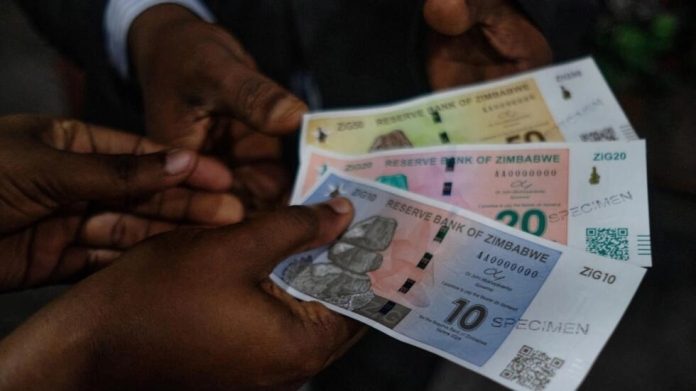
The newly launched Zimbabwe Gold-backed ZIG currency has been reported to be faced with low acceptance rate by Zimbabweans, as credibility doubt lingers.

The currency was introduced by the Reserve Bank of Zimbabwe in early April 2024, to replace the old note that has been battered by depreciation against major currencies, and has faced outright rejection by the people.

Since the rollout of ZIG, the currency appears to be heading down the same path of mistrust and credibility concerns as some government departments as well as businesses have refused to accept it.

Several business owners said they would rather forgo a sale than accept the ZIG, preferring the U.S. as a safer currency. This spurred the Zimbabwe government to freeze the bank accounts of several businesses, accusing them of rejecting the ZIG currency, thereby sabotaging the growth of the economy.

Meanwhile, reports reveal that the government has allowed some businesses, such as gas stations, to refuse to accept the ZiG in favor of US dollars. Some departments, like the office that issues and renews passports, accept only US dollars.

Commenting on ZIG’s mistrust among citizens, Zimbabwe’s president Emmerson Mnangagwa has urged the citizens to embrace the newly launched currency, describing it as a matter of “national identity and dignity”. He however commended Zimbabweans who have adopted and are protecting the use of the country’s currency.

As the ZiG enters circulation, its fate remains uncertain, with Zimbabweans torn between the allure of a new currency and the safety of the tried and trusted U.S. dollar. Across Zimbabwe, the US dollar is still widely used, from paying rent and school fees to buying groceries. Many take their local currency earnings to the black market to exchange for dollars.

This forced the government to take a hard-line approach to arrest several black market currency who were accused of trying to undermine the new currency. While the issue of mistrust lingers, Zimbabwe authorities say they have faith in the ZiG because it’s backed by the country’s gold reserves.

The ZiG is the sixth currency Zimbabwe has used since the 2009 collapse of the Zimbabwe dollar amid hyperinflation of 5 billion percent, one of the world’s worst currency crashes to date. The government had previously floated various ideas to replace the Zimbabwe dollar, including introducing gold coins to stem inflation and even trying out a digital currency.

The gold-backed ZIG is the southern African country’s latest attempt to halt a long-running currency crisis underlining its persistent economic troubles.

Nigerian Fintech Firms Tighten Scrutiny on Crypto Traders Following CBN Directive

0

Nigerian fintech firms have reportedly begun to tighten scrutiny on crypto traders following a directive from the Central Bank of Nigeria (CBN).

The CBN alleged that a lot of crypto traders in the country were leveraging on several fintech platforms to disrupt the forex market.

This prompted four fintech platforms Kuda, Moniepoint, Opay, and Palmpay to temporarily halt the opening of new accounts for customers.

In line with this Moniepoint and Paga have further notified their customers that their accounts risk being blocked if they facilitate crypto transactions with it.

In the notification sent to customers on May 2, 2024, Moniepoint wrote,

“In line with CBN regulation, we will close the account of anyone engaging or other virtual assets transactions and share their details with relevant authorities.”

Also, Paga sent a similar message to their customers which reads,

“Pursuant to the CBN circular with reference FPR/DIR/GEN/CIR/06/10, we wish to remind you that dealing in or facilitating transactions in cryptocurrency and other virtual currencies is not permitted.”

One of the fintechs disclosed that the CBN’s directive is linked to the EFCC’s ongoing investigation into bank accounts involved in unauthorized FX dealings. Meanwhile, an analysis of about 1,146 accounts blocked by the EFCC revealed that only 10% are operated by fintechs, with the majority being commercial bank accounts.

The CBN directive on restriction of crypto transactions shows a reversal of the apex bank’s previous announcement to lift its crypto ban imposed in 2021.

Recall that in December 2023, the CBN rolled out a circular mandating financial institutions to open accounts, provide designated settlement accounts and settlement services, and act as channels for forex inflows and trade for firms transacting in crypto assets.

Part of the circular reads,

“However, current trends globally have shown that there is a need to regulate the activities of virtual assets service providers (VASPs) which include cryptocurrencies and crypto assets.”

The directive by the CBN aimed to establish minimum standards and requirements for establishing banking relationships and opening accounts for virtual asset service providers (VASPs) in Nigeria.

However, with the recent reversal of the ban on crypto platforms and transactions, the Nigerian government has expressed concerns about its effects on the devaluation of the Naira, amidst other challenges.

Notably, the Blockchain Industry Coordinating Committee of Nigeria (BICCON) is convening a roundtable on May 6 between the new director general of the Nigerian Securities and Exchange Commission (SEC) and local and international crypto exchanges to discuss and seek consensus on the status of crypto in the country.

The BICCON chair, Lucky Uwakwe, explained  that the meeting is open to all digital assets exchange operators, wallet providers, and other virtual asset service providers (VASPs), and relevant industry associations and bodies to address relevant issues and chart a progressive course for crypto regulations in Nigeria.

“Ndubuisi, why are you against the floating of the Naira?” – A Question

1

Question: “Ndubuisi, why are you against the floating of the Naira?”

My Response: Let me simply quote from my piece in June 2023 when the float was announced: “In his O’ Level textbook on economics, AO Lawal explained demand and supply and the movement of price on the demand-supply curve. If I apply what he explained in that book, floating naira with no capacity to earn USD dollars will kill Naira, because there is an asymmetric imbalance on demand and supply of USD in the Willing Buyer, Willing Seller nexus. In other words, two people may each have $100 to sell while twenty people want to buy each $100. If you do not close that number to near parity, the equilibrium point will keep shifting and I do not see how Naira will stabilize because demand outweighs supply here.”

So, you can see, it is structural, and you cannot financialize yourself out of the core tenets of the market. The “laws” of demand and supply cannot be disintermediated. So, provided Nigeria does not earn enough USD even as demand of USD stays strong, in multiples, Naira will struggle to attain a decent pricing rate equilibrium against the USD. This is foundational economics.

So, if Naira is unable to attain that equilibrium, the smart thing to do is NOT to expose the Naira to the full weight of market forces, since it cannot compete effectively. Nigeria should FLOAT companies (yes, start companies for productive things) and should change the policy of floating its currency!

What is happening here is giving someone a sword in a battle of military tanks. Yes, it is all about Demand and Supply, and how those shift pricing equilibrium. It works in Oriendu Market Ovim and certainly in CBN headquarters in Abuja.

Comment Summary via Facebook:

Your response against floating the Naira focuses on the demand-supply imbalance for USD in Nigeria. High demand for USD, driven by import dependency and other factors, contrasts with limited supply due to reliance on oil exports. This imbalance can lead to a sharp decline in the Naira’s value if floated, causing market instability and increased inflation.
Given these risks, you suggest alternatives like managed exchange rates and policies to boost USD earnings through economic diversification and foreign investment. The goal is to stabilize the currency without exposing it to the full impact of market forces. Floating the Naira without addressing these structural issues can harm the economy, so a cautious approach that focuses on underlying economic changes is preferable.

Central Bank of Nigeria Must Work With Urgency to Stabilize The Naira And Save the Economy

0

“Economic activity has been contracting for eight consecutive months, mainly due to exchange rate pressures, rising input prices, security challenges, and other idiosyncratic headwinds,…This calls for well-nuanced policy decisions targeted at price stability to forestall stifling economic activities and derailing output performance,’’ wrote Bala Bello, Central Bank of Nigeria’s deputy governor of Corporate Services.

When we warned the apex bank that some of the recent decisions would destroy the economy, some people read the posts as being partisan. Ndubuisi is a free thinker village boy, apolitical and non-partisan. My barometer is simple: if any policy does not meet AO Lawal’s basic economic tenets, I become worried.

Just a few days ago, I challenged the Central Bank of Nigeria to focus on stabilizing Naira, over fighting to reduce FX rates, because what is driving all the mess in the country is not necessarily the high FX, but the volatility.  I am happy to read that line: “This calls for well-nuanced policy decisions targeted at price stability”.

Make it happen, and that could happen by not fighting for the FX reduction, but by boosting the reserves to calm the system. If you can stop the bleeding, by having stability, you can in three months focus on reducing the FX. Recall my concern when the reserves were being depleted to reduce FX; I wrote it was bad, because for investors and businesses, stability is more important than the absolute FX rate! (That contrasts with how traders, peer to peer players, etc see currency which is normally short-term.)

The biggest risk to Nigeria’s economy, from the Naira, is not the different rates between the black and official rates, but the instability of the rates. As I argued in June 2023, positing that pursuing rate unification, via floating of the currency, was  creating a solution where there was not a big problem. Indeed, unifying the black and official rates, while helpful, is not catalytic. What is catalytic is making sure those rates are stable over months. In other words, having a stable FX state is supreme.

CBN: I see data from more than 100 companies in Nigeria via Tekedia Capital. By the time I read all the reports, I have clarity on what is going on. This is not theory; my perspectives are backed by data.

We’re in a very big mess in Nigeria. Today, we are reading that those who can get us out of this mess, the manufacturers and builders, are giving up, according to CBN: “It is concerning to note that the Composite Purchasing Managers’ Index declined sharply to 39.2 index points in February 2024 from 48.5 index points in the previous month.” We must do all to reverse this trajectory.

I still believe that Nigeria should not float the Naira because it does not have the life jackets (factories, warehouses, etc) to save the Naira should it start drowning!

Question: Don’t float Don’t defend sounds confusing to me. Maybe they should go back to dual rate then. In the absence of those factories immediately what should then be done?

My Response– have a 4-year plan to deepen Nigeria’s manufacturing base by providing 24/7 electricity. Once that is done, you can float. Floating the Naira when you have absolute LIMITED supply even though demand keeps going up for USD will destroy Naira. That is Econ 101. Today, we cannot earn enough USD even though we need more USD, and under that condition, ceteris paribus, the Naira will weaken.  This problem is structural and no economist or banker can fix it until you return to the basic tenets of economic systems: making demand and supply to attain equilibrium through parity in supply and demand.

 Nigeria’s Central Bank decries the nation’s deepening economic woes

0

In a concerning revelation, the Central Bank of Nigeria (CBN) has sounded the alarm over the country’s deteriorating economic situation underlined by soaring inflation and dwindling economic activities.

Bala Bello, the CBN’s deputy governor of Corporate Services, raised these concerns in a recent statement published on the bank’s website, shedding light on a myriad of issues plaguing the nation’s financial stability. 

He highlighted a stark decline in the country’s economic activities, citing a significant drop in the Composite Purchasing Managers’ Index. 

“It is concerning to note that the Composite Purchasing Managers’ Index declined sharply to 39.2 index points in February 2024 from 48.5 index points in the previous month,” expressed Bello, signaling a worrisome trend.

According to Bello, the economic downturn, which he attributed to a confluence of factors including exchange rate pressures, inflation, and security challenges, has persisted for eight consecutive months. 

“Economic activity has been contracting for eight consecutive months, mainly due to exchange rate pressures, rising input prices, security challenges, and other idiosyncratic headwinds,” he remarked, emphasizing the need for strategic policy interventions to reignite economic growth.

‘‘This calls for well-nuanced policy decisions targeted at price stability to forestall stifling economic activities and derailing output performance,’’ he said.

Of particular concern is the relentless surge in inflation, despite concerted efforts to mitigate its effects. Bello lamented, “Both food and core inflation rose in February 2024, underpinning an acceleration in headline inflation to 31.70 per cent in February 2024 from 29.90 per cent in the previous month,” attributing the rise to escalating production costs, security threats, and exchange rate volatility.

Highlighting the gravity of the situation, Bello revealed that inflation surged even further to 33.22 percent in March, necessitating urgent and coordinated action to quell its upward trajectory. 

“Inflation is currently unacceptably high and requires decisive and coordinated efforts to curb it, given its adverse impact on citizens’ purchasing power, investment decisions, and broad output performance,” he urged.

While acknowledging the Federal Government’s initiatives to address food insecurity through various interventions, including the release of grains from strategic reserves and support for agricultural activities, Bello emphasized the need for sustained efforts to mitigate the adverse effects of inflation on the populace.

The Monetary Policy Committee (MPC) had previously responded to the economic challenges by raising the country’s interest rate to 24.75 percent in March, indicating a proactive stance to stabilize the economy amidst mounting pressures.

However, the persistent rise in inflation and the free fall of the naira in the forex market show that the government efforts are not yielding the needed results. Economic experts have attributed the economic downturn to the policies and other actions of the government.

While President Bola Tinubu has been traveling the world in search of foreign direct investments, existing businesses in the country are liquidating. The poor response of investors to the president’s pleas for investments in Nigeria has been attributed to a lot of factors, including the nation’s disregard for the rule of law and the insincerity of the government.

Recently, there has been an uptick in misleading statements from the federal government, heralding foreign direct investments secured by Tinubu. For instance, a few days ago, the presidency released a statement announcing that shipping giant Maersk will invest $600m in Nigeria. The news was refuted by Maersk, adding to other similar false announcements by the government in the past.

Economic experts say such developments are significantly affecting Nigeria’s international reputation, belying the president’s preachment that the country is an investment destination.