DD
MM
YYYY

PAGES

DD
MM
YYYY

spot_img

PAGES

Home Blog Page 3700

Bitcoin market cap surpasses $1.3 trillion

0

In a historic milestone, the total market capitalization of Bitcoin has exceeded $1.3 trillion, making it the ninth-largest asset in the world by market value. This means that Bitcoin is now worth more than some of the most influential companies in the world, such as Facebook, Tesla, and Amazon.

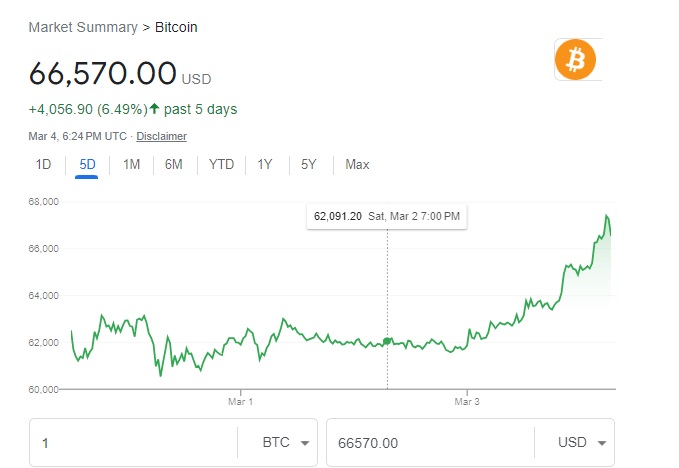
Bitcoin crosses $66,000 per coin; it is not only breaking new records but also breaking new grounds.

Bitcoin’s remarkable rise has been driven by several factors, including increased institutional adoption, growing public awareness, and favorable regulatory developments. Some of the recent events that have boosted Bitcoin’s momentum include:

The launch of the first Bitcoin exchange-traded fund (ETF) in Canada, which attracted over $400 million in assets under management in its first week of trading.

The announcement by Tesla that it had purchased $1.5 billion worth of Bitcoin and would accept it as a form of payment for its products. The endorsement of Bitcoin by prominent figures such as Elon Musk, Jack Dorsey, and Michael Saylor, who have expressed their support and confidence in the cryptocurrency. The adoption of Bitcoin as a legal tender by El Salvador, which became the first country in the world to do so.

These events have demonstrated that Bitcoin is not only a viable store of value, but also a medium of exchange and a unit of account. Bitcoin has proven its resilience and innovation in the face of challenges and uncertainties, such as the Covid-19 pandemic, the halving event, and the network upgrades.

As Bitcoin continues to grow and mature, it is expected to attract more investors, users, and developers, who will contribute to its further development and adoption. Bitcoin has the potential to revolutionize the global financial system and create a more inclusive, transparent, and efficient economy for everyone.

Bitcoin crosses $66,000 per BTC.

The cryptocurrency market has witnessed a historic milestone as Bitcoin, the leading digital asset by market capitalization, has crossed the $66,000 mark for the first time ever. This comes after months of anticipation and speculation following the launch of the first Spot Bitcoin exchange-traded fund (ETF) in the US in January 2024.

The Bitcoin ETF, which trades under the ticker BITO, allows investors to gain exposure to the price movements of Bitcoin without having to buy or store the actual coins. The ETF tracks the performance of a basket of Bitcoin futures contracts traded on the Chicago Mercantile Exchange (CME). The ETF has attracted over $1 billion in assets under management in its first week of trading, signaling a strong demand for Bitcoin exposure among institutional and retail investors.

The surge in Bitcoin price also coincides with a positive sentiment in the broader crypto space, as several other major coins have also reached new all-time highs in recent days. Ethereum, the second-largest cryptocurrency by market cap, has surpassed $3,500, while Solana, Cardano, Binance Coin, and Polkadot have also recorded impressive gains.

The bullish momentum in the crypto market is driven by several factors, including the growing adoption of blockchain technology and decentralized applications (DApps) across various industries, the increasing innovation and competition among crypto projects and platforms, and the rising awareness and acceptance of digital assets among regulators, policymakers, and consumers.

As Bitcoin crosses $66,000 per coin, many analysts and experts are predicting that it could reach even higher levels in the near future. Some of the factors that could support further growth include:

The increasing scarcity of Bitcoin supply, as more than 18.8 million out of the total 21 million coins have already been mined, and many of them are lost or locked up in long-term holdings.

The growing network effect of Bitcoin, as more users, merchants, and institutions adopt it as a store of value, medium of exchange, and unit of account. The improving security and resilience of the Bitcoin network, as more miners and nodes participate in validating transactions and securing the ledger.

The expanding innovation and development in the Bitcoin ecosystem, as more developers and entrepreneurs create new products and services that enhance the functionality and usability of Bitcoin. The rising interest and involvement of institutional investors, such as hedge funds, pension funds, endowments, and corporations, who are looking for alternative assets to diversify their portfolios and hedge against inflation and currency devaluation.

Bitcoin has come a long way since its inception in 2009, when it was worth less than a cent. It has overcome numerous challenges and obstacles, such as technical glitches, regulatory uncertainty, security breaches, market volatility, and fierce competition. It has proven its resilience and adaptability in the face of changing economic and social conditions. It has emerged as a global phenomenon that transcends borders, cultures, and ideologies.

Bitcoin is not just a currency or a technology. It is a social movement that represents a paradigm shift in how we perceive and interact with money and value. It is a vision of a more open, inclusive, and decentralized world where everyone can participate and benefit from the digital economy.

As Bitcoin crosses $66,000 per coin, it is not only breaking new records but also breaking new grounds. It is opening new possibilities and opportunities for individuals, businesses, and societies. It is challenging the status quo and inspiring change. It is showing us that the future of money is not only digital but also democratic.

The future of Blockchain and AI is not what you’ve heard

0

Blockchain and AI are two of the most popular buzzwords in the tech industry today. But what can they really do for each other? And how can they work together to create value and innovation?

Blockchain is a distributed ledger technology that enables secure and transparent transactions among multiple parties, without the need for intermediaries or central authorities. It can also support smart contracts, which are self-executing agreements that encode the rules and logic of a transaction.

AI is a broad term that encompasses various technologies that enable machines to perform tasks that normally require human intelligence, such as learning, reasoning, decision making, and natural language processing.

Some of the common claims about the synergy between blockchain and AI are:

Blockchain can provide trust, security, and privacy for AI data and models, which are often sensitive and proprietary. Blockchain can enable decentralized and collaborative AI, where multiple agents can share data and resources, and collectively learn from each other.

Blockchain can incentivize and reward AI participants, such as data providers, model developers, and validators, using tokens or cryptocurrencies. Blockchain can enhance the explainability and accountability of AI, by recording the provenance and audit trail of data and models and enabling verifiable claims and outcomes.

While these claims are not entirely false, they are also not as straightforward or easy as they sound. There are many technical and practical challenges that need to be addressed before blockchain and AI can truly integrate and complement each other.

Some of these challenges are:

Blockchain is not a silver bullet for AI data quality and security. While blockchain can ensure the integrity and immutability of data transactions, it cannot guarantee the accuracy or validity of the data itself.

Moreover, storing large amounts of data on a blockchain is costly and inefficient, due to its limited scalability and throughput. Therefore, blockchain may not be suitable for high-volume or high-frequency AI applications that require fast and frequent data access and processing.

Blockchain is not a magic wand for AI decentralization and collaboration. While blockchain can enable peer-to-peer communication and coordination among multiple AI agents, it cannot solve the fundamental issues of trust, alignment, and coordination that arise in multi-agent systems.

For example, how can we ensure that the agents have compatible goals and incentives? How can we prevent malicious or faulty agents from compromising the system? How can we handle conflicts or disputes among agents? These are complex problems that require sophisticated mechanisms and protocols beyond blockchain.

Blockchain is not a panacea for AI incentivization and reward. While blockchain can facilitate value exchange and distribution among AI participants, it cannot determine the optimal or fair allocation of rewards or costs.

For example, how can we measure the value or contribution of each participant? How can we balance the trade-offs between efficiency and equity? How can we prevent free-riding or cheating behaviors? These are challenging questions that require careful design and evaluation of economic models and incentive schemes.

Blockchain is not a guarantee for AI explainability and accountability. While blockchain can provide transparency and traceability for AI data and models, it cannot ensure the interpretability or understandability of the underlying logic or reasoning. Moreover, blockchain cannot enforce or verify the compliance or correctness of AI outcomes or actions.

For example, how can we ensure that the AI models are fair, ethical, or legal? How can we hold the AI agents responsible or liable for their decisions or actions? These are difficult issues that require rigorous standards and regulations.

Therefore, while blockchain and AI have great potential to work together to create value and innovation, they also have significant limitations and challenges that need to be overcome. Blockchain is not a one-size-fits-all solution for AI problems, nor is AI a plug-and-play component for blockchain applications. They are both complex and evolving technologies that require careful analysis and design to suit different contexts and objectives.

Bitcoin ETFs now hold nearly 4% of all Bitcoins

0

The demand for bitcoin exchange-traded funds (ETFs) is growing rapidly, as more investors seek exposure to the leading cryptocurrency without having to deal with the complexities of storing and managing it. According to data from CryptoCompare, bitcoin ETFs now hold nearly 4% of the total supply of bitcoin, up from less than 1% a year ago.

Bitcoin ETFs are funds that track the price of bitcoin and trade on regulated stock exchanges. They offer investors a convenient way to gain exposure to bitcoin without having to buy, sell, or custody the digital asset themselves. Bitcoin ETFs also provide more liquidity, transparency, and regulatory oversight than other types of bitcoin products, such as trusts or futures.

The first bitcoin ETF was launched in Canada in February 2021, and since then, several more have followed suit. As of March 2024, there are 12 bitcoin ETFs available in Canada and in the US, with a combined market capitalization of over $40 billion. The largest one is the Purpose Bitcoin ETF (BTCC), which holds over 200,000 bitcoins, or about 1% of the total supply.

In the US, the first bitcoin ETF was approved by the Securities and Exchange Commission (SEC) in October 2023, after years of rejections and delays. The ProShares Bitcoin Strategy ETF (BITO) debuted on the New York Stock Exchange (NYSE) with a record-breaking $1 billion in assets under management on its first day of trading.

Since then, four more bitcoin ETFs have been launched in the US, with a total market capitalization of over $30 billion. The largest one is the VanEck Bitcoin Trust (XBTF), which holds over 150,000 bitcoins, or about 0.8% of the total supply.

Other countries that have approved or are considering approving bitcoin ETFs include Brazil, Australia, Germany, Switzerland, and Japan. The global market for bitcoin ETFs is expected to grow even further as more investors and institutions embrace the cryptocurrency as a legitimate asset class.

Bitcoin ETFs have several advantages for both investors and the bitcoin ecosystem. For investors, bitcoin ETFs offer a simple and cost-effective way to access the cryptocurrency market without having to deal with technical issues such as wallets, keys, or exchanges.

Bitcoin ETFs also reduce the risk of theft, hacking, or loss of funds that can occur with direct ownership of bitcoin. Additionally, bitcoin ETFs provide more tax efficiency and diversification benefits than other forms of bitcoin investment.

For the bitcoin ecosystem, bitcoin ETFs increase the demand and adoption of the cryptocurrency, as they attract more mainstream and institutional investors who may otherwise be reluctant or unable to invest in bitcoin directly. Bitcoin ETFs also help to reduce the volatility and improve the liquidity of the bitcoin market, as they create more stable and consistent sources of buying and selling pressure.

Furthermore, bitcoin ETFs enhance the legitimacy and credibility of bitcoin as an asset class, as they bring more regulatory oversight and compliance standards to the industry.

Bitcoin ETFs are not without their drawbacks, however. Some critics argue that bitcoin ETFs dilute the original vision and value proposition of bitcoin as a decentralized and censorship-resistant form of money that does not rely on intermediaries or authorities.

By investing in bitcoin ETFs instead of holding bitcoin directly, investors give up some of their control and sovereignty over their funds and expose themselves to counterparty risk and potential regulatory interference.

Moreover, some skeptics question whether bitcoin ETFs actually contribute to the security and sustainability of the bitcoin network, as they do not necessarily increase the number of nodes or miners that validate transactions and secure the network.

Despite these challenges, bitcoin ETFs are likely to continue to grow in popularity and adoption as more investors seek exposure to the cryptocurrency market. Bitcoin ETFs now hold nearly 4% of all bitcoins — and they’re not slowing down.

US national debt increases by $1 trillion every 100 days!

0

The US national debt is a topic that has been widely discussed and debated in recent years, especially as it continues to grow at an alarming rate. According to the latest data from the US Treasury Department, the national debt stood at $29.1 trillion as of February 28, 2024, an increase of $4.8 trillion since the start of the fiscal year on October 1, 2023. This means that the US national debt increases by $1 trillion every 100 days, or about $10 billion per day.

What are the causes and consequences of this massive debt accumulation? How does it affect the economy, the government, and the citizens of the US? And what can be done to address this looming fiscal challenge? These are some of the questions that we will explore in this blog post, using data and analysis from various sources.

The causes of the US national debt

The US national debt is the sum of two components: the public debt and the intragovernmental debt. The public debt is the amount that the federal government owes to external entities, such as foreign governments, corporations, individuals, and institutions. The intragovernmental debt is the amount that the federal government owes to itself, such as to various trust funds and accounts that are dedicated to specific programs, such as Social Security, Medicare, and military pensions.

The main cause of the increase in the public debt is the gap between the federal government’s revenues and expenditures, also known as the budget deficit. When the government spends more than it collects in taxes and other sources of income, it has to borrow money from the public to finance its activities. The budget deficit can be influenced by various factors, such as economic conditions, policy decisions, and unexpected events.

For example, in fiscal year 2020, which ended on September 30, 2020, the US government recorded a record-high budget deficit of $3.1 trillion, or 14.9% of GDP. This was largely due to the unprecedented fiscal stimulus measures that were enacted in response to the COVID-19 pandemic, which increased government spending by $2.6 trillion and reduced government revenues by $0.5 trillion. In contrast, in fiscal year 2019, which ended on September 30, 2019, the budget deficit was $0.98 trillion, or 4.6% of GDP.

The main cause of the increase in the intragovernmental debt is the accumulation of surpluses in some of the trust funds and accounts that are part of the federal budget. When these programs collect more in taxes and other income than they spend on benefits and services, they lend their excess funds to the Treasury Department in exchange for special securities that earn interest. These securities are counted as part of the intragovernmental debt.

For example, in fiscal year 2020, the Social Security program collected $1.06 trillion in payroll taxes and other income and spent $1.05 trillion on benefits and administration, resulting in a surplus of $0.01 trillion. This surplus was invested in Treasury securities that increased the intragovernmental debt by $0.01 trillion.

In contrast, in fiscal year 2019, the Social Security program collected $1.04 trillion in payroll taxes and other income and spent $1.04 trillion on benefits and administration, resulting in a balance of zero.

Top-performing sectors in the S&P 500 are technology, health care and consumer discretionary

0

The stock market continued its remarkable streak of gains, as the S&P 500 index closed the week with a modest increase of 0.4%. This marks the 18th consecutive week that the benchmark index has ended in positive territory, a feat that has not been seen since the late 1990s. The S&P 500 has now risen more than 25% since the start of the year, outperforming most other major markets around the world.

What is behind this impressive performance? There are several factors that have contributed to the bullish sentiment, such as:

The strong recovery of the US economy from the pandemic-induced recession, supported by fiscal stimulus, monetary easing, and widespread vaccination. The robust earnings growth of corporate America, especially in sectors such as technology, health care, and consumer discretionary.

The relative calmness of the geopolitical and trade landscape, as tensions between the US and China have eased under the Biden administration. The low interest rate environment, which has made stocks more attractive compared to bonds and other fixed-income assets.

Of course, there are also some risks and challenges that could derail the rally, such as:

The emergence of new variants of the coronavirus that could pose a threat to public health and economic activity.

The inflationary pressures that could force the Federal Reserve to tighten its monetary policy sooner than expected.
The potential for regulatory crackdowns on big tech companies that could hurt their profitability and valuation. The possibility of political gridlock and social unrest in the US ahead of the midterm elections in 2022.

However, for now, investors seem to be shrugging off these concerns and focusing on the positive aspects of the market. The S&P 500 has shown remarkable resilience and stability, with minimal volatility and few corrections. It seems that nothing can stop this bull market from reaching new heights, at least for the time being.

The possibility of a rate hike by the Federal Reserve in the near future is not ruled out by some analysts. In fact, former Treasury Secretary Larry Summers suggested that the Fed may have to tighten its monetary policy sooner rather than later, given the inflationary pressures and the robust recovery of the US economy.

The US stock market continues to soar, reaching new heights in 2024. The S&P 500 index, which tracks the performance of 500 large companies listed on US exchanges, has gained more than a quarter of its value since January, beating most of its global peers.

This remarkable rally reflects the strength and resilience of the US economy, which has recovered from the pandemic faster than expected. The S&P 500 is also supported by strong earnings growth, low interest rates, fiscal stimulus and investor optimism. Here are some of the key factors behind the S&P 500’s impressive run this year.

The top-performing sectors in the S&P 500 are technology, health care and consumer discretionary. These sectors have benefited from the digital transformation, the vaccine rollout and the pent-up demand for goods and services.

Technology companies such as Apple, Microsoft and Amazon have led the market with their innovative products and services, while health care companies such as Pfizer, Johnson & Johnson and Moderna have delivered breakthroughs in fighting the coronavirus. Consumer discretionary companies such as Tesla, Starbucks and Nike have seen strong sales growth as consumers spend more on leisure and entertainment.