DD
MM
YYYY

PAGES

DD
MM
YYYY

spot_img

PAGES

Home Blog Page 3744

Binance Website Blocked for Nigerian Users Amidst Government Clampdown on Cryptocurrency Platforms

0

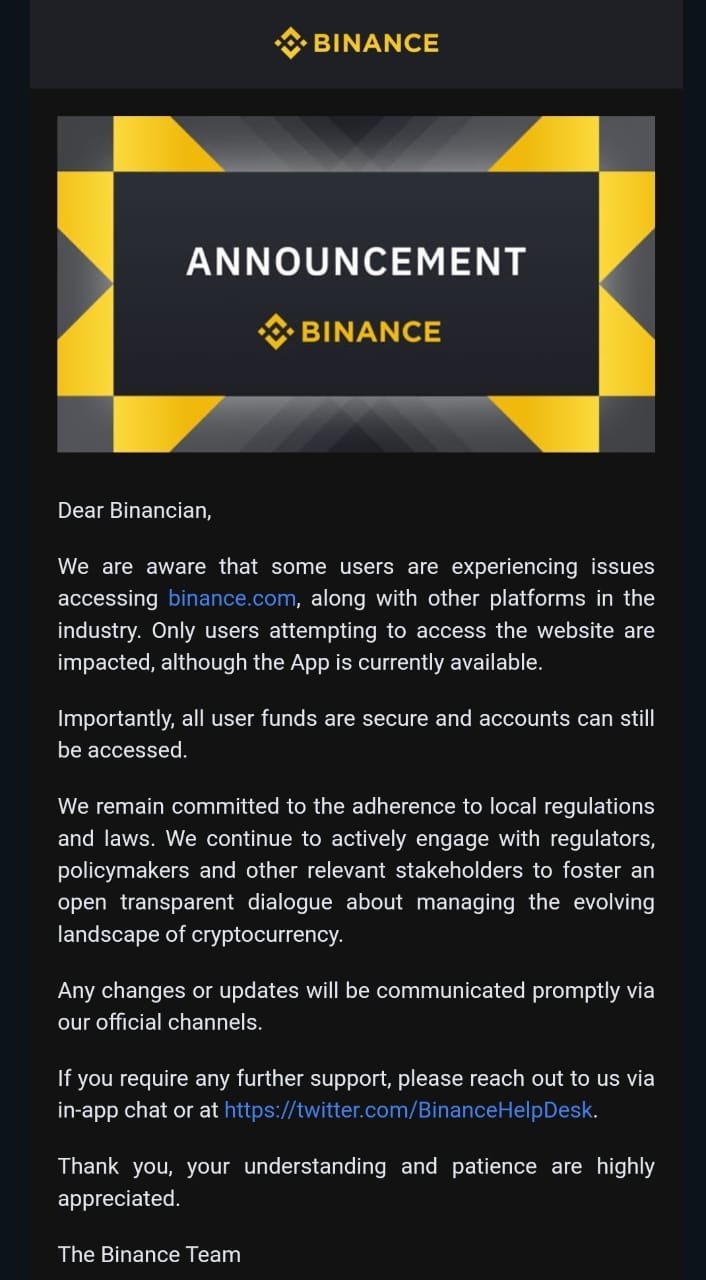
Binance, the world’s largest cryptocurrency trading platform, has confirmed the blockade of its website for Nigerian users. This move, disclosed by Binance in a statement on Thursday, comes amidst growing frustration among Nigerian users who have reported difficulties accessing the platform’s website.

“We are aware that some users are experiencing issues accessing binance.com, along with other platforms in the industry,” Binance acknowledged, addressing concerns raised by Nigerian users regarding the accessibility of its website.

Clarifying the extent of the blockade, Binance emphasized that only users attempting to access the platform via its website were affected, reassuring users that the app remained functional for accessing the platform.

“Only users attempting to access the website are impacted, although the App is currently available. Importantly, all user funds are secure and accounts can still be accessed,” Binance assured its users.

In its commitment to compliance with local regulations and laws, Binance reiterated its dedication to engaging with regulators, policymakers, and other stakeholders to facilitate open and transparent dialogue on managing its cryptocurrency exchange platform.

This development follows a series of regulatory actions taken by the government, under the leadership of President Bola Tinubu, aimed at stabilizing the declining Nigerian currency, the naira.

The government’s clampdown on cryptocurrency platforms has drawn criticism from Nigerian Binance users, especially considering the recent lifting of the ban on cryptocurrency trading by the Federal Government less than two months ago.

Binance had previously confirmed its cooperation with the Federal Government to restrict dollar-naira trading on its platform. This collaboration led to measures such as disabling the sell option for Nigerian users and capping the buy option on Tuesday. The exchange imposed a cap of $1802 on the buy option for Nigerian users, sparking panic among its users.

Subsequently, the naira experienced some gains against the dollar, trading at N1,600 to a dollar after dipping to N1,900 against the dollar on crypto exchanges.

Nigeria ranks among countries with the largest population of cryptocurrency traders globally, with “more than half of its adult population” engaging in monthly cryptocurrency trading, according to Binance. However, the government’s actions, including the blocking of Binance’s website, signal a broader crackdown on cryptocurrency operations within the country.

While the blockade of Binance’s website by the Federal Government has not been officially announced, presidential spokesperson Bayo Onanuga hinted at the government’s intentions in a tweet on Wednesday. Onanuga called for stringent measures against cryptocurrency platforms, accusing them of manipulating the national currency and advocating for a ban on cryptocurrency trading in the country to prevent further devaluation of the naira.

Besides this move, the Nigerian government has also launched a clampdown on currency exchanges across the country. Scores of Bureau De Change operators were arrested yesterday by security and anti-graft agents, in a desperate move by the government to curtail the free falling of the naira that it has attributed to the activity of speculators.

Given Nigeria’s history with digital assets, the future of cryptocurrency trading in Nigeria remains uncertain amidst heightened regulatory scrutiny and government clampdown.

Total Amount of Global Crypto Laundering Hits $22.2 Billion in 2023 – Report

0

A Recent report from American blockchain analysis firm, Chainalysis, has revealed that a total amount of $22.2 billion was laundered through different cryptocurrency exchanges in 2023.

The report however disclosed that the amount recorded in 2023, was a significant decrease from the $31.5 billion sent in 2022. Chainalysis attributes some of the decline to an overall decrease in crypto transaction volume, both legitimate and illicit.

However, the drop in money laundering activity was steeper at 29.5%, compared to the 14.9% drop in total transaction volume. In the report, centralized exchanges remain the primary destination for funds sent from illicit addresses, at a rate that has remained relatively stable over the last five years.

Over time, the role of illicit services is reported to have shrunk, while the share of illicit funds going to DeFi protocols has grown. The analysis firm attributes this primarily to the overall growth of DeFi generally during the time period but notes that DeFi’s inherent transparency generally makes it a poor choice for obfuscating the movement of funds.

Notably, the report stated that 2023 was quite similar to 2022 in terms of breakdown of service types used for money laundering, but saw a slight decrease in the share of illicit funds moving to illicit service types, and an increase in funds moving to gambling services and bridge protocols.

Part of the report reads,

If we zoom in to look at how specific types of crypto criminals laundered money, we can see that there was significant change in some areas. Most notably, we saw a huge increase in the volume of funds sent to cross-chain bridges from addresses associated with stolen funds, a trend we’ll examine in greater detail later. We also observed a substantial increase in funds sent from ransomware to gambling platforms and in funds sent to bridges from ransomware wallets.

“In 2023, 109 exchange deposit addresses received over $10 million worth of illicit cryptocurrency each, and collectively, they received $3.4 billion in illicit cryptocurrency. While that still represents significant concentration, in 2022, only 40 addresses received over $10 million in illicit crypto, for a collective total of just under $2.0 billion.

“In 2022, just 542 deposit addresses received over $1 million in illicit cryptocurrency, for a total of $6.3 billion, which was over half of all illicit value received by centralized exchanges that year. In 2023, 1,425 deposit addresses received over $1 million in illicit cryptocurrency, for a total of $6.7 billion, which accounts for just 46% of all illicit value received by exchanges for the year”.

Chain analysis observed a trend among crypto criminals diversifying their money laundering activity across more nested services or deposit addresses to better conceal it from law enforcement and exchange compliance teams.

It further disclosed that spreading the activity across more addresses may likely be a strategy to lessen the impact of any one deposit address being frozen for suspicious activity. As a result, fighting crypto crime via the targeting of money laundering infrastructure may require greater diligence and understanding of interconnectedness through on-chain activity than in the past, as the activity is more diffuse.

Another notable trend in the report is a constant change of tactics in Money laundering. The report revealed that a big share of crypto money laundering activity is relatively unsophisticated, and consists of bad actors simply sending funds directly to exchanges.

However, crypto criminals with more sophisticated on-chain laundering skill sets – such as the notorious North Korean cybercriminals associated with hacking gangs like Lazarus Group tend to utilize a greater variety of crypto services and protocols.

The report further concluded by stating that the changes in money laundering strategy serve as an important reminder that the most sophisticated illicit actors are always adapting their money laundering strategy and exploiting new kinds of crypto services.

It therefore posited that Law enforcement and compliance teams can be more effective by studying these new laundering methods and becoming familiar with the on-chain patterns associated with them.

The Era of Nvidia is loading…

0

It is a massive convergence in the world of business on its ecosystem. You have the best platform upon which the most important technology of a new century is being built. With that platform, you have set a new basis of competition, creating an orthogonal path which is totally different from whatever that is in the market. As a result, the world of market has anointed you a category-king.

Good People, Nvidia is an amazing company as upon its technology, a new era – the AI era – is currently being built. Nvidia is now worth $1.939 trillion: “At the core of Nvidia’s success lies its pivotal role in the technology industry’s fervor for large artificial intelligence (AI) models. The company’s graphics processors for servers have become indispensable in the development of these models, positioning Nvidia as the primary beneficiary of this trend.”

In its era, US Steel benefitted in the early 1900s’ steel boom. Later, IBM ruled in the mid-1900s as computing evolved. GE had a moment in the 1980s as a dominant industrialized conglomerate, and Apple/Microsoft/Google remain as peers on mobile internet and personal computing. Ahead, the era of Nvidia is loading…

Good People, the lesson is clear: do great things. Nvidia is on an ascension because it is doing great things.

Implications of Nigeria Going Tough on Cryptocurrency Exchanges and BDC Merchants as the Naira Plummets Against the US Dollar

1

In an unprecedented move, Nigeria has embarked on a rigorous campaign to stem the tide of its currency’s devaluation by blocking access to cryptocurrency exchanges. This bold step underscores the government’s determination to stabilize the financial situation in Africa’s largest economy, which has been grappling with a rapidly sliding Naira.

The Central Bank of Nigeria (CBN) recently lifted its restrictions on cryptocurrency transactions in commercial banks in December 2023. This decision comes after two years of waiting, during which crypto enthusiasts and companies yearned for the apex bank to lift the ban.

The CBN recognized that current global trends necessitate regulation of crypto activities, acknowledging that virtual asset service providers (VASPs), including cryptocurrencies and crypto assets, play a significant role in today’s financial landscape.

Press Release from Binance

However, Nigerian authorities have taken a compelling step by imposing a ban on accessing cryptocurrency exchanges. The Central Bank of Nigeria (CBN) and the Nigerian Communications Commission (NCC) jointly directed telecommunication companies to block access to crypto companies, their websites, and applications.

This move aims to curb perceived manipulation of the foreign exchange (FX) market, a claim which the government refuted but many Crypto like myself have haven’t been able to connect some Airdrop sites and some relatively slow to access at the time of writing this post.

As a result of this directive, some Nigerian users are currently unable to access major crypto platforms like Binance, Kraken, and Coinbase through local networks. Even initial access that was granted through some selective applications has been revoked.

The government’s decision to clamp down on crypto exchanges follows concerns over continuous FX market manipulation, which the government believes is contributing to the rapid depreciation of the Naira.

Government officials, including Bayo Onanuga (the Special Adviser to the President on Information and Strategy), have called for regulatory action against market manipulation by crypto platforms, specifically singling out Binance. Binance has been accused of setting exchange rates and operating beyond regulatory oversight.

Interestingly, this development contrasts with events just over a year ago when the CBN imposed a ban on crypto transactions between banks, exchanges, and individuals. However, in December 2023, the CBN lifted its restrictions on banks facilitating cryptocurrency transactions.

The future of digital asset adoption in Nigeria remains uncertain. While the government aims to stabilize the Naira by banning access to crypto exchanges, this move may prove to be a hurdle for the country’s development of the crypto industry. Crypto users in Nigeria remain optimistic and hope for eventual access to crypto exchanges once again.

Apparently, the government have not been able to follow through the process, mode of trading operations of the blockchain, Pricing is not determined by set of individuals but on the sole forces of supply and demand, market forces suchlike demand and supply result in up/downwards in prices of crypto asset. Crypto traders have the peculiarities in determining price according to demand and real market value of a said coin which is the purpose of decentralization.

P2P is a free market, the CBN can go on Binance P2P and sell their own dollars for let’s say 800 NGN/$ and march trade with other merchants who they claim are selling above the proscribed government exchange rate. Total volume on Binance today is barely $30 million. In the kind of scenario, the Central Bank of Nigeria should bring out $100 million, counter crypto traders by crashing prices in Binance if they so see crypto p2p trades as conventional bank trading, crypto prices hedge on value of demands and supply.

Also, CBN and the Nigerian government should fix the problem from its core, which is the Naira value to the Dollar $, bring it down to let’s say 100 naira to the dollar, how? Increase oil output to 1.8M barrel per day. Maintain consistency for two quarters then lobby OPEC to increase allocation. Secondly attract private equity capital.

Thirdly, cutting down of our bourgeoisie government circle, which translate to cutting down of unnecessary frivolities in government structure. Above all incubation of production mechanism as against dependency on imports should be an aggressive drive of Nigeria.

The CBN has released guidelines for banks and other financial institutions when operating with entities that provide crypto services. While banks can now facilitate crypto transactions, they are prohibited from trading, holding, or transacting cryptocurrencies directly. Here are some key points from the guidelines:

Banking Relationships with VASPs: Banks are allowed to open accounts for crypto companies (VASPs), provide them with designated settlement accounts, and act as channels for foreign exchange flows and trade.

Licensing Requirement: Crypto companies wishing to use banks must obtain a license issued by the Nigerian Securities Exchange Commission (SEC) to operate.

I expect crypto companies to urgently look in the way of its users in order to maintain her leverage, and more so, negotiate a soft laden with the government, this is crypto where centralization and government interference isn’t treated with levity by crypto natives. The government should find ways to balance the Naira against the US Dollars and not to subjugate legitimate organizations into shifts, not healthy for the crypto industry.

The outcome of the rift between the government and cryptocurrency in Nigeria might be a long haul as many crypto degenerates are scaping for leverage in order to continuing trading with many joggling from Telegram OTC to local merchant via P2P channel.

President Tinubu’s Adviser Pushes For Crypto Platforms Ban in Nigeria Amid Forex Crisis

0

Special Adviser to President Bola Tinubu on Information and Strategy, Bayo Onanuga is advocating for the ban of cryptocurrency trading platforms in Nigeria amidst the forex crisis.

Mr. Onanuga accused these platforms of manipulating the Naira, which according to him has caused the local currency to significantly lose value.

In a post made on X (formerly Twitter), which he titled “The Naira-Dollar Manipulators”, he urged the Economic and Financial Crimes Commission (EFCC) and the Central Bank of Nigeria (CBN), to move against these platforms trying to manipulate the national currency to Ground Zero.

He wrote,

Binance which is blatantly setting exchange rate for Nigeria, hijacking CBN role, is a cryptocurrency trading platform, and suffers access limitations from multiple jurisdictions, such as the US, Singapore, Canada and the The UK. According to Data Wallet, Binance is prohibited in the United Kingdom by the Financial Conduct Authority from conducting any regulated activities. In Japan, the Financial Services Agency (FSA) banned Binance from operating without the necessary regulatory approval.

Ontario, Canada, has also suspended Binance services following its inability to meet the province’s securities regulation criteria. The Monetary Authority of Singapore also banned Singaporean investors from accessing Binance’s services. Binance, facing regulatory showdown in many countries, and causing disruptions in the currency market, should not be allowed to dictate the value of the Naira, not on its crypto exchange platform.

“Other crypto platforms such as Kucoin, and Bybit should be banned from operating in our cyberspace. FX platform Aboki should be re-banned. The EFCC and the CBN should move against these platforms trying to manipulate our national currency to Ground Zero. Crypto should be banned in our country or else this bleeding of our currency will continue unabated”.

The accusation of Binance for setting the exchange rates for Nigeria and hijacking the CBN role is followed by a blogpost from the crypto exchange, distancing itself from the Forex crisis in Nigeria.

Binance wrote,

“Don’t believe the FUD. We would like to assure users that their funds are secure and our peer-to-peer (P2P) product remains operational. Binance provides a P2P marketplace, not as a price discovery platform. To be clear: it is market-driven and is not intended to be a proxy for currency pricing in Nigeria. It is important to note that foreign exchange rates are influenced by various complex factors, which Binance has no influence on. 

“However, we continue to actively engage with regulators, policymakers, and other relevant stakeholders to foster an open transparent dialogue about managing the evolving landscape of cryptocurrency and financial markets. We remain dedicated to providing market-driven, fraud-free, and manipulation-free products for users. We take our responsibility to protect users and their confidential data very seriously.”

Mr. Onanuga’s call for the ban of crypto platforms in Nigeria comes amidst reports that a fresh crypto crackdown is brewing in Nigeria.

Although, regulators such as the Nigerian Communications Commission (NCC) the Securities Exchange Commission (SEC), and the Central Bank (CBN) are yet to release public notices on the matter. Meanwhile, it is alleged that the NCC has directed telecom operators to interfere with the operations of players like Binance, OctaFX, Coinbase, Kraken and FXTM.

Sources disclose that the recent movement against the crypto industry is inspired by the belief that digital currency exchanges have been weaponized by currency speculators and money laundering groups for dubious activities that continue to undermine the strength of the naira against the dollar.