DD
MM
YYYY

PAGES

DD
MM
YYYY

spot_img

PAGES

Home Blog Page 3904

Latest Crypto News: Scorpion Casino Presale Soars Past $3m, Chilliz Up 40%, Bitcoin Down 8%

0

Since Q4 of 2023, Scorpion Casino Presale has emerged as a formidable player in crypto, breaking through the $3 million mark. In other news, Chilliz experienced a remarkable 40% surge whilst Bitcoin navigated an 8% downturn. This crypto news roller coaster offers a riveting narrative for readers seeking the next big investment opportunity.

As the crypto market rides the waves of volatility, our spotlight turns to the dynamic trio of Scorpion Casino, Chilliz, and Bitcoin, each carving its unique path in this bustling financial arena. Beyond the price fluctuations lie stories of innovation, resilience, and, most notably, the Scorpion Casino Presale – a project that many experts are calling the next big thing.

Chilliz: A Heatwave in the Crypto Space

Chilliz has been much maligned in some corners of the internet, but this week has been another story altogether; a huge 40% surge has captivated investors and enthusiasts alike. There could be a multitude of reasons for this jump in value; a boost in fan engagement, and generally favourable market conditions. CHZ whales, those who own between 1-10 million CHZ, have also been seen to be packing their bags.

Bitcoin: Weathering the Bitcoin Storm

Amidst the tumultuous sea of crypto news, Bitcoin experiences an 9% dip, triggering discussions on market dynamics and investor sentiment. Any fluctuation in the price of BTC has alarm bells ringing about the potential impact on the broader cryptocurrency ecosystem. However, this time around, the market seems to have retained an element of stability.

The market as a whole has remained relatively stable; at the time of writing, the total valuation of all cryptocurrencies combined stands at over $1.65 trillion. Considering that in 2023, this figure dipped below $1 trillion, the crypto market is comparatively healthy, despite the small dip for its largest token.

Scorpion Casino Presale’s Meteoric Rise

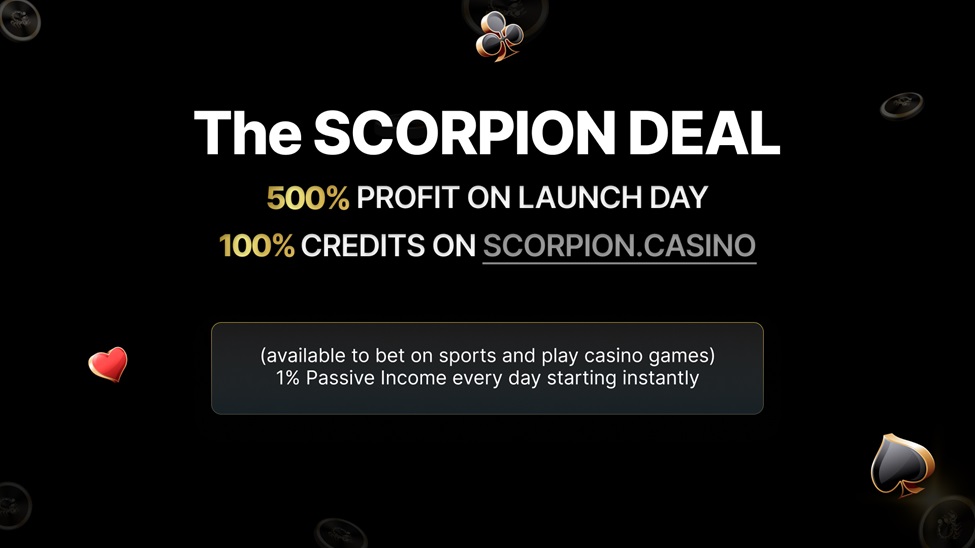
In the crescendo of this crypto symphony, the spotlight turns decisively to Scorpion Casino. As Chilliz basks in its heatwave and Bitcoin weathers a storm, the Scorpion Casino Presale stands tall, offering daily USDT rewards, engaging partnerships, and a trailblazing approach to gaming and investment. The casino, operational for 18 months, continues to evolve, embracing innovation, collaboration, and the promise of a lucrative crypto journey for those ready to seize the opportunity.

To enter the Scorpion Casino:


Presale: https://presale.scorpion.casino/

Twitter: https://twitter.com/ScorpionCasino

Telegram: https://t.me/scorpioncasino_official

Apply for World Economic Forum Young Global Leaders, if you can

0

If you do something amazing, and want to build the world’s finest pipeline to connect to the 1%, I recommend the World Economic Forum Young Global Leaders. If they accept you, they will give you access to connect with practically any influential person in the world.  So, when they open it, ask someone to nominate you or follow whatever the process is. (This is the season with WEF Annual Event). The day mine came, I was in the engineering lab in Carnegie Mellon University in Pittsburgh when our campus in Africa congratulated me. Within days, WEF provided access to people who continue to assist in my missions.

Don’t listen to the misinformation about WEF; that is natural when it is the gathering of the most powerful people who run this world. The key is access where you can learn from hedge fund kings, cardinals, bank leaders, political leaders, tech CEOs, etc. During my time, my mentor was then CEO of $196 billion publicly traded SAP, Bill McDermott. Bill assisted in many areas, making key referrals for me.

WEF YGL brings enormous credibility to missions. Go for it if you can because the “club” delivers value. You will join a community where you will meet people around the world who can assist you. An ex-US president’s daughter was on my set, and everyone was like averaged!

Cases Where The Courts Held Airlines Liable For Delaying Of Flights In Nigeria

0

Airlines are always behaving like mini gods in Nigeria; they delay flights at will without any regard for the repercussions. They even reschedule or cancel flights at the boarding time with no just cause leaving some Passengers to feel that nothing can be done about it or that they are not entitled to seek damages and compensation.

Contrary to that notion which is understandably facilitated by the slow judicial system in Nigeria, airlines and even their directors, captains, pilots and the hosts/hostesses have been severally held accountable for their lackadaisical attitudes and fined millions of naira by both the courts and the federal consumer protection agency for flights delays, late boarding, flight reschedule or cancellation of flight or general mishandling of their passengers or their passengers’ luggages.

In 2020, the High Court of the federal capital territory fined Arik Air Ltd ten million naira as damages for delaying the flight of a passenger in the case of Mallam Isa Ibrahim Modibbo V Arik Air Ltd (2020) FCT High Court. One of the passengers, Mallam Isa Modibbo brought an action against Arik Air Ltd for delaying the flight without any reasonable justification causing him to skip taking his drugs. The court while delivering judgment in favor of the passenger held that the failure of the airline to fulfill its contractual obligation of airlifting the plaintiff from the scheduled location to another scheduled location at the stipulated time indicated on the flight ticket is a serious breach of contract and infringement of the

plaintiff’s right to free movement and this breach entitles the passenger to compensatory damages.

Even foreign airlines have been held liable and fined by Nigerian courts for delays, cancellation or mishandling of a passenger or a passenger’s luggage. In the case of BRITISH AIRWAYS v. ATOYEBI (2014) LPELR-23120(SC) the Supreme Court affirmed that airlines owe a duty of care to their passengers failure to fully live up to that duty will grant the passenger the right of action to seek compensation for damages.

In the above case, the respondent at the Supreme, Mr Atoyebi Oyetola, Muyiwa SAN was a first-class passenger of the Appellant’s flight, British Airways on 7th May 2000. He was flying from Heathrow Airport, London to Lagos, Nigeria and he was advised by the airline staff that his handbag was too bulky to be hand luggage and he was advised to check in the handbag. He obeyed and checked in the handbag, but on reaching Lagos, he was told that his checked-in bag was left in London. The airline subsequently failed to send the bag down to Lagos or release the bag to someone else and the respondent had to fly back to London for the sole purpose of getting the bag himself.

Subsequently, the passenger wrote to the airline requesting compensation and reimbursement for the money he spent flying himself back to London just to get the back bag but the airline failed to reimburse or compensate him. This led to the passenger filing an action at the federal high court Lagos for the compensation and the court held in his favor that he is entitled to be reimbursed and compensated by the airline. The appeal court and the Supreme Court concurred with the judgment of the high court.

In these mentioned cases and many other cases, we have seen airlines cautioned, chastised and even fined by the courts for mishandling passengers, canceling flights, delaying flights or acting as mini gods, this attests to the high-end legal principle that “no one is above the law”, not even airlines and this is, therefore, to say that any passenger who has been delayed by an airline with no reasonable justification or your flight canceled or rescheduled, or you have been mistreated by an airline, you are entitled to compensation by the airline or you will have a right to approach the court to seek damages.


Supercharged EOAs will save cost and cement the EVM’s network effects

0

One of the most exciting developments in the Ethereum ecosystem is the emergence of supercharged externally owned accounts (EOAs). These are smart contract wallets that can interact with other contracts and protocols without requiring a separate transaction fee. Instead, they use meta-transactions that are sponsored by relayers or other parties who benefit from the wallet’s activity.

This innovation has several advantages for both users and developers. For users, it means that they can enjoy a seamless and user-friendly experience without having to worry about gas fees, network congestion, or wallet management. They can also access a variety of services and incentives from different protocols and platforms that integrate with supercharged EOAs.

For developers, it means that they can attract and retain more users by offering them a frictionless and cost-effective way to use their applications. They can also leverage the composability and interoperability of the Ethereum Virtual Machine (EVM) to create new and innovative features and functionalities.

EOA’s from FooBar’s Standpoint

Smart contract wallets are welcome infrastructure, but EOAs remain 99.9% of all addresses. Several reasons for this – cheaper gas, familiarity, wallet support, counterfactual multichain addresses, compatibility with msg.sender == tx.origin checks, compatibility with EIP-712 message signing.

Can smart contract wallets address these problems in due time? Potentially! But this will be a multiyear rollout process before there’s even sufficient maturity for most users to consider migrating. In the meantime, the path-dependent blockchain wars rage on and the EVM must supercharge EOAs to remain an attractive option. Far from competing, light clients points out that EIP-3074 makes EOAs compatible with 4337.

EOAs are 99.9% of all used Ethereum addresses. From a censorship resistance and permissionless perspective, creating an EOA is a trivial off-chain activity which can take place on any device, doesn’t require connectivity and doesn’t require any funds or sponsor. Creating an account with a contract wallet requires either a funded EOA to start from or a sponsor.

Counterpoints

“We should be moving beyond EOAs, not enshrining them even further” – This is a mindset of jealousy not growth. I hope smart contract wallets thrive, but dangerous to do so by handicapping EOA functionality and fearfully blocking improvements.

Nobody would suggest crippling existing EOA functionality so SC wallets can grow; likewise, we should not reject EOA improvements proposals so SC wallets can grow. EOAs were already enshrined in the core protocol on day 1, improving them is just that – an improvement not an enshrinement.

Supercharged EOAs are not only beneficial for the individual actors in the ecosystem, but also for the network as a whole. By reducing the transaction costs and increasing the usability of the EVM, supercharged EOAs will drive more adoption and activity on the network, creating a positive feedback loop that will strengthen the network effects and security of the EVM. This will make it harder for competing platforms to challenge Ethereum’s dominance and leadership in the decentralized space.

Supercharged EOAs are a game-changer for the Ethereum ecosystem. They will save millions of dollars for users and developers and cement the EVM’s network effects. They will also enable new and exciting possibilities for innovation and collaboration in the decentralized web.

Why a Spot ETF is a Game-Changer for Ethereum

Ethereum, the second-largest cryptocurrency by market capitalization, has been on a remarkable rally in the past year, reaching new all-time highs and gaining more adoption and recognition from investors, developers, and regulators.

However, one of the main challenges that Ethereum faces is the lack of accessibility and liquidity for retail investors who want to gain exposure to its price movements without having to deal with the technical and regulatory hurdles of buying and storing it directly.

This is where a spot ETF, or exchange-traded fund, comes in. A spot ETF is a type of investment vehicle that tracks the price of an underlying asset, such as Ethereum, and allows investors to buy and sell shares of the fund on a regulated stock exchange, just like any other stock.

A spot ETF differs from a futures-based ETF, which tracks the price of futures contracts that are derived from the underlying asset and may not reflect its true value due to factors such as contango, backwardation, and rollover costs.

A spot ETF for Ethereum would be a game-changer for several reasons. First, it would provide a simple and convenient way for retail investors to access the Ethereum market without having to worry about the complexities and risks of buying and storing it themselves. This would lower the barriers to entry and increase the demand and liquidity for Ethereum, which could boost its price and adoption.

Second, it would provide a more accurate and transparent representation of the Ethereum market than a futures-based ETF, which may suffer from tracking errors and discrepancies due to the nature of futures contracts. A spot ETF would reflect the actual spot price of Ethereum at any given time, which would benefit both investors and regulators who want to have a clear picture of the market dynamics.

Third, it would enhance the credibility and legitimacy of Ethereum as an asset class, as it would attract more institutional investors who are looking for regulated and compliant ways to invest in cryptocurrencies. A spot ETF would also signal that regulators are becoming more comfortable and supportive of Ethereum and its potential to transform various sectors of the economy through its decentralized applications.

A spot ETF for Ethereum would be a game-changer for the cryptocurrency industry, as it would provide a more accessible, accurate, and credible way for investors to participate in the Ethereum market. While there are still some regulatory and technical challenges to overcome before such a product can be launched, there is no doubt that the demand and interest for it are growing rapidly. A spot ETF for Ethereum would not only benefit Ethereum itself, but also the entire ecosystem of developers, users, and innovators who are building on its platform.

Access Bank Holdings Obtains CBN License to Establish A Consumer Lending Subsidiary

0

Nigerian multinational commercial bank, Access Bank Holdings plc has received the Central Bank of Nigeria (CBN) approval-in-principle, to establish a consumer lending subsidiary to be known as Oxygen X Finance Company Limited.

The bank announced that the proposed subsidiary will make a positive impact on the financial landscape by providing innovative and seamless digital lending solutions to address distinct challenges faced by businesses and individuals.

The proposed subsidiary will commence operation upon obtaining the final operating license from the Central Bank of Nigeria.

Access Bank Holdings’ launch of a lending subsidiary is the second diversification the company is making after a week ago, it announced the acquisition of Lagos-based Megatech Insurance Brokers.

Both of these are part of the corporation’s plan to branch out from core banking into new areas within the financial services sector in a bid to diversify and grow more revenue.

With the launch of Oxygen X, Access Bank seeks to target micro-SMEs and retail customers including lower and middle-income salary earners as well as self-employed individuals as its clientele.

According to its 5-year strategy document, the lending subsidiary product offerings encompass traditional consumer and SME lending (asset and device, financing, personal loans, working capital financing), emerging consumer lending (Buy Now Pay Later, savings & investment products, and value-added services.

While other lending companies in the financial services space have focused on fintech, Access Bank holdings has become the first to make a play for standalone digital lending with the launch of Oxygen X.

The bank’s lending subsidiary (Oxygen X) will look to compete with digital lenders like Opay and Carbon in the growing consumer lending industry in Nigeria.

The consumer lending industry in Nigeria, is reported to be growing at a significant rate. It is worth noting that in the first quarter of 2023, the Central Bank of Nigeria disclosed that Consumer credit in Nigeria rose by 1.3 percent to N2.35 trillion, from N2.32 trillion in the previous quarter.

Personal loans constituted a substantial portion, totaling N1.75 trillion or 74.5 percent, while retail loans accounted for the remaining 25.5 percent at N598.3 billion.

Also, other Depository Corporations (ODCs) contributed about 7.8% of consumer credit in Q3 2023. Based on the sectoral distinction, these ODCs constitute mostly of fintech lending startups, microfinance banks, and players in the alternative lending market, among others.

Financial experts have stated that the surge in consumer credit in Nigeria, is indicative of the evolving financial landscape in the country, with fintech playing a pivotal role in expanding access to credit and formal financial services.