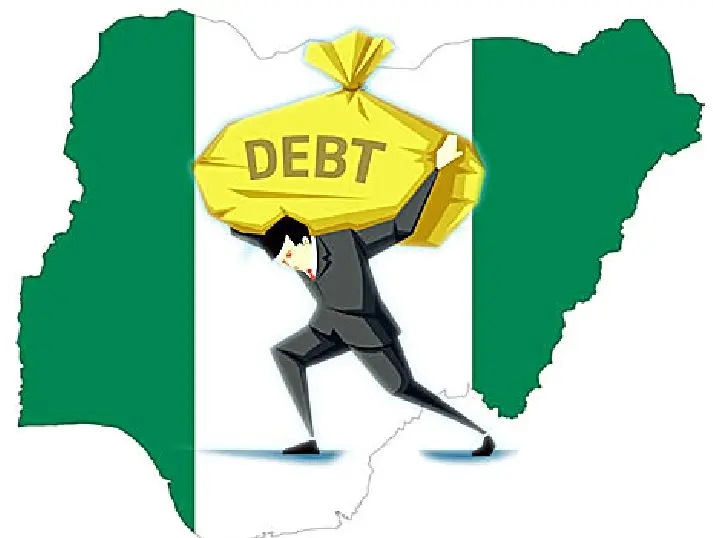
Nigeria’s public finances are coming under increasing strain as debt servicing continues to consume the bulk of government revenue, leaving little room for investment in infrastructure and social services.
New data from the Federal Government shows that in the first seven months of 2025, Abuja spent almost three-quarters of its income paying creditors, a trend that underscores how deeply debt obligations are shaping fiscal outcomes.
The situation is becoming even more troubling when set against the scale of the country’s revenue weakness, with new budget data showing that the government is not only struggling to fund development but is increasingly borrowing just to meet existing debt obligations.
Figures from the 2026–2028 Medium-Term Expenditure Framework and Fiscal Strategy Paper reveal that in the first seven months of 2025, the Federal Government generated N13.67 trillion in revenue, yet spent N9.81 trillion servicing domestic and foreign debt. That meant nearly 72% of all income was swallowed by debt service. When personnel costs of N4.51 trillion are added, spending on wages and debt alone rose to N14.32 trillion, exceeding total revenue for the period.
This imbalance is unfolding against the backdrop of a far deeper revenue crisis. The Federal Government’s 2025 budget was anchored on spending of about N40 trillion, but Finance Minister Wale Edun told members of the House of Representatives Committees on Finance and National Planning earlier this week that the federal government is on course to close 2025 with total revenue of about N10.7 trillion — barely a quarter of the N40.8 trillion projected. That leaves a yawning gap of roughly N30 trillion, highlighting the scale of the fiscal hole confronting the administration.
The implication is twofold. First, the government has been unable to implement large portions of the 2025 budget because expected revenues have failed to materialize. Second, and more worrying, borrowing has increasingly been used not to fund new infrastructure or growth-enhancing projects, but to service existing debt and keep basic government operations running.
Oil revenue remains the weakest link. Between January and July 2025, oil earnings stood at N4.64 trillion, far below the pro rata target of N12.25 trillion. The resulting shortfall of over N7.6 trillion underscores the vulnerability of public finances to crude production challenges, oil theft, and price volatility. Dividends from key entities such as Nigeria Liquefied Natural Gas and development finance institutions also fell sharply short of expectations, further tightening revenue inflows.
While some non-oil taxes showed modest resilience, they were nowhere near sufficient to plug the gap. Company Income Tax slightly exceeded its target, and Value Added Tax performed better than projected, but customs revenue, Federation Account levies, and oil-related inflows all posted steep declines. Overall, aggregate revenue of N13.67 trillion was more than N10 trillion below the pro rata target for the first seven months of the year.
On the expenditure side, debt servicing overshot budget estimates, reaching N9.81 trillion compared with a pro rata target of N8.35 trillion. Foreign debt service, in particular, exceeded projections by nearly 29%, reflecting higher external obligations and exchange rate pressures. This overshoot came even as non-debt recurrent spending and capital expenditure were sharply curtailed.
Capital spending suffered the most. Only N3.60 trillion was spent on capital projects against a pro rata budget of N13.67 trillion, a shortfall of almost 74%. Releases to ministries, departments, and agencies were especially weak, limiting progress on infrastructure, health, education, and other critical sectors. The Budget Office partly attributed this to the extension of the 2024 budget, but the broader issue remains the lack of cash to fund capital votes.
The picture that emerges is of a government boxed in by deficient revenue, rising debt service costs, and shrinking fiscal space. With only a fraction of its N40 trillion budget funded, Abuja has been forced to prioritize debt repayment and salaries over development spending, even as borrowing continues to rise.
In 2024, debt service already consumed 77.5% of the federal government’s revenue. The 2025 figures suggest the situation has not improved. Instead, Nigeria appears caught in a cycle where weak revenues limit budget implementation, borrowing fills the gap, and an increasing share of income is then used to service the resulting debt. Without a significant turnaround in revenue generation, the data points to growing constraints on growth, investment, and the government’s ability to deliver on its policy promises.