DD
MM
YYYY

PAGES

DD
MM
YYYY

spot_img

PAGES

Home Blog

The 7 Best Platforms for BNB to XMR Swaps (2026)

0

A handful of non-custodial instant swap services stand out when it comes to moving BNB into Monero in 2026. Some put privacy first, others remove any account requirement entirely, and a few focus on speed with fixed rates.

Quick Verdict on Top Platforms

One option ranks highest overall for privacy and BNB-specific routing. Another suits users who want unlimited volume without registration. A third delivers reliable fixed-rate swaps on BSC pairs. Additional services work well for beginners or those who like comparing rates across providers. All handle standard swaps without forcing registration.

Why BNB to XMR Swaps Matter in 2026

Monero’s ring signatures and stealth addresses give it privacy tools that BNB Chain transactions simply lack. Swapping directly sidesteps centralized exchanges that record addresses and sometimes share data with regulators. Non-custodial services run atomic or near-atomic trades so users keep control until the swap finishes. Demand has risen as more people move value from transparent chains like BSC into privacy assets. The Monero Project’s own documentation underscores these privacy benefits for cross-chain moves.

Users like these platforms because they need only a wallet address for the output. No email, phone, or ID upload is required for most transactions under the platform’s usual thresholds. This cuts down on data exposure compared with registration exchanges. Still, users remain responsible for their own keys, and blockchain analysis on the BNB side can happen before the swap completes.

How Instant No-registration Swaps Work

The flow starts when you pick the pair on the platform. The service creates a unique deposit address on the BNB Chain. You send BNB, the platform watches the blockchain for confirmation, then calculates and sends the XMR output using either live market rates or a fixed quote locked at the start.

Floating rates move with the market during the swap. Fixed rates lock the amount you receive no matter how prices shift. Most services finish the whole process in 5–30 minutes. Because the design is non-custodial, the platform never holds your funds for long; the swap happens through smart contracts or direct wallet transfers where possible.

  • Pick fixed rate when you want predictability on volatile pairs.
  • Always confirm the deposit address on the official site before sending.
  • Begin with a small test amount to check timing and output.
  • Use a fresh Monero wallet address for the strongest privacy.

These habits keep the process anonymous and under your control.

Baltex.io – Best for Privacy-Focused BNB to XMR Routing

Baltex.io focuses on privacy for BNB (BSC) to XMR pairs. It runs non-custodially and collects minimal data. Users often mention fast processing and reliable XMR delivery even when networks are congested. Competitive rates on privacy pairs and clear transaction tracking without accounts are common strengths.

Feedback highlights consistent uptime and helpful support when confirmations lag. A drawback is that spreads can widen during high volatility compared with pure aggregators. Many appreciate the Monero-native routing that helps preserve privacy better than generic services.

Godex.io – Best for Unlimited No-registration Volume

Godex.io allows unlimited anonymous swaps with no registration or verification tiers. It supports BNB to XMR and many other pairs at a fixed 0.5% fee. Testers completed multiple Monero transactions without registration prompts, even above typical thresholds elsewhere. Broad coin support and a straightforward interface stand out.

Users praise the lack of hidden limits and quick execution, often under 10 minutes. Some note slightly higher fees than floating-rate options during calm markets. Overall, it serves as a reliable choice for larger or repeated privacy swaps.

GhostSwap – Best Instant Monero Swaps with No Registration

GhostSwap focuses on fast, account-free Monero exchanges across 1,600+ cryptocurrencies, including BNB pairs. Its non-custodial model and cross-chain support appeal to users who prioritize speed and anonymity. Reviews note strong liquidity and minimal slippage on major routes.

Zero registration and support for many networks are clear strengths. Variable rates that can shift during longer confirmation windows are the main reported drawback. It fits users who want quick turnarounds without creating any profile.

Methodology: How We Selected and Ranked These Platforms

We evaluated platforms on support for the exact BNB (BSC) to XMR pair, verified no-registration policies from official sources, transaction speed, fee structures, user-reported reliability, and privacy features. Data came from platform documentation, recent 2026 reviews, and aggregated user experiences across forums and review sites. Weighting favored actual BNB-XMR functionality over general crypto support. Only services with confirmed non-custodial or instant-swap mechanics were considered. Rankings reflect a balance of privacy strength, usability, and consistency in real-world testing.

Practical Tips for Safe BNB to XMR Swaps

Always double-check the destination Monero address on the official platform page. Use hardware wallets or air-gapped setups for larger amounts when possible. Monitor network fees on BNB Chain before sending to avoid underfunding. Test with minimal amounts first to confirm the full flow. Avoid sharing transaction hashes publicly, as they can link activity. Stay updated on Monero network upgrades that may affect swap compatibility.

  • Verify the platform URL matches the official domain exactly.
  • Enable two-factor authentication on any associated wallet apps.
  • Keep transaction records private and encrypted.
  • Consider timing swaps during lower network activity for faster confirmations.

These habits maximize both security and privacy throughout the process.

Understanding BNB Chain and Monero Compatibility

BNB runs on a high-throughput smart chain built for low fees and fast transfers. Monero uses its own blockchain with a focus on untraceability. Cross-chain swaps bridge these differences through services that handle the conversion logic. No native atomic swap exists directly between the two, so trusted non-custodial intermediaries remain essential. Rates depend on liquidity pools, market demand for XMR, and current BNB pricing. Users benefit from Monero’s resistance to chain analysis once the swap completes.

Potential Risks and How to Mitigate Them

While no-registration reduces identity exposure, smart-contract vulnerabilities or provider downtime can still occur. Choose established services with public track records. Diversify across platforms for repeated large swaps. Remember that BNB sending addresses can still be analyzed before conversion. Use VPNs or privacy browsers for extra operational security. Never reuse addresses across multiple swaps when maximum anonymity is required.

Future Outlook for No-registration Privacy Swaps

As regulatory pressure grows, non-custodial aggregators and decentralized options are expected to add better multi-chain support and improved rate algorithms. Monero’s privacy features continue to drive demand for such tools. Platforms that invest in transparency and user education will likely hold leadership positions through 2026 and beyond.

FAQ

Which platform offers the best rates for BNB to XMR swaps without registration?

Baltex.io and Godex.io frequently provide competitive fixed or floating rates with no mandatory verification for standard volumes.

Do any no-registration services support direct BNB Chain to Monero swaps?

Yes, ChangeNOW, Godex, and Baltex.io explicitly support BNB (BSC) to XMR pairs with non-custodial execution.

What are the typical transaction limits on no-registration swap platforms?

Most services allow $1,000 to $10,000 per swap without verification, though limits vary and can trigger reviews on larger or repeated trades.

Is it safe to use instant swap services for privacy coins like XMR?

Non-custodial platforms minimize risk by never holding funds long-term, but users should verify official sites and start with small test transactions.

How long do BNB to XMR swaps usually take on these platforms?

Most complete in under 30 minutes, with many averaging 2-10 minutes depending on network confirmations and chosen rate type.

Can I swap BNB to XMR on a DEX like PancakeSwap?

PancakeSwap handles BNB Chain tokens but does not support native XMR; cross-chain no-registration aggregators are required for direct swaps.

The services described herein are not available to residents, citizens, or entities located in the United States or any other prohibited/sanctioned jurisdictions.


Critical Minerals and the Fragile Foundations of the Energy and Digital Transition

0

The global transition toward electric vehicles, renewable energy, data centres and modern power grids is creating an unprecedented appetite for minerals and industrial materials.

Technologies that are often presented as symbols of a cleaner and more digital economy depend on vast quantities of copper, lithium, nickel, cobalt, graphite, rare earth elements and other critical inputs.

Yet the growing importance of these resources is exposing a major weakness in the transition: the supply chains supporting it remain highly concentrated, vulnerable and difficult to expand quickly.

Electric vehicles are among the clearest examples. Batteries require lithium, nickel, graphite and, in many chemistries, cobalt. At the same time, electric motors and charging infrastructure rely heavily on copper and rare earth elements.

As governments encourage consumers to move away from internal combustion engines, demand for these materials is expected to rise substantially. The same resources are also needed for renewable energy systems, transmission networks and energy storage, meaning different sectors are competing for overlapping supplies.

The rapid expansion of data centres adds another layer of pressure. Artificial intelligence and cloud computing require enormous amounts of electricity, while the physical infrastructure connecting data centres to power networks requires copper, aluminium, steel and other industrial materials.

New transmission lines, substations and generation capacity cannot be built without securing these inputs. Consequently, the digital transformation and energy transition are becoming increasingly interconnected through their dependence on physical resources.

Mineral production is not evenly distributed around the world. Mining and processing capacity for several critical materials is concentrated in a relatively small number of countries. This creates strategic vulnerabilities because disruptions caused by trade restrictions, political instability, export controls, sanctions or infrastructure failures can quickly affect global manufacturers.

Recent geopolitical tensions have demonstrated how easily commodity markets can be disrupted. Governments are increasingly treating critical minerals as strategic assets rather than ordinary commodities.

Export restrictions, industrial policies and efforts to develop domestic processing capacity are becoming more common as major economies seek to reduce dependence on foreign suppliers. While such policies can strengthen national resilience, they can also fragment global markets and increase costs.

Infrastructure presents another challenge. Mining projects can take years, sometimes decades, to move from exploration to commercial production. New mines also require roads, railways, ports, electricity and processing facilities. Even when geological resources are available, inadequate infrastructure can prevent them from reaching international markets efficiently.

The result is a difficult policy dilemma. Governments and companies must accelerate investment in mining, recycling, refining and alternative technologies while simultaneously managing environmental and social concerns. Simply increasing extraction is not enough. More diversified supply chains, improved recycling systems and greater material efficiency will be essential.

The energy and digital transitions are not weightless transformations. Electric vehicles, artificial intelligence and modern power systems depend on a vast physical industrial base. If governments and businesses fail to address mineral supply vulnerabilities, shortages and price volatility could become major constraints on technological growth.

Building resilient supply chains will therefore be as important as developing new technologies. The success of the next phase of electrification and digitalisation may depend not only on innovation, but on whether the world can secure the materials required to turn that innovation into infrastructure.

How AI and Emerging Technologies Are Changing the Future

0

In a world defined by accelerating change and overlapping crises, the future can feel increasingly unstable and difficult to navigate. Geopolitical fragmentation, technological disruption, economic uncertainty and environmental pressures are reshaping societies at a remarkable pace.

Leaders across governments, businesses and institutions face a difficult challenge: they must respond to immediate problems while simultaneously preparing for risks that may be difficult to predict.

In this environment, traditional approaches to planning are becoming less effective, making adaptability and resilience essential qualities for the future.

Geopolitical fragmentation has become one of the most significant sources of uncertainty. Competition between major powers, trade disputes, regional conflicts and changing alliances are transforming the global economic and political landscape.

Countries are increasingly concerned about energy security, critical minerals, food supplies, semiconductor production and technological sovereignty. As governments prioritize national interests, global cooperation is becoming more complicated. This fragmentation can create new vulnerabilities for businesses and communities whose prosperity depends on interconnected international markets.

At the same time, technological change is accelerating faster than many institutions can adapt. Artificial intelligence, automation, blockchain, biotechnology and advanced computing are transforming industries and redefining the nature of work.

These technologies offer enormous opportunities to improve productivity, healthcare, financial systems and public services. However, they also create new challenges involving employment, privacy, cybersecurity, misinformation and inequality. The central question is no longer whether technology will change society, but whether institutions can manage that change responsibly.

Economic uncertainty further complicates the outlook. Inflation, high borrowing costs, volatile financial markets and uneven economic growth have created pressure for households, companies and governments. Rising public debt and changing monetary policies can limit the ability of governments to respond to future crises.

Meanwhile, businesses must make long-term investments despite uncertain demand and unpredictable geopolitical conditions. This environment rewards organizations that can remain financially disciplined while maintaining enough flexibility to respond quickly when circumstances change.

Climate change adds another layer of complexity. Extreme weather events, resource shortages and changing environmental conditions can disrupt infrastructure, agriculture and supply chains. Addressing these risks requires investment in resilient infrastructure, cleaner energy systems and sustainable economic models.

Yet the transition itself can generate political and economic tensions, particularly where communities depend heavily on traditional industries. The solution is not to predict the future with perfect accuracy, because such certainty is impossible.

Instead, leaders must develop systems capable of functioning under multiple possible futures. Scenario planning, diversified supply chains, technological flexibility and strong institutions can help societies absorb shocks without losing their strategic direction. Equally important is investment in education and human capital, ensuring that workers can adapt as industries evolve.

Uncertainty should not be viewed solely as a threat. It can also create opportunities for innovation, reform and cooperation. Organizations that embrace experimentation, learn quickly and respond to changing conditions are more likely to succeed in an unstable environment. The future will inevitably contain surprises, but societies can influence how damaging those surprises become.

The defining leadership challenge of the coming decades will therefore be balancing urgency with foresight. Immediate crises cannot be ignored, but decisions made today must also account for tomorrow’s uncertainties.

Resilience, adaptability and cooperation will be critical tools for navigating a world where change is no longer an occasional disruption, but a permanent condition.

Federal Reserve July FOMC Minutes Set the Stage for the Next Policy Decision

0

The U.S. Federal Reserve is preparing to release the minutes of its July Federal Open Market Committee meeting, offering investors a detailed look at the debate among policymakers over interest rates, inflation, employment and the broader economic outlook.

The July 28–29 meeting was closely watched because monetary policy remains at the center of financial-market expectations, with investors searching for clues about the timing and pace of future rate adjustments.

The Federal Reserve’s official calendar confirms that the July meeting took place on July 28–29 and that its minutes are scheduled for release three weeks after the policy decision.

The minutes are important because the Federal Reserve’s policy statement provides only a summary of the committee’s position. The detailed record can reveal how strongly officials disagreed, which economic risks received the most attention and what conditions could influence the next decision.

For markets, these details can be more consequential than the headline interest-rate decision itself. A major focus is likely to be inflation. The Federal Reserve has maintained price stability as one of its central objectives while also attempting to avoid unnecessarily weakening economic activity.

Persistent inflation can encourage policymakers to maintain restrictive monetary policy for longer, while convincing evidence of cooling price pressures could provide greater flexibility to reduce borrowing costs.

Employment conditions will also be closely examined. The labor market is an important component of the Fed’s dual mandate, and policymakers must balance the risk of inflation remaining elevated against the possibility that restrictive interest rates eventually weaken hiring and economic growth. Any discussion in the minutes about unemployment, wage growth or labor-market resilience could therefore influence expectations for future policy.

The economic projections associated with FOMC meetings also matter because they provide insight into policymakers’ expectations for growth, inflation and unemployment. However, not every regular meeting is accompanied by a new Summary of Economic Projections.

The Federal Reserve’s 2026 schedule identifies the June, September and December meetings as those associated with projections, meaning the July meeting did not include a fresh set of official projections.

Financial markets will consequently pay particular attention to the language surrounding risks and the policy path.

Interest-rate expectations influence Treasury yields, the U.S. dollar, equities and risk assets such as cryptocurrencies. A more hawkish interpretation could push yields higher and reduce appetite for speculative assets, while signals that officials are becoming more comfortable with easing could support risk-taking.

The minutes also arrive during an important transition for the Federal Reserve. The central bank’s 2026 leadership structure includes Kevin Warsh as chairman, while Jerome Powell remains listed among the FOMC members. The Federal Reserve says the committee meets regularly to assess economic and financial conditions and determine the appropriate monetary-policy stance.

The July minutes are unlikely to provide a simple prediction of what the Fed will do next. Instead, they will show the range of views policymakers considered and the economic developments that could move them in either direction. Investors will therefore examine every reference to inflation, employment, financial conditions and policy risks.

The release reinforces a broader reality for global markets: monetary policy remains highly dependent on incoming data. Until inflation demonstrates a convincing and sustained path toward the Fed’s objective, policymakers are likely to remain cautious.

For investors, the July minutes will provide another piece of the puzzle as markets attempt to determine whether the next major shift in U.S. monetary policy will be toward easing, continued restraint or a prolonged period of uncertainty.

Tekedia Capital Invests in Apollo Atomics and the Compact Nuclear Energy Revolution for the AI Age

0

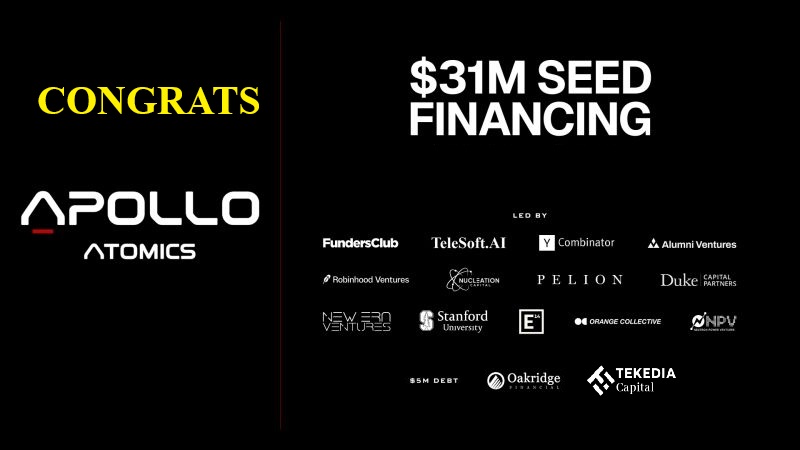
The age of compact nuclear energy is emerging, and Apollo Atomics is entering the arena with an oversubscribed $31 million seed round to accelerate the commercialization of its next-generation nuclear reactors.

An MIT spinoff, Apollo Atomics is redesigning the pressurized water reactor, not by abandoning proven nuclear science, but by improving its economics, scale and deployment architecture. The company uses commercially available fuel, established supply chains and familiar regulatory pathways while seeking to reduce plant size by 80% without sacrificing power output.

Its steam systems are approximately 20 times smaller than those used in conventional plants. Its fuel has achieved criticality at full power, and the company is pursuing commercial approval from the U.S. Nuclear Regulatory Commission. Apollo is targeting deployment in fewer than two years, compared with the 10 years or more commonly associated with conventional nuclear projects.

That matters because the AI economy has an energy problem. Data centres, advanced manufacturing facilities, university campuses and industrial operations need abundant, reliable and always-available electricity. Solar and wind will remain important, but the modern digital economy also requires dependable baseload power.

Apollo is working to provide that capability through reactors that can be deployed faster, occupy substantially less space and cost far less to prototype than competing systems. The technology is supported by more than 15 years of MIT research and testing, while prospective demand has already reached 20 gigawatts across data-centre developers, universities and industrial customers.

This is the playbook of consequential innovation: preserve what science has validated, redesign what economics has constrained, and build a better system for the needs of a new era. Upon this thesis, Tekedia Capital joined many global investors to invest in the company.

Nuclear energy is being reconstructed for the age of AI, and Apollo Atomics wants to lead that redesign.

Congratulations to the Apollo Atomics team. The mission is bold, the opportunity is massive, and a new energy category is emerging.