

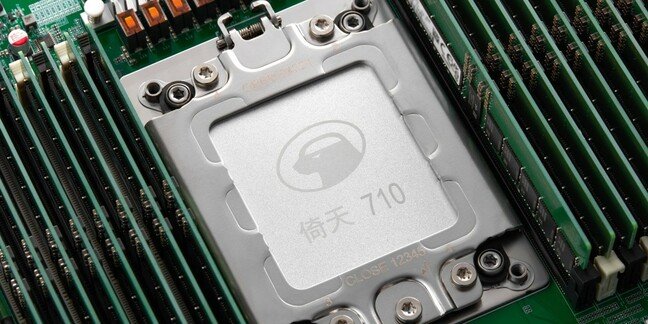
Alibaba is quietly developing a new chip tailored for artificial intelligence applications, according to two people familiar with the matter, marking its latest move in the intensifying race among Chinese technology companies to secure homegrown semiconductors.
The yet-to-be-launched chip, first reported by The Wall Street Journal and confirmed by sources who spoke to CNBC, is designed for “inferencing”—the stage where AI models are deployed to perform real-world tasks such as image recognition or language processing—rather than “training,” which requires significantly larger computing power and vast data sets.
Unlike Nvidia, which sells its hardware directly to customers, Alibaba’s new chip will not be made available for external sale. Instead, businesses will rent computing power from Alibaba’s cloud services, a model that keeps the technology in-house while strengthening its cloud division, which already saw revenue jump 26% year-on-year in its latest earnings report.
Register for Tekedia Mini-MBA edition 20 (June 8 – Sept 5, 2026).
Register for Tekedia AI in Business Masterclass.
Join Tekedia Capital Syndicate and co-invest in great global startups.
Register for Tekedia AI Lab.
Shares of Alibaba surged 12% on Friday, buoyed both by the chip news and stronger-than-expected earnings. Nvidia, meanwhile, saw its stock fall more than 3% in early U.S. trading as concerns grew over the company’s vulnerability to mounting U.S.-China technology tensions.
Beijing’s Push for Semiconductor Self-Reliance
Alibaba’s chip effort is part of a wider push by Beijing to bolster China’s semiconductor capabilities amid U.S. restrictions that have targeted advanced chip exports. Washington has prohibited Nvidia and other American firms from selling their most powerful chips to Chinese companies, arguing that such technology could aid military applications.
One of the most high-profile examples came earlier this year when Nvidia’s H20 chip, designed with reduced performance to meet U.S. export rules, was barred from being shipped to China. Although the company has since been allowed to resume exports under a deal requiring it to pay 15% of the revenue to the U.S. government, Nvidia admitted it has not shipped any H20 units yet.

These restrictions have accelerated Beijing’s longstanding ambitions for “technological self-reliance,” with Chinese firms scrambling to fill the gap.
Alibaba’s biggest domestic rivals—Baidu and Huawei—are also making parallel bets on homegrown chips, each positioning itself as a pillar of China’s semiconductor independence.
Baidu has invested heavily in its Kunlun line of AI chips, designed for both training and inference tasks. The chips are integrated into Baidu’s cloud services, much like Alibaba’s approach, and have already been used to support its autonomous driving and generative AI platforms. Baidu sees chips as critical to ensuring that its AI services remain competitive even if foreign supplies tighten further.

Huawei, meanwhile, has emerged as a more aggressive player in this space. Despite U.S. sanctions that cut off its access to advanced chipmaking equipment, the company stunned the global tech industry last year by unveiling its Kirin 9000S chip, built with domestically produced tools and materials.
Huawei has since expanded its AI-focused Ascend chip series, which is increasingly being adopted in Chinese data centers as an alternative to Nvidia GPUs. The company’s resurgence underscores Beijing’s determination to build a fully independent semiconductor ecosystem, even in the face of export bans.
While Chinese firms continue to use Nvidia’s chips where available, they are steadily building internal capabilities to ensure resilience. Cambricon, another homegrown AI chipmaker, recently reported a 4,000% surge in revenue and record profits in the first half of the year, highlighting how domestic firms are capitalizing on the policy push.
Alibaba’s Chip Track Record
Alibaba, however, has been in the semiconductor design for some time. Through its T-Head unit, the Hangzhou-based company has been developing chips for years. Its most notable release was the Hanguang 800 inference chip in 2019, designed to power data centers handling AI workloads.
Now, with plans to invest at least 380 billion yuan ($53.1 billion) over the next three years into AI infrastructure, Alibaba is doubling down on the sector. Its cloud business has already benefited from this strategy, reporting that AI-related products have seen “triple-digit year-over-year growth for the eighth consecutive quarter.”
By keeping its chips proprietary—using them to enhance its own services rather than compete directly with Nvidia on the open market—Alibaba appears to be aligning both with Beijing’s strategic priorities and with its own need to build competitive advantage in cloud computing.
The Gap Is Still Wide
Despite these advances, Chinese companies remain reliant on foreign technologies for the most cutting-edge semiconductor processes. Nvidia’s chips, capable of both training and inference, still play a central role where export rules allow. Nvidia CEO Jensen Huang has warned that continued restrictions could backfire, accelerating China’s push to replace U.S. technology altogether.
Alibaba’s new chip is not expected to compete directly with Nvidia’s hardware in terms of performance, at least not yet. Instead, it represents a step toward securing control over critical AI infrastructure.
The battle for AI chips in China, for now, is less about outright replacement of U.S. products and more about survival under tightening restrictions. But with Alibaba, Baidu, Huawei, and smaller players like Cambricon pushing ahead, the outlines of a new semiconductor landscape in China are beginning to emerge.