

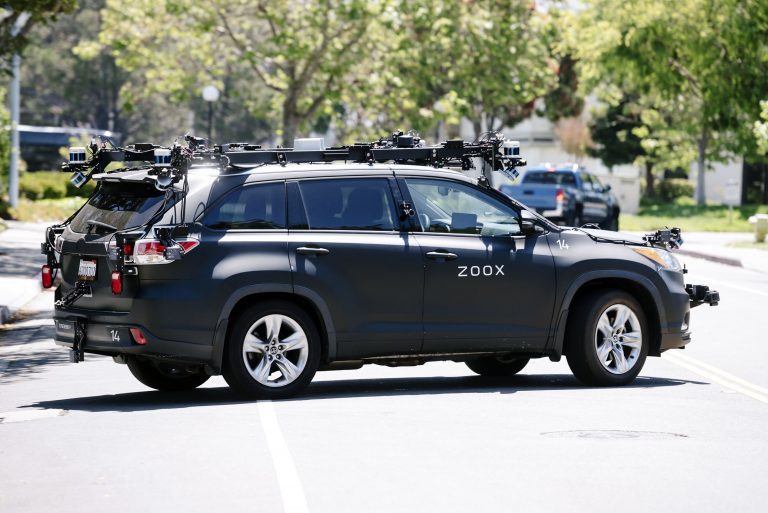
Amazon-owned Zoox has begun offering free robotaxi rides to the public on and around the Las Vegas Strip, marking its most ambitious step yet in the push toward commercializing fully autonomous ride-hailing.
The service, which started on Wednesday, comes as Zoox awaits state approval to collect fares and formally compete with Alphabet’s Waymo and Tesla.
Unlike its rivals, Zoox’s vehicles stand out: purpose-built, carriage-style pods with no steering wheels, pedals, or driver seats. Passengers instead sit facing each other in a cabin that Zoox executives admit looks more like a “toaster oven on wheels” than a traditional car.
Register for Tekedia Mini-MBA edition 20 (June 8 – Sept 5, 2026).
Register for Tekedia AI in Business Masterclass.
Join Tekedia Capital Syndicate and co-invest in great global startups.
Register for Tekedia AI Lab.
“This is a very differentiating experience that you want people to sort of get to understand and know the robotaxi, get used to it, and give us feedback too,” Zoox CEO Aicha Evans told Reuters. “That’s good for the community, that’s good for the riders, and that’s good for Zoox.”
Robotaxi Race and Rivalry
Zoox’s rollout underscores the increasingly crowded fight over robotaxi dominance. Waymo, with a fleet of roughly 2,000 vehicles, already runs fare-collecting services in parts of Phoenix, Los Angeles, San Francisco, Austin, and Atlanta.
Tesla, meanwhile, has begun offering rides in Austin, Texas, and has launched a small ride-hailing program in the San Francisco Bay Area using its driver-assistance technology — though with a safety driver still behind the wheel.

Traditional ride-hailing giant Uber is also fast emerging as a competitor, striking multiple deals to integrate autonomous vehicles into its network rather than building its own cars.
Why Zoox Looks Different
The design difference is Zoox’s biggest gamble. While Tesla retrofits its existing vehicles with self-driving systems and Waymo adapts Chrysler and Jaguar models, Zoox has pursued a ground-up redesign of the car itself. The all-electric pods are symmetrical, able to drive in either direction, and rely entirely on sensors and AI for navigation.
The absence of manual controls highlights Zoox’s commitment to a future where passengers won’t need to think of “drivers” at all. But it also makes the company more dependent on regulatory approval, as safety standards for such unconventional vehicles are still evolving.

Testing, Expansion, and Rider Feedback
Over the past month, Zoox has been quietly testing its vehicles on a loop from a Las Vegas casino, attracting thousands of weekly riders.
“We’ve actually been getting thousands of riders every week just from this one location, which actually quite exceeded our expectations,” Chief Technology Officer Jesse Levinson said.
Zoox currently operates about 50 vehicles, the majority in Las Vegas, and plans to “very soon” expand public rides to San Francisco, where testing has been underway for months. A rider wait list is already open. Further expansions are mapped out for Miami, Austin, Atlanta, and Los Angeles over the coming year.
The company envisions fleets running mostly on their own, with remote human assistance only stepping in when vehicles request help.
The High-Stakes Backstory
Commercializing robotaxis has proven far more difficult than promised. Across the U.S., rollout efforts have faced tight regulations, safety investigations, and public protests from communities wary of autonomous cars sharing the road. Several well-funded ventures — including Ford and Volkswagen-backed Argo AI — have already collapsed under the weight of high costs and slow regulatory progress.
Amazon’s 2020 $1.3 billion acquisition of Zoox signaled its long-term commitment to the space, giving the project deep-pocketed backing that many rivals lacked. For Amazon, the bet is about more than transportation: successful robotaxi fleets could generate huge returns by reshaping logistics, delivery, and mobility at scale.
Still, even with Amazon’s backing, Zoox faces stiff competition from Waymo’s head start, Tesla’s aggressive rollout strategy, and Uber’s vast ride-hailing network.
However, Zoox is pushing for regulatory clearance to begin charging fares in Las Vegas in the coming months. If approvals come through, the company will directly compete with Waymo in key U.S. cities while Tesla attempts to scale its own vision of robotaxis.
Currently, Zoox is betting that offering free rides will help the public grow comfortable with a very different kind of car — one where the driver’s seat no longer exists.