

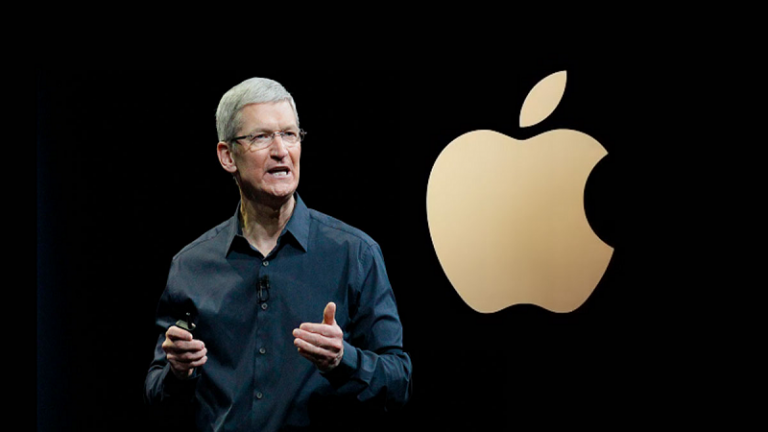
Apple CEO Tim Cook has delivered a rare all-hands address, rallying employees behind the company’s artificial intelligence ambitions and assuring them that Apple is well-positioned to lead the next big technological leap.
Speaking at the Steve Jobs Theater in Cupertino after a strong quarterly earnings report, Cook described the ongoing AI revolution as “ours to grab,” emphasizing the urgency of seizing the moment.
“This is as big or bigger than the internet, smartphones, cloud computing and apps,” Cook said, making clear that AI isn’t just a passing trend but a fundamental shift in how technology works—and how Apple must operate. “Apple must do this. Apple will do this.”
Register for Tekedia Mini-MBA edition 20 (June 8 – Sept 5, 2026).
Register for Tekedia AI in Business Masterclass.
Join Tekedia Capital Syndicate and co-invest in great global startups.
Register for Tekedia AI Lab.
“We will make the investment to do it.”
Wall Street’s Mounting Pressure
The meeting came as Wall Street intensifies its calls for Apple to show a clear AI roadmap. Investors have grown increasingly vocal about Apple’s slow response to the AI wave, especially as competitors like Microsoft, Google, Amazon, and OpenAI move swiftly to integrate large language models and generative AI into consumer and enterprise platforms. Apple, known for its cautious and polished approach to new technologies, has so far taken a quieter route—an approach that many analysts say is no longer enough.
For much of the past year, investors have watched rivals’ AI announcements drive massive gains in stock value. Microsoft’s investment in OpenAI has reshaped its product ecosystem and pushed its valuation higher, while Nvidia’s dominance in AI chips has turned it into a trillion-dollar firm. Meanwhile, Apple’s stock has been volatile, with analysts questioning whether the company has a credible AI strategy.

The pressure grew particularly intense earlier this year after Apple skipped flashy AI launches while its peers rolled out new tools and integrations seemingly every quarter. Some investors began openly questioning whether the company, long viewed as a hardware-first business, was at risk of missing the AI revolution entirely.
Cook’s internal remarks appear designed to silence those concerns, not just within Apple’s walls but on Wall Street.
“We’ve rarely been first,” he said, referencing how Apple redefined existing product categories like smartphones and tablets without being first to market.

“There was a PC before the Mac; there was a smartphone before the iPhone; there were many tablets before the iPad; there was an MP3 player before iPod.”
But Apple invented the “modern” versions of those product categories, he said. “This is how I feel about AI.”
The statement implies that Apple may be late to show its hand, but that doesn’t mean it won’t dominate the space.
Siri’s Overhaul and Internal Restructuring
A key part of Apple’s AI revamp is a major overhaul of Siri, the company’s long-criticized voice assistant. Craig Federighi, Apple’s senior vice president of software engineering, told staff that Apple had initially planned to update Siri using a hybrid approach that combined legacy command features with modern AI tools. But the results weren’t good enough.
“We didn’t meet the quality bar,” Federighi admitted, noting that the company shifted course earlier this year, handing Siri’s redevelopment to a new team under Vision Pro chief Mike Rockwell. The team is now building a completely new foundation for Siri, with the goal of launching it sometime in 2025.
“There is no project people are taking more seriously,” Federighi added.
The revamp also includes investments in core infrastructure. Cook highlighted Apple’s internally developed chip for cloud AI computing—code-named Baltra—as well as a new AI server production hub in Houston. These moves suggest Apple is preparing to handle more processing in the cloud, similar to how OpenAI’s ChatGPT and Google’s Gemini work, rather than relying solely on on-device models.
Workforce and Product Pipeline Expanding
In the last year, Apple has hired around 12,000 people, with nearly half of those joining research and development—a sign of the company’s renewed technical focus. Apple’s chip division, led by Johny Srouji, has been particularly active in developing silicon tailored for AI workloads, both in its consumer devices and its backend systems.
Cook also reaffirmed Apple’s commitment to international expansion. He noted that a “disproportionate” share of the company’s growth would come from emerging markets. New stores are opening in India, China, and the UAE this year, with Saudi Arabia set to get its first Apple Store next year.
“We’re planting flags where we see long-term demand,” Cook said.
He also hinted at growth in other areas like Apple TV+, wearables, and health features in AirPods Pro, including hearing aid-like functionality, which could open up new use cases and markets. Meanwhile, the company remains committed to achieving carbon neutrality by 2030, despite regulatory hurdles.
Regulatory and Trade Headwinds
Even as it charges into new frontiers, Apple faces external challenges. Cook acknowledged that trade tensions are not letting up. Tariffs introduced under President Donald Trump’s administration are expected to cost the company $1.1 billion in the current quarter alone. Apple had already spent $800 million in the previous quarter dealing with these duties, primarily tied to the International Emergency Economic Powers Act (IEEPA) tariffs related to China.
Trump’s tariffs have touched nearly every Apple product, most of which are manufactured in China, Vietnam, or India. Although Apple has diversified its supply chain—with most iPhones sold in the US now coming from India and many Macs and iPads from Vietnam—it still faces threats of further tariff hikes if it doesn’t shift more production to the United States.
Riding a Wave of Momentum—But With Caution
Apple’s rally comes on the heels of a stronger-than-expected earnings report. Revenue rose 10% to $94 billion between April and June, buoyed by solid iPhone and Mac sales and a double-digit jump in App Store revenue. While that momentum has helped stabilize investor confidence, Apple’s AI narrative remains a key driver of its future valuation.
In his speech, Cook also pushed employees to move more quickly to weave AI into their work and future products.
“All of us are using AI in a significant way already, and we must use it as a company as well,” Cook said. “To not do so would be to be left behind, and we can’t do that.”
The all-hands meeting was as much about aligning internal teams as it was about reassuring the market. As Cook wrapped up the hourlong session, he struck an optimistic tone.
“I have never felt so much excitement and so much energy before as right now,” he said, without disclosing any product specifics.
However, some have summed up his message to mean that Apple is late to AI, but not out of the race.