

Asian equities traded mixed on Monday as investors navigated a market increasingly dominated by geopolitical risk, oil volatility, and the prospect of a fresh escalation in the Iran war that could spill deeper into regional economies.
With several major markets, including Australia, Hong Kong, mainland China, and Taiwan, shut for public holidays, trading volumes were thin, amplifying the sensitivity of markets that remained open. Against that backdrop, every headline from Washington and Tehran carried outsized weight.
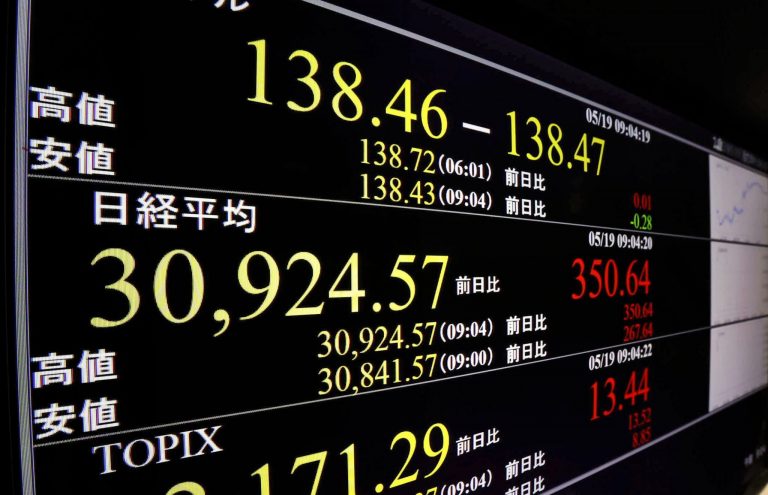
Japan’s Nikkei 225 rose 0.55% to 53,413.68, while the broader Topix ended flat at 3,644.8. South Korea’s Kospi advanced 1.36%, extending its strong run, although the Kosdaq slipped 1.5%, suggesting investors were rotating into large-cap defensives while reducing exposure to smaller growth names. India’s benchmark indices also reversed early weakness to trade higher in afternoon dealing.
Register for Tekedia Mini-MBA edition 20 (June 8 – Sept 5, 2026).
Register for Tekedia AI in Business Masterclass.
Join Tekedia Capital Syndicate and co-invest in great global startups.
Register for Tekedia AI Lab.
The broader story, however, lies beyond the daily index moves. Markets across Asia are increasingly being forced to price a binary geopolitical outcome.
President Donald Trump’s latest ultimatum to Iran, demanding a full reopening of the Strait of Hormuz by Tuesday evening or face attacks on power plants and civilian infrastructure, has raised the risk premium across equities, commodities, and currencies. Tehran’s rejection of the demand, coupled with continued strikes on Gulf economic targets, has left investors, particularly those in Asia, bracing for another volatile stretch.
The region is the world’s largest importer of Middle Eastern crude, making it uniquely exposed to any disruption in the Strait of Hormuz, through which roughly one-fifth of global oil supply flows. That explains why even modest gains in equities should not be mistaken for confidence.

Rather, markets appear to be trading on fragile hopes of diplomacy, with reports of back-channel discussions around a possible 45-day ceasefire helping to temper immediate panic. Yet the slim odds of a deal before the Tuesday deadline continue to keep risk sentiment fragile.
“The question is whether or not a more favorable outcome can be reached without another round of exchanges that can potentially narrow the path to lower intensity conflict in the medium term,” said Homin Lin, senior macro strategist at Lombard Odier, adding that investors will be careful with trading from headline to headline.
Oil remains the key transmission channel. Although crude prices eased slightly, WTI remained above $109 per barrel and Brent near $108, levels that continue to pose inflation risks for Asia’s import-dependent economies. For markets such as Japan, South Korea, and India, this has direct implications for inflation, trade balances, and central bank policy.

The Nikkei’s advance suggests investors are still willing to buy exporters and industrial names, perhaps on expectations that any sustained energy shock may weaken the yen further and support overseas earnings.
However, this optimism remains conditional.
A further rise in oil prices would quickly begin to weigh on margins for manufacturers, airlines, logistics firms, and chemicals producers, sectors highly sensitive to imported energy costs.
South Korea’s market action offers a similarly nuanced signal. The rise in the Kospi, driven largely by heavyweight technology and industrial names, points to continued confidence in the country’s export-led large caps. But the simultaneous drop in the Kosdaq suggests more speculative domestic growth plays remain under pressure. That divergence often signals selective risk-taking rather than broad-based optimism.
Another key layer is OPEC+.
The group’s decision to raise production quotas by 206,000 barrels per day for May appears to have done little to materially calm the market, largely because war-related disruptions have constrained actual flows from parts of the Gulf. Investors appear to view the move as more symbolic than transformative.
What makes this market environment especially fragile is liquidity. With several exchanges closed for holidays, thinner volumes mean price moves can be exaggerated by relatively small trades. That raises the risk of sharper swings in equities, currencies, and oil futures as markets react headline by headline.
In effect, Asia is trading in a high-beta geopolitical regime.
The next decisive driver will likely be whether any credible diplomatic framework emerges before Tuesday’s deadline. Currently, the mixed performance across Asia’s markets captures a region caught between two competing forces: the hope of de-escalation and the growing realization that the Iran war is becoming an increasingly systemic threat to global trade, inflation, and market stability.