

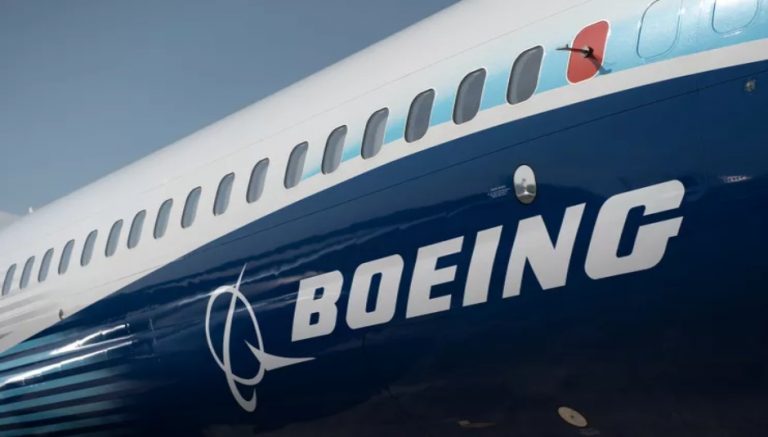
Boeing has delivered its first commercial aircraft to a Chinese airline since the United States and China agreed to roll back some of the tariffs imposed during the bruising trade war that began under President Donald Trump.
The handover of a 787-9 Dreamliner to Juneyao Air, which took off from Paine Field in Everett, Washington, on Friday en route to Shanghai Pudong International Airport, is being seen as a key sign that trade relations between the world’s two largest economies are beginning to stabilize.
The aircraft delivery, tracked via Flightradar24, had been delayed for a long as China imposed retaliatory duties on U.S. goods, including Boeing aircraft after the U.S. government slapped tariffs on hundreds of billions of dollars worth of Chinese exports in 2018. At the height of the dispute, both sides had imposed tit-for-tat tariffs covering goods ranging from semiconductors to soybeans, snarling global supply chains and freezing aircraft orders. The Chinese government, in protest, largely suspended approval for new Boeing purchases and slowed or blocked deliveries of already completed jets.
Register for Tekedia Mini-MBA edition 20 (June 8 – Sept 5, 2026).
Register for Tekedia AI in Business Masterclass.
Join Tekedia Capital Syndicate and co-invest in great global startups.
Register for Tekedia AI Lab.
But this recent delivery comes just days after Beijing and Washington reached a partial agreement to reduce or suspend select tariffs on key industrial and consumer goods, including aerospace components. While the full details of the deal remain under wraps, U.S. officials confirmed that the Trump administration had agreed to delay further tariff hikes on Chinese-made electronics and auto parts, while China had signaled readiness to reopen its market to U.S. aircraft and agricultural exports. Both sides also committed to resuming bilateral talks to address broader trade imbalances and technology transfer concerns.
The breakthrough appears to be yielding tangible results. Earlier this week, a Boeing 737 Max aircraft designated for Xiamen Airlines landed at the company’s Zhoushan delivery facility in China, a move widely interpreted as a signal that China is once again preparing to accept U.S. jetliners. On Friday, a second 737-8 Max also departed from Boeing Field in Seattle, heading across the Pacific via Hawaii en route to China — further evidence that the delivery pipeline, which had been effectively frozen, is now beginning to thaw.
The resumption of deliveries is critical for Boeing. The U.S. planemaker has about 85 completed aircraft originally ordered by Chinese customers that have been sitting undelivered, some for years. China had been Boeing’s largest overseas market before the trade war and before the prolonged grounding of the 737 Max following two fatal crashes in 2018 and 2019.

Now, with Chinese airlines grappling with a rebound in passenger demand and a growing need to modernize their fleets, the thaw in trade relations comes at a pivotal moment. The delivery of the Juneyao Dreamliner, in particular, offers hope for Boeing’s 787 program, which has been under pressure following a recent crash involving an Air India Express 787, and broader scrutiny over safety and quality control lapses.
Industry analysts say the move also underscores China’s strategic calculus in balancing its domestic aviation ambitions — particularly the commercial rollout of the C919 jet by COMAC — with the need to maintain a diversified fleet that includes advanced U.S.-made aircraft. Airbus has aggressively expanded its footprint in China in recent years, striking multiple deals and even opening final assembly lines. Boeing’s renewed access signals a potential rebalancing of that competitive dynamic.
For now, the deliveries remain modest. But they could grow quickly. Boeing has reportedly lined up nearly 50 aircraft for Chinese customers this year, and the latest movements suggest that regulatory bottlenecks are easing. More broadly, the delivery reflects a significant softening of trade tensions between Washington and Beijing after more than five years.

The tariff dispute, which began in early 2018 when Trump imposed sweeping levies on Chinese steel, aluminum, and later on over $200 billion worth of other products, marked the most significant rupture in U.S.-China trade in decades. It led to $550 billion worth of tariffs being levied by both countries and severely disrupted sectors like technology, automotive, and aviation.
The delivery of Boeing jets, therefore, is more than just a business transaction — it’s a diplomatic barometer.