

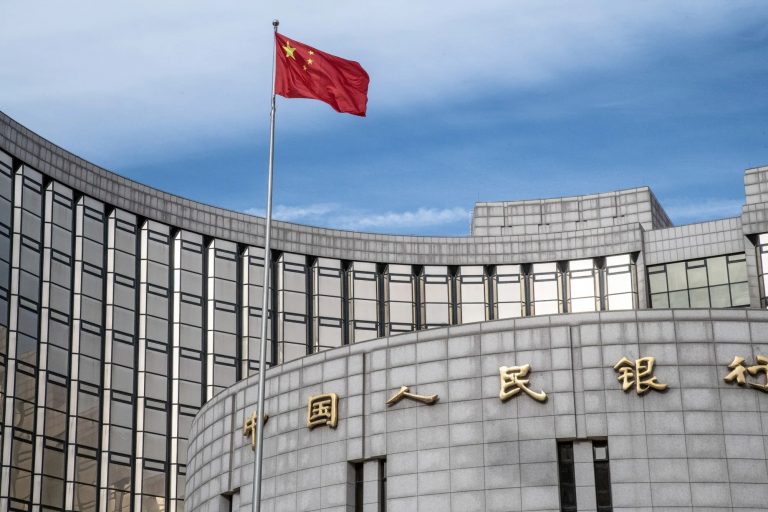
China’s central bank, the People’s Bank of China (PBOC), opted to keep its benchmark lending rates unchanged for a seventh consecutive month on Monday, maintaining the one-year Loan Prime Rate (LPR) at 3.00% and the five-year LPR at 3.50%, in line with unanimous expectations from a Reuters poll of 25 market analysts conducted last week.
This decision, the longest streak of stability since the LPR system’s inception in 2019, underlines a cautious monetary policy stance aimed at balancing growth support with financial stability, even as recent data highlights softening domestic demand and persistent property sector woes. The one-year LPR serves as the primary reference for most new corporate and household loans, while the five-year rate heavily influences mortgage pricing—a critical lever in addressing the ongoing real estate slump.
Despite the hold, effective lending rates for new loans have continued to trend lower, hovering at historic lows due to prior PBOC guidance and targeted relending facilities, with average corporate loan rates dipping to around 3.5% in Q3 2025.
Register for Tekedia Mini-MBA edition 20 (June 8 – Sept 5, 2026).
Register for Tekedia AI in Business Masterclass.
Join Tekedia Capital Syndicate and co-invest in great global startups.
Register for Tekedia AI Lab.
The last adjustments occurred in May 2025, when both rates were trimmed by 10 basis points amid efforts to revive post-pandemic recovery.
November’s economic indicators painted a mixed picture, prompting calls for more stimulus but not immediate action. Industrial output expanded by 4.8% year-on-year, a slight deceleration from October’s 4.9% and below the 5.0% consensus forecast, reflecting weaker manufacturing amid subdued external demand.
Retail sales growth slowed sharply to 1.3% from 2.9%, the weakest since August 2024, hampered by cautious consumer spending and a lingering property crisis that has eroded household wealth.

Fixed-asset investment for January-November rose 3.3% year-on-year, steady but underscoring infrastructure’s role in propping up activity.
Property investment plunged 10.4% in the first 11 months, with new home prices falling at the fastest pace in over a decade, exacerbating deflationary pressures.
New bank loans totaled 1.09 trillion yuan ($150 billion), missing estimates due to tepid household borrowing, while the urban unemployment rate edged up to 5.1%.

Inflation remained subdued, with the Consumer Price Index (CPI) up 0.7% year-on-year, far below the 3% target.
Despite these headwinds, the economy appears on track to achieve Beijing’s “around 5%” growth target for 2025, bolstered by a record $1.08 trillion trade surplus through November—up 8.7% year-on-year—and resilient exports, which surged 12.4% in November amid front-loading ahead of potential tariffs.
Q3 GDP came in at 4.6%, with full-year projections from institutions like the World Bank and IMF revised upward to 4.8-5.0%, citing easing U.S.-China trade tensions following a November interim agreement suspending certain duties.
The PBOC’s “cross-cyclical” adjustments—focusing on long-term stability—and banks’ record-low net interest margins (around 1.5%) afford policymakers flexibility to delay broad easing, prioritizing targeted measures like the September 50-basis-point reserve requirement ratio (RRR) cut and a November reduction in the medium-term lending facility (MLF) rate to 2.0%.
The announcement echoed signals from the annual Central Economic Work Conference (CEWC) held December 8-10, where top leaders, including President Xi Jinping, pledged a shift to a “moderately loose” monetary policy for 2026—marking the first such designation since 2010—and a “more proactive” fiscal stance to boost consumption, investment, and innovation.
The conference outlined nine key priorities: stimulating domestic demand through wage hikes and social security enhancements; advancing technological self-reliance in sectors like AI and quantum computing; deepening reforms in state-owned enterprises; stabilizing the property market via affordable housing initiatives; and managing risks in local government debt, estimated at $13 trillion.
Officials hailed 2025’s “remarkable” resilience amid external shocks but acknowledged challenges like weak consumption and overcapacity, committing to a 5% GDP target for 2026 while emphasizing “high-quality development.”
Analysts broadly interpret the hold as a sign of strategic patience rather than complacency. Barclays economists highlighted the CEWC’s call for “flexible and efficient” use of tools like RRR and interest rates, forecasting a 10-basis-point policy rate cut and 50bp RRR reduction in Q1 2026 to facilitate bond issuance.
Nomura anticipates a similar easing in Q2 2026, emphasizing fiscal ramps to arrest slowdowns.
Goldman Sachs and JPMorgan echo this, projecting cumulative 20-30bp LPR cuts in 2026 if property drags persist, while Pantheon Macroeconomics notes reduced trade risks post-U.S. deal could ease external pressures.
Zichun Huang of Capital Economics attributed November’s weakness to fiscal pullbacks, urging bolder reforms.
Market responses were subdued, reflecting pre-priced expectations. The Shanghai Composite Index rose 0.36% to close at 3,890.45 points, with gains in consumer and tech stocks offsetting property declines.
The onshore yuan held steady around 7.12 per U.S. dollar, supported by PBOC midpoint guidance, while 10-year government bond yields dipped slightly to 1.95%.
As China transitions into 2026, the PBOC’s hold buys time for fiscal tools, potentially including a larger deficit and special bonds, to take center stage, but persistent deflation and external uncertainties could force earlier intervention. With global peers like the Federal Reserve pausing hikes, Beijing’s calibrated approach aims to foster sustainable growth without reigniting debt risks, setting the stage for a pivotal year ahead.