

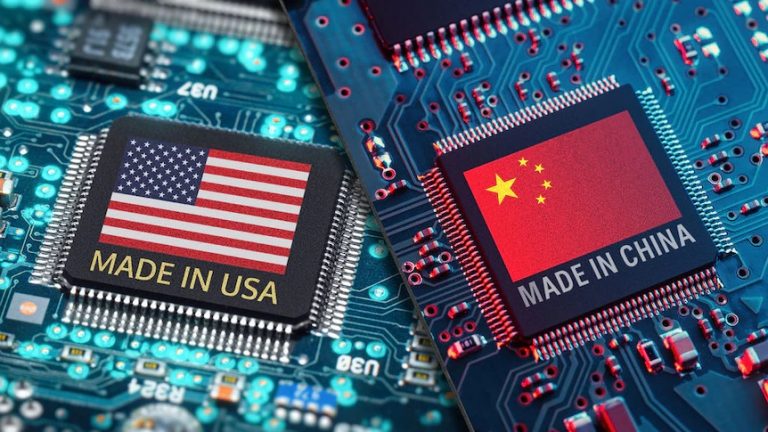
China is pressing Washington to ease restrictions on a critical component for artificial intelligence chips as part of ongoing trade negotiations, a push that has gained urgency ahead of a possible summit between President Donald Trump and President Xi Jinping.
The FT reports, citing multiple people familiar with the matter, that Beijing wants the Trump administration to relax export controls on high-bandwidth memory (HBM) chips, a component regarded by U.S. officials as one of the most important bottlenecks in China’s ability to develop advanced AI systems. Chinese officials have reportedly raised the HBM issue repeatedly during three rounds of trade talks in recent months led by U.S. Treasury Secretary Scott Bessent and China’s Vice-Premier He Lifeng. The U.S. Treasury has declined to comment.
The talks are part of efforts to strike a deal before an August 12 deadline, when failure to reach an agreement could trigger the reimposition of high tariffs. Commerce Secretary Howard Lutnick has indicated that the administration may extend the current ceasefire on tariffs by 90 days.
Register for Tekedia Mini-MBA edition 20 (June 8 – Sept 5, 2026).
Register for Tekedia AI in Business Masterclass.
Join Tekedia Capital Syndicate and co-invest in great global startups.
Register for Tekedia AI Lab.
This push from Beijing comes amid a significant development in Washington: Nvidia and AMD have reached an unprecedented agreement with the Trump administration to hand over 15 percent of revenues from certain chip sales in China in exchange for export licenses. The deal — disclosed just days after Nvidia chief executive Jensen Huang met Trump at the White House — allows both companies to resume selling chips tailored for the Chinese market despite previous export restrictions.
Nvidia will pay 15 percent of revenue from sales of its H20 chip in China, while AMD will make the same payment on sales of its MI308 chip. U.S. officials have not yet decided how the funds will be used. But analysts say this move is not merely about regulating AI chip exports—it signals a broader shift in the Trump administration’s trade strategy toward China. Washington seems to be testing whether it can both protect national security and extract economic value from controlled technologies by turning export restrictions into a revenue-generating tool.
China’s growing frustration stems from the Biden administration’s sweeping 2022 measures to curb Chinese access to advanced AI chips, followed in 2024 by a ban on exporting HBM to China, targeting Huawei and Semiconductor Manufacturing International Corporation (SMIC). While much public attention has focused on restrictions around Nvidia’s H20 chip, which the U.S. recently approved for export, Beijing is reportedly far more concerned about the HBM ban.

HBM is essential for pairing with the logic components of AI chips, significantly boosting performance. Gregory Allen, an AI expert at the Center for Strategic and International Studies, warned that allowing China to access more advanced HBM “is the exact same as saying we should help Huawei make better AI chips so that they can replace Nvidia.” U.S. officials have previously described HBM controls as “the single biggest constraint” on China’s AI chip ambitions.
Washington fears that loosening these controls could enable Huawei, SMIC, and others to mass-produce millions of AI chips annually, potentially diverting scarce HBM supplies away from the U.S. market. There are also concerns about Chinese firms like SophGo acquiring chip components — in one case from Taiwan’s TSMC — in suspected violation of U.S. law, highlighting the growing complexity of enforcing restrictions.
China’s embassy in Washington has accused the U.S. of “abusing export controls to suppress China” and harming the “legitimate rights” of Chinese companies.

Meanwhile, scrutiny is mounting over Nvidia’s sales in China. Although the company insists it complies with U.S. law, Chinese groups have been openly marketing Nvidia gaming chips such as the 4090D and 5090D for AI applications. This comes after reports of large-scale smuggling of advanced AI chips into China, with $1 billion worth of chips allegedly entering the country in the second quarter alone.
House China Committee Chair John Moolenaar said the scale of the activity underscores the need for Nvidia and the Commerce Department’s Bureau of Industry and Security to step up enforcement. Nvidia maintains that its gaming cards are intended for consumers and academic use, adding that “cannibalizing gaming cards is not a viable way to create data center compute clusters for AI.”
With Trump eager to secure a summit with Xi, officials in Washington are increasingly concerned that Beijing’s demands on HBM could become part of the final deal — a concession that could significantly shift the balance in the U.S.-China AI technology race.