

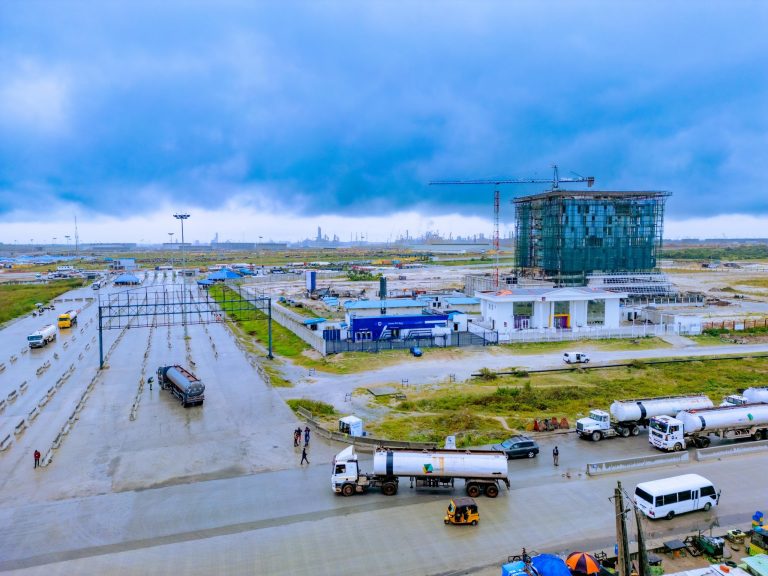
Aliko Dangote, President of the Dangote Group, is calling on President Bola Tinubu to include refined petroleum products in the list of items banned under the Federal Government’s ‘Nigeria First’ policy.
Dangote made the request last week while addressing industry stakeholders at the Global Commodity Insights Conference on West African Refined Fuel Markets, organized by the Nigerian Midstream and Downstream Petroleum Regulatory Authority (NMDPRA) in partnership with S&P Global Insights.
Speaking at the conference, Dangote urged the Tinubu administration to apply the ‘Nigeria First’ policy—originally intended to bar public institutions from importing goods or services that can be sourced locally—to the petroleum sector. He insisted that the continued importation of petrol, diesel, and other refined products into Nigeria is discouraging local refining and driving away critical investment.
Register for Tekedia Mini-MBA edition 20 (June 8 – Sept 5, 2026).
Register for Tekedia AI in Business Masterclass.
Join Tekedia Capital Syndicate and co-invest in great global startups.
Register for Tekedia AI Lab.
“The Nigeria First policy announced by His Excellency, President Bola Tinubu, should apply to the petroleum product sector and all other sectors,” Dangote said.
He argued that domestic refiners, including his $20 billion refinery in Lagos, are being undercut by the dumping of cheap, often toxic, fuel into the Nigerian market. Some of these imported fuels, according to him, would never be allowed into Europe or North America due to their substandard nature.
“We are now facing increased dumping of cheap, often toxic petroleum products… some of which are blended to substandard levels,” he said. “Due to the price caps on Russian petroleum products, discounted products produced in Russia or with discounted Russian crude find their way to Africa, severely undercutting our local production.”

Dangote went further to argue that Nigeria has already become a net exporter of refined fuel, revealing that between June and July 2025, his refinery exported approximately 1.35 billion liters of petrol.
Monopoly Concerns Resurface
But the demand has triggered immediate backlash from marketers, energy experts, and sections of the public, who accuse the billionaire of seeking to monopolize the oil sector, echoing similar accusations made against him in the cement industry.
Despite his assertion that the ban would protect local investment, many believe that the proposal reeks of monopolistic ambition. The request has revived longstanding concerns that Dangote is again attempting to control a critical sector of Nigeria’s economy, just as he is believed to have done in the cement industry, where his company has dominated market share for years amid allegations of regulatory capture and market manipulation.

“No, we cannot have a ban on petroleum imports. It’s not a legal ban. That would not be acceptable because we don’t have diverse sources for petroleum products. We can’t rely solely on the Dangote refineries. That would give a monopoly to a private individual,” an energy expert at the University of Lagos, Professor Dayo Ayoade, said, warning that it would promote monopolistic tendencies.
Many Nigerians, including oil marketers, have expressed concern that such a move would entrench Dangote’s dominance at the expense of competition and consumer welfare.
There is also concern that banning the importation of petroleum products contradicts the deregulation framework enshrined in the Petroleum Industry Act (PIA), which mandates a liberalized downstream sector where marketers are free to source and sell products without price controls or import restrictions.
Marketers and Experts Push Back
Against this backdrop, independent marketers and downstream operators who spoke to The Punch swiftly rejected Dangote’s proposal, reiterating that it would kill competition, spike fuel prices, and destabilize the sector.
“We independent marketers will depart from that request. If the government does that, that means we will not be able to check inflation and monopoly, since it is the only refinery operating in the country now. We should continue to import even as we buy locally,” said Chinedu Ukadike, Publicity Secretary of the Independent Petroleum Marketers Association of Nigeria (IPMAN).
“I heard that the NMDPRA stated clearly that Dangote cannot produce all the fuel that the country needs. We will appreciate it if the country allows importation to continue since we are not paying subsidy,” he added.
Ukadike also dismissed Dangote’s claim that importation would kill businesses and local refineries. He noted that although the country is no longer paying subsidies on fuel, allowing imports ensures price discovery and market checks.
“Importation won’t kill local businesses or refineries; it will strengthen them. It will ensure local refineries step up their game. I don’t agree with Dangote on this,” he said.
Billy Gillis-Harry, National President of the Petroleum Products Retail Outlet Owners Association of Nigeria (PETROAN), also opposed the idea.
“I don’t agree with Dangote. We are running a free economy. There’s no reason why any one company should have an overarching value on the entire industry,” he said.
He added that while the importation of locally available products like toothpicks or food items could be banned, refined petroleum products should remain open to market forces to ensure stability.
Protectionism vs. Deregulation
President Tinubu’s ‘Nigeria First’ policy, which restricts public procurement of foreign goods and services already available in Nigeria, is seen as a protectionist move to boost domestic industries. But experts argue that applying it to the petroleum sector—especially in a country that just exited fuel subsidy and enacted sweeping deregulation laws—would be illegal and economically self-defeating.
The Petroleum Industry Act (PIA), passed in 2021, legally supports deregulation of the downstream sector and emphasizes market-driven pricing. A fuel import ban would contradict both the letter and the spirit of the PIA, potentially triggering investor flight.
While Dangote’s monopoly concerns have been widely criticized, his call for regulators to revoke inactive refinery licenses has received some support.
“On that side, I agree with him,” Ukadike said. “You can’t obtain a refinery license and use it to decorate your house. The nation needs more refineries to export more.”
Dangote, for his part, insists his refinery has the capacity to meet Nigeria’s needs and produce for export. He recently said the facility, currently operating at 650,000 barrels per day (bpd), will scale up to 700,000 bpd by December.
He explained that his request was not to monopolize the sector but to produce local investments. Africa’s richest man noted that those who have the resources to invest in Nigeria keep taking their resources outside the country while they criticize local investors.
“Let me take this opportunity to address concerns around monopoly and dominance. The reality is that too many people who have the means and the opportunity to contribute meaningfully to our nation’s growth choose instead to criticize from the sidelines while investing their wealth abroad,” Dangote said.
His request to ban fuel imports comes just days after he stepped down as Chairman of Dangote Cement Plc to focus more on his $20 billion refinery and its supporting businesses in petrochemicals, fertilizer, and energy.
However, industry players say unless more refineries come onstream and market conditions become liberalized, any attempt to shut out fuel importation will be viewed not as patriotic but as an audacious play for market control.