

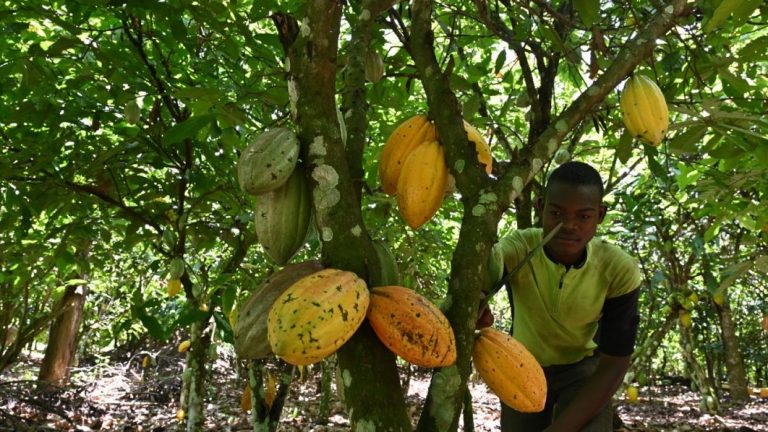
In a step toward agricultural transformation and economic expansion, the Enugu State Government, in partnership with WhiteRabbit Agro Limited, has launched a 20-hectare cocoa plantation in Nkanu East Local Government Area.
This initiative is part of the state’s broader vision to achieve a $30 billion Gross Domestic Product (GDP), reinforcing its commitment to leveraging agriculture as a key driver of economic prosperity.
The Commissioner for Agriculture and Agro-Industrialisation, Mr. Patrick Ubru, while briefing journalists in Enugu, stated that the cocoa plantation marks the beginning of a large-scale agro-industrialization strategy aimed at turning Enugu into a major cocoa-producing and processing hub in Nigeria.
Register for Tekedia Mini-MBA edition 20 (June 8 – Sept 5, 2026).
Register for Tekedia AI in Business Masterclass.
Join Tekedia Capital Syndicate and co-invest in great global startups.
Register for Tekedia AI Lab.
“In line with Governor Peter Mbah’s vision, we have partnered with WhiteRabbit Agro Limited to develop this cocoa initiative and establish Enugu as a key player in the cocoa industry. This is not just about farming—it’s about industrialization, processing, and ensuring that we maximize the value chain,” Ubru declared.
Recognizing the favorable topography and soil composition in parts of the state, the Enugu government has identified five additional local government areas—Nkanu West, Isi-Uzo, Oji River, Aninri, and Awgu—for cocoa expansion projects. Each of these LGAs is expected to develop a pilot 100-hectare cocoa plantation, significantly increasing the state’s overall production capacity.
WhiteRabbit Agro Limited, the private partner in the project, has already begun developing 100,000 high-yielding, early-producing cocoa varieties, sourced from the Cocoa Research Institute of Nigeria (CRIN) in Ibadan, to ensure the initiative’s long-term viability.

Economic Prospects of Cocoa
Cocoa farming presents a lucrative economic opportunity, with prices in the international market currently reaching $10,500 per tonne—equivalent to approximately N16.3 million per tonne. The global demand for cocoa, driven by the chocolate and confectionery industries, remains high, positioning Enugu for strong export potential.
Ubru noted that the cocoa nursery at Amaechi Idodo community in Nkanu East is strategically placed to support future expansion.
“With cocoa prices at this level, there’s no doubt that this initiative will drive economic growth, create jobs, and improve the livelihoods of our farmers. His Excellency, Governor Peter Mbah, has given a clear directive to prioritize cocoa farming, and we are fully committed to implementing this mandate,” Ubru affirmed.

Enugu and Abia Driving the South-East’s Investment Boom
Enugu is not alone in its push for agricultural and industrial investment. Neighboring Abia State, under the leadership of Governor Alex Otti, has also been making significant strides in attracting private-sector investment and boosting agricultural output.
Abia’s ongoing investment drive in key sectors—ranging from agribusiness to manufacturing—has positioned the state as a model for economic diversification in the South-East region. The state has focused on revamping moribund industries, improving the ease of doing business, and implementing pro-business policies that have attracted investors.
Observers have noted that the combined efforts of Enugu and Abia in driving investment and development could set a precedent for other South-Eastern states to follow. Their proactive governance models, with emphasis on private-sector collaboration, and focus on agro-industrialization are seen as a blueprint for regional economic transformation.
Calls for Ebonyi to Follow Enugu’s Lead
As Enugu and Abia are spearheading large-scale investments, Ebonyi State has been urged to replicate its approach by fully utilizing its rich agricultural resources.
Although rich in fertile land and has a strong history of rice production, Ebonyi has yet to embrace large-scale agro-industrialization at the level of its neighbors. Stakeholders in the agriculture and business sectors have emphasized that Ebonyi must expand beyond subsistence farming and move towards commercial-scale agriculture to harness its full economic potential.
Economists believe that Ebonyi’s agricultural sector could be transformed with policies that incentivize private-sector investment, similar to the cocoa initiative in Enugu. They note that expanding into crops such as cocoa, palm oil, cashew, and cassava, alongside its existing rice dominance, could turn the state into a powerhouse for agro-industrial exports.
Infrastructure Developments to Support Export Growth
To sustain this agricultural revolution, the Enugu State Government is also investing in critical infrastructure that will support large-scale farming and facilitate exports.
One of the most crucial developments is the cargo section of Akanu Ibiam International Airport, which is undergoing an upgrade. Once completed, the facility will allow direct export of high-quality, organic cocoa and other agricultural products to international markets.
“This will not only boost our exports but also increase foreign exchange earnings for the state,” Ubru noted.
Encouraging Private-Sector and Community Participation
The Enugu State Ministry of Agriculture and Agro-Industrialization has opened its doors to partnerships from individuals, corporate entities, cooperatives, and multinationals looking to participate in the cocoa initiative.
“The ministry is ready to provide guidance, agricultural extension services, and access to high-yield seedlings for cocoa, palm, cashew, and other crops. This is to ensure that our farmers maximize productivity, contribute to the economy, and generate sustainable profits,” Ubru said.
The commissioner expressed optimism that Governor Peter Mbah’s $30 billion GDP target is well within reach, given the ongoing expansion in agriculture, industrialization, and investment-driven policies.
“With these developments, I am confident that we will not only achieve but surpass the $30 billion GDP target, transforming Enugu into a hub for agro-industrialization and economic prosperity,” he concluded.