

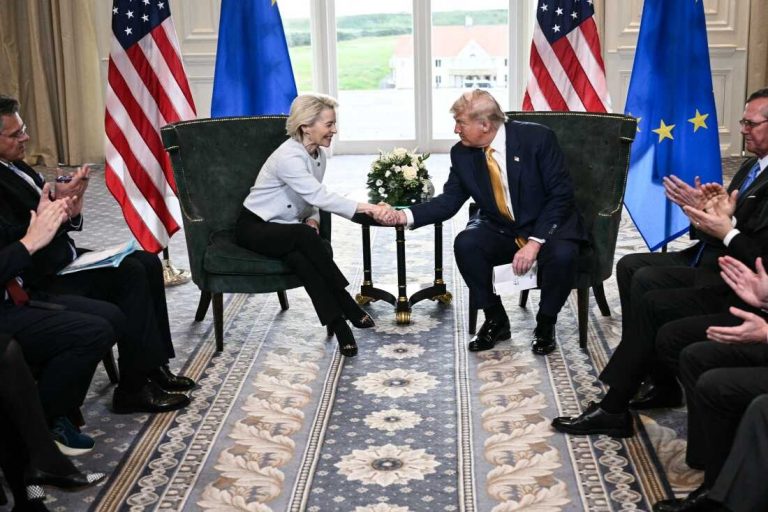
The European Union has agreed to suspend its retaliatory tariffs against the United States for six months, following a new agreement reached with U.S. President Donald Trump.
The move, confirmed by a European Commission spokesperson on Monday, is being seen as a temporary cooling of tensions in a trade war that has lingered for months, originating from the Trump administration’s aggressive tariff policies.
The two EU countermeasure packages being paused were designed to strike back against Trump’s tariffs on steel, aluminum, and a broader range of goods, including automobiles. While the Commission cited the deal as a sign of progress, the EU made clear that the suspension remains provisional, with key uncertainties still looming.
Register for Tekedia Mini-MBA edition 20 (June 8 – Sept 5, 2026).
Register for Tekedia AI in Business Masterclass.
Join Tekedia Capital Syndicate and co-invest in great global startups.
Register for Tekedia AI Lab.
Among those uncertainties is the status of European spirits exports and automotive goods, which were left out of Trump’s executive order last week that imposed a sweeping 15% tariff on most EU imports. European officials say they expect more such orders from Washington in the coming days.
“The EU continues to work with the U.S. to finalize a Joint Statement, as agreed on 27 July,” the Commission said in a statement. “With these objectives in mind, the Commission will take the necessary steps to suspend by 6 months the EU’s countermeasures against the US, which were due to enter into force on 7 August.”
The current truce is the latest chapter in a tariff dispute that dates back to early 2018 when President Trump began invoking Section 232 of the 1962 Trade Expansion Act to justify tariffs on foreign steel and aluminum imports, claiming they threatened U.S. national security. The move triggered swift backlash from key American allies, particularly the European Union, which imposed retaliatory tariffs on iconic U.S. exports, such as Harley-Davidson motorcycles, bourbon whiskey, and denim jeans.

Trump, in his second term, has widened the scope of the tariffs, targeting European automobile exports — a critical sector for Germany and other EU economies, further straining relations. Brussels responded with a second wave of countermeasures, but these were set to take full effect on August 7 before the recent six-month suspension was announced.
The tit-for-tat dynamic strained economic ties and overshadowed broader cooperation between the EU and the U.S., including efforts to reform the World Trade Organization (WTO). European officials have consistently argued that Trump’s use of national security provisions to justify economic protectionism undermines multilateral rules.
A Calculated Pause — But No Final Resolution
While the suspension of tariffs is a diplomatic gesture aimed at creating room for negotiations, the EU’s concerns remain firmly in place. Trump’s executive order last week, which placed a flat 15% tariff on a wide swath of EU imports without exemptions for automobiles or parts, has renewed fears that the trade standoff is far from over. The order’s lack of carve-outs has left European manufacturers on edge, especially in the auto sector, which has lobbied hard for relief.

More broadly, Trump’s trade policy has redefined America’s posture toward allies and trading partners. Embracing economic nationalism, Trump has repeatedly framed tariffs as a tool to rebalance U.S. trade deficits and revive domestic industries. His administration also pulled out of the Transatlantic Trade and Investment Partnership (TTIP) talks, which were once envisioned as a cornerstone of U.S.-EU economic integration.
The EU, meanwhile, has tried to hold the line by defending the multilateral trading system and seeking to diversify its partnerships globally. However, with U.S. tariffs still in place — and more expected — European officials acknowledge that the path to a full resolution remains uncertain.
For now, industries on both sides of the Atlantic are struggling to cope with the uncertainties. Whether this six-month pause leads to a more stable trade framework or simply postpones another round of retaliation depends on how negotiations unfold — and on what additional executive orders President Trump may choose to issue in the weeks ahead.