

59 Years Ago: The First Photograph of Earth Taken from Lunar Orbit

Quote from Alex Bobby on August 24, 2025, 7:07 AM
59 Years Ago Today: The First Photograph of Earth from Lunar Orbit
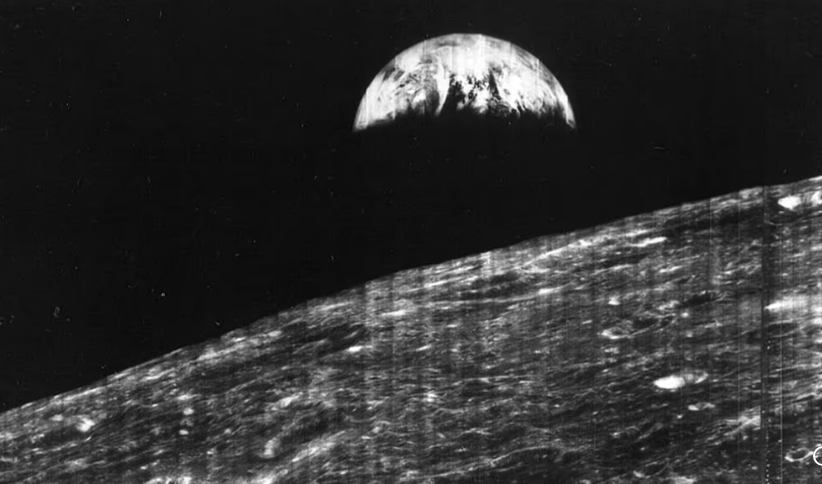
On 23 August 1966, humanity’s view of itself changed forever. That day, NASA’s Lunar Orbiter 1 probe, circling the Moon, captured the very first photograph of Earth taken from lunar orbit. What began as a technical mission aimed at mapping the Moon’s surface for future landings ended with a snapshot that offered humanity a new perspective: our planet as a fragile sphere suspended in the vast darkness of space.
This unexpected photograph marked the beginning of an era in which space exploration was not just about science and engineering, but also about understanding our place in the universe.
A Mission with a Different Purpose
The Lunar Orbiter 1 spacecraft was launched on 10 August 1966. Its primary task was straightforward: to photograph potential landing sites on the Moon for the upcoming Surveyor and Apollo missions. NASA needed precise images of smooth, safe areas where astronauts and robotic probes could touch down without risk.
To achieve this, Lunar Orbiter 1 carried a state-of-the-art imaging system developed by Eastman Kodak. Weighing around 68 kilograms, this camera was unlike anything sent to space before. It was capable of photographing, developing film inside the spacecraft, scanning the developed images, and transmitting them back to Earth. The technology itself was a Cold War secret—originally designed for the National Reconnaissance Office (NRO) and used on U.S. spy satellites.
Now adapted for lunar exploration, the camera was meant to photograph craters, ridges, and plains. Yet in the middle of this purely technical mission, the team behind Lunar Orbiter 1 made an unplanned, almost artistic decision: to turn the camera away from the Moon and toward Earth.
The First Glimpse of Home from Afar
The photograph was taken from a distance of approximately 380,000 kilometres. It shows half of the Earth, stretching from Istanbul in the north to Cape Town in the south, with the eastern regions shrouded in night.
The image, at the time, was grainy and lacked the detail we associate with today’s satellite photos. No continents or landmarks could be seen with clarity. Yet the power of the photograph was never about precision—it was about perspective.
For the first time, humankind could see its planet from the Moon, appearing as a delicate sphere hanging in an infinite black void. This was the first time Earth was truly captured as a single, united object, untethered from maps, borders, or nations.
The photograph was not part of the spacecraft’s official objectives. It happened because mission controllers decided to take the risk and point the camera homeward. That spontaneous decision created one of the most iconic images in space exploration history.
Emotional and Scientific Impact
Although the image did not provide immediate scientific value, its emotional resonance was profound. Scientists, astronauts, and the general public were struck by the fragility and isolation of the Earth when seen from space. It provided an early echo of the themes that would later dominate discussions of space travel, environmentalism, and global unity.
In fact, the 1966 Earth photograph can be seen as the precursor to the famous “Earthrise” image taken by Apollo 8 astronauts in 1968 and the “Blue Marble” photo taken by Apollo 17 in 1972. Each of these images helped shape public awareness of the environment and emphasised the shared destiny of all people on Earth.
A Hidden Technical Story
What many did not know at the time was that the imaging system aboard Lunar Orbiter 1 had a classified origin. The camera design had been borrowed from U.S. reconnaissance satellites. Its capability to develop film onboard and beam scanned images to Earth was cutting-edge in 1966.
Yet despite the advanced technology, the original Earth photograph from Lunar Orbiter 1 was never fully recovered at its maximum resolution. Early transmissions degraded, and for decades the image was seen only in its lower-quality form.
It was not until 2008 that the Lunar Orbiter Image Retrieval Project (LOIRP) managed to restore the image. Using original mission tapes stored in NASA archives, the team was able to reprocess the photograph with modern digital tools. The result was a significantly improved version, revealing details that had been hidden for over forty years.
The End of the Mission
Lunar Orbiter 1 completed its mission objectives with remarkable success. Over the course of its operation, it transmitted 205 images of the Moon back to Earth, mapping regions that would later serve as landing sites for Apollo astronauts.
The spacecraft’s journey came to an end on 29 October 1966, when NASA deliberately commanded it to crash into the lunar surface. This was done to prevent it from interfering with later missions and to eliminate the risk of accidental contamination.
While its physical presence ended on the Moon, its legacy lived on—not just in the detailed lunar photographs it captured, but in that single, world-changing image of Earth.
A Legacy Beyond Exploration
Looking back 59 years later, the photograph taken by Lunar Orbiter 1 reminds us of the dual nature of space exploration: it is both a technical challenge and a deeply human journey. The decision to photograph Earth was not necessary for science, yet it became one of the most valuable outcomes of the mission.
In the decades since, countless images of Earth from space have been taken, each sharper and more detailed than the last. Satellites now provide daily high-resolution photographs of our planet, monitoring weather, climate, and human activity. But none can quite match the awe inspired by that first, grainy black-and-white image from 1966.
It showed us that Earth is not just where we live—it is our shared home in a vast, indifferent cosmos.
Looking Forward
As we reflect on the milestone set by Lunar Orbiter 1, we also look ahead to a new era of exploration. NASA’s Artemis program aims to return humans to the Moon in the coming years, and with it, new technology will capture Earth and the cosmos in ways the 1966 team could never have imagined. Private companies and international space agencies are also preparing missions that could deliver even more breathtaking perspectives of our planet from deep space.
Yet, no matter how advanced our images become, the spirit of that first Earth photograph remains unmatched. It was a reminder that beyond the boundaries of nations and politics, we share one small, beautiful world. Looking forward, every mission to the Moon and beyond carries with it the potential to reshape not just our scientific knowledge, but also our understanding of ourselves.
Conclusion
The first photograph of Earth from lunar orbit, taken on 23 August 1966 by Lunar Orbiter 1, was more than a technical achievement—it was a turning point in human self-awareness. Though originally intended as a lunar reconnaissance mission, the probe gave us our first glimpse of Earth from the Moon, forever changing how we perceive our planet.
Nearly six decades later, this photograph continues to inspire reflection on our unity, our fragility, and our enduring drive to explore. It is a reminder that sometimes the most profound discoveries happen not when we follow the plan, but when we dare to look back.
Meta Description:
On 23 August 1966, NASA’s Lunar Orbiter 1 captured the first image of Earth from lunar orbit—an unplanned photograph that forever changed our perspective of the universe.
59 Years Ago Today: The First Photograph of Earth from Lunar Orbit
On 23 August 1966, humanity’s view of itself changed forever. That day, NASA’s Lunar Orbiter 1 probe, circling the Moon, captured the very first photograph of Earth taken from lunar orbit. What began as a technical mission aimed at mapping the Moon’s surface for future landings ended with a snapshot that offered humanity a new perspective: our planet as a fragile sphere suspended in the vast darkness of space.
This unexpected photograph marked the beginning of an era in which space exploration was not just about science and engineering, but also about understanding our place in the universe.
Register for Tekedia Mini-MBA edition 20 (June 8 – Sept 5, 2026).
Register for Tekedia AI in Business Masterclass.
Join Tekedia Capital Syndicate and co-invest in great global startups.
Register for Tekedia AI Lab.
A Mission with a Different Purpose
The Lunar Orbiter 1 spacecraft was launched on 10 August 1966. Its primary task was straightforward: to photograph potential landing sites on the Moon for the upcoming Surveyor and Apollo missions. NASA needed precise images of smooth, safe areas where astronauts and robotic probes could touch down without risk.
To achieve this, Lunar Orbiter 1 carried a state-of-the-art imaging system developed by Eastman Kodak. Weighing around 68 kilograms, this camera was unlike anything sent to space before. It was capable of photographing, developing film inside the spacecraft, scanning the developed images, and transmitting them back to Earth. The technology itself was a Cold War secret—originally designed for the National Reconnaissance Office (NRO) and used on U.S. spy satellites.

Now adapted for lunar exploration, the camera was meant to photograph craters, ridges, and plains. Yet in the middle of this purely technical mission, the team behind Lunar Orbiter 1 made an unplanned, almost artistic decision: to turn the camera away from the Moon and toward Earth.
The First Glimpse of Home from Afar
The photograph was taken from a distance of approximately 380,000 kilometres. It shows half of the Earth, stretching from Istanbul in the north to Cape Town in the south, with the eastern regions shrouded in night.

The image, at the time, was grainy and lacked the detail we associate with today’s satellite photos. No continents or landmarks could be seen with clarity. Yet the power of the photograph was never about precision—it was about perspective.
For the first time, humankind could see its planet from the Moon, appearing as a delicate sphere hanging in an infinite black void. This was the first time Earth was truly captured as a single, united object, untethered from maps, borders, or nations.
The photograph was not part of the spacecraft’s official objectives. It happened because mission controllers decided to take the risk and point the camera homeward. That spontaneous decision created one of the most iconic images in space exploration history.
Emotional and Scientific Impact
Although the image did not provide immediate scientific value, its emotional resonance was profound. Scientists, astronauts, and the general public were struck by the fragility and isolation of the Earth when seen from space. It provided an early echo of the themes that would later dominate discussions of space travel, environmentalism, and global unity.
In fact, the 1966 Earth photograph can be seen as the precursor to the famous “Earthrise” image taken by Apollo 8 astronauts in 1968 and the “Blue Marble” photo taken by Apollo 17 in 1972. Each of these images helped shape public awareness of the environment and emphasised the shared destiny of all people on Earth.
A Hidden Technical Story
What many did not know at the time was that the imaging system aboard Lunar Orbiter 1 had a classified origin. The camera design had been borrowed from U.S. reconnaissance satellites. Its capability to develop film onboard and beam scanned images to Earth was cutting-edge in 1966.
Yet despite the advanced technology, the original Earth photograph from Lunar Orbiter 1 was never fully recovered at its maximum resolution. Early transmissions degraded, and for decades the image was seen only in its lower-quality form.
It was not until 2008 that the Lunar Orbiter Image Retrieval Project (LOIRP) managed to restore the image. Using original mission tapes stored in NASA archives, the team was able to reprocess the photograph with modern digital tools. The result was a significantly improved version, revealing details that had been hidden for over forty years.
The End of the Mission
Lunar Orbiter 1 completed its mission objectives with remarkable success. Over the course of its operation, it transmitted 205 images of the Moon back to Earth, mapping regions that would later serve as landing sites for Apollo astronauts.
The spacecraft’s journey came to an end on 29 October 1966, when NASA deliberately commanded it to crash into the lunar surface. This was done to prevent it from interfering with later missions and to eliminate the risk of accidental contamination.
While its physical presence ended on the Moon, its legacy lived on—not just in the detailed lunar photographs it captured, but in that single, world-changing image of Earth.
A Legacy Beyond Exploration
Looking back 59 years later, the photograph taken by Lunar Orbiter 1 reminds us of the dual nature of space exploration: it is both a technical challenge and a deeply human journey. The decision to photograph Earth was not necessary for science, yet it became one of the most valuable outcomes of the mission.
In the decades since, countless images of Earth from space have been taken, each sharper and more detailed than the last. Satellites now provide daily high-resolution photographs of our planet, monitoring weather, climate, and human activity. But none can quite match the awe inspired by that first, grainy black-and-white image from 1966.
It showed us that Earth is not just where we live—it is our shared home in a vast, indifferent cosmos.
Looking Forward
As we reflect on the milestone set by Lunar Orbiter 1, we also look ahead to a new era of exploration. NASA’s Artemis program aims to return humans to the Moon in the coming years, and with it, new technology will capture Earth and the cosmos in ways the 1966 team could never have imagined. Private companies and international space agencies are also preparing missions that could deliver even more breathtaking perspectives of our planet from deep space.
Yet, no matter how advanced our images become, the spirit of that first Earth photograph remains unmatched. It was a reminder that beyond the boundaries of nations and politics, we share one small, beautiful world. Looking forward, every mission to the Moon and beyond carries with it the potential to reshape not just our scientific knowledge, but also our understanding of ourselves.
Conclusion
The first photograph of Earth from lunar orbit, taken on 23 August 1966 by Lunar Orbiter 1, was more than a technical achievement—it was a turning point in human self-awareness. Though originally intended as a lunar reconnaissance mission, the probe gave us our first glimpse of Earth from the Moon, forever changing how we perceive our planet.
Nearly six decades later, this photograph continues to inspire reflection on our unity, our fragility, and our enduring drive to explore. It is a reminder that sometimes the most profound discoveries happen not when we follow the plan, but when we dare to look back.
Meta Description:
On 23 August 1966, NASA’s Lunar Orbiter 1 captured the first image of Earth from lunar orbit—an unplanned photograph that forever changed our perspective of the universe.
Share this:
- Click to share on Facebook (Opens in new window) Facebook
- Click to share on X (Opens in new window) X
- Click to share on WhatsApp (Opens in new window) WhatsApp
- Click to share on LinkedIn (Opens in new window) LinkedIn
- Click to email a link to a friend (Opens in new window) Email
- Click to print (Opens in new window) Print