

AI Robot Dogs Begin Delivering Fast Food in Zurich as Just Eat Pilots New Technology

Quote from Alex Bobby on August 23, 2025, 7:21 AM
AI Robot Dogs Deliver Fast Food in Zurich as Just Eat Pilots New Technology
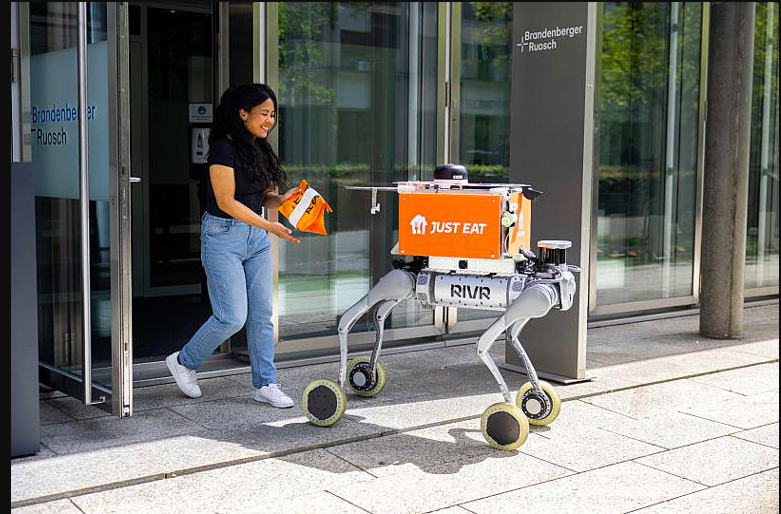
Zurich’s streets are about to get a futuristic twist. Forget the sight of scooters or cyclists weaving through traffic with takeaway bags strapped to their backs — the Swiss city is now witnessing robot dogs delivering food to hungry customers. In a pioneering move, Dutch food delivery giant Just Eat Takeaway.com has partnered with Swiss robotics firm RIVR to test autonomous wheeled-legged “robo-dogs” designed to make meal deliveries more efficient, sustainable, and tech-driven.
The pilot programme, first launched in Zurich with deliveries from the restaurant Zekis World, could mark a turning point in how Europeans experience food delivery. With expansion plans already on the horizon, these mechanical couriers may soon be a familiar sight in other major cities across the continent.
What Makes These Robot Dogs Different
Unlike conventional delivery robots, which often resemble small rolling boxes, RIVR’s creation combines wheels and legs, enabling the robo-dogs to navigate far more complex urban environments. Equipped with Physical AI, the machines can adapt to real-world challenges in ways that previous models struggled with.
For instance, the AI allows them to:
- Climb stairs — crucial in dense European cities with multi-storey buildings.
- Avoid obstacles — manoeuvring around pedestrians, cyclists, cars, and even common obstructions like bins or uneven terrain.
- Handle weather extremes — operating smoothly in rain, snow, strong winds, or heatwaves.
With speeds of up to 15 kilometres per hour, these robot dogs are both fast and durable. Each delivery is monitored in real time, with human operators capable of taking remote control if needed. This oversight ensures safety for pedestrians and security for customer orders.
A First in Europe
Just Eat Takeaway.com proudly stated that it is the first on-demand delivery company in Europe to pilot wheeled-legged robots enhanced with Physical AI. This gives the company a technological edge in an industry where efficiency and innovation are increasingly vital.
The partnership reflects Just Eat’s broader vision of diversifying delivery options beyond traditional human couriers. In recent years, the company has experimented with drone deliveries in Ireland in collaboration with Manna Drones Ltd., showing a willingness to invest in next-generation logistics.
For RIVR, the collaboration is equally significant. The Swiss firm envisions its robots being used not just for fast food, but also for parcels, groceries, and retail products. As e-commerce continues to boom across Europe, autonomous solutions like this could help alleviate bottlenecks in urban logistics.
The Future of Food and Retail Deliveries
Marko Bjelonic, CEO of RIVR, framed the project as a glimpse into a near future where automation is seamlessly integrated into daily life.
“Our collaboration with Just Eat Takeaway.com is a glimpse into a future where automation blends naturally into our cities, helping people get what they need, when they need it. Physical AI allows our robots to understand and adapt to the real world.”
This vision extends well beyond Zurich. RIVR has confirmed that more robot dogs will be deployed in other European cities later this year, with a potential rollout into retail and convenience store deliveries. That means groceries, pharmacy essentials, and even clothing could one day arrive at your doorstep courtesy of an AI-powered courier.
Why This Matters
The adoption of robot dogs highlights a few key trends shaping the food delivery sector and urban life more broadly:
- Sustainability: Autonomous robots, powered by electricity, produce no emissions during operation and reduce reliance on cars or scooters. For cities grappling with pollution and climate goals, this is a major win.
- Efficiency: With the ability to move faster than most walking couriers and bypass certain obstacles, these robots could shorten delivery times and streamline logistics for restaurants.
- Labour Challenges: The food delivery industry has long faced challenges around working conditions, courier shortages, and rising costs. Robotics could complement — though not fully replace — human workers, especially during peak demand hours.
- Urban Adaptation: Cities are under pressure to adapt to new technologies while maintaining safety and liability. How Zurich manages robo-dog integration may serve as a model for others.
Public Reaction and Concerns
While the prospect of robot dogs carrying pizza and burgers might sound thrilling, public response is expected to be mixed. Some citizens may view the pilot as a fascinating glimpse into the future, while others could worry about job losses or safety risks.
Key concerns likely to arise include:
- Job displacement — what happens to human couriers if robots become more widespread?
- Public safety — while AI can prevent collisions, pedestrians may feel uneasy sharing the streets with machines.
- Data privacy — given real-time monitoring, questions may arise about what data is being collected and how it’s used.
Just Eat and RIVR will need to navigate these issues carefully, balancing technological enthusiasm with transparency and community engagement.
A Step Toward Smarter Cities
Zurich is no stranger to innovation, often ranking among Europe’s most tech-forward cities. The pilot reflects the city’s openness to smart solutions that improve urban life. If successful, this programme could lay the foundation for smarter, more automated cities, where AI-driven robots complement human labour, reduce congestion, and enhance sustainability.
For consumers, the novelty may be enough to spark excitement. Imagine opening your door to find a robotic dog patiently waiting with dinner — it’s a scene that just a few years ago belonged only in science fiction.
looking forward
Looking forward, the Zurich pilot could set the stage for a Europe-wide rollout of AI-powered delivery dogs, fundamentally changing how food, groceries, and parcels reach consumers. If the trial proves successful, we may see these robots integrated into everyday city life — from bringing late-night takeout to delivering prescription medicine.
As automation and Physical AI mature, robot couriers will likely become more efficient, cost-effective, and sustainable, potentially easing traffic congestion and reducing emissions in urban centres.
For businesses, this technology opens new possibilities for faster, more reliable logistics, while consumers can expect greater convenience and novel experiences. The future of delivery could very well be four-legged, autonomous, and always on time.
Conclusion
The rollout of AI-powered robo-dogs in Zurich is more than a quirky experiment in fast food delivery. It represents a bold step toward the future of urban logistics, where technology, sustainability, and convenience converge.
As Just Eat and RIVR expand their pilot to more cities, Europeans may soon find themselves living alongside these mechanical couriers as part of everyday life. Whether they’re delivering groceries, takeout, or retail goods, the message is clear: the way we receive food and essentials is changing, and robot dogs could soon become a trusted part of the modern cityscape.
Meta Description:
Just Eat has launched a pilot program in Zurich using AI-powered robot dogs to deliver fast food. Developed with Swiss firm RIVR, the robots can climb stairs, avoid obstacles, and adapt to real-world conditions, marking a bold step in the future of food delivery across Europe.
AI Robot Dogs Deliver Fast Food in Zurich as Just Eat Pilots New Technology
Zurich’s streets are about to get a futuristic twist. Forget the sight of scooters or cyclists weaving through traffic with takeaway bags strapped to their backs — the Swiss city is now witnessing robot dogs delivering food to hungry customers. In a pioneering move, Dutch food delivery giant Just Eat Takeaway.com has partnered with Swiss robotics firm RIVR to test autonomous wheeled-legged “robo-dogs” designed to make meal deliveries more efficient, sustainable, and tech-driven.
The pilot programme, first launched in Zurich with deliveries from the restaurant Zekis World, could mark a turning point in how Europeans experience food delivery. With expansion plans already on the horizon, these mechanical couriers may soon be a familiar sight in other major cities across the continent.
Register for Tekedia Mini-MBA edition 20 (June 8 – Sept 5, 2026).
Register for Tekedia AI in Business Masterclass.
Join Tekedia Capital Syndicate and co-invest in great global startups.
Register for Tekedia AI Lab.
What Makes These Robot Dogs Different
Unlike conventional delivery robots, which often resemble small rolling boxes, RIVR’s creation combines wheels and legs, enabling the robo-dogs to navigate far more complex urban environments. Equipped with Physical AI, the machines can adapt to real-world challenges in ways that previous models struggled with.
For instance, the AI allows them to:

- Climb stairs — crucial in dense European cities with multi-storey buildings.
- Avoid obstacles — manoeuvring around pedestrians, cyclists, cars, and even common obstructions like bins or uneven terrain.
- Handle weather extremes — operating smoothly in rain, snow, strong winds, or heatwaves.
With speeds of up to 15 kilometres per hour, these robot dogs are both fast and durable. Each delivery is monitored in real time, with human operators capable of taking remote control if needed. This oversight ensures safety for pedestrians and security for customer orders.
A First in Europe
Just Eat Takeaway.com proudly stated that it is the first on-demand delivery company in Europe to pilot wheeled-legged robots enhanced with Physical AI. This gives the company a technological edge in an industry where efficiency and innovation are increasingly vital.

The partnership reflects Just Eat’s broader vision of diversifying delivery options beyond traditional human couriers. In recent years, the company has experimented with drone deliveries in Ireland in collaboration with Manna Drones Ltd., showing a willingness to invest in next-generation logistics.
For RIVR, the collaboration is equally significant. The Swiss firm envisions its robots being used not just for fast food, but also for parcels, groceries, and retail products. As e-commerce continues to boom across Europe, autonomous solutions like this could help alleviate bottlenecks in urban logistics.
The Future of Food and Retail Deliveries
Marko Bjelonic, CEO of RIVR, framed the project as a glimpse into a near future where automation is seamlessly integrated into daily life.
“Our collaboration with Just Eat Takeaway.com is a glimpse into a future where automation blends naturally into our cities, helping people get what they need, when they need it. Physical AI allows our robots to understand and adapt to the real world.”
This vision extends well beyond Zurich. RIVR has confirmed that more robot dogs will be deployed in other European cities later this year, with a potential rollout into retail and convenience store deliveries. That means groceries, pharmacy essentials, and even clothing could one day arrive at your doorstep courtesy of an AI-powered courier.
Why This Matters
The adoption of robot dogs highlights a few key trends shaping the food delivery sector and urban life more broadly:
- Sustainability: Autonomous robots, powered by electricity, produce no emissions during operation and reduce reliance on cars or scooters. For cities grappling with pollution and climate goals, this is a major win.
- Efficiency: With the ability to move faster than most walking couriers and bypass certain obstacles, these robots could shorten delivery times and streamline logistics for restaurants.
- Labour Challenges: The food delivery industry has long faced challenges around working conditions, courier shortages, and rising costs. Robotics could complement — though not fully replace — human workers, especially during peak demand hours.
- Urban Adaptation: Cities are under pressure to adapt to new technologies while maintaining safety and liability. How Zurich manages robo-dog integration may serve as a model for others.
Public Reaction and Concerns
While the prospect of robot dogs carrying pizza and burgers might sound thrilling, public response is expected to be mixed. Some citizens may view the pilot as a fascinating glimpse into the future, while others could worry about job losses or safety risks.
Key concerns likely to arise include:
- Job displacement — what happens to human couriers if robots become more widespread?
- Public safety — while AI can prevent collisions, pedestrians may feel uneasy sharing the streets with machines.
- Data privacy — given real-time monitoring, questions may arise about what data is being collected and how it’s used.
Just Eat and RIVR will need to navigate these issues carefully, balancing technological enthusiasm with transparency and community engagement.
A Step Toward Smarter Cities
Zurich is no stranger to innovation, often ranking among Europe’s most tech-forward cities. The pilot reflects the city’s openness to smart solutions that improve urban life. If successful, this programme could lay the foundation for smarter, more automated cities, where AI-driven robots complement human labour, reduce congestion, and enhance sustainability.
For consumers, the novelty may be enough to spark excitement. Imagine opening your door to find a robotic dog patiently waiting with dinner — it’s a scene that just a few years ago belonged only in science fiction.
looking forward
Looking forward, the Zurich pilot could set the stage for a Europe-wide rollout of AI-powered delivery dogs, fundamentally changing how food, groceries, and parcels reach consumers. If the trial proves successful, we may see these robots integrated into everyday city life — from bringing late-night takeout to delivering prescription medicine.
As automation and Physical AI mature, robot couriers will likely become more efficient, cost-effective, and sustainable, potentially easing traffic congestion and reducing emissions in urban centres.
For businesses, this technology opens new possibilities for faster, more reliable logistics, while consumers can expect greater convenience and novel experiences. The future of delivery could very well be four-legged, autonomous, and always on time.
Conclusion
The rollout of AI-powered robo-dogs in Zurich is more than a quirky experiment in fast food delivery. It represents a bold step toward the future of urban logistics, where technology, sustainability, and convenience converge.
As Just Eat and RIVR expand their pilot to more cities, Europeans may soon find themselves living alongside these mechanical couriers as part of everyday life. Whether they’re delivering groceries, takeout, or retail goods, the message is clear: the way we receive food and essentials is changing, and robot dogs could soon become a trusted part of the modern cityscape.
Meta Description:
Just Eat has launched a pilot program in Zurich using AI-powered robot dogs to deliver fast food. Developed with Swiss firm RIVR, the robots can climb stairs, avoid obstacles, and adapt to real-world conditions, marking a bold step in the future of food delivery across Europe.
Uploaded files:Share this:
- Click to share on Facebook (Opens in new window) Facebook
- Click to share on X (Opens in new window) X
- Click to share on WhatsApp (Opens in new window) WhatsApp
- Click to share on LinkedIn (Opens in new window) LinkedIn
- Click to email a link to a friend (Opens in new window) Email
- Click to print (Opens in new window) Print