

British Couple Freed by Taliban After Seven Months in Jail Arrive in Doha

Quote from Alex Bobby on September 21, 2025, 5:27 AM
British Couple Released by the Taliban After Months in Jail Touch Down in Doha
After more than seven months in Taliban custody, a British couple has finally been released and safely arrived in Doha, Qatar, in an emotional reunion with their family. Peter Reynolds, 80, and his wife Barbie, 76, both long-term residents of Afghanistan, were freed following intensive diplomatic negotiations involving the Taliban, Qatar, and the United Kingdom.
The couple, who had lived in Afghanistan for 18 years and dedicated their lives to education and training in the country’s central Bamiyan province, were detained on undisclosed charges. Their ordeal highlights not only the risks faced by foreigners remaining in Afghanistan under Taliban rule but also the growing importance of Qatar as a mediator in sensitive international disputes.
The Long Ordeal
Peter and Barbie Reynolds chose to remain in Afghanistan even after the Taliban’s dramatic return to power in 2021, when the group seized control of Kabul in a lightning offensive that stunned the world. Their decision was rooted in their deep ties to the Afghan community, where they operated an education and training organisation aimed at empowering locals in Bamiyan.
In early 2024, the couple was abruptly arrested by Taliban authorities. No official explanation was given at the time, and for months their family, friends, and the British government struggled to ascertain the reasons behind their detention.
Their daughter, Sarah Entwistle, repeatedly appealed for their release, describing the experience as a nightmare. She alleged that her parents were being mistreated in prison and that their detention was both unjust and incomprehensible.
On Friday, after what appeared to be a court hearing in Kabul, the Taliban announced the couple’s release. A statement from Abdul Qahar Balkhi, spokesperson for the Taliban’s Foreign Ministry, said the pair had “violated Afghan law,” though no details were provided about what law they allegedly broke.
Emotional Reunion in Doha
The Reynolds’ release was facilitated by Qatar, which has long served as a diplomatic bridge between the Taliban and Western governments. They were formally handed over to Richard Lindsay, the UK’s special envoy for Afghanistan, and flown out of Kabul on a Qatari aircraft.
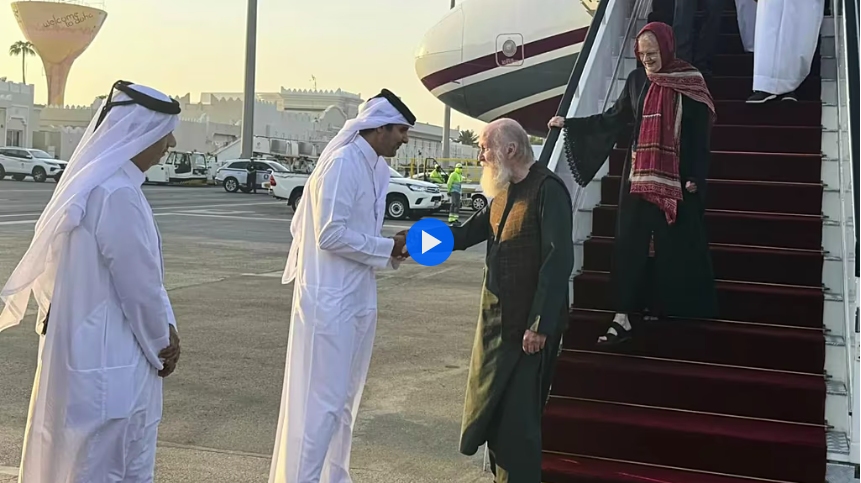
As they descended the steps of the plane in Doha, the couple appeared remarkably upbeat despite their ordeal. Both were smiling, waving, and in seemingly good health. The most emotional moment came on the tarmac when their daughter Sarah rushed forward to embrace them.
Entwistle hugged her mother tightly before grasping her father’s hand and walking him toward the terminal building. Speaking to reporters, she expressed the family’s relief:
“We are overwhelmed with gratitude and relief to have our parents back after their incomprehensible detention by the Taliban.”
For her part, Barbie Reynolds offered a brief but poignant reflection on their ordeal:
“God is good, as they say in Afghanistan.”
Taliban’s Position
While the release brought joy to the Reynolds family, questions remain about the couple’s arrest and imprisonment. In his statement on X (formerly Twitter), Balkhi insisted that the couple had “violated Afghan law,” but he did not specify which laws were broken.
This ambiguity has raised concerns among rights groups and international observers, who argue that foreigners and Afghans alike often face arbitrary detention under the Taliban’s justice system, which operates without transparent due process.
At the same time, the Taliban used the release as an opportunity to highlight its willingness to cooperate with international partners. Balkhi specifically thanked Qatar for its sincere efforts and mediation, signaling Kabul’s reliance on Doha as a key interlocutor with Western powers.
Britain’s Response
The UK government has not publicly commented on the specific charges but welcomed the couple’s safe release. London has no formal diplomatic presence in Afghanistan since the Taliban takeover, meaning it must rely heavily on allies such as Qatar for negotiations and consular support.
British officials have long urged citizens not to travel to Afghanistan due to security risks, warning that the Taliban’s opaque legal system makes it particularly difficult to assist those who are detained. The Reynolds’ case illustrates the precarious situation faced by those who defy such advice, even when their intentions are rooted in humanitarian or educational work.
Qatar’s Expanding Role
The release of the Reynolds highlights Qatar’s evolving role as a regional mediator. Over the past decade, Doha has positioned itself as a neutral player capable of engaging with groups shunned by the West, from the Taliban to Hamas. Its capital was even the site of negotiations that eventually led to the U.S. withdrawal agreement with the Taliban in 2020.
By securing the couple’s release, Qatar once again demonstrated its influence and diplomatic utility. Analysts suggest that Doha’s ability to maintain dialogue with the Taliban while also collaborating closely with Western governments will continue to make it indispensable in addressing humanitarian and political crises in Afghanistan.
Risks for Foreign Nationals in Afghanistan
The case of Peter and Barbie Reynolds underscores the dangers of remaining in Afghanistan under Taliban rule. Many aid workers, educators, and journalists left the country after 2021, fearing reprisals, arbitrary arrests, and restrictions on freedoms. Those who stayed behind often did so out of commitment to the Afghan people—but their presence has become increasingly fraught.
The Taliban government, facing international isolation and economic hardship, has frequently been accused of cracking down on civil society groups and foreign nationals. Arbitrary detentions are sometimes seen as a way to exert pressure in diplomatic negotiations.
For the Reynolds, their detention has ended in freedom. But for others still imprisoned in Afghanistan, their fate remains uncertain.
Looking Forward
The release of Peter and Barbie Reynolds may signal a willingness by the Taliban to use diplomacy in certain cases, but it also highlights the fragility of life for foreigners still in Afghanistan. For families with loved ones detained, the couple’s safe return offers hope—but also a reminder of the opaque and unpredictable nature of Taliban justice.
Going forward, the UK will likely continue to rely on Qatar’s mediation to navigate relations with Afghanistan. Yet, unless broader agreements are reached on human rights, legal transparency, and the safety of aid workers, similar cases may emerge in the future.
For the Reynolds family, however, the focus now is on recovery, reunion, and gratitude after an ordeal that could have ended far differently.
Conclusion
The release of Peter and Barbie Reynolds after more than seven months in Taliban custody is both a story of relief and a cautionary tale. For their family, the moment in Doha marked the end of an agonizing ordeal and the beginning of healing. For the international community, however, the case raises troubling questions about the safety of foreigners in Afghanistan, the lack of transparency in the Taliban’s justice system, and the fragile role of diplomacy in securing basic human rights.
Qatar’s success in brokering the release reaffirms its place as a vital mediator in regional politics, while the UK’s reliance on Doha highlights the difficulties of engaging with a Taliban-led Afghanistan from afar.
As the Reynolds family embraces their newfound freedom, their case serves as a stark reminder: life under Taliban rule remains unpredictable, and the risks for those who stay behind are higher than ever.
Meta Description:
Peter and Barbie Reynolds, a British couple detained by the Taliban for over seven months, have been released after Qatar-brokered talks and reunited with family in Doha.
British Couple Released by the Taliban After Months in Jail Touch Down in Doha
After more than seven months in Taliban custody, a British couple has finally been released and safely arrived in Doha, Qatar, in an emotional reunion with their family. Peter Reynolds, 80, and his wife Barbie, 76, both long-term residents of Afghanistan, were freed following intensive diplomatic negotiations involving the Taliban, Qatar, and the United Kingdom.
The couple, who had lived in Afghanistan for 18 years and dedicated their lives to education and training in the country’s central Bamiyan province, were detained on undisclosed charges. Their ordeal highlights not only the risks faced by foreigners remaining in Afghanistan under Taliban rule but also the growing importance of Qatar as a mediator in sensitive international disputes.
Register for Tekedia Mini-MBA edition 20 (June 8 – Sept 5, 2026).
Register for Tekedia AI in Business Masterclass.
Join Tekedia Capital Syndicate and co-invest in great global startups.
Register for Tekedia AI Lab.
The Long Ordeal
Peter and Barbie Reynolds chose to remain in Afghanistan even after the Taliban’s dramatic return to power in 2021, when the group seized control of Kabul in a lightning offensive that stunned the world. Their decision was rooted in their deep ties to the Afghan community, where they operated an education and training organisation aimed at empowering locals in Bamiyan.
In early 2024, the couple was abruptly arrested by Taliban authorities. No official explanation was given at the time, and for months their family, friends, and the British government struggled to ascertain the reasons behind their detention.

Their daughter, Sarah Entwistle, repeatedly appealed for their release, describing the experience as a nightmare. She alleged that her parents were being mistreated in prison and that their detention was both unjust and incomprehensible.
On Friday, after what appeared to be a court hearing in Kabul, the Taliban announced the couple’s release. A statement from Abdul Qahar Balkhi, spokesperson for the Taliban’s Foreign Ministry, said the pair had “violated Afghan law,” though no details were provided about what law they allegedly broke.
Emotional Reunion in Doha

The Reynolds’ release was facilitated by Qatar, which has long served as a diplomatic bridge between the Taliban and Western governments. They were formally handed over to Richard Lindsay, the UK’s special envoy for Afghanistan, and flown out of Kabul on a Qatari aircraft.
As they descended the steps of the plane in Doha, the couple appeared remarkably upbeat despite their ordeal. Both were smiling, waving, and in seemingly good health. The most emotional moment came on the tarmac when their daughter Sarah rushed forward to embrace them.
Entwistle hugged her mother tightly before grasping her father’s hand and walking him toward the terminal building. Speaking to reporters, she expressed the family’s relief:
“We are overwhelmed with gratitude and relief to have our parents back after their incomprehensible detention by the Taliban.”
For her part, Barbie Reynolds offered a brief but poignant reflection on their ordeal:
“God is good, as they say in Afghanistan.”
Taliban’s Position
While the release brought joy to the Reynolds family, questions remain about the couple’s arrest and imprisonment. In his statement on X (formerly Twitter), Balkhi insisted that the couple had “violated Afghan law,” but he did not specify which laws were broken.
This ambiguity has raised concerns among rights groups and international observers, who argue that foreigners and Afghans alike often face arbitrary detention under the Taliban’s justice system, which operates without transparent due process.
At the same time, the Taliban used the release as an opportunity to highlight its willingness to cooperate with international partners. Balkhi specifically thanked Qatar for its sincere efforts and mediation, signaling Kabul’s reliance on Doha as a key interlocutor with Western powers.
Britain’s Response
The UK government has not publicly commented on the specific charges but welcomed the couple’s safe release. London has no formal diplomatic presence in Afghanistan since the Taliban takeover, meaning it must rely heavily on allies such as Qatar for negotiations and consular support.
British officials have long urged citizens not to travel to Afghanistan due to security risks, warning that the Taliban’s opaque legal system makes it particularly difficult to assist those who are detained. The Reynolds’ case illustrates the precarious situation faced by those who defy such advice, even when their intentions are rooted in humanitarian or educational work.
Qatar’s Expanding Role
The release of the Reynolds highlights Qatar’s evolving role as a regional mediator. Over the past decade, Doha has positioned itself as a neutral player capable of engaging with groups shunned by the West, from the Taliban to Hamas. Its capital was even the site of negotiations that eventually led to the U.S. withdrawal agreement with the Taliban in 2020.
By securing the couple’s release, Qatar once again demonstrated its influence and diplomatic utility. Analysts suggest that Doha’s ability to maintain dialogue with the Taliban while also collaborating closely with Western governments will continue to make it indispensable in addressing humanitarian and political crises in Afghanistan.
Risks for Foreign Nationals in Afghanistan
The case of Peter and Barbie Reynolds underscores the dangers of remaining in Afghanistan under Taliban rule. Many aid workers, educators, and journalists left the country after 2021, fearing reprisals, arbitrary arrests, and restrictions on freedoms. Those who stayed behind often did so out of commitment to the Afghan people—but their presence has become increasingly fraught.
The Taliban government, facing international isolation and economic hardship, has frequently been accused of cracking down on civil society groups and foreign nationals. Arbitrary detentions are sometimes seen as a way to exert pressure in diplomatic negotiations.
For the Reynolds, their detention has ended in freedom. But for others still imprisoned in Afghanistan, their fate remains uncertain.
Looking Forward
The release of Peter and Barbie Reynolds may signal a willingness by the Taliban to use diplomacy in certain cases, but it also highlights the fragility of life for foreigners still in Afghanistan. For families with loved ones detained, the couple’s safe return offers hope—but also a reminder of the opaque and unpredictable nature of Taliban justice.
Going forward, the UK will likely continue to rely on Qatar’s mediation to navigate relations with Afghanistan. Yet, unless broader agreements are reached on human rights, legal transparency, and the safety of aid workers, similar cases may emerge in the future.
For the Reynolds family, however, the focus now is on recovery, reunion, and gratitude after an ordeal that could have ended far differently.
Conclusion
The release of Peter and Barbie Reynolds after more than seven months in Taliban custody is both a story of relief and a cautionary tale. For their family, the moment in Doha marked the end of an agonizing ordeal and the beginning of healing. For the international community, however, the case raises troubling questions about the safety of foreigners in Afghanistan, the lack of transparency in the Taliban’s justice system, and the fragile role of diplomacy in securing basic human rights.
Qatar’s success in brokering the release reaffirms its place as a vital mediator in regional politics, while the UK’s reliance on Doha highlights the difficulties of engaging with a Taliban-led Afghanistan from afar.
As the Reynolds family embraces their newfound freedom, their case serves as a stark reminder: life under Taliban rule remains unpredictable, and the risks for those who stay behind are higher than ever.
Meta Description:
Peter and Barbie Reynolds, a British couple detained by the Taliban for over seven months, have been released after Qatar-brokered talks and reunited with family in Doha.
Share this:
- Click to share on Facebook (Opens in new window) Facebook
- Click to share on X (Opens in new window) X
- Click to share on WhatsApp (Opens in new window) WhatsApp
- Click to share on LinkedIn (Opens in new window) LinkedIn
- Click to email a link to a friend (Opens in new window) Email
- Click to print (Opens in new window) Print