

EU Leaders Mark Moldova’s Independence Day with Strong Pledge of Support for EU Membership

Quote from Alex Bobby on August 28, 2025, 7:37 AM
EU Leaders Visit Moldova on Independence Day with Message of Solidarity for Chișinău
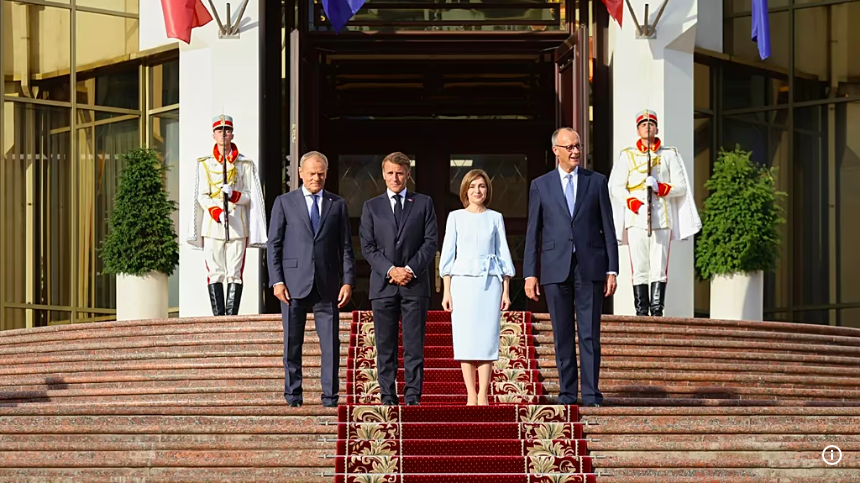
On 27 August, Moldova’s 34th Independence Day, the streets of Chișinău welcomed not only celebrations of national pride but also high-profile European visitors. The leaders of France, Germany, and Poland—Emmanuel Macron, Friederich Merz, and Donald Tusk—arrived to deliver a clear message of solidarity: the European Union stands firmly behind Moldova’s pro-European course and its aspiration for full EU membership.
The timing of the visit was anything but accidental. Just one month before Moldova’s parliamentary elections on 28 September, the joint appearance of three of Europe’s most influential leaders underscored the strategic importance of Moldova, a small nation caught between the European project and Russia’s geopolitical ambitions.
A Signal of Support Before Elections
Moldova has been governed since 2021 by the pro-EU Party of Action and Solidarity (PAS), led by President Maia Sandu. But polls suggest a tight race against pro-Russian forces represented by the Socialist and Communist Parties. With tensions high, the presence of Macron, Merz, and Tusk was intended to send voters a strong signal: Moldova’s future lies in Europe.
Speaking in Chișinău, President Macron directly challenged Kremlin narratives.
“Kremlin propaganda tells us that Europeans want to prolong the war and that the European Union oppresses its people. These are lies. Unlike Russia, the European Union does not threaten anyone and respects the sovereignty of each member state,” Macron said.
“It is a union of prosperity and peace. The European Union is in no way the Soviet Union.”His remarks were a deliberate counter to Moscow’s disinformation campaign, which seeks to sway Moldovan voters ahead of the crucial election.
Hybrid Threats Loom Large
President Sandu has repeatedly warned of hybrid threats from Russia, including disinformation, vote-buying, and cyberattacks. These concerns were echoed by German Chancellor Merz, who confirmed that Moldova is under constant pressure.
“In the run-up to the upcoming parliamentary elections in this country, not a day goes by without massive hybrid attacks from Russia. Moldova’s democracy is in the crosshairs, both online and offline. A free, open, liberal society is in the crosshairs,” Merz stated.The EU leaders’ visit was therefore more than symbolic—it was a show of resilience against Russian interference. Moldova’s vulnerability stems not only from its fragile democracy but also from geography. Sandwiched between Romania and Ukraine, Moldova borders Transnistria, a pro-Russian breakaway territory backed by Moscow since a short war in 1992. With Russian troops still stationed there, Moldova remains on the frontline of Europe’s security landscape.
EU Membership: A Historic Opportunity?
For President Sandu and her government, EU membership remains the ultimate safeguard against instability. Accession talks officially began in June 2023, but Moldova’s candidacy is closely linked to that of Ukraine. Many in Chișinău fear that Ukraine’s size and ongoing war will delay Moldova’s progress.
Macron acknowledged these concerns, describing EU enlargement as a “historic opportunity” for Moldova. Yet Brussels remains cautious, reluctant to fast-track Moldova ahead of Ukraine for fear of undermining Kyiv’s European prospects.
Romanian MEP Siegfried Mureșan has argued that Moldova’s integration should be treated separately. “Integrating the Republic of Moldova into the EU will be a smaller effort. The integration of small countries is easier than the integration of bigger countries,” he said, stressing that Moldova could achieve transformation with relatively modest EU investments.
Indeed, the EU has already pledged nearly €2 billion to strengthen Moldova’s economy and reduce its reliance on Russia.
Economic and Energy Transformation
Since 2022, Moldova has undergone significant changes in its energy infrastructure. It is now connected to the European electricity grid, reducing its dependence on Russian supplies, and major upgrades to domestic distribution systems have been financed by the EU. By 2030, Chișinău has committed to generating 27% of its energy from renewable sources.
Despite the shockwaves of Russia’s war in Ukraine, Moldova’s economy has shown resilience. The European Bank for Reconstruction and Development (EBRD) recently described the country’s outlook as stable. A landmark development came in 2024 when over 50% of Moldovan exports went to the EU—a record high and a sign of deepening economic integration.
Still, challenges remain. Moldova officially has just 2.6 million inhabitants, with many working abroad in the diaspora. Remittances form a crucial part of the economy, but the political influence of Moldovans living in both Europe and Russia adds another layer of uncertainty to election outcomes.
Geopolitical Stakes
For Moscow, Moldova represents another arena to contest European influence. The Kremlin continues to exploit Transnistria, economic vulnerabilities, and disinformation campaigns to weaken Chișinău’s pro-European orientation. For Brussels, however, Moldova is increasingly seen as a frontline state—its stability tied directly to the broader security of Eastern Europe.
That reality explains why Macron, Merz, and Tusk chose to stand shoulder-to-shoulder with Maia Sandu on Moldova’s Independence Day. Their presence sent a strong geopolitical message: Moldova is not alone, and its European aspirations are supported by the continent’s most powerful states.
Looking Ahead
As Moldova heads into its elections, the stakes could not be higher. A victory for pro-European forces would strengthen the country’s EU trajectory and bring it closer to long-term security and prosperity. A win for pro-Russian parties, however, could reverse years of progress and reopen Moldova to Moscow’s influence.
For the EU, Moldova is both a test case and a symbol. If a small, vulnerable nation on Russia’s border can be successfully integrated, it will demonstrate the EU’s capacity to expand peace and stability even under external pressure.
Independence Day 2024 will likely be remembered as a pivotal moment in Moldova’s European journey. Whether the celebrations in Chișinău mark the start of a decisive shift towards Europe—or a temporary pause in a difficult struggle—will depend on the choices Moldovan voters make next month.
Final Thoughts
Moldova’s 34th Independence Day became a turning point not just in national celebration, but in the broader struggle for its political and geopolitical future. The strong show of support from France, Germany, and Poland underscores the EU’s recognition that Moldova is more than a small neighbour—it is a test case for Europe’s ability to safeguard democracy under pressure.
As Chișinău heads into decisive elections, the stakes could not be higher. The EU’s encouragement offers hope, but the ultimate choice rests with Moldovan voters who must weigh promises of integration against the persistence of Russian influence. What is clear is that Moldova has captured Europe’s attention, and its journey toward full EU membership will serve as a powerful measure of how committed the bloc is to building a stronger, more united, and resilient continent.
Conclusion
The Independence Day visit of France’s Emmanuel Macron, Germany’s Friederich Merz, and Poland’s Donald Tusk to Chișinău was far more than symbolic diplomacy. It was a clear message of solidarity with Moldova at a time when its democracy faces unprecedented external pressures and internal uncertainty.
As Moldova prepares for pivotal parliamentary elections, the country finds itself at a crossroads: either reaffirming its European path or risking a return to Moscow’s orbit. The EU’s visible support not only strengthens the pro-European government of Maia Sandu but also reassures Moldovan citizens that their aspirations for peace, prosperity, and sovereignty are shared by Europe’s biggest powers.
Whether the visit will tip the balance in the upcoming elections remains to be seen, but it undeniably signals that Moldova’s future is not being decided in isolation. In the broader geopolitical contest between democracy and authoritarianism, Moldova is no longer on the periphery—it has become a frontline state whose success or failure could shape the trajectory of EU enlargement and Europe’s stability for years to come.
Meta Description:
On Moldova’s 34th Independence Day, leaders from France, Germany, and Poland visited Chișinău to reaffirm EU solidarity and back Moldova’s path to membership ahead of pivotal elections.
EU Leaders Visit Moldova on Independence Day with Message of Solidarity for Chișinău
On 27 August, Moldova’s 34th Independence Day, the streets of Chișinău welcomed not only celebrations of national pride but also high-profile European visitors. The leaders of France, Germany, and Poland—Emmanuel Macron, Friederich Merz, and Donald Tusk—arrived to deliver a clear message of solidarity: the European Union stands firmly behind Moldova’s pro-European course and its aspiration for full EU membership.
The timing of the visit was anything but accidental. Just one month before Moldova’s parliamentary elections on 28 September, the joint appearance of three of Europe’s most influential leaders underscored the strategic importance of Moldova, a small nation caught between the European project and Russia’s geopolitical ambitions.
Register for Tekedia Mini-MBA edition 20 (June 8 – Sept 5, 2026).
Register for Tekedia AI in Business Masterclass.
Join Tekedia Capital Syndicate and co-invest in great global startups.
Register for Tekedia AI Lab.
A Signal of Support Before Elections
Moldova has been governed since 2021 by the pro-EU Party of Action and Solidarity (PAS), led by President Maia Sandu. But polls suggest a tight race against pro-Russian forces represented by the Socialist and Communist Parties. With tensions high, the presence of Macron, Merz, and Tusk was intended to send voters a strong signal: Moldova’s future lies in Europe.
Speaking in Chișinău, President Macron directly challenged Kremlin narratives.
“Kremlin propaganda tells us that Europeans want to prolong the war and that the European Union oppresses its people. These are lies. Unlike Russia, the European Union does not threaten anyone and respects the sovereignty of each member state,” Macron said.
“It is a union of prosperity and peace. The European Union is in no way the Soviet Union.”

His remarks were a deliberate counter to Moscow’s disinformation campaign, which seeks to sway Moldovan voters ahead of the crucial election.
Hybrid Threats Loom Large
President Sandu has repeatedly warned of hybrid threats from Russia, including disinformation, vote-buying, and cyberattacks. These concerns were echoed by German Chancellor Merz, who confirmed that Moldova is under constant pressure.
“In the run-up to the upcoming parliamentary elections in this country, not a day goes by without massive hybrid attacks from Russia. Moldova’s democracy is in the crosshairs, both online and offline. A free, open, liberal society is in the crosshairs,” Merz stated.

The EU leaders’ visit was therefore more than symbolic—it was a show of resilience against Russian interference. Moldova’s vulnerability stems not only from its fragile democracy but also from geography. Sandwiched between Romania and Ukraine, Moldova borders Transnistria, a pro-Russian breakaway territory backed by Moscow since a short war in 1992. With Russian troops still stationed there, Moldova remains on the frontline of Europe’s security landscape.
EU Membership: A Historic Opportunity?
For President Sandu and her government, EU membership remains the ultimate safeguard against instability. Accession talks officially began in June 2023, but Moldova’s candidacy is closely linked to that of Ukraine. Many in Chișinău fear that Ukraine’s size and ongoing war will delay Moldova’s progress.
Macron acknowledged these concerns, describing EU enlargement as a “historic opportunity” for Moldova. Yet Brussels remains cautious, reluctant to fast-track Moldova ahead of Ukraine for fear of undermining Kyiv’s European prospects.
Romanian MEP Siegfried Mureșan has argued that Moldova’s integration should be treated separately. “Integrating the Republic of Moldova into the EU will be a smaller effort. The integration of small countries is easier than the integration of bigger countries,” he said, stressing that Moldova could achieve transformation with relatively modest EU investments.
Indeed, the EU has already pledged nearly €2 billion to strengthen Moldova’s economy and reduce its reliance on Russia.
Economic and Energy Transformation
Since 2022, Moldova has undergone significant changes in its energy infrastructure. It is now connected to the European electricity grid, reducing its dependence on Russian supplies, and major upgrades to domestic distribution systems have been financed by the EU. By 2030, Chișinău has committed to generating 27% of its energy from renewable sources.
Despite the shockwaves of Russia’s war in Ukraine, Moldova’s economy has shown resilience. The European Bank for Reconstruction and Development (EBRD) recently described the country’s outlook as stable. A landmark development came in 2024 when over 50% of Moldovan exports went to the EU—a record high and a sign of deepening economic integration.
Still, challenges remain. Moldova officially has just 2.6 million inhabitants, with many working abroad in the diaspora. Remittances form a crucial part of the economy, but the political influence of Moldovans living in both Europe and Russia adds another layer of uncertainty to election outcomes.
Geopolitical Stakes
For Moscow, Moldova represents another arena to contest European influence. The Kremlin continues to exploit Transnistria, economic vulnerabilities, and disinformation campaigns to weaken Chișinău’s pro-European orientation. For Brussels, however, Moldova is increasingly seen as a frontline state—its stability tied directly to the broader security of Eastern Europe.
That reality explains why Macron, Merz, and Tusk chose to stand shoulder-to-shoulder with Maia Sandu on Moldova’s Independence Day. Their presence sent a strong geopolitical message: Moldova is not alone, and its European aspirations are supported by the continent’s most powerful states.
Looking Ahead
As Moldova heads into its elections, the stakes could not be higher. A victory for pro-European forces would strengthen the country’s EU trajectory and bring it closer to long-term security and prosperity. A win for pro-Russian parties, however, could reverse years of progress and reopen Moldova to Moscow’s influence.
For the EU, Moldova is both a test case and a symbol. If a small, vulnerable nation on Russia’s border can be successfully integrated, it will demonstrate the EU’s capacity to expand peace and stability even under external pressure.
Independence Day 2024 will likely be remembered as a pivotal moment in Moldova’s European journey. Whether the celebrations in Chișinău mark the start of a decisive shift towards Europe—or a temporary pause in a difficult struggle—will depend on the choices Moldovan voters make next month.
Final Thoughts
Moldova’s 34th Independence Day became a turning point not just in national celebration, but in the broader struggle for its political and geopolitical future. The strong show of support from France, Germany, and Poland underscores the EU’s recognition that Moldova is more than a small neighbour—it is a test case for Europe’s ability to safeguard democracy under pressure.
As Chișinău heads into decisive elections, the stakes could not be higher. The EU’s encouragement offers hope, but the ultimate choice rests with Moldovan voters who must weigh promises of integration against the persistence of Russian influence. What is clear is that Moldova has captured Europe’s attention, and its journey toward full EU membership will serve as a powerful measure of how committed the bloc is to building a stronger, more united, and resilient continent.
Conclusion
The Independence Day visit of France’s Emmanuel Macron, Germany’s Friederich Merz, and Poland’s Donald Tusk to Chișinău was far more than symbolic diplomacy. It was a clear message of solidarity with Moldova at a time when its democracy faces unprecedented external pressures and internal uncertainty.
As Moldova prepares for pivotal parliamentary elections, the country finds itself at a crossroads: either reaffirming its European path or risking a return to Moscow’s orbit. The EU’s visible support not only strengthens the pro-European government of Maia Sandu but also reassures Moldovan citizens that their aspirations for peace, prosperity, and sovereignty are shared by Europe’s biggest powers.
Whether the visit will tip the balance in the upcoming elections remains to be seen, but it undeniably signals that Moldova’s future is not being decided in isolation. In the broader geopolitical contest between democracy and authoritarianism, Moldova is no longer on the periphery—it has become a frontline state whose success or failure could shape the trajectory of EU enlargement and Europe’s stability for years to come.
Meta Description:
On Moldova’s 34th Independence Day, leaders from France, Germany, and Poland visited Chișinău to reaffirm EU solidarity and back Moldova’s path to membership ahead of pivotal elections.
Share this:
- Click to share on Facebook (Opens in new window) Facebook
- Click to share on X (Opens in new window) X
- Click to share on WhatsApp (Opens in new window) WhatsApp
- Click to share on LinkedIn (Opens in new window) LinkedIn
- Click to email a link to a friend (Opens in new window) Email
- Click to print (Opens in new window) Print