

Prabowo Subianto Cancels China Visit as Indonesia Faces Widespread Protests

Quote from Alex Bobby on September 1, 2025, 6:07 AM
Indonesian President Prabowo Subianto Cancels China Visit Amid Growing Protests
Indonesian President Prabowo Subianto has abruptly cancelled a scheduled state visit to China after days of intensifying protests spread across the country, marking one of the first major political challenges to his presidency, which began less than a year ago. The announcement comes as demonstrations, sparked by the death of a motorbike driver struck by a police vehicle, have escalated into a broader wave of unrest touching several provinces.
A Cancelled Visit to Beijing
Prabowo was due to travel to Beijing on September 3 to attend a "Victory Parade" commemorating the end of World War II and Japan’s formal surrender. The event, hosted by Chinese President Xi Jinping, was expected to include numerous foreign leaders, with Russian President Vladimir Putin invited as the guest of honour.
Instead, in a video statement released on Saturday, presidential spokesperson Prasetyo Hadi announced that Prabowo would remain in Indonesia.
“The president wants to continue monitoring the situation in Indonesia directly and seek the best solutions,” Hadi said. “Therefore, the president apologises to the Chinese government that he could not attend the invitation.”
The decision underscores the gravity of the unrest at home, which has rapidly spiralled into violence and poses a test of the new administration’s ability to manage public anger and maintain order.
Protests Sparked in Jakarta Spread Nationwide
The protests first erupted in Jakarta on Friday, triggered by outrage over the death of a ride-hailing motorbike driver after being hit by a police vehicle near the national parliament building. Demonstrators gathered to demand not only justice for the incident but also higher parliamentary salaries and greater government spending on education.
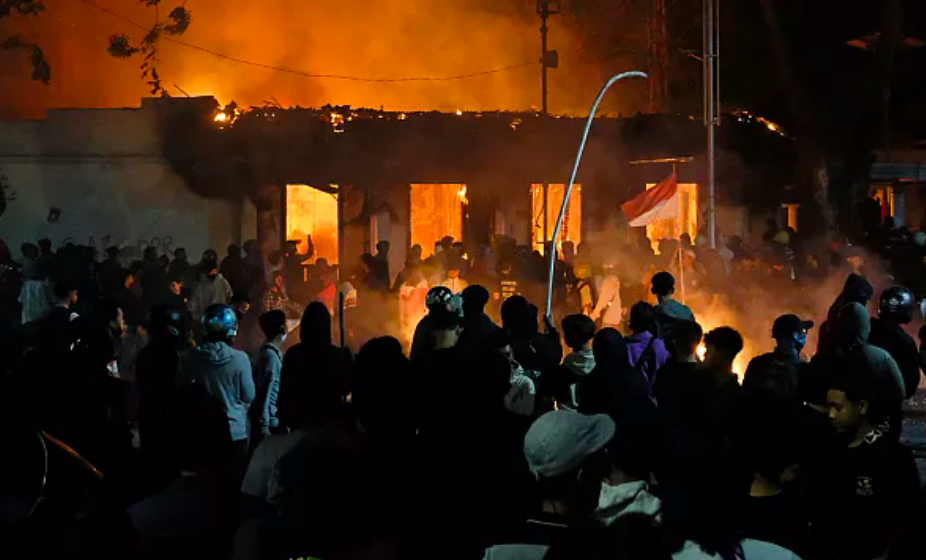
By Saturday, the movement had spread well beyond the capital. Local media reported that protesters set fire to regional parliament buildings in West Nusa Tenggara, Pekalongan (Central Java), and Cirebon (West Java). The destruction marked a dramatic escalation in both the intensity and geographic spread of the unrest.
The National Disaster Management Agency further confirmed that on Friday, a blaze at the parliament building in Makasar claimed at least three lives.
In Bali, a tourist hotspot, police clashed with demonstrators, deploying tear gas to disperse crowds. The use of force in such a heavily visited international destination risks drawing global attention to Indonesia’s domestic turmoil, potentially impacting tourism—a cornerstone of the country’s economy.
Social Media’s Amplifying Role
The Subianto administration has pointed to the role of social media in fuelling anti-government sentiment, particularly platforms such as TikTok and Meta-owned services like Facebook and Instagram.
Officials claim that misinformation and disinformation have circulated widely online, intensifying public anger and helping to coordinate demonstrations. Viral livestreams, especially on TikTok, have broadcast the protests in real time, drawing larger crowds and amplifying the visibility of the movement.
In response, Indonesian authorities have reportedly pressured social media companies to tighten content moderation and even restrict live-streaming features that protesters use to document confrontations with security forces.
A Major Early Test for Prabowo’s Presidency
For President Prabowo Subianto, the unrest represents the first major crisis of his leadership. Elected on a platform of stability, security, and economic growth, Prabowo has sought to portray himself as a strongman leader capable of navigating both domestic and international challenges.
Yet, with his presidency still in its early stages, the eruption of protests underscores deep-seated frustrations among parts of the population. The demands for more equitable government spending on social services such as education reflect broader discontent with persistent inequality and economic struggles facing many Indonesians.
The situation also risks tarnishing Indonesia’s image on the global stage. By cancelling his high-profile visit to Beijing—a symbolic event showcasing ties with China—Prabowo sends a message that domestic stability currently outweighs diplomatic gestures.
Implications for Indonesia-China Relations
The cancellation may cause disappointment in Beijing, where Xi Jinping has long sought to deepen ties with Southeast Asia’s largest country. Indonesia plays a crucial role in China’s Belt and Road Initiative (BRI), hosting major infrastructure projects such as the Jakarta-Bandung high-speed rail line.
Prabowo’s absence from the parade does not necessarily signal a cooling of relations, but it does highlight how domestic instability can complicate Indonesia’s diplomatic calendar. China has historically valued Indonesia’s participation in regional showcases, especially amid its geopolitical rivalry with the United States.
Still, the presidential spokesperson’s careful wording—emphasising Prabowo’s apology and the importance of monitoring the home front—suggests Jakarta is keen to avoid offending Beijing while also prioritising domestic governance.
The Road Ahead
How Prabowo manages the protests in the coming days will shape public perception of his administration and determine whether this episode becomes a temporary disruption or a long-term political liability.
If the government opts for a heavy-handed crackdown, it risks escalating tensions and alienating segments of the population. Conversely, a more conciliatory approach that addresses protesters’ grievances—particularly regarding economic policies and accountability for the motorbike driver’s death—could help defuse anger.
Meanwhile, the call for greater regulation of social media platforms raises broader questions about digital freedoms and state control in Indonesia, a country with one of the world’s largest and most active online populations.
looking forward
Looking ahead, much will depend on how President Prabowo chooses to balance firmness with dialogue. Protesters’ grievances over education funding, income inequality, and government accountability will not vanish overnight, even if the demonstrations eventually quiet down.
In the coming weeks, Indonesia may see either a cautious return to stability or deeper unrest if frustrations remain unaddressed. For Prabowo, navigating this moment could set the tone for his entire presidency—shaping not only public trust at home but also Indonesia’s standing as a stable partner abroad.
The world, especially regional allies and economic partners, will be looking forward to whether Indonesia can turn this early crisis into an opportunity for reform and unity.
Final Thoughts
President Prabowo’s decision to cancel his China visit highlights the difficult balance between global diplomacy and domestic responsibility. By choosing to remain in Indonesia, he signalled that the grievances of his people cannot be sidelined for ceremonial appearances abroad. Yet the unrest also underscores the fragility of public trust in a young administration and the urgency of addressing deep-seated frustrations over inequality, governance, and accountability.
For Indonesia, this moment is a reminder that the strength of its democracy lies not only in institutions but also in the government’s willingness to listen and respond. How Prabowo handles these early tests will define his leadership, not just in the eyes of Indonesians but also on the international stage.
Conclusion
President Prabowo Subianto’s cancellation of his China trip is more than a scheduling change—it reflects the growing urgency of a domestic crisis that has spread rapidly across Indonesia. The protests, initially sparked by a tragic accident, have tapped into broader frustrations over inequality, governance, and the role of security forces.
As fires rage in parliament buildings and tear gas fills the streets, Indonesia’s new president faces a defining moment: whether to double down on authority or seek dialogue and reform. The world will be watching closely—not only for how Indonesia handles its unrest but also for how this turbulence shapes the nation’s role in regional geopolitics.
Meta Description:
Indonesian President Prabowo Subianto has cancelled his planned visit to China amid escalating nationwide protests sparked by police violence and growing unrest across major cities.
Indonesian President Prabowo Subianto Cancels China Visit Amid Growing Protests
Indonesian President Prabowo Subianto has abruptly cancelled a scheduled state visit to China after days of intensifying protests spread across the country, marking one of the first major political challenges to his presidency, which began less than a year ago. The announcement comes as demonstrations, sparked by the death of a motorbike driver struck by a police vehicle, have escalated into a broader wave of unrest touching several provinces.
A Cancelled Visit to Beijing
Register for Tekedia Mini-MBA edition 20 (June 8 – Sept 5, 2026).
Register for Tekedia AI in Business Masterclass.
Join Tekedia Capital Syndicate and co-invest in great global startups.
Register for Tekedia AI Lab.
Prabowo was due to travel to Beijing on September 3 to attend a "Victory Parade" commemorating the end of World War II and Japan’s formal surrender. The event, hosted by Chinese President Xi Jinping, was expected to include numerous foreign leaders, with Russian President Vladimir Putin invited as the guest of honour.
Instead, in a video statement released on Saturday, presidential spokesperson Prasetyo Hadi announced that Prabowo would remain in Indonesia.
“The president wants to continue monitoring the situation in Indonesia directly and seek the best solutions,” Hadi said. “Therefore, the president apologises to the Chinese government that he could not attend the invitation.”

The decision underscores the gravity of the unrest at home, which has rapidly spiralled into violence and poses a test of the new administration’s ability to manage public anger and maintain order.
Protests Sparked in Jakarta Spread Nationwide
The protests first erupted in Jakarta on Friday, triggered by outrage over the death of a ride-hailing motorbike driver after being hit by a police vehicle near the national parliament building. Demonstrators gathered to demand not only justice for the incident but also higher parliamentary salaries and greater government spending on education.

By Saturday, the movement had spread well beyond the capital. Local media reported that protesters set fire to regional parliament buildings in West Nusa Tenggara, Pekalongan (Central Java), and Cirebon (West Java). The destruction marked a dramatic escalation in both the intensity and geographic spread of the unrest.
The National Disaster Management Agency further confirmed that on Friday, a blaze at the parliament building in Makasar claimed at least three lives.
In Bali, a tourist hotspot, police clashed with demonstrators, deploying tear gas to disperse crowds. The use of force in such a heavily visited international destination risks drawing global attention to Indonesia’s domestic turmoil, potentially impacting tourism—a cornerstone of the country’s economy.
Social Media’s Amplifying Role
The Subianto administration has pointed to the role of social media in fuelling anti-government sentiment, particularly platforms such as TikTok and Meta-owned services like Facebook and Instagram.
Officials claim that misinformation and disinformation have circulated widely online, intensifying public anger and helping to coordinate demonstrations. Viral livestreams, especially on TikTok, have broadcast the protests in real time, drawing larger crowds and amplifying the visibility of the movement.
In response, Indonesian authorities have reportedly pressured social media companies to tighten content moderation and even restrict live-streaming features that protesters use to document confrontations with security forces.
A Major Early Test for Prabowo’s Presidency
For President Prabowo Subianto, the unrest represents the first major crisis of his leadership. Elected on a platform of stability, security, and economic growth, Prabowo has sought to portray himself as a strongman leader capable of navigating both domestic and international challenges.
Yet, with his presidency still in its early stages, the eruption of protests underscores deep-seated frustrations among parts of the population. The demands for more equitable government spending on social services such as education reflect broader discontent with persistent inequality and economic struggles facing many Indonesians.
The situation also risks tarnishing Indonesia’s image on the global stage. By cancelling his high-profile visit to Beijing—a symbolic event showcasing ties with China—Prabowo sends a message that domestic stability currently outweighs diplomatic gestures.
Implications for Indonesia-China Relations
The cancellation may cause disappointment in Beijing, where Xi Jinping has long sought to deepen ties with Southeast Asia’s largest country. Indonesia plays a crucial role in China’s Belt and Road Initiative (BRI), hosting major infrastructure projects such as the Jakarta-Bandung high-speed rail line.
Prabowo’s absence from the parade does not necessarily signal a cooling of relations, but it does highlight how domestic instability can complicate Indonesia’s diplomatic calendar. China has historically valued Indonesia’s participation in regional showcases, especially amid its geopolitical rivalry with the United States.
Still, the presidential spokesperson’s careful wording—emphasising Prabowo’s apology and the importance of monitoring the home front—suggests Jakarta is keen to avoid offending Beijing while also prioritising domestic governance.
The Road Ahead
How Prabowo manages the protests in the coming days will shape public perception of his administration and determine whether this episode becomes a temporary disruption or a long-term political liability.
If the government opts for a heavy-handed crackdown, it risks escalating tensions and alienating segments of the population. Conversely, a more conciliatory approach that addresses protesters’ grievances—particularly regarding economic policies and accountability for the motorbike driver’s death—could help defuse anger.
Meanwhile, the call for greater regulation of social media platforms raises broader questions about digital freedoms and state control in Indonesia, a country with one of the world’s largest and most active online populations.
looking forward
Looking ahead, much will depend on how President Prabowo chooses to balance firmness with dialogue. Protesters’ grievances over education funding, income inequality, and government accountability will not vanish overnight, even if the demonstrations eventually quiet down.
In the coming weeks, Indonesia may see either a cautious return to stability or deeper unrest if frustrations remain unaddressed. For Prabowo, navigating this moment could set the tone for his entire presidency—shaping not only public trust at home but also Indonesia’s standing as a stable partner abroad.
The world, especially regional allies and economic partners, will be looking forward to whether Indonesia can turn this early crisis into an opportunity for reform and unity.
Final Thoughts
President Prabowo’s decision to cancel his China visit highlights the difficult balance between global diplomacy and domestic responsibility. By choosing to remain in Indonesia, he signalled that the grievances of his people cannot be sidelined for ceremonial appearances abroad. Yet the unrest also underscores the fragility of public trust in a young administration and the urgency of addressing deep-seated frustrations over inequality, governance, and accountability.
For Indonesia, this moment is a reminder that the strength of its democracy lies not only in institutions but also in the government’s willingness to listen and respond. How Prabowo handles these early tests will define his leadership, not just in the eyes of Indonesians but also on the international stage.
Conclusion
President Prabowo Subianto’s cancellation of his China trip is more than a scheduling change—it reflects the growing urgency of a domestic crisis that has spread rapidly across Indonesia. The protests, initially sparked by a tragic accident, have tapped into broader frustrations over inequality, governance, and the role of security forces.
As fires rage in parliament buildings and tear gas fills the streets, Indonesia’s new president faces a defining moment: whether to double down on authority or seek dialogue and reform. The world will be watching closely—not only for how Indonesia handles its unrest but also for how this turbulence shapes the nation’s role in regional geopolitics.
Meta Description:
Indonesian President Prabowo Subianto has cancelled his planned visit to China amid escalating nationwide protests sparked by police violence and growing unrest across major cities.
Uploaded files:Share this:
- Click to share on Facebook (Opens in new window) Facebook
- Click to share on X (Opens in new window) X
- Click to share on WhatsApp (Opens in new window) WhatsApp
- Click to share on LinkedIn (Opens in new window) LinkedIn
- Click to email a link to a friend (Opens in new window) Email
- Click to print (Opens in new window) Print