

Protests Erupt Across UK Over Asylum Seeker Hotels as Counter-Movements Gain Momentum

Quote from Alex Bobby on August 24, 2025, 3:10 AM
Protests in UK Against Asylum Seeker Housing Continue as Counter-Movements Arise
Tensions over how Britain houses asylum seekers boiled over again this weekend, as protests and counter-protests swept across several cities, underscoring the deep divides within the UK’s immigration debate. Demonstrations in Liverpool, Bristol, Newcastle, London, and other cities brought thousands to the streets — some demanding an end to the use of hotels for asylum seekers, others rallying in defence of migrant rights and against racism.
The renewed wave of protests comes at a critical time for the government, which remains legally obligated to house asylum seekers but increasingly under pressure from both opponents of its accommodation policies and human rights advocates who say the system is failing vulnerable people.
Hotels as a Battleground
For years, the question of where to house asylum seekers barely registered in mainstream political debate. That changed in 2020, when the number of arrivals surged dramatically and the Conservative government scrambled to secure accommodation. Hotels quickly became a key part of the housing strategy.
By the end of June 2025, Home Office figures showed that more than 32,000 asylum seekers were being housed in hotels — an 8% rise compared with the previous year. While this is significantly lower than the peak of 56,000 in September 2023, the numbers remain substantial. In fact, people temporarily placed in hotels currently make up about 35% of all asylum seekers in accommodation, according to the National Audit Office.
This policy, once viewed as a stopgap solution, has now become a focal point for controversy. For critics, hotels symbolise government mismanagement and rising taxpayer costs. For supporters, they are a lifeline for people fleeing war, persecution, poverty, or climate-related displacement.
The Streets of Liverpool
On Saturday, Liverpool became the epicentre of this conflict. Marchers aligned with right-wing groups and political parties rallied under the slogan “Abolish Asylum System”, calling for an end to hotels being used as housing and urging broader restrictions on immigration. Their protests reflected growing anger among sections of the public, particularly in towns and cities where local hotels have been converted into temporary asylum shelters.
But the Liverpool protest did not go unchallenged. Stand Up To Racism, a nationwide campaign, organised a counter-demonstration, arguing that anti-asylum rhetoric is inflaming xenophobia and scapegoating vulnerable people. The counter-protest drew hundreds, many waving banners proclaiming solidarity with refugees.
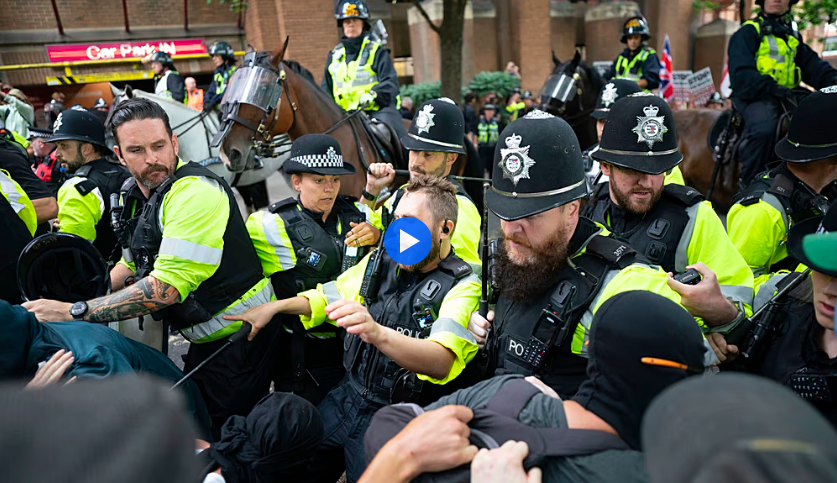
Police presence was heavy, with officers seen leading protesters away from the Abolish Asylum System march and pushing back counter-demonstrators to prevent violent clashes.
A Legal and Political Turning Point
The protests have been energised by a landmark legal ruling earlier this week. A temporary injunction blocked the government from housing asylum seekers in a hotel in Epping, just outside London. Though narrowly focused, the ruling was seized upon by politicians on the right, who encouraged other communities to challenge similar housing plans through the courts.
This legal battle has sharpened the dilemma for the government: it must comply with international and domestic obligations to house asylum seekers, but it faces mounting opposition from local councils, residents, and political actors seeking to limit or stop hotel use altogether.
The timing is significant. More than 111,000 people applied for asylum in the year to June 2025, the highest number since current records began in 2001. Channel crossings remain central to the issue: so far this year, over 27,000 unauthorised arrivals have been recorded, nearly 50% more than at the same point in 2024.
Broader Context: A Divided Nation
The asylum housing debate is inseparable from the wider controversy over immigration that has long bedevilled British politics. The sight of small boats crossing the Channel has become a flashpoint in national discourse, amplified by both politicians and the media. To some, the crossings symbolise a loss of border control and government weakness. To others, they highlight desperation — individuals risking their lives to escape hardship.
Across the West, similar tensions have unfolded, as countries grapple with rising displacement caused by war, poverty, political instability, and climate change. Britain’s challenges mirror those faced in France, Italy, and Germany, where the balance between humanitarian obligation and political backlash remains precarious.
The Cost Question
Public discontent is not solely ideological. The financial cost of hotel housing has been a recurring theme, with critics pointing to millions in government spending at a time of economic uncertainty. With local services already stretched, residents in towns hosting hotels often complain that they were not consulted and that resources are being diverted from their own communities.
The government has attempted to shift away from hotels, exploring alternatives such as large-scale accommodation centres, retrofitted barges, and military sites. However, each proposal has faced legal, logistical, and political obstacles, leaving hotels as an unavoidable short-term solution.
Counter-Movements and the Fight for Solidarity
Despite the backlash, pro-migrant groups continue to push back against what they describe as a dangerous rise in anti-refugee sentiment. Campaigners argue that asylum seekers are being unfairly demonised and that the real crisis lies in a broken immigration system that leaves thousands in limbo for months or even years while their cases are processed.
Stand Up To Racism and similar groups emphasise that the protests are not just about hotels but about the values Britain wishes to uphold. They highlight the long history of the UK providing refuge to those in need, from Holocaust survivors to people fleeing conflicts in the Balkans, the Middle East, and Africa.
Final Thoughts
The UK’s asylum housing dilemma has become more than a policy issue — it is now a mirror reflecting the nation’s deepest political and social divides. On one side are those who see hotels as a strain on public resources and evidence of a broken immigration system; on the other, campaigners who view them as a humanitarian necessity for people escaping unimaginable hardship.
As long as record numbers of people continue to seek refuge in Britain, the clash between obligation, cost, and compassion will persist. Whether the country leans toward solidarity or restriction may well shape not only the future of immigration policy but also Britain’s identity in a world where displacement is increasingly the norm.
Looking Forward
With asylum applications at record highs and hotel use still widespread, the debate over housing migrants is far from over. The government is under pressure to find longer-term solutions that balance legal obligations with public concerns, but any new proposals are likely to face the same mix of legal challenges and political backlash.
Grassroots campaigns, local councils, and human rights groups will continue to play a decisive role in shaping the direction of this issue. For communities across Britain, the question is not just about where asylum seekers sleep at night, but what kind of country the UK chooses to be in an era of global displacement.
Conclusion
The weekend’s protests underscore a fundamental truth: Britain is deeply divided on the asylum question, with both sides unwilling to cede ground. The government’s legal obligation to house asylum seekers collides with political pressure to reduce migration, while communities remain caught in the middle.
As the numbers continue to climb — both in asylum applications and in Channel crossings — the tension is unlikely to dissipate. What happens next may depend not only on government policy but also on the courts, local councils, and grassroots movements shaping the national conversation.
For now, the hotels remain a symbol: to some, of generosity and obligation; to others, of failure and burden. And as protests and counter-protests grow, Britain’s asylum dilemma shows no sign of resolution.
Meta Description:
Protests against asylum seeker housing in UK hotels continue as counter-protests rise. With record asylum applications and a landmark court ruling, the debate over immigration grows more heated.
Protests in UK Against Asylum Seeker Housing Continue as Counter-Movements Arise
Tensions over how Britain houses asylum seekers boiled over again this weekend, as protests and counter-protests swept across several cities, underscoring the deep divides within the UK’s immigration debate. Demonstrations in Liverpool, Bristol, Newcastle, London, and other cities brought thousands to the streets — some demanding an end to the use of hotels for asylum seekers, others rallying in defence of migrant rights and against racism.
The renewed wave of protests comes at a critical time for the government, which remains legally obligated to house asylum seekers but increasingly under pressure from both opponents of its accommodation policies and human rights advocates who say the system is failing vulnerable people.
Register for Tekedia Mini-MBA edition 20 (June 8 – Sept 5, 2026).
Register for Tekedia AI in Business Masterclass.
Join Tekedia Capital Syndicate and co-invest in great global startups.
Register for Tekedia AI Lab.
Hotels as a Battleground
For years, the question of where to house asylum seekers barely registered in mainstream political debate. That changed in 2020, when the number of arrivals surged dramatically and the Conservative government scrambled to secure accommodation. Hotels quickly became a key part of the housing strategy.
By the end of June 2025, Home Office figures showed that more than 32,000 asylum seekers were being housed in hotels — an 8% rise compared with the previous year. While this is significantly lower than the peak of 56,000 in September 2023, the numbers remain substantial. In fact, people temporarily placed in hotels currently make up about 35% of all asylum seekers in accommodation, according to the National Audit Office.

This policy, once viewed as a stopgap solution, has now become a focal point for controversy. For critics, hotels symbolise government mismanagement and rising taxpayer costs. For supporters, they are a lifeline for people fleeing war, persecution, poverty, or climate-related displacement.
The Streets of Liverpool
On Saturday, Liverpool became the epicentre of this conflict. Marchers aligned with right-wing groups and political parties rallied under the slogan “Abolish Asylum System”, calling for an end to hotels being used as housing and urging broader restrictions on immigration. Their protests reflected growing anger among sections of the public, particularly in towns and cities where local hotels have been converted into temporary asylum shelters.

But the Liverpool protest did not go unchallenged. Stand Up To Racism, a nationwide campaign, organised a counter-demonstration, arguing that anti-asylum rhetoric is inflaming xenophobia and scapegoating vulnerable people. The counter-protest drew hundreds, many waving banners proclaiming solidarity with refugees.
Police presence was heavy, with officers seen leading protesters away from the Abolish Asylum System march and pushing back counter-demonstrators to prevent violent clashes.
A Legal and Political Turning Point
The protests have been energised by a landmark legal ruling earlier this week. A temporary injunction blocked the government from housing asylum seekers in a hotel in Epping, just outside London. Though narrowly focused, the ruling was seized upon by politicians on the right, who encouraged other communities to challenge similar housing plans through the courts.
This legal battle has sharpened the dilemma for the government: it must comply with international and domestic obligations to house asylum seekers, but it faces mounting opposition from local councils, residents, and political actors seeking to limit or stop hotel use altogether.
The timing is significant. More than 111,000 people applied for asylum in the year to June 2025, the highest number since current records began in 2001. Channel crossings remain central to the issue: so far this year, over 27,000 unauthorised arrivals have been recorded, nearly 50% more than at the same point in 2024.
Broader Context: A Divided Nation
The asylum housing debate is inseparable from the wider controversy over immigration that has long bedevilled British politics. The sight of small boats crossing the Channel has become a flashpoint in national discourse, amplified by both politicians and the media. To some, the crossings symbolise a loss of border control and government weakness. To others, they highlight desperation — individuals risking their lives to escape hardship.
Across the West, similar tensions have unfolded, as countries grapple with rising displacement caused by war, poverty, political instability, and climate change. Britain’s challenges mirror those faced in France, Italy, and Germany, where the balance between humanitarian obligation and political backlash remains precarious.
The Cost Question
Public discontent is not solely ideological. The financial cost of hotel housing has been a recurring theme, with critics pointing to millions in government spending at a time of economic uncertainty. With local services already stretched, residents in towns hosting hotels often complain that they were not consulted and that resources are being diverted from their own communities.
The government has attempted to shift away from hotels, exploring alternatives such as large-scale accommodation centres, retrofitted barges, and military sites. However, each proposal has faced legal, logistical, and political obstacles, leaving hotels as an unavoidable short-term solution.
Counter-Movements and the Fight for Solidarity
Despite the backlash, pro-migrant groups continue to push back against what they describe as a dangerous rise in anti-refugee sentiment. Campaigners argue that asylum seekers are being unfairly demonised and that the real crisis lies in a broken immigration system that leaves thousands in limbo for months or even years while their cases are processed.
Stand Up To Racism and similar groups emphasise that the protests are not just about hotels but about the values Britain wishes to uphold. They highlight the long history of the UK providing refuge to those in need, from Holocaust survivors to people fleeing conflicts in the Balkans, the Middle East, and Africa.
Final Thoughts
The UK’s asylum housing dilemma has become more than a policy issue — it is now a mirror reflecting the nation’s deepest political and social divides. On one side are those who see hotels as a strain on public resources and evidence of a broken immigration system; on the other, campaigners who view them as a humanitarian necessity for people escaping unimaginable hardship.
As long as record numbers of people continue to seek refuge in Britain, the clash between obligation, cost, and compassion will persist. Whether the country leans toward solidarity or restriction may well shape not only the future of immigration policy but also Britain’s identity in a world where displacement is increasingly the norm.
Looking Forward
With asylum applications at record highs and hotel use still widespread, the debate over housing migrants is far from over. The government is under pressure to find longer-term solutions that balance legal obligations with public concerns, but any new proposals are likely to face the same mix of legal challenges and political backlash.
Grassroots campaigns, local councils, and human rights groups will continue to play a decisive role in shaping the direction of this issue. For communities across Britain, the question is not just about where asylum seekers sleep at night, but what kind of country the UK chooses to be in an era of global displacement.
Conclusion
The weekend’s protests underscore a fundamental truth: Britain is deeply divided on the asylum question, with both sides unwilling to cede ground. The government’s legal obligation to house asylum seekers collides with political pressure to reduce migration, while communities remain caught in the middle.
As the numbers continue to climb — both in asylum applications and in Channel crossings — the tension is unlikely to dissipate. What happens next may depend not only on government policy but also on the courts, local councils, and grassroots movements shaping the national conversation.
For now, the hotels remain a symbol: to some, of generosity and obligation; to others, of failure and burden. And as protests and counter-protests grow, Britain’s asylum dilemma shows no sign of resolution.
Meta Description:
Protests against asylum seeker housing in UK hotels continue as counter-protests rise. With record asylum applications and a landmark court ruling, the debate over immigration grows more heated.
Share this:
- Click to share on Facebook (Opens in new window) Facebook
- Click to share on X (Opens in new window) X
- Click to share on WhatsApp (Opens in new window) WhatsApp
- Click to share on LinkedIn (Opens in new window) LinkedIn
- Click to email a link to a friend (Opens in new window) Email
- Click to print (Opens in new window) Print