

UN Warns Aid Cuts in North-East Nigeria Could Fuel Boko Haram Recruitment

Quote from Alex Bobby on August 12, 2025, 7:45 AM
Aid Cuts in North-East Nigeria Risk Strengthening Boko Haram, UN Warns
Drastic cuts to humanitarian aid in north-eastern Nigeria could fuel the recruitment drive of one of the world’s deadliest militant groups, Boko Haram, aid agencies have warned. The UN’s World Food Programme (WFP) has already been forced to reduce its rations in recent months, and now, it says, supplies have run out entirely.
Trust Mlambo, head of operations in the region for WFP, told the BBC that this worsening situation could make it far easier for militants to lure vulnerable youths into their ranks, further destabilising the already fragile security situation.
“It will be much easier for militants to lure youths to join them and spiral insecurity across the whole region,” Mlambo cautioned.
Boko Haram’s notoriety skyrocketed after the kidnapping of more than 200 schoolgirls from Chibok in 2014, but their campaign of violence began long before then. Founded in the early 2000s as a religious movement opposed to Western education, the group launched its armed insurgency in 2009 with the goal of establishing an Islamic state. Its attacks have devastated not only Nigeria’s Borno, Adamawa, and Yobe states but have also spilled into neighbouring Cameroon, Chad, and Niger. In 2015, a splinter faction pledged allegiance to the Islamic State, further complicating the conflict.
Lives Shattered by Violence
The human toll of the insurgency is staggering. Tens of thousands have been killed, more than a million displaced, and thousands abducted. Among the displaced is 40-year-old Aisha Abubakar, who fled her village in Borno State after Boko Haram attacks and illness claimed the lives of her husband and six of her children.
“My husband and six children were killed in the bush,” Abubakar recounted. Four of her children survived, including one who was recently rescued from Boko Haram captivity.
She now lives in Gwoza, a garrison town west of Maiduguri, where she has remarried and given birth to a seven-month-old baby. But even here, danger lurks beyond the rocky hills, where militants remain camped in dense forests.
“I could never go back to the village,” she said. “Life in the village was unbearable; we were always on the run.”
A Lifeline Under Threat
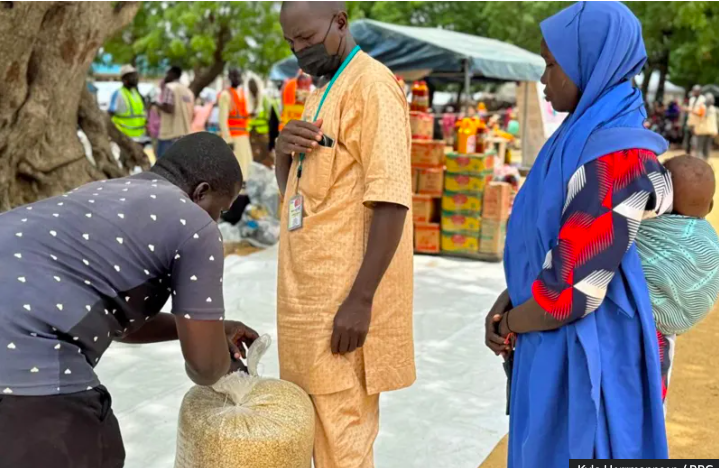
For the 1.4 million displaced people in north-east Nigeria, humanitarian aid is a lifeline. At the Gwoza aid distribution centre, Abubakar recently received $20 (₦31,000) for the month via a debit card system based on family size. With it, she purchased maize and other essentials — barely enough to sustain her household.
The WFP says it has nothing more to give after this month’s cycle. “Our warehouses are empty, and we just are desperate for any generous donations,” Mlambo said.
The funding crisis stems in part from a reorganisation of humanitarian aid programmes by major donors, including the United States. Washington has acknowledged some cuts, citing former President Donald Trump’s “America First” policy. While the US insists it remains the largest global donor and that 80% of its WFP support is unaffected, the impact on the ground tells a different story.
Rising Malnutrition and Closing Clinics
Reduced funding has already driven up malnutrition rates in the region. Médecins Sans Frontières (MSF) reports that the number of children suffering from the most severe and deadly form of malnutrition has more than doubled in the first half of 2025.
“Six-hundred-and-fifty-two children have already died in our facilities since the beginning of 2025 due to lack of timely access to care,” MSF’s country representative Ahmed Aldikhari said. He described 2024 as a “turning point” in Nigeria’s nutrition crisis, with major donors — including the US, UK, and EU — scaling down or halting support entirely.
The looming closure of more than 150 donor-funded malnutrition treatment clinics will leave vast swathes of the region without access to critical healthcare. For mothers like 25-year-old Hauwa Badamasi, the consequences are heartbreaking. Despite her best efforts to feed her children nutritious meals, she recently learned her first child, Amina, is now malnourished.
“I feel bad, because every mother wants her baby to be healthy,” she said.
A National Challenge Amid Economic Strain
Nigeria, Africa’s largest economy and most populous nation, has long been plagued by corruption, economic mismanagement, and chronic insecurity. Inflation and currency devaluation have further strained household incomes. While the federal government has pledged to tackle malnutrition — Vice-President Kashim Shettima recently declared it had robbed 40% of children under five of their full physical and cognitive potential — such commitments face the stark reality of dwindling resources.
Shettima has promised a nationwide “war room” to combat malnutrition, but without immediate intervention from both the government and the international community, aid agencies warn the situation will worsen. The combination of hunger, poverty, and insecurity creates a perfect recruitment environment for Boko Haram, which has a history of exploiting desperation to swell its ranks.
The Stakes
The warning from the UN is clear: unless funding is restored and aid flows resume, the humanitarian crisis in north-eastern Nigeria could escalate into a security catastrophe, not only for the country but for the wider Lake Chad region. For displaced families like Abubakar’s and Badamasi’s, survival is already a daily struggle. Without urgent action, millions risk being left without food, medical care, or hope — and Boko Haram stands ready to take advantage.
conclusion
In conclusion, the deepening humanitarian crisis in north-eastern Nigeria underscores the catastrophic consequences of funding cuts on vulnerable populations already caught in the grip of conflict. Without urgent action from both the Nigerian government and the international community, the vacuum left by dwindling aid will likely be exploited by Boko Haram and other extremist groups, further destabilising the region. The testimonies from displaced families reveal not just the scale of suffering but also the resilience of communities struggling to survive. Addressing this crisis requires immediate restoration of aid, strategic long-term investment in food security, and decisive security measures to protect civilians. Failure to act swiftly risks undoing years of progress and pushing an already fragile region closer to the brink of collapse.
Meta description
Drastic cuts to humanitarian aid in north-eastern Nigeria risk worsening malnutrition and insecurity, with the UN warning that Boko Haram could exploit the crisis to recruit vulnerable youths.
Aid Cuts in North-East Nigeria Risk Strengthening Boko Haram, UN Warns
Drastic cuts to humanitarian aid in north-eastern Nigeria could fuel the recruitment drive of one of the world’s deadliest militant groups, Boko Haram, aid agencies have warned. The UN’s World Food Programme (WFP) has already been forced to reduce its rations in recent months, and now, it says, supplies have run out entirely.
Trust Mlambo, head of operations in the region for WFP, told the BBC that this worsening situation could make it far easier for militants to lure vulnerable youths into their ranks, further destabilising the already fragile security situation.
Register for Tekedia Mini-MBA edition 20 (June 8 – Sept 5, 2026).
Register for Tekedia AI in Business Masterclass.
Join Tekedia Capital Syndicate and co-invest in great global startups.
Register for Tekedia AI Lab.
“It will be much easier for militants to lure youths to join them and spiral insecurity across the whole region,” Mlambo cautioned.
Boko Haram’s notoriety skyrocketed after the kidnapping of more than 200 schoolgirls from Chibok in 2014, but their campaign of violence began long before then. Founded in the early 2000s as a religious movement opposed to Western education, the group launched its armed insurgency in 2009 with the goal of establishing an Islamic state. Its attacks have devastated not only Nigeria’s Borno, Adamawa, and Yobe states but have also spilled into neighbouring Cameroon, Chad, and Niger. In 2015, a splinter faction pledged allegiance to the Islamic State, further complicating the conflict.
Lives Shattered by Violence

The human toll of the insurgency is staggering. Tens of thousands have been killed, more than a million displaced, and thousands abducted. Among the displaced is 40-year-old Aisha Abubakar, who fled her village in Borno State after Boko Haram attacks and illness claimed the lives of her husband and six of her children.
“My husband and six children were killed in the bush,” Abubakar recounted. Four of her children survived, including one who was recently rescued from Boko Haram captivity.
She now lives in Gwoza, a garrison town west of Maiduguri, where she has remarried and given birth to a seven-month-old baby. But even here, danger lurks beyond the rocky hills, where militants remain camped in dense forests.

“I could never go back to the village,” she said. “Life in the village was unbearable; we were always on the run.”
A Lifeline Under Threat
For the 1.4 million displaced people in north-east Nigeria, humanitarian aid is a lifeline. At the Gwoza aid distribution centre, Abubakar recently received $20 (₦31,000) for the month via a debit card system based on family size. With it, she purchased maize and other essentials — barely enough to sustain her household.
The WFP says it has nothing more to give after this month’s cycle. “Our warehouses are empty, and we just are desperate for any generous donations,” Mlambo said.
The funding crisis stems in part from a reorganisation of humanitarian aid programmes by major donors, including the United States. Washington has acknowledged some cuts, citing former President Donald Trump’s “America First” policy. While the US insists it remains the largest global donor and that 80% of its WFP support is unaffected, the impact on the ground tells a different story.
Rising Malnutrition and Closing Clinics
Reduced funding has already driven up malnutrition rates in the region. Médecins Sans Frontières (MSF) reports that the number of children suffering from the most severe and deadly form of malnutrition has more than doubled in the first half of 2025.
“Six-hundred-and-fifty-two children have already died in our facilities since the beginning of 2025 due to lack of timely access to care,” MSF’s country representative Ahmed Aldikhari said. He described 2024 as a “turning point” in Nigeria’s nutrition crisis, with major donors — including the US, UK, and EU — scaling down or halting support entirely.
The looming closure of more than 150 donor-funded malnutrition treatment clinics will leave vast swathes of the region without access to critical healthcare. For mothers like 25-year-old Hauwa Badamasi, the consequences are heartbreaking. Despite her best efforts to feed her children nutritious meals, she recently learned her first child, Amina, is now malnourished.
“I feel bad, because every mother wants her baby to be healthy,” she said.
A National Challenge Amid Economic Strain
Nigeria, Africa’s largest economy and most populous nation, has long been plagued by corruption, economic mismanagement, and chronic insecurity. Inflation and currency devaluation have further strained household incomes. While the federal government has pledged to tackle malnutrition — Vice-President Kashim Shettima recently declared it had robbed 40% of children under five of their full physical and cognitive potential — such commitments face the stark reality of dwindling resources.
Shettima has promised a nationwide “war room” to combat malnutrition, but without immediate intervention from both the government and the international community, aid agencies warn the situation will worsen. The combination of hunger, poverty, and insecurity creates a perfect recruitment environment for Boko Haram, which has a history of exploiting desperation to swell its ranks.
The Stakes
The warning from the UN is clear: unless funding is restored and aid flows resume, the humanitarian crisis in north-eastern Nigeria could escalate into a security catastrophe, not only for the country but for the wider Lake Chad region. For displaced families like Abubakar’s and Badamasi’s, survival is already a daily struggle. Without urgent action, millions risk being left without food, medical care, or hope — and Boko Haram stands ready to take advantage.
conclusion
In conclusion, the deepening humanitarian crisis in north-eastern Nigeria underscores the catastrophic consequences of funding cuts on vulnerable populations already caught in the grip of conflict. Without urgent action from both the Nigerian government and the international community, the vacuum left by dwindling aid will likely be exploited by Boko Haram and other extremist groups, further destabilising the region. The testimonies from displaced families reveal not just the scale of suffering but also the resilience of communities struggling to survive. Addressing this crisis requires immediate restoration of aid, strategic long-term investment in food security, and decisive security measures to protect civilians. Failure to act swiftly risks undoing years of progress and pushing an already fragile region closer to the brink of collapse.
Meta description
Drastic cuts to humanitarian aid in north-eastern Nigeria risk worsening malnutrition and insecurity, with the UN warning that Boko Haram could exploit the crisis to recruit vulnerable youths.
Uploaded files:Share this:
- Click to share on Facebook (Opens in new window) Facebook
- Click to share on X (Opens in new window) X
- Click to share on WhatsApp (Opens in new window) WhatsApp
- Click to share on LinkedIn (Opens in new window) LinkedIn
- Click to email a link to a friend (Opens in new window) Email
- Click to print (Opens in new window) Print