

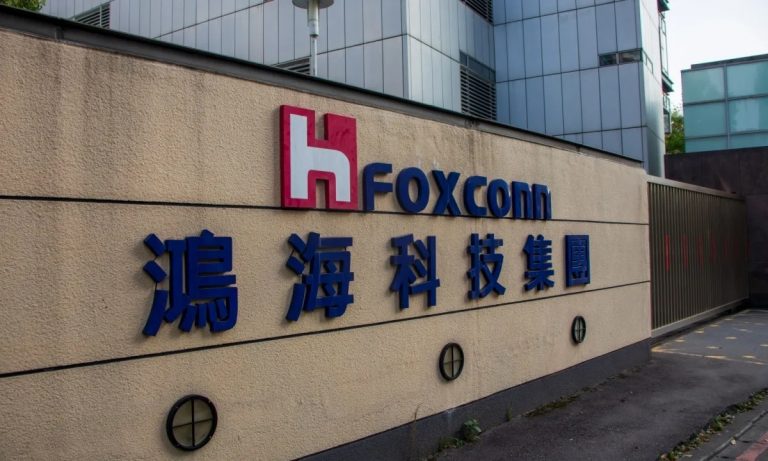
Taiwan’s Foxconn, the world’s largest contract electronics manufacturer and a critical supplier to both Nvidia and Apple, has posted a sharp rise in first-quarter revenue.
The near-30 per cent surge in first-quarter revenue is the clearest signal yet that the global artificial intelligence build-out is fundamentally reshaping the economics of the hardware supply chain, with the Taiwanese giant emerging as one of the most strategic industrial beneficiaries of the spending boom.
The company, formally known as Hon Hai Precision Industry, reported T$2.13 trillion ($66.6 billion) in first-quarter revenue, a 29.7 per cent increase from a year earlier, driven by sustained demand for AI servers and renewed strength in smart consumer electronics.
Register for Tekedia Mini-MBA edition 20 (June 8 – Sept 5, 2026).
Register for Tekedia AI in Business Masterclass.
Join Tekedia Capital Syndicate and co-invest in great global startups.
Register for Tekedia AI Lab.
That figure came in slightly below the T$2.148 trillion LSEG SmartEstimate, but the broader picture remains emphatically positive: Foxconn is increasingly evolving from the world’s best-known iPhone assembler into a central infrastructure player in the AI arms race. The most important story inside the numbers is the continued acceleration of its cloud and networking division, the segment tied directly to AI servers, data-center racks, and high-performance computing systems.
Foxconn remains Nvidia’s biggest server manufacturing partner, placing it at the heart of global capital expenditure by hyperscalers, cloud providers, and enterprises racing to build AI infrastructure. As companies such as Nvidia, Microsoft, Amazon, and Meta continue to pour tens of billions of dollars into AI data centers, Foxconn’s production lines are becoming a direct proxy for that investment cycle.
This is why the March revenue print deserves closer attention. Monthly revenue jumped 45.6 per cent year-on-year to T$803.7 billion, the highest ever for that month. That kind of acceleration suggests sustained shipment momentum in AI racks, rather than a one-off quarter-end spike.

It also reinforces the view that the AI infrastructure cycle remains in its expansion phase. Foxconn itself signaled as much, saying that AI racks are maintaining a continued growth trend, with second-quarter operations expected to rise both sequentially and from a year earlier.
However, “it remains necessary to monitor the impact of the volatile global political and economic situation”, Foxconn said, without elaborating.
The company’s chairman, Young Liu, has already framed this as a multi-year cycle rather than a short-term surge. According to Reuters’ earlier reporting, Liu said the AI boom is expected to persist for another two to three years, while major customers see the industry approaching $1 trillion in size over that horizon.

That outlook is central to understanding Foxconn’s strategic repositioning. Historically, the company’s fortunes were tied heavily to smartphone cycles, particularly demand from Apple. Now, a second growth engine is clearly taking shape. The smart consumer electronics segment, which includes iPhones, also posted “significant” growth thanks to new product launches, giving Foxconn a rare dual exposure to both consumer-device demand and AI infrastructure spending.
This diversification matters for investors because many hardware companies remain exposed to cyclical weakness in PCs and smartphones. Foxconn, by contrast, now benefits from the strongest capital-spending theme in global technology while still retaining its traditional scale in consumer electronics.
That makes it structurally more resilient than peers that remain dependent on a single end-market cycle. Foxconn’s position in AI server manufacturing places it at the center of the geopolitical contest over technology infrastructure, marking a strategic supply-chain dimension.
As the U.S., China, and Europe race to secure AI leadership, the company’s factories in Taiwan, Mexico, India, and the United States become increasingly critical nodes in the global technology stack. Many believe it’s the reason management’s warning about “the volatile global political and economic situation” should not be treated as boilerplate.
The company has specifically pointed to the Middle East conflict as a major external challenge. For a business with deeply global logistics operations, any disruption to shipping routes, energy prices, or component supply chains can have direct operational and margin implications.
Higher oil prices, for instance, can feed into freight costs and industrial input inflation, while geopolitical tensions can disrupt customer capex timelines. That likely explains why the market response has remained cautious.
Despite the strong revenue growth, Foxconn shares have fallen 16 per cent this year, underperforming the broader Taiwan market, which is up 12 per cent. This divergence suggests investors are weighing two competing narratives. The extraordinary AI-driven revenue momentum, and the uncertainty over how much of that growth can translate into margin expansion amid geopolitical volatility and continued heavy capital investment.
That profitability question will become sharper when Foxconn reports full first-quarter earnings on May 14. But analysts have warned that revenue strength alone is no longer enough. This is because markets will be looking for evidence that the AI hardware boom is not just lifting top-line numbers but also improving earnings quality.
Even so, the broader industrial story is becoming harder to ignore. Foxconn is no longer simply the world’s largest contract electronics maker. It is increasingly becoming one of the most important physical enablers of the global AI economy, supplying the racks, systems, and infrastructure on which the next wave of computing power will run.
Some analysts believe that shift could define its next decade far more than smartphones ever did.