

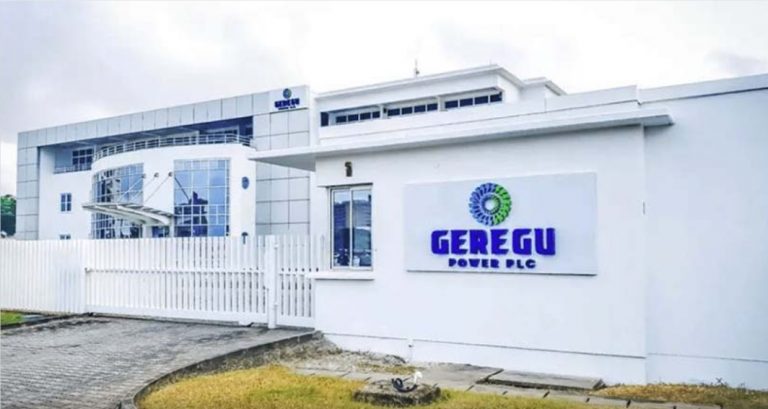
Geregu Power Plc, Nigeria’s first publicly listed electricity generation company, has reported a record-breaking 71% increase in profit after tax to N27.4 billion for the 2024 financial year, marking its fifth consecutive year of profitability.
This growth was primarily driven by a 65.3% surge in revenue to N137.1 billion, the highest the company has ever declared. The strong financial performance underscores the enormous profitability of Nigeria’s power sector, despite the chronic electricity shortages that continue to affect the majority of the population.
Nigeria, Africa’s fourth-largest economy and most populous country continues to battle a power deficit that has stifled economic growth for decades. With an estimated population of over 200 million, a staggering 85 million Nigerians—nearly 43% of the population—lack access to electricity, according to the World Bank. For those who have access, supply remains unreliable, with frequent blackouts and grid collapse being common occurrences. This leaves a massive gap in the market, one that companies like Geregu Power have positioned themselves to exploit profitably.
Register for Tekedia Mini-MBA edition 20 (June 8 – Sept 5, 2026).
Register for Tekedia AI in Business Masterclass.
Join Tekedia Capital Syndicate and co-invest in great global startups.
Register for Tekedia AI Lab.
Geregu Power has not only remained profitable but has steadily grown its earnings yearly, proving that the sector remains lucrative for those who can navigate the landscape effectively. The company’s total assets surged to N243.7 billion, an increase of 33.7% compared to the previous year, indicating a continuous expansion in its power generation capacity.
A deeper look at Geregu Power’s revenue breakdown shows that energy sales rose by 69% to N87.4 billion, while capacity charges increased by 59.4% to N49.6 billion. These figures suggest a rising demand for electricity in Nigeria, and more importantly, that power companies operating within the sector can generate significant earnings if they have the capacity to meet this demand.
However, rising costs affected the company’s operating profit margins, which declined slightly from 51.3% to 42.6%, reflecting the broader impact of inflation on operational expenses.

One major challenge in Nigeria’s power industry remains the issue of non-payment and debt accumulation by government-backed agencies like the Nigerian Bulk Electricity Trading (NBET) Plc. Geregu Power’s impairment charges soared to N9 billion, a sharp contrast to the N986 million write-back recorded in 2023. Sources within the company indicate that the impairment relates to outstanding payments from NBET. Some analysts argue that if impairment charges were kept at industry averages of around 6%, Geregu Power’s profit could have been as high as N50 billion.
The company also reduced its external debt burden, repaying N17.6 billion in bonds and borrowings, while also taking on an additional N9.7 billion in financing to support expansion efforts. Investments in plant capacity were evident as the company spent N42 billion on assets under construction, indicating that it is actively scaling up to generate more power in the coming years.
Geregu Power’s profitability has also translated into higher returns for investors, as it announced an increase in dividend payments to N21.25 billion, the first dividend hike since its listing in 2023. Previously, the company had maintained an annual dividend of N20 billion, making this increase a sign of confidence in its continued financial strength.

However, the profitability of Geregu Power highlights a stark paradox in Nigeria’s electricity industry: while the sector remains highly lucrative for companies, the vast majority of Nigerians continue to struggle with access to reliable power. Nigeria currently generates between 4,000 to 5,500 megawatts (MW) of electricity, far below the estimated 30,000 MW needed to power the country’s homes and industries effectively. The gap between supply and demand means that businesses and households rely heavily on alternative sources of energy such as diesel generators, solar power, and inverters, making electricity an expensive commodity.
Despite the enormous market opportunity, Nigeria’s power sector continues to face structural bottlenecks. The transmission and distribution networks are largely inefficient, with outdated infrastructure that struggles to handle even the current low generation levels.
The sector is also plagued by policy inconsistencies, liquidity constraints, and regulatory challenges, making large-scale investments risky. However, companies like Geregu Power have managed to leverage these inefficiencies to their advantage, filling the power gap and reaping substantial financial rewards.
However, energy analysts believe that the success of Geregu Power is a strong indicator that Nigeria’s power sector is not only viable but capable of delivering exceptional returns for investors willing to navigate its challenges.