

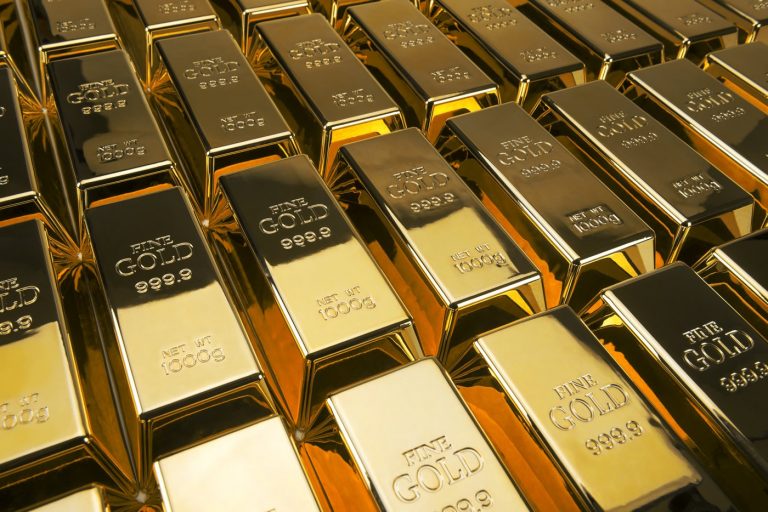
Gold surged to a record high for the fourth consecutive session on Thursday, breaking past $4,300 per ounce as investors poured into safe-haven assets amid escalating U.S.-China trade tensions, an ongoing government shutdown in Washington, and mounting expectations of U.S. Federal Reserve rate cuts.
Spot gold climbed 2.6% to $4,316.99 per ounce by 4:07 p.m. ET (2007 GMT), having earlier hit an all-time high of $4,318.75. U.S. gold futures for December delivery settled 2.5% higher at $4,304.60 after briefly touching $4,335. The rally underscores the extent of investor anxiety gripping global markets, pushing bullion to heights once thought implausible.
The yellow metal has gained more than 60% so far this year, propelled by a combination of factors — from geopolitical tensions and de-dollarisation efforts to renewed central bank accumulation and robust inflows into exchange-traded funds (ETFs). Analysts say gold’s unstoppable momentum has now placed the $5,000-per-ounce mark within sight if current conditions persist.
Register for Tekedia Mini-MBA edition 20 (June 8 – Sept 5, 2026).
Register for Tekedia AI in Business Masterclass.
Join Tekedia Capital Syndicate and co-invest in great global startups.
Register for Tekedia AI Lab.
Zain Vawda, analyst at MarketPulse by OANDA, said the trajectory of gold prices will largely depend on two key elements: the path of U.S. interest rates heading into 2026 and the evolving dynamic between Washington and Beijing.
“If no deal is reached between the U.S. and China and the relationship continues to deteriorate, that could be the spark gold needs to cross the $5,000/oz barrier,” Vawda said.
The flight to safety intensified this week after the U.S. sharply criticized Beijing’s latest restrictions on exports of rare earth minerals, describing the move as a threat to global supply chains. China, which dominates the rare earths market, expanded its export controls last week in what many in Washington view as retaliation for recent U.S. trade measures.

Investors fear the dispute could reignite a broader trade conflict between the world’s two largest economies — a prospect that rattled global equities and strengthened demand for assets traditionally viewed as stable stores of value.
The surge in gold also coincides with growing uncertainty in Washington, where a prolonged government shutdown has forced federal agencies to halt scheduled data releases. The U.S. Treasury Secretary Scott Bessent warned the standoff could shave as much as $15 billion a week from U.S. economic output, compounding worries about fiscal instability.
Trump’s Diplomatic Moves Add to Market Crosscurrents
Amid these developments, President Donald Trump said on Thursday that he and Russian President Vladimir Putin had agreed to hold another summit aimed at negotiating an end to the war in Ukraine. The announcement came just a day before Trump was scheduled to speak with Ukrainian President Volodymyr Zelenskiy, signaling renewed U.S. diplomatic efforts even as global markets remain on edge.

While geopolitical optimism could normally cool safe-haven demand, investors appear unconvinced that any immediate breakthroughs are likely, keeping gold’s appeal intact.
Rate Cut Bets Reinforce Bullish Momentum
The rally in bullion is being further supported by expectations that the Federal Reserve will resume monetary easing. Traders are now pricing in near-certainty of a 25-basis-point rate cut in October, followed by another in December, with market-implied probabilities at 98% and 95% respectively.
Gold, which offers no yield, tends to perform strongly in low-interest-rate environments as the opportunity cost of holding the metal diminishes.
“Short-term pullbacks in gold are likely to be temporary,” Vawda added. “Bullish investors are simply waiting for dips to re-enter positions.”
The dovish rate outlook comes amid persistent inflationary pressures and weakening U.S. growth indicators. However, with official data releases frozen by the government shutdown, traders have little clarity on near-term economic conditions — further enhancing gold’s allure as a hedge against policy uncertainty.
Analysts Raise Forecasts as Gold’s Rally Reshapes Markets
HSBC on Wednesday raised its 2025 average gold price forecast to $3,355 an ounce, citing a trifecta of safe-haven demand, global economic uncertainty, and a weaker U.S. dollar. The bank said sustained central bank buying — particularly from emerging markets seeking to diversify reserves away from the greenback — has added a long-term structural tailwind for gold prices.
Several central banks, including those of China, India, and Turkey, have steadily increased gold holdings over the past year as part of what analysts describe as a global trend toward “de-dollarisation.” The move reflects growing caution among emerging economies toward U.S. fiscal policy, sanctions risk, and mounting debt levels.
Silver and Other Precious Metals Follow the Surge
Silver, often seen as gold’s smaller sibling, also joined the rally. Spot silver rose 1.8% to $54.04 per ounce after reaching a record high of $54.15 earlier in the session. Analysts attribute the gains to both gold’s momentum and tightening supply conditions in the spot market.
Platinum climbed 3.2% to $1,706.65, while palladium rose 4.6% to $1,606.00, extending gains driven by investor rotation into hard assets amid fears of a broader economic slowdown.
The surge across the precious metals complex highlights a renewed investor preference for tangible assets in uncertain times. With equities under pressure and bond yields slipping, analysts say the move into gold and its peers is part of a wider realignment of portfolios toward inflation-resistant stores of value.
Outlook: $5,000 in Sight?
While analysts warn that profit-taking could trigger short-term volatility, the consensus remains that gold’s longer-term trajectory points higher. The convergence of geopolitical instability, fiscal strains in the United States, and dovish monetary policy has created what some describe as a “perfect storm” for gold.
With investor sentiment increasingly defensive and the global economy facing fresh fractures, gold’s unprecedented run may be far from over.