

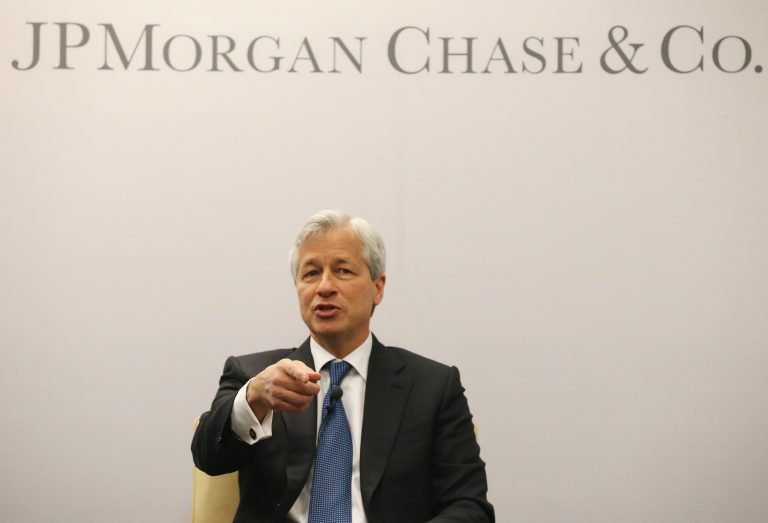
A renewed wave of global economic uncertainty is dimming the lights on Nigeria’s reform-driven optimism, as U.S. investment bank J.P. Morgan pulls the brakes on its bullish stance over the country’s debt instruments.
In a sharp departure from its earlier position, the bank has told investors to exit long positions in Nigerian Open Market Operation (OMO) bills, citing deepening macroeconomic vulnerabilities linked to declining oil prices and an increasingly unstable global economy.
The April 9 research note, titled “Frontier Local Markets Strategy: Reducing risk further,” is the strongest signal yet that foreign appetite for Nigerian debt may be drying up. J.P. Morgan had previously recommended Nigerian treasury bills as a high-yield opportunity, particularly after the Central Bank of Nigeria (CBN) initiated market reforms last year to unify exchange rates and end costly fuel subsidies. But now, with Brent crude heading below $60 per barrel, dangerously close to Nigeria’s budgetary break-even point, the bank is sounding the alarm.
Register for Tekedia Mini-MBA edition 20 (June 8 – Sept 5, 2026).
Register for Tekedia AI in Business Masterclass.
Join Tekedia Capital Syndicate and co-invest in great global startups.
Register for Tekedia AI Lab.
“We’re advising clients to close their positions in Nigerian T-bills,” the report stated, warning that oil below $60 could sink Nigeria’s current account back into deficit and pile pressure on the naira.
The shift in tone comes amid a swirl of global uncertainties. J.P. Morgan pointed to the global tariffs by the U.S. President Donald Trump. The bank says Trump’s stance on sweeping global tariffs could reignite trade wars that hurt emerging markets like Nigeria, where export earnings remain precariously tied to crude oil.
This geopolitical backdrop, coupled with the reality of falling oil prices, now threatens to upend Nigeria’s fragile economic recovery.

CBN’s optimism meets investor caution
Just days before J.P. Morgan’s note, Nigeria’s central bank had offered a more hopeful picture. It reported a $6.83 billion balance of payment surplus in 2024 and said external reserves, which hovered around $23 billion, were expected to climb due to improved oil output and export diversification.
“We anticipate a steady uptick in reserves, underpinned by improved oil production levels, and a more supporting export growth environment that is expected to boost non-oil FX earnings,” the CBN said.
But that optimism may now be colliding with crude realities. As oil prices tumble, so too do the prospects of a genuine FX buffer. J.P. Morgan warned that if oil remains under $60—a level seen as Nigeria’s fiscal red line—it could trigger renewed dollar demand, spark portfolio outflows, and lead to a current account deficit.

The bank even floated a worst-case scenario: if the tide of oil-linked FX dries up, the naira could weaken past the 1,700/$1 mark. It currently trades over 1,500, but analysts say that’s largely propped up by central bank intervention.
To defend the naira, the CBN has stepped up its interventions. According to J.P. Morgan, the apex bank sold around $550 million into the market in March alone. That figure has since surged past $1 billion this month, based on estimates from financial analysts.
The bank says this increasing reliance on CBN support highlights a deeper vulnerability: Nigeria’s FX market remains too dependent on a single revenue stream—oil.
“Any disruption to CBN dollar inflows—primarily from oil—could create panic in both currency and bond markets,” the note warned.
J.P. Morgan estimates that potential portfolio outflows from Nigeria could hit $10 billion, although it acknowledged that a portion of this is likely locked in illiquid assets or long-term placements. Still, even a fraction of that leaving the system could rattle already-shaky investor confidence.
OMO bills under pressure, yields spike
Beyond the currency market, cracks are now showing in the domestic fixed-income space. The report notes that liquidity in Nigerian T-bills and OMO instruments has thinned significantly, as rising inflation, foreign outflows, and geopolitical shocks spook investors.
Yields on short-dated securities have surged by as much as 300 basis points in recent weeks, a signal that risk appetite is waning. With fewer buyers in the market, the CBN has had to step in—either injecting liquidity or directly participating in auctions to avoid failed bids.
The shift may seem technical, but the implications are broad. When investor demand weakens for government debt, borrowing costs rise. And when a country like Nigeria is already struggling to plug fiscal holes, this compounds the burden.
At the heart of Nigeria’s dilemma is its dependence on oil, which still accounts for more than 90 percent of FX earnings. The government had pinned its hopes on higher crude exports and economic diversification, especially with the Nigerian National Petroleum Company (NNPC) now fully commercialized. But oil’s global downturn is threatening that push.
The country’s fiscal plans are also built on the assumption of improved tax collection and revenue reforms—yet neither has materialized at the pace needed to offset oil volatility.
“The government had hoped for increased FX inflows through oil exports and multilateral support. However, with oil prices falling and no clear path to alternative revenue streams, the pressure on fiscal and external balances is likely to grow,” J.P. Morgan warned.
However, It’s Not All That Bad
Despite the caution, J.P. Morgan hasn’t written Nigeria off entirely. The bank maintains a medium-term positive outlook, suggesting that reforms like the FX unification and subsidy removal will eventually pay off. It also expects the country to continue its shift towards market-determined exchange rates and local revenue mobilization.
But it hinges all that hope on one condition: Nigeria must withstand the current wave of global headwinds without losing control of its currency or fiscal position.
In essence, Nigeria’s economic recovery remains a balancing act—one that is now swaying under the combined weight of geopolitics, oil market dynamics, and investor nerves. And with oil slipping below the red line and Trump’s sweeping tariffs echoing across markets, the outlook seems gloomy.