

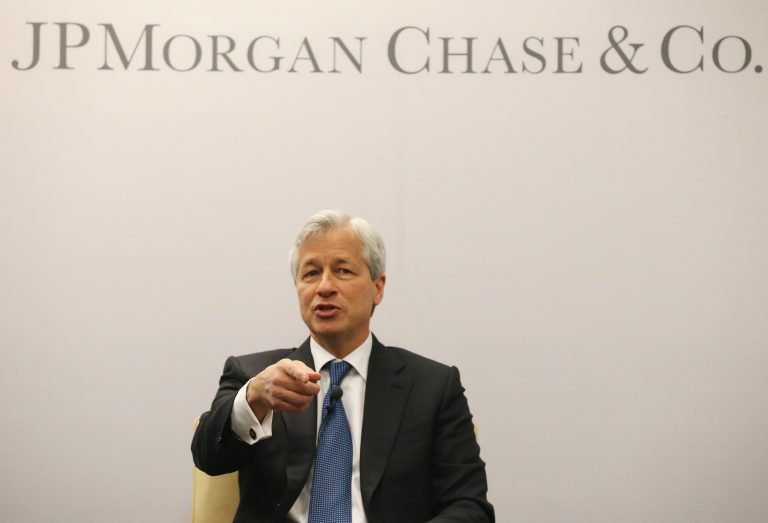
JPMorgan Chase chief executive Jamie Dimon has delivered one of his most sweeping shareholder letters in years, weaving together war, inflation, regulation, private-credit risk, and artificial intelligence into a stark warning that the global economy may be entering a more volatile and structurally uncertain phase.
More than a review of JPMorgan’s performance, the annual letter reads as a macroeconomic roadmap from one of Wall Street’s most influential voices, with Dimon arguing that the intersection of geopolitical conflict and technological disruption could shape the next global economic order.
He opens on a note of national purpose, invoking America’s approaching 250th anniversary. Dimon wrote that it is “the perfect time to rededicate ourselves to the values that made this great nation of ours — freedom, liberty and opportunity.”
Register for Tekedia Mini-MBA edition 20 (June 8 – Sept 5, 2026).
Register for Tekedia AI in Business Masterclass.
Join Tekedia Capital Syndicate and co-invest in great global startups.
Register for Tekedia AI Lab.
That appeal, however, quickly gives way to a far more sobering diagnosis of the risks facing both markets and policymakers.
“The challenges we all face are significant. The list is long but at the top are the terrible ongoing war and violence in Ukraine, the current war in Iran and the broader hostilities in the Middle East, terrorist activity and growing geopolitical tensions, importantly with China,” he wrote.
This framing is notable because Dimon is not treating these risks as isolated events. Instead, he presents them as interconnected fault lines capable of feeding directly into inflation, interest rates, credit conditions, and market sentiment.

His warning comes amid the Middle East conflict and its widening implications for inflation. Dimon cautioned that the Iran war could trigger fresh oil and commodity shocks, a development that would quickly feed through to consumer prices and monetary policy.
According to Reuters, he warned that such disruptions could keep inflation sticky and force interest rates higher than markets currently expect.
Markets had increasingly leaned toward expectations of policy easing later in the year. Dimon’s letter pushes back sharply against that optimism, suggesting investors may be underestimating the inflationary impact of war-driven supply shocks.

The risk is not merely higher fuel prices. Energy costs ripple through transportation, manufacturing, food supply chains, and logistics, creating second-round inflation effects that central banks find harder to tame.
This is why Dimon’s line that war is “the realm of uncertainty” carries a broader meaning than a geopolitical observation.
“The outcome of current geopolitical events may very well be the defining factor in how the future global economic order unfolds,” he wrote. “Then again, it may not.”
That ambiguity is central to the report’s uniqueness. Rather than making a definitive forecast, Dimon is underscoring the fragility of current assumptions around growth, inflation, and market resilience.
He also turned his fire on banking regulation, arguing that parts of the post-2008 framework are now impeding productive lending. According to the letter, while the rules introduced after the global financial crisis “accomplished some good things,” they have also “created a fragmented, slow-moving system with expensive, overlapping and excessive rules and regulations — some of which made the financial system weaker and reduced productive lending.”
This is one of the letter’s most politically charged sections.
Dimon sharply criticized the latest Basel III Endgame and GSIB surcharge proposals, saying the revised rules still contain elements that are “frankly nonsensical.” He argued that under the proposed framework, JPMorgan would be forced to hold “as much as 50% more capital across the vast majority of loans to U.S. consumers and businesses when compared with a large non-GSIB bank for the same set of loans.”
He bluntly concluded: “Frankly, it’s not right, and it’s un-American.”
That line is likely to reverberate in Washington. Dimon is effectively making the case that over-calibrated regulation may now be suppressing credit creation just as the economy confronts rising geopolitical and technological risks.
On private markets, his tone is equally cautionary. Dimon flagged concerns over transparency in private credit, a market that has ballooned as non-bank lenders take a larger share of corporate financing.
“By and large, private credit does not tend to have great transparency or rigorous valuation ‘marks’ of their loans — this increases the chance that people will sell if they think the environment will get worse — even if actual realized losses barely change,” he wrote.
This is especially relevant as private funds face redemption pressure and concerns over software-sector loans intensify. Dimon’s insight here is less about immediate systemic risk and more about the danger of opacity. When valuations are not frequently stress-tested by markets, downturns can trigger abrupt repricing.
He also warned that insurance regulators may eventually demand stricter ratings and markdowns, leading to calls for more capital. On trade, the letter offers a subtle but significant commentary on President Donald Trump’s tariff agenda.
Dimon wrote that the world is undergoing a “realignment of economic relations”, adding: “The trade battles are clearly not over, and it should be expected that many nations are analyzing how and with whom they should create trade arrangements.”
That suggests Dimon sees tariff policy not as a temporary negotiation tool but as a catalyst for longer-term shifts in global trade blocs and supply chains. His comments on AI are among the most nuanced parts of the letter.
Rather than dismissing the boom as speculative, he strongly endorsed the long-term investment case.
“Overall, the investment in AI is not a speculative bubble; rather, it will deliver significant benefits. However, at this time, we cannot predict the ultimate winners and losers in AI-related industries,” he wrote.
Dimon is bullish on the technology’s structural value while openly acknowledging that competitive winners remain uncertain. That position mirrors JPMorgan’s own strategy, where AI is being embedded across compliance, analytics, customer service, and workforce planning.
He reinforced that point with another direct statement: “We will not put our heads in the sand. We will deploy AI, as we deploy all technology, to do a better job for our customers (and employees).”
Perhaps the most distinctive feature of the letter is that it ties all these issues together.
War threatens inflation.
Inflation keeps rates elevated.
Higher rates expose weak credit structures.
Trade fragmentation alters supply chains.
AI disrupts labor markets and business models.
Dimon’s central message is that these are not separate market stories. They are converging forces. That convergence, more than any single risk, is what makes this moment uniquely consequential for markets and policymakers.