

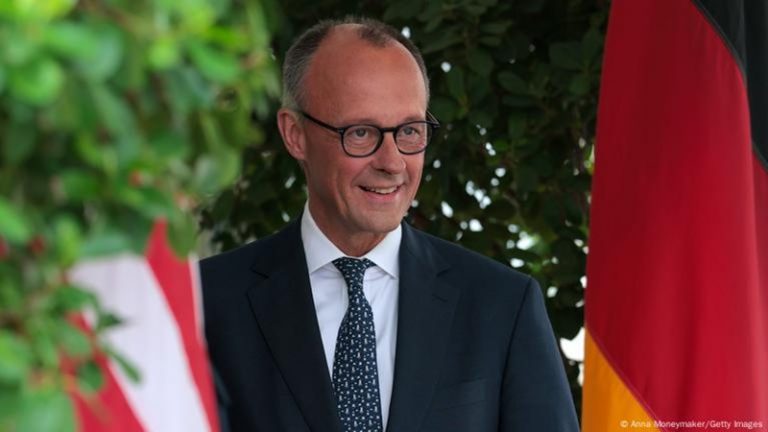
Friedrich Merz, Germany’s Chancellor since May 6, 2025, has seen a notable uptick in popularity in his initial weeks in office. A June 2025 poll by the INSA research institute for Bild newspaper reported that 36% of 1,202 respondents were satisfied with his performance as the Christian Democratic Union (CDU) leader. Additionally, 37% expressed satisfaction with the coalition government of the CDU/CSU and the Social Democrats (SPD), up from 29% in the previous survey.
Despite this rise, Merz’s overall approval remains modest, and he faces challenges. His coalition’s support is at 27%, slightly ahead of the far-right Alternative for Germany (AfD) at 23%. Merz’s earlier unpopularity stemmed from controversial moves, like aligning with the AfD on a migration vote and agreeing to a €1 trillion debt package, which alienated some conservative voters. His initial failure to secure the chancellorship in the first parliamentary vote on May 6, a historic setback, also raised doubts about his coalition’s stability.
Sentiment on X reflects mixed views. CDU posts praise Merz’s leadership and vision for a stable Germany, while critics, including some users, label him divisive or untrustworthy, pointing to his rightward shift and perceived betrayals. Merz’s gains in popularity are real but fragile, with political fragmentation and AfD’s rise posing ongoing risks. Friedrich Merz’s rising popularity as Germany’s Chancellor, alongside his leadership of the CDU/CSU-SPD coalition, carries significant implications for Germany’s political landscape, while deepening existing divides.
Register for Tekedia Mini-MBA edition 20 (June 8 – Sept 5, 2026).
Register for Tekedia AI in Business Masterclass.
Join Tekedia Capital Syndicate and co-invest in great global startups.
Register for Tekedia AI Lab.
Merz’s approval rating of 36% and the coalition’s 37% satisfaction rate (per June 2025 INSA poll) suggest a tentative stabilizing effect after a turbulent election period. However, the coalition’s narrow 27% support, barely ahead of the AfD’s 23%, indicates fragility. Merz’s ability to maintain this coalition, especially with the SPD, will be critical to avoiding early elections, which could further empower populist forces like the AfD.
Merz’s alignment with the AfD on migration issues and his push for stricter policies reflect a rightward shift to recapture conservative voters. This could consolidate CDU/CSU support but risks alienating moderates and SPD partners, potentially destabilizing the coalition. It also emboldens the AfD, which continues to gain traction amid economic and migration concerns.
The €1 trillion debt package, while aimed at addressing economic stagnation, has drawn criticism from fiscal conservatives within Merz’s base. His ability to balance economic recovery with fiscal responsibility will shape public perception and Germany’s economic trajectory, especially as inflation and energy costs remain voter priorities.

Merz’s leadership strengthens Germany’s conservative voice in the EU, potentially pushing for tougher migration policies and fiscal restraint. However, his coalition’s internal divides could weaken Germany’s influence in Brussels, especially if domestic instability grows. Merz’s right-leaning policies, including his migration stance and occasional alignment with the AfD, have deepened Germany’s political divide.
The AfD’s strong polling (23%) underscores a growing far-right bloc, contrasting with progressive and Green voters who feel sidelined. The CDU/CSU-SPD coalition is inherently strained, as Merz’s conservative agenda clashes with SPD’s social-democratic priorities. X sentiment highlights distrust from SPD supporters, who view Merz’s leadership as a betrayal of coalition unity. This internal divide risks paralyzing governance on key issues like migration and economic reform.
Merz’s support is stronger in conservative strongholds like Bavaria, but urban and progressive areas remain skeptical. The AfD’s gains in eastern Germany further complicate regional dynamics, as Merz struggles to unify diverse voter bases. Merz’s historic failure to win the chancellorship in the first parliamentary vote (May 6, 2025) eroded trust among some voters, as seen in X posts labeling him a weak leader. Meanwhile, the AfD capitalizes on anti-establishment sentiment, deepening the divide between traditional and populist voters.

Merz’s rising popularity offers a chance to stabilize Germany’s government, but his rightward shift and the coalition’s fragility risk exacerbating ideological and regional divides. The AfD’s growing influence and public distrust in the establishment could undermine his leadership if he fails to bridge these gaps.
German Industrial Sector Faces Over 100,000 Job Cut Within A Year
The German industrial sector has faced significant challenges, with reports indicating over 100,000 job losses within a year, particularly impacting the automotive industry. According to an analysis by EY, based on Federal Statistical Office data, German industry employed 5.46 million people by the end of Q1 2025, a 1.8% drop (101,000 jobs) from the previous year, with the auto sector alone losing 45,400 jobs. Since 2019, the sector has shed 217,000 jobs, a 3.8% decline from its 2018 peak of 5.7 million.
Key factors driving these cuts
Germany’s economy contracted in 2024, with industrial production falling due to weak demand, particularly for electric vehicles, and high energy costs. Aggressive pricing from Chinese competitors and stagnating European demand have pressured German firms, especially in automotive, chemical, and machinery sectors. The shift to electromobility has led to job losses in traditional manufacturing, particularly for combustion engine components, while new jobs in IT and battery tech are not direct replacements.
Companies like Volkswagen, Bosch, and ZF Friedrichshafen are implementing austerity programs, with VW planning 35,000 job cuts by 2030, Bosch targeting 3,800 in Germany, and ZF aiming for up to 14,000 reductions by 2028. Additional sectors affected include chemicals (BASF, Evonik), steel (Thyssenkrupp), and IT (SAP), with firms citing high costs, bureaucratic burdens, and relocation of production to Asia as reasons for layoffs. Experts warn of further cuts, with EY predicting at least 70,000 more industrial job losses by the end of 2025.
However, some argue the situation isn’t entirely bleak. New roles in electromobility, IT, and energy engineering are emerging, and Germany’s strong co-determination laws may soften the impact through retraining and early retirement schemes. Still, without significant reforms, the industrial sector faces ongoing risks from global competition and economic stagnation. The loss of 100,000 industrial jobs in Germany within a year has significant economic, social, and political implications, while also highlighting a growing divide between traditional industrial regions and emerging sectors, as well as between economic classes and regions.
Germany’s industrial sector, a cornerstone of its economy, is shrinking, with a 1.8% workforce reduction in Q1 2025 and 217,000 jobs lost since 2019. This erodes the country’s global competitiveness, particularly in automotive, chemicals, and machinery, where Germany has historically led. Lower industrial employment correlates with declining production. The automotive sector, for instance, saw a 6% drop in jobs, contributing to a broader economic slowdown, with Germany’s GDP contracting in 2024.
Job cuts at major firms like Volkswagen, Bosch, and ZF Friedrichshafen disrupt supply chains, impacting smaller suppliers and regional economies dependent on these giants. High energy costs, bureaucratic hurdles, and global competition (e.g., from Chinese manufacturers) discourage reinvestment in Germany, pushing companies to relocate production to Asia or Eastern Europe. The loss of well-paid industrial jobs, particularly in traditional manufacturing hubs like Baden-Württemberg and Bavaria, threatens livelihoods.
Many workers, especially older ones, may struggle to transition to emerging sectors like IT or battery technology, increasing unemployment and income inequality. Industrial job losses disproportionately affect regions like Lower Saxony (Volkswagen’s base) and North Rhine-Westphalia (steel and chemicals). This widens the economic divide between prosperous urban centers like Munich and struggling industrial heartlands.
Layoffs and plant closures fuel resentment, potentially boosting populist movements. Workers in traditional industries may feel left behind by the shift to a greener, tech-driven economy, exacerbating social divides. The government faces demands to intervene, but high energy costs and bureaucratic inefficiencies limit options. Subsidies or tax breaks for industries may strain public finances, while labor reforms risk union backlash.
Germany’s co-determination laws empower unions, which are pushing for retraining and early retirement schemes to cushion job losses. However, prolonged negotiations (e.g., Volkswagen’s cost-cutting talks) could delay recovery. Economic hardship in industrial regions could strengthen far-right or far-left parties, as seen in recent European trends, blaming globalization, immigration, or green policies for job losses.
The shift to electromobility and digitalization creates a divide between declining traditional industries (e.g., combustion engine manufacturing) and growing sectors like battery production and IT. While new jobs are emerging, they require different skills and are often located in different regions, leaving many workers stranded. Cities like Berlin and Munich benefit from tech and service sector growth, while industrial regions face deindustrialization. This geographic divide deepens economic inequality and fuels regional resentment.
Skilled, younger workers with tech or engineering backgrounds are better positioned to transition to new roles, while older, less-skilled workers face unemployment or precarious gig jobs, widening the class gap. German firms face a divide between maintaining domestic jobs and competing globally by cutting costs through automation or offshoring. This tension pits corporate profitability against local economic stability. Government and industry could invest in retraining workers for roles in electromobility, renewable energy, or IT, though this requires time and funding.
Targeted subsidies or infrastructure projects could revitalize industrial heartlands, reducing regional disparities. Lowering energy prices through policy changes could make Germany more attractive for industrial production. Strengthening EU trade policies to counter Chinese competition could protect jobs, though this risks escalating trade tensions.