

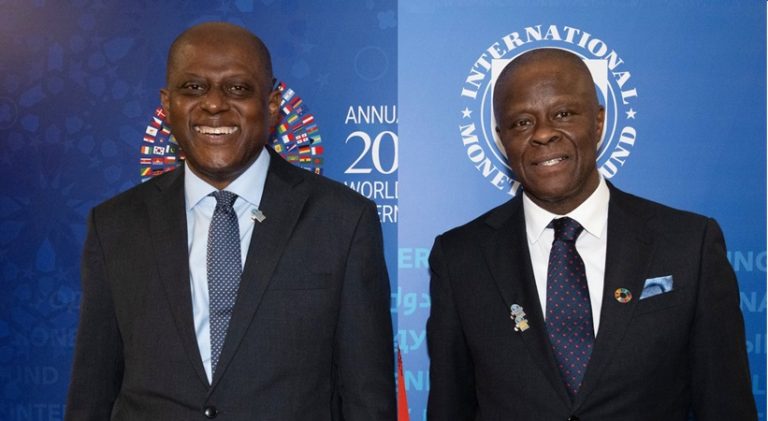
Nigeria is moving away from its traditional reliance on concessional funding to a more aggressive strategy centered on domestic revenue mobilization and asset optimization, Finance Minister and Coordinating Minister of the Economy, Wale Edun, said on Friday.
Speaking at a news conference following Nigeria’s participation at the 2025 International Monetary Fund (IMF) and World Bank Spring Meetings in Washington D.C., Edun explained that the government under President Bola Ahmed Tinubu is determined to wean the country off dependence on external concessional loans from institutions such as the World Bank, bilateral donors, and agencies including the European Union, Germany, and France.
According to Edun, the administration’s strategy has shifted away from the previous practice of heavy external borrowing, including raising commercial dollar funds through Eurobonds, toward a focus on boosting internal revenue and optimizing government assets.
Register for Tekedia Mini-MBA edition 20 (June 8 – Sept 5, 2026).
Register for Tekedia AI in Business Masterclass.
Join Tekedia Capital Syndicate and co-invest in great global startups.
Register for Tekedia AI Lab.
“Raising commercial funds from Nigerians, then Nigerian diasporas saving in dollars by buying government dollar-denominated Eurobonds, and then ultimately going to the Eurobond market has run its course,” Edun said. “The focus now is on domestic revenue mobilization.”
The finance minister highlighted that Nigeria had made considerable progress in improving its debt profile with international institutions. He disclosed that the country’s consistent quarterly repayments to the IMF over the past two years have resulted in an 87.5 percent reduction in outstanding obligations. If this trend holds, Nigeria is expected to fully clear its IMF debt by mid-2025, a milestone Edun described as a “significant achievement” in strengthening the country’s financial governance.
Beyond revenue reforms, Edun emphasized that the broader economic strategy is to foster private-sector investment. Rather than the government leading major projects, the Tinubu administration aims to create an environment where private capital can drive investments in key sectors like infrastructure, transportation, and the digital economy.

“The philosophy and strategy of the administration of President Bola Ahmed Tinubu is to crowd in the private sector so that they can come in and invest across the board: infrastructure, digital, toll roads,” he said.
Mobilizing Domestic Revenue – An Uphill Climb
However, the domestic revenue mobilization agenda is not without serious challenges. One major hurdle lies in the tax component of the plan, which has so far faced strong headwinds from economic realities and public resistance.
The federal government’s efforts to reform the tax system — particularly around Value Added Tax (VAT) and other consumption taxes — have encountered stiff resistance. Earlier attempts to review VAT upwards triggered widespread pushback, with state governments also pushing back over control of VAT collection. In 2021, for instance, Rivers and Lagos states dragged the federal government to court over who should collect VAT within their jurisdictions, sparking a fierce legal and political battle that remains unresolved.

Also, the ongoing presidential proposed tax reform bills have sparked opposition, particularly from Northern Nigeria, which fears that the reforms could shortchange the region’s federal allocation, exacerbate economic hardship, and leave the region impoverished.
These tensions have complicated efforts to streamline and enhance tax revenue at the federal level.
Moreover, the economic downturn has severely depleted Nigeria’s tax base. As inflation bites deeper and businesses close, the number of individuals earning taxable income has drastically shrunk. Recent government policy decisions are also expected to have an impact.
In a bid to cushion the effects of hardship, the federal government exempted workers earning the minimum wage from paying personal income tax. With the national minimum wage currently standing at N70,000 monthly — and with more than 50 percent of Nigerians earning 50 percent less than that amount, according to 2023 data from Enhancing Financial Innovation and Access (EFInA), the pool of taxable individuals has become significantly narrower.
In essence, while the government seeks to mobilize more funds internally, the harsh reality is that there simply are not enough people with sufficient income to tax at the scale required to fill Nigeria’s revenue gaps.
The problem runs deeper. Even among the shrinking number of higher earners, voluntary tax compliance remains weak, and many in the informal sector, which accounts for nearly 60 percent of the economy, operate entirely outside the tax net.
As Edun and his team push forward with a model that prioritizes tax and asset-driven revenue over borrowing, questions remain about whether the broader economic structure can sustain such an ambitious shift without deep and inclusive reforms to widen the tax base, improve compliance, and stimulate real income growth.
The shift comes amid Nigeria’s continued battle with revenue shortfalls, high debt servicing costs, and mounting economic pressures triggered by global headwinds. With limited fiscal space and escalating demands for social and infrastructure spending, the government is now betting on domestic solutions to shore up its finances.
Edun’s comments reflect a broader narrative emerging from the Spring Meetings, where policymakers from developing countries faced increasing pressure to build more resilient and self-reliant economies rather than depending excessively on external borrowing, especially in a high-interest-rate global environment.