

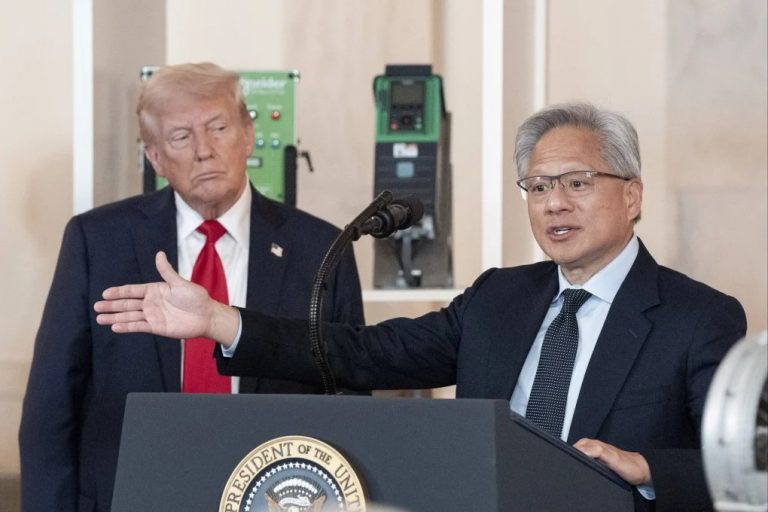
Nvidia CEO Jensen Huang is set to meet with President Donald Trump at the White House on Thursday, just hours after the chipmaker closed trading with a market capitalization of over $4 trillion—a historic first for any company.
The milestone cements Nvidia’s status not only as the most valuable public company in the world but also as the face of America’s artificial intelligence revolution.
The meeting, confirmed by CNBC’s Megan Cassella, has fueled speculation over the growing strategic importance of Nvidia in U.S. economic policy, global trade, and national security. Although the exact agenda of the White House meeting remains undisclosed, it comes at a critical time for Nvidia and the broader AI semiconductor industry, particularly as U.S.-China tech tensions intensify and Washington doubles down on trade restrictions.
Register for Tekedia Mini-MBA edition 20 (June 8 – Sept 5, 2026).
Register for Tekedia AI in Business Masterclass.
Join Tekedia Capital Syndicate and co-invest in great global startups.
Register for Tekedia AI Lab.
Nvidia’s record valuation coincides with renewed scrutiny of President Trump’s aggressive trade and tariff strategy—especially as it relates to China. Earlier this year, Trump imposed tighter export controls that effectively shut Nvidia out of the lucrative Chinese AI chip market. The H20 chip, which was specifically designed by Nvidia for Chinese customers to comply with earlier U.S. export limits, was rendered unsellable in April after the administration revoked its prior clearance and made an export license mandatory.
“China’s AI market is likely to grow to $50 billion in the next two to three years, Huang said in an interview with CNBC in May. “It would be a tremendous loss not to be able to address it as an American company,” he said.
Selling to China would also help bring revenue back to the US, contributing to taxes and helping to “create lots of jobs”, he added. “The world’s dynamic today. You just got to stay agile.”

However, Nvidia’s stock has continued to defy gravity. The company’s value surged more than 1.8% on Thursday, closing at $4.02 trillion, lifting it above tech heavyweights Apple and Microsoft. It had briefly crossed the $4 trillion mark a day earlier during intraday trading but pulled back before close.
Yet, several analysts view the company’s astronomical growth not as a validation of tariffs, but rather a quiet rebuke of them. Nvidia’s success, they argue, is being achieved despite the export controls and trade restrictions—not because of them. The company’s rally has come even as its access to one of the world’s largest markets was abruptly severed.
Indeed, Nvidia’s dominance stems from its near-monopoly on high-performance graphics processing units (GPUs), which are essential for training and running large AI models. Since the launch of ChatGPT in late 2022, demand for Nvidia chips has surged across sectors—from cloud computing giants like Microsoft and Amazon to emerging AI startups and national governments.

While the company has profited immensely from the AI boom—its stock has skyrocketed more than 15x in five years—it is now caught in the middle of Washington’s strategic tug-of-war over who controls the future of artificial intelligence.
Earlier this year, the Trump administration scrapped a Biden-era “AI diffusion rule” and promised to replace it with simpler and tougher export limits on who can access U.S. AI technology. Nvidia is expected to be central to that coming policy, both as a supplier and as a stakeholder. OpenAI, Microsoft, Meta, and several large AI firms depend on Nvidia for AI compute power.
Meanwhile, Trump has framed his trade policy—including tariffs on Chinese-made AI hardware and rare earth components—as essential for safeguarding U.S. jobs and technological leadership.
Based on these, the optics of Thursday’s meeting are hard to ignore. Trump has campaigned aggressively on decoupling from China and reindustrializing the U.S. economy through protectionist trade policies. At the same time, Nvidia’s ascent illustrates how global interdependence—on markets, manufacturing, and supply chains—remains baked into America’s tech sector.
The company, for instance, still depends on Taiwan Semiconductor Manufacturing Company (TSMC) for chip fabrication. Its products are shipped worldwide. And while China now accounts for a smaller slice of Nvidia’s revenue pie, many analysts believe the company will eventually need a way back into the market to sustain long-term growth.