DD
MM
YYYY

PAGES

DD
MM
YYYY

spot_img

PAGES

Home Blog Page 10

Egypt’s Fincart Secures $2.8 Million Seed Funding to Expand AI-Powered E-Commerce Platform Across MEA

0

Egypt-based logistics and e-commerce technology startup Fincart has raised $2.8 million in a seed funding round to accelerate the growth of its AI-powered shipping and operations platform across the Middle East and Africa.

The funding round was co-led by Launch Africa Ventures and Antler, with participation from Yango Ventures, Five35 Ventures, Bluestream Capital, Hi2 Global, Kalahari Venture Capital, and several other regional investors.

The newly secured capital will be used to further enhance Fincart’s technology platform, expand its team, strengthen strategic commercial partnerships, and accelerate its expansion across key markets in the Middle East and Africa.

Speaking on the round, Fincart’s co-founder and chief executive officer Mostafa Masry said,

“With our strategy focused on strengthening the e-commerce ecosystem, this investment will enable us to deepen our partnerships, enhance our AI-powered platform, expand our infrastructure, and accelerate our growth across Africa and the Middle East”.

Also commenting, accounting manager at Fincart Mohamed Elafndy said,

“Proud moment for Fincart. Having been part of this journey as Accounting Manager for the past two years, I’ve watched Fincart grow from an ambitious idea into a platform that’s redefining how e-commerce merchants manage shipping, access financing, and scale across the Middle East and Africa.

“This funding marks a new chapter, and I couldn’t be more excited for what’s ahead as we expand into new markets and continue building the largest integrated courier network in the region.”

The raise comes 18 months after Fincart’s undisclosed pre-seed round and coincides with the startup’s pivot from a logistics management platform into an AI-powered operating system for e-commerce merchants.

According to the company’s CEO, the pivot was driven by merchants’ reliance on a myriad of software to manage shipping, customer support, marketing, and payments.

Notably, the recent investment secured, underscores growing investor confidence in technology solutions that improve operational efficiency and financial access for e-commerce businesses in emerging markets.

Founded in 2023 by Mostafa Masry and Nihal Ali, Fincart was established to address a critical challenge facing the rapidly growing e-commerce sector in Egypt and the wider Middle East and North Africa (MENA) region.

The founders observed that despite the industry’s strong growth, merchants were losing significant revenue due to unreliable shipping services, fragmented customer support, and limited operational tools for scaling their businesses.

To solve these challenges, Fincart developed an AI-powered end-to-end operating platform designed to help e-commerce businesses improve sales, streamline deliveries, and enhance customer support.

Rather than offering a single solution, the company provides merchants with a comprehensive operating system that simplifies logistics and optimises day-to-day operations.

Fincart’s mission is to help e-commerce merchants unlock new revenue opportunities by eliminating operational inefficiencies.

Through access to one of Africa’s largest courier networks and data-driven solutions such as its Instant Cash Out service for cash-on-delivery (COD) payouts, the company aims to empower the next generation of direct-to-consumer (D2C) brands to compete more effectively in an increasingly digital marketplace.

Since its launch, Fincart has attracted a growing portfolio of customers, including leading brands such as Decathlon, Carina, and In Your Shoe.

The company reports achieving fourfold year-over-year growth, driven by its focus on transforming logistics challenges into improved customer experiences, stronger retention, and sustainable business growth.


AI Background Screening Market to Reach $9.7 Billion by 2035

0

Artificial intelligence is rapidly changing the way that organizations assess risk and verify identities. A new report has been released that forecasts the rapid growth of background screening with AI.

Identity Verification Is Expanding Across Industries

AI-verification technology is being embraced in almost every industry that handles sensitive customer information or that operates under strict requirements.

Banks and financial institutions use AI to perform KYC checks and AML checks before accounts are opened. Fintech firms rely on automated verification to streamline digital onboarding, and cryptocurrency exchanges use AI to verify customers, mobile transactions, and behavior.

Online gaming and gambling providers use particularly advanced verifications, which range from geolocation to multi-step log-ins, payment analysis, and anti-fraud tools to identify duplicate accounts. Security measures also help regulate the current welcome offer for new players, ensuring that the offer is not claimed twice and to make sure that the requirements are met.

Other sectors include retail and eCommerce platforms, which invest heavily in fraud detection, using artificial intelligence to analyze payment methods, consumer behavior, purchasing patterns, and more.

It’s becoming evident that organizations are not relying on a single identity check. Instead, platforms are combining technology to build risk profiles before approving a customer or applicant. Depending on the sector, systems may analyze government-issued identification.

Source: Pexels

Compliance Is Fuelling Technological Advancements

New reports have identified that the banking, financial services, and insurance sectors are the largest end-user market. This accounts for 34.9% of adoption.

Larger enterprises represent around two-thirds, reflecting high hiring volumes and broader regulatory obligations. As more and more organizations digitize their recruitment processes and onboarding. AI-powered background screening is set to become an important part of digital infrastructures.

Rather than replacing manual checks, there are now intelligent risk management systems that are capable of recruiting faster while meeting complex requirements. Latest data shows that the market generated US$1.6 billion in 2025 and is expected to grow to US$1.9 billion in 2026. This translates to a growth rate of 19%.

Some of the latest advancements include OCR (optical character recognition), natural language processing, and machine learning, which can analyze large amounts of data in a matter of seconds. Reports have found that retrieval and document parsing accounts for 42.8% of the market, as it’s an effective way to break down large amounts of data into smaller, more manageable chunks.

Hybrid working in particular, combined with international recruitment and contract-based employment, has helped to make background screening more complicated than ever. Companies are now in the position where they have to verify applications across different jurisdictions while ensuring they meet local laws too. AI has a big role to play here, as it can identify inconsistencies while ensuring that everything complies with privacy laws.

AI also allows organizations to standardize reports faster when compared to traditional manual screening. Pre-employment screening remains the largest application and accounts for 76% of the market.

As digital hiring becomes the norm, the AI background screening market will grow even more, which could change the way people are onboarded.

AI Isn’t Replacing Marketing Communicators

0

Artificial intelligence has become one of the most discussed topics in marketing communications. Scroll through LinkedIn today and it becomes clear that marketing leaders are no longer debating whether AI matters. They are discussing how to use it effectively, responsibly, and strategically. Yet beneath the excitement lies a more important conversation about the changing nature of marketing itself.

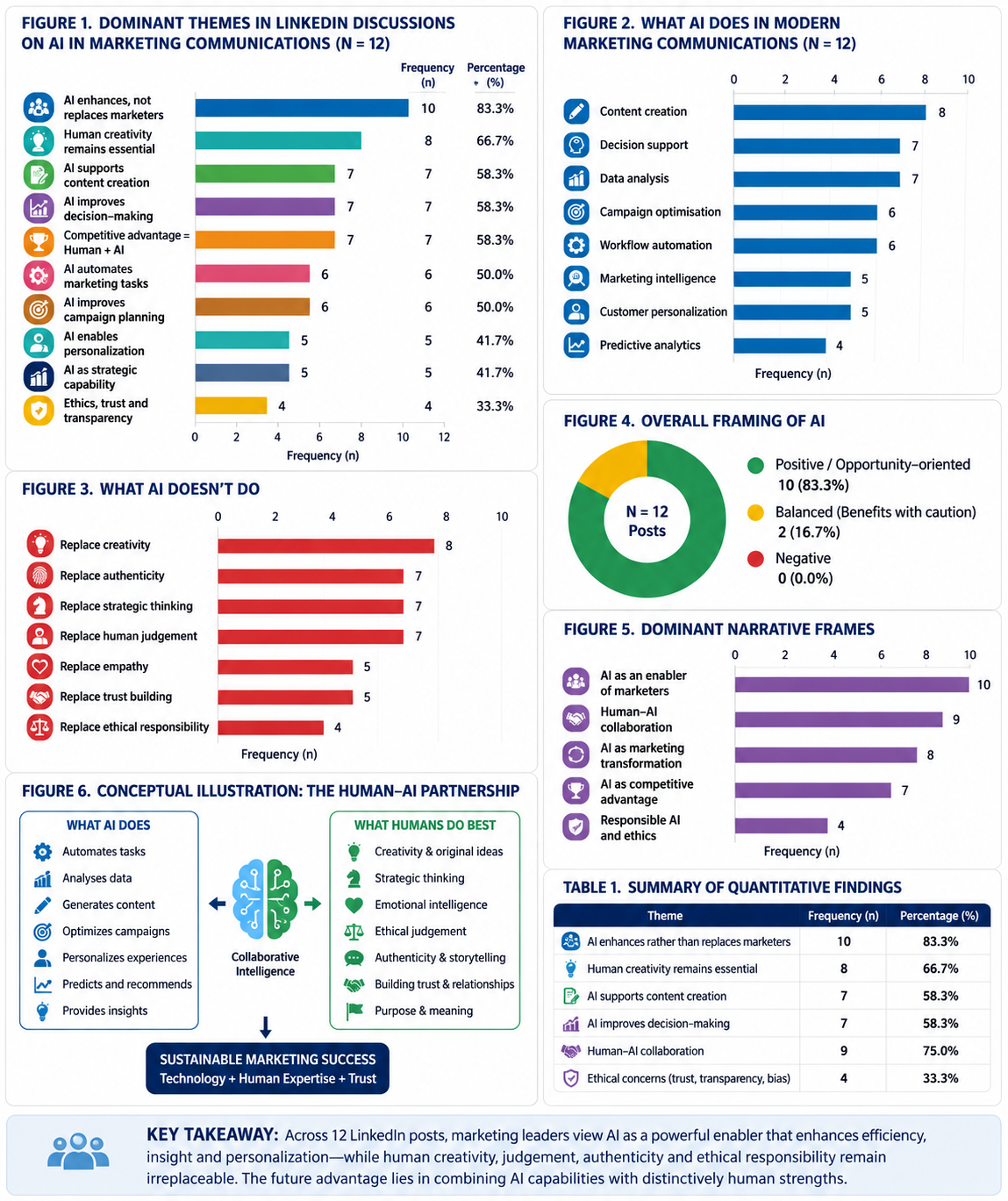
An analysis of thought leadership posts shared by marketing and communications professionals reveals a remarkably consistent narrative. Rather than portraying AI as a replacement for marketers, industry leaders overwhelmingly frame it as a tool that amplifies human capability. The emerging consensus is that the future of marketing will not be determined by artificial intelligence alone, but by the ability of organisations to combine technological capability with distinctly human strengths.

Across the discussions, AI is consistently associated with operational excellence. Marketing professionals describe it as a powerful assistant capable of generating content ideas, drafting social media posts, optimising advertising campaigns, analysing vast quantities of customer data, automating repetitive workflows, and personalising communication at scale. These capabilities are transforming everyday marketing activities by reducing the time spent on routine tasks and enabling faster decision-making.

However, the conversation does not end with efficiency. Almost every contributor establishes clear boundaries around what AI cannot do. While algorithms can generate words, images, recommendations, and predictions, they cannot replace authenticity, empathy, ethical judgement, strategic thinking, or lived human experience. These qualities remain central to building meaningful relationships between organisations and their audiences.

This distinction reflects an important shift in how the marketing profession understands technology. Earlier waves of digital transformation often focused on replacing manual processes with automated systems. Today’s discourse is different. AI is increasingly viewed as an augmentation technology rather than a substitution technology. Its primary role is to strengthen human decision-making rather than eliminate it.

This emerging perspective also challenges one of the most common misconceptions surrounding artificial intelligence. Simply adopting AI does not create competitive advantage. Several marketing leaders argue that AI has quickly become a baseline capability, much like search engines, customer relationship management systems, or social media platforms before it. As AI becomes embedded in everyday workflows, access to the technology itself will no longer differentiate organisations. Instead, competitive advantage will come from how effectively businesses integrate AI into broader marketing strategies, organisational culture, and customer experience.

The discussions also highlight an important evolution in the role of marketing leaders. Historically, marketers were expected to create compelling campaigns and manage brand visibility. Increasingly, they are becoming orchestrators of intelligent systems that combine automation with human insight. AI can identify patterns within customer behaviour, predict market opportunities, and optimise campaign performance, but it cannot determine organisational priorities or define a brand’s purpose. Those responsibilities remain firmly within the domain of leadership.

Perhaps the most compelling aspect of the conversation concerns trust. Several contributors express concern that the rapid adoption of AI-generated content may blur the line between authenticity and manipulation. As artificial intelligence becomes more capable of producing convincing text, images, and personalised communication, marketing professionals are recognising that transparency is becoming just as important as innovation.

Consumers may appreciate faster responses and more relevant content, but they continue to value honesty, credibility, and genuine human connection. This suggests that the future role of marketing communicators will extend beyond content production to include ethical stewardship. Building trust in an AI-enabled marketplace will require organisations to establish clear principles for transparency, accountability, and responsible communication.

Another notable insight from the LinkedIn discussions is the rejection of technological determinism. Rather than viewing AI as an unstoppable force that inevitably replaces human expertise, contributors consistently portray it as a decision-support system. AI can analyse millions of data points in seconds, uncover hidden patterns, and recommend actions based on predictive models. Yet interpreting those insights, balancing competing priorities, and making strategic decisions remain uniquely human responsibilities.

This perspective is particularly important because it redefines professional value. The marketers who will thrive are unlikely to be those who simply know how to operate AI tools. Instead, they will be those who understand customers deeply, communicate authentically, think strategically, and use AI to strengthen rather than substitute those capabilities.

Specifically, the LinkedIn conversation reflects a profession that is adapting rather than resisting. Marketing communicators recognise that artificial intelligence is becoming part of the industry’s infrastructure, but they also understand that technology alone cannot build relationships, inspire confidence, or create lasting brand loyalty.

The real transformation is therefore not about machines replacing marketers. It is about marketers evolving into more strategic professionals who use AI to enhance creativity, improve decision-making, and deliver greater value. In that future, artificial intelligence may accelerate marketing, but it is human judgement, empathy, and authenticity that will continue to define successful communication.

Strategy Raises $525 Million While Pausing Bitcoin Purchases for Fifth Straight Week

0

Strategy, the business intelligence company best known for its aggressive Bitcoin treasury strategy, has once again surprised the market by raising an additional $525 million in cash while refraining from purchasing more Bitcoin for the fifth consecutive week.

The move marks an unusual pause for a company that has become synonymous with accumulating the world’s largest corporate Bitcoin reserve.

The latest capital raise strengthens Strategy’s balance sheet and provides the company with greater financial flexibility at a time when global markets remain uncertain.

Investors have closely watched every move by the firm, whose Bitcoin acquisition strategy has inspired numerous publicly traded companies to adopt digital assets as part of their corporate treasury management.

The decision to hold off on new Bitcoin purchases has fueled speculation about the company’s next move. Some analysts believe Strategy is waiting for more favorable market conditions before deploying the newly raised capital.

Others argue that management may simply be preserving liquidity while assessing macroeconomic developments, including interest rate expectations, regulatory changes, and broader market volatility.

Despite the pause, Strategy has repeatedly emphasized that its long-term commitment to Bitcoin remains unchanged. The company has consistently described Bitcoin as the world’s premier digital asset and a superior store of value over long investment horizons.

Its strategy has never been focused on short-term market timing but rather on steadily building a substantial Bitcoin position over time.

Raising $525 million without immediately purchasing additional Bitcoin also demonstrates disciplined capital management.

Rather than rushing into the market after securing fresh funding, the company appears willing to wait for an entry point that aligns with its long-term objectives. This measured approach contrasts with the perception that Strategy buys Bitcoin at every opportunity, suggesting that treasury management has become increasingly sophisticated as its holdings have grown.

The five-week buying pause comes after years of frequent Bitcoin acquisitions that transformed Strategy into the largest corporate holder of the cryptocurrency.

Those purchases helped establish the company as a bellwether for institutional Bitcoin adoption, with investors often interpreting its actions as a signal of confidence in the broader digital asset market.

Market participants will now be watching closely for signs of when Strategy resumes its accumulation. The company has taken advantage of market pullbacks to increase its holdings, but it has also demonstrated patience during periods of elevated uncertainty.

The sizeable cash reserve gives management the ability to act quickly should attractive buying opportunities emerge.

Beyond Bitcoin itself, Strategy’s fundraising success highlights continued investor confidence in its business model.

Despite the inherent volatility associated with cryptocurrency markets, investors remain willing to provide capital, reflecting confidence in the company’s long-term vision and its ability to execute its treasury strategy responsibly.

The broader crypto market is paying attention because Strategy’s buying activity has often influenced market sentiment. Large purchases by the company have historically reinforced bullish narratives surrounding institutional adoption, while periods of inactivity have prompted discussions about valuation and market timing.

Strategy’s decision to strengthen its cash position while delaying further Bitcoin purchases should not necessarily be interpreted as a shift away from its Bitcoin-first philosophy. Instead, it appears to reflect prudent financial management in a dynamic market environment.

With an additional $525 million now available, the company has significantly expanded its financial firepower, positioning itself to capitalize on future opportunities when management believes the timing is right.

Whether that next purchase comes next week or several months from now, Strategy remains one of the most influential institutional players in the Bitcoin ecosystem, and its next move is likely to attract significant attention across both traditional finance and the cryptocurrency industry.

Circle Acquires 1,000 IBM Blockchain Patents to Become America’s Largest Blockchain Patent Holder

0

Circle has taken a major step in strengthening its position within the blockchain industry by acquiring approximately 1,000 blockchain-related patents from IBM.

The landmark transaction makes Circle the largest blockchain patent holder in the United States, significantly expanding its intellectual property portfolio and reinforcing its ambitions to become a dominant infrastructure provider for the digital asset economy.

The acquisition signals a broader shift in the blockchain sector, where companies are increasingly investing not only in products and services but also in intellectual property that can shape the future of financial technology.

Patents covering distributed ledger technologies, digital identity, smart contracts, tokenization, payment systems, security, and enterprise blockchain solutions have become strategic assets as blockchain adoption accelerates across industries.

IBM has long been recognized as one of the pioneers in enterprise blockchain innovation.

Over the past decade, the technology giant invested heavily in research and development, securing hundreds of patents related to blockchain applications for finance, supply chains, healthcare, and identity management.

While IBM has gradually shifted its business priorities toward artificial intelligence and hybrid cloud computing, Circle has emerged as a company focused on expanding blockchain-based financial infrastructure, making the patent transfer a logical strategic move.

The acquisition extends beyond simply owning intellectual property. The patents could provide the company with new opportunities to enhance its existing products, including stablecoin infrastructure, tokenized payments, cross-border settlement, and digital asset services.

They may also accelerate innovation by giving Circle access to technologies that would otherwise require years of internal research and development.

The timing is especially significant. Blockchain technology is rapidly moving into the mainstream as banks, payment companies, governments, and financial institutions embrace tokenized assets and digital currencies.

Stablecoins have become a crucial component of this transformation, with Circle’s USDC already serving as one of the world’s largest regulated digital dollars.

As tokenization expands into stocks, bonds, real estate, and traditional financial products, ownership of foundational blockchain patents could provide Circle with a competitive advantage.

Beyond product development, the expanded patent portfolio strengthens Circle’s ability to defend its innovations against competitors while creating opportunities for strategic licensing partnerships.

Intellectual property has become an increasingly valuable asset in technology industries, allowing companies to protect proprietary technologies, negotiate collaborations, and generate additional revenue streams through licensing agreements.

The acquisition may also influence the broader blockchain ecosystem. Many startups and enterprise blockchain firms could seek partnerships with Circle to leverage technologies covered by its patent portfolio.

If managed effectively, the company could help establish common technical standards that improve interoperability and security across blockchain networks.

From an investor perspective, the move demonstrates Circle’s long-term commitment to building foundational infrastructure rather than focusing solely on short-term market cycles.

As regulatory frameworks for digital assets continue to evolve in the United States and globally, companies with strong intellectual property portfolios may enjoy greater resilience and strategic flexibility.

Competition within blockchain infrastructure is becoming increasingly intense, with major technology firms, fintech companies, and crypto-native organizations racing to build the financial systems of the future.

By becoming America’s largest blockchain patent holder, Circle positions itself as a leading innovator capable of influencing how blockchain technology evolves over the coming years.

The acquisition of IBM’s blockchain patents represents more than a transfer of intellectual property. It reflects the maturation of the blockchain industry, where ownership of core technologies is becoming as important as market share and user adoption.

If Circle successfully integrates these innovations into its growing ecosystem, the company could play a defining role in shaping the next generation of digital finance, enterprise blockchain solutions, and the global tokenized economy.