DD
MM
YYYY

PAGES

DD
MM
YYYY

spot_img

PAGES

Home Blog Page 1006

Amazon to Invest Over $233m in India’s Operations Network in 2025, Underscoring Rising US Corporate Shift Amid US-China Tensions

0

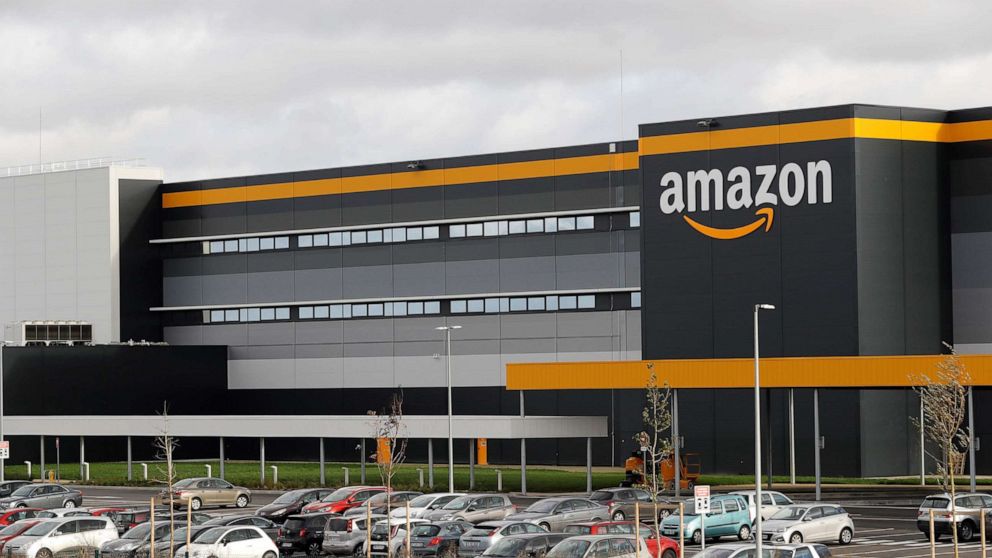
Amazon has announced plans to invest over $233 million in its Indian operations in 2025, marking a significant step in its continued expansion in the country.

The move is aimed at boosting the safety, efficiency, and reliability of its logistics network while also enhancing employee well-being and integrating advanced technologies into its operations.

“For over a decade now in India, we have been focused on building the best-in-class logistics infrastructure—designed to deliver with safety, speed, scale, and reliability for our customers across the country,” said Abhinav Singh, Vice President of Operations for Amazon India and Australia. “These latest investments reflect our commitment to continually expand and upgrade our operations across our fulfilment, sortation, and delivery network.”

India’s Growing Appeal for US Companies

The decision by Amazon to deepen its footprint in India aligns with a broader shift among US companies seeking to diversify supply chains and operations away from China. This pivot is largely driven by rising US-China tech rivalry, export restrictions on advanced technology, and the increased risk of operating under Beijing’s tightening regulatory environment. With strategic alternatives becoming a necessity, India has emerged as a clear front-runner.

India’s expanding consumer market, supported by strong GDP growth and a digitally savvy population of over 1.4 billion people, makes it a lucrative destination for American firms. The International Monetary Fund projects India will be the world’s fastest-growing major economy in 2025, further bolstering investor confidence.

Apple is perhaps the most prominent example of this US corporate rebalancing. For years, Apple relied heavily on China as both a key manufacturing hub and consumer market. But recently, the company has steadily ramped up its operations in India. Apple now assembles several iPhone models in Indian factories operated by its suppliers Foxconn and Pegatron.

In 2023, Apple opened its first retail stores in Mumbai and Delhi, a symbolic milestone that underscored its growing commitment to the Indian market. The company has also doubled down on expanding its local supplier ecosystem, encouraged by India’s Production Linked Incentive (PLI) scheme and a government push to build domestic manufacturing capacity. Reports suggest that Apple aims to produce 25% of all iPhones in India by 2026.

Amazon’s Investment Strategy

Amazon’s new $233 million investment in India will go toward upgrading its fulfilment centers, expanding processing capacity, and improving safety across its logistics network. A key objective is to ensure faster, more reliable deliveries across all serviceable pin codes in India.

The company is also prioritizing the health and financial stability of its employees and delivery partners through expanded initiatives such as:

  • Ashray, a rest-point programme for delivery workers, offering air-conditioned waiting areas, clean water, charging stations, and washrooms
  • Samridhi, a financial wellness programme focused on personal finance education
  • Pratidhi, a scholarship programme for children of Amazon associates
  • Sushruta, a healthcare support initiative for truck drivers

Amazon will also offer free health check-ups to over 80,000 delivery associates across the country by the end of 2025 and has committed to enhancing safety through the deployment of new technologies like the Helmet Adherence Application, which monitors helmet usage before each trip and sends real-time safety alerts.

To ensure equitable distribution of workloads and improved delivery safety, Amazon is enhancing its Driver App, simplifying workflows, improving GPS navigation for unstructured addresses, and introducing tools that verify deliveries using video and photo inputs. New analytics tools will also measure route complexity and encourage fair distribution among drivers.

In line with its global emphasis on energy-efficient operations, Amazon says its fulfillment centers will integrate smart building technologies aimed at reducing energy consumption and creating more inclusive, safer workplaces—particularly for employees with disabilities.

India as a Strategic Hub in a Reordering Global Economy

Amazon’s investment is seen as part of a larger pattern of American corporations reconfiguring global supply chains and market strategies in response to shifting geopolitical realities. The e-commerce giant, which has faced regulatory hurdles and stiff competition in China, India offers a clearer path to long-term growth, both as a consumer market and as a hub for regional logistics.

The company’s continued investment in local infrastructure and welfare schemes also reinforces its desire to build goodwill and secure a long-lasting presence in the country.

“By strengthening our infrastructure capabilities, enhancing processing capacity, and implementing state-of-the-art technology, we’re positioning Amazon to better serve customers throughout India while supporting our employees, associates and partners who are the heart of it all,” Singh said.

Now with this $233 million boost, Amazon is not just delivering packages faster—it’s delivering a strong vote of confidence in India’s role as a new pillar of global tech and trade realignment.


Tekedia Capital Congratulates Zeeh Africa for Winning Two Awards in VivaTech 2025

0

Tekedia Capital congratulates our portfolio company, Zeeh Africa, for winning two awards in VivaTech 2025, the most prestigious global tech event.

Yes, Zeeh Africa, the only African startup among 30 global finalists of the VivaTech 2025 competition, has emerged winner of two awards – the Fintech/eCommerce category at the 2025 AfricaTech Awards, hosted by VivaTech in partnership with Deloitte and supported by Edouard Mendy, and the Impact 2035 Award by OVHcloud, recognizing startups driving sustainable digital growth. Congratulations CEO David Adeleke.

“Out of thousands of startups worldwide, we were selected as one of the Top 30 Innovation Finalists by TechCrunch and VivaTech — and the only African fintech on that prestigious list” – David

Tekedia Capital >> a farmland breeding tech unicorns!

BBVA Advises Its Affluent Clients On Bitcoin and Ethereum Investment

0

Spain’s second-largest bank, BBVA (Banco Bilbao Vizcaya Argentaria), has advised its affluent clients to allocate 3% to 7% of their investment portfolios to cryptocurrencies, primarily Bitcoin and Ether, depending on their risk tolerance. This recommendation, which began in September 2024, marks a significant shift for a major European bank, as most EU banks (approximately 95%) remain cautious about digital assets due to their volatility. BBVA’s guidance is based on the belief that a small crypto allocation can enhance portfolio performance without significantly increasing risk.

For example, Philippe Meyer, head of digital and blockchain solutions at BBVA Switzerland, noted that a 3% allocation can boost returns while keeping risk manageable. The bank has also received regulatory approval to offer Bitcoin and Ether trading in Spain, with plans to roll out these services to retail clients via its mobile app in the coming months, following the EU’s Markets in Crypto-Assets (MiCA) regulation implementation in December 2024.

For investors considering this advice, here are key points to keep in mind: A 3%-7% allocation aligns with BBVA’s strategy for diversification, but cryptocurrencies are highly volatile. Bitcoin’s price, for instance, was around $105,273.31 as of June 2025, with a 22.63% increase over the past 90 days but a 2.24% dip in the last 24 hours. Ensure your risk appetite matches this exposure.

Crypto gains are subject to capital gains tax (19%-28% depending on the gain amount). Holdings exceeding €50,000 abroad must be reported via Form 721, and wealth tax may apply if your net worth exceeds €700,000. Keep detailed records of transactions to comply with Agencia Tributaria regulations. BBVA will offer trading and custody services for Bitcoin and Ether, but other platforms like Bit2Me (Spain-based, 0%-0.6% fees) or Coinbase (registered with the Bank of Spain) are also viable for Spanish investors. Ensure any platform complies with MiCA and has robust security.

BBVA’s advice targets Bitcoin and Ether, but consider diversifying within crypto (e.g., stablecoins like USDC) or across other asset classes to mitigate risk. MiCA provides a clearer framework for crypto in the EU, but full compliance is required by July 2026. Stay updated on regulatory changes, as they could impact market dynamics.

This move by BBVA reflects growing institutional acceptance of crypto, but the asset class remains speculative. Consult a financial advisor to tailor this allocation to your financial goals and consider Spain’s tax obligations to avoid penalties.  The recommendation by BBVA, Spain’s second-largest bank, to allocate 3%-7% of client portfolios to cryptocurrencies like Bitcoin and Ether carries several implications for investors, the financial sector, and the broader crypto market. A 3%-7% allocation to crypto could enhance portfolio returns due to the high growth potential of assets like Bitcoin (recently at ~$105,273.31 with a 22.63% 90-day gain) and Ether.

BBVA’s analysis suggests this small exposure boosts performance without excessive risk. Crypto’s volatility (e.g., Bitcoin’s 2.24% 24-hour dip) means even a small allocation could lead to significant losses, especially for conservative investors. Risk-averse clients may find this allocation challenging. Crypto gains are taxed as capital gains (19%-28% based on profit size). Investors must report holdings above €50,000 abroad via Form 721 and may face wealth tax if their net worth exceeds €700,000. Non-compliance risks penalties from the Agencia Tributaria.

Investors will need meticulous transaction records to comply with tax laws, increasing administrative effort. BBVA’s planned rollout of Bitcoin and Ether trading via its mobile app (post-MiCA, December 2024) lowers entry barriers for retail investors. This could attract new crypto investors but requires understanding platform fees and security.

BBVA’s move signals growing acceptance of crypto among traditional financial institutions, potentially encouraging other EU banks to follow. Only ~5% of EU banks currently engage with crypto, so this is a bold step. It may pressure competitors to offer similar services or risk losing clients to crypto-friendly banks like BBVA or platforms like Bit2Me.

The EU’s MiCA regulation (fully effective by July 2026) provides a framework for BBVA’s crypto offerings. This could set a precedent for standardized, regulated crypto services across European banks, reducing fraud and enhancing trust. Banks may need to invest in compliance infrastructure to meet MiCA’s requirements, increasing operational costs.

BBVA positions itself as a forward-thinking institution, appealing to younger, tech-savvy clients. However, it risks reputational damage if crypto markets crash or if clients suffer losses due to volatility. Institutional endorsements like BBVA’s could drive crypto adoption, increasing demand for Bitcoin and Ether. This may contribute to price appreciation, though volatility remains a factor.

Retail access via BBVA’s app could bring new capital into the market, particularly in Spain, a growing crypto hub. A major bank’s recommendation lends credibility to crypto as an asset class, potentially reducing stigma and attracting conservative investors. This could shift perceptions from speculative to mainstream. BBVA’s focus on Bitcoin and Ether may concentrate investment in these assets, potentially overshadowing smaller altcoins. This could limit diversification within the crypto space.

Early adopters of BBVA’s strategy could benefit from crypto’s potential upside, but losses could exacerbate wealth inequality if less-informed investors enter without proper risk management. BBVA’s move may spur innovation in blockchain and digital asset services, encouraging fintechs and banks to develop new products (e.g., crypto custody, DeFi integration).

As a major European bank, BBVA’s actions could influence other jurisdictions. If successful, it may prompt banks in the U.S., Asia, or elsewhere to adopt similar strategies, accelerating global crypto integration. Ensure a 3%-7% allocation aligns with your financial goals and risk appetite. Consider stress-testing your portfolio for crypto volatility. Use tools like CoinTracking or Koinly to track transactions for tax purposes. Consult a tax advisor familiar with Spain’s crypto regulations.

MiCA’s evolving rules may impact trading and custody. Stay informed via updates from the Bank of Spain or ESMA. While BBVA’s app is convenient, compare it with regulated platforms like Bit2Me or Coinbase for fees and security. BBVA’s recommendation is a pivotal moment for crypto’s integration into traditional finance, but it comes with risks and responsibilities.

Amazon’s Zoox Opens Massive Robotaxi Factory, Signaling Fierce New Phase in Autonomous Vehicle Race

0

Amazon-backed Zoox has launched its first dedicated robotaxi production facility in Hayward, California, a move that underscores intensifying competition in the autonomous ride-hailing sector.

The facility, a 220,000-square-foot complex, is designed to build over 10,000 custom-built autonomous vehicles annually, marking Zoox’s transition from a testing-phase innovator to a full-fledged manufacturer in a market currently dominated by Alphabet’s Waymo and, soon, Elon Musk’s Tesla.

Zoox confirmed on Wednesday that it plans to begin its commercial robotaxi services in Las Vegas later this year, followed by a broader rollout in San Francisco, where it already conducts public road testing in the SoMa (South of Market) neighborhood. This next phase will include onboarding public riders and scaling production in response to anticipated demand across new U.S. cities in the years ahead.

“This expansion, plus the anticipated demand once rides open up to the general public, and additional market entrances in the coming years, warrants this increase in robotaxi production,” the company said in a statement.

A Purpose-Built Robotaxi, Not a Retrofit

Unlike rivals such as Waymo and Tesla that modify existing vehicles, Zoox stands out as the only U.S. company operating fully autonomous, purpose-built robotaxis. The vehicles, designed from the ground up, lack traditional driving controls like steering wheels and pedals and instead feature a carriage-style layout where passengers face each other—akin to a lounge on wheels.

This deliberate design shift allows Zoox to optimize safety, user experience, and efficiency, differentiating itself from Tesla’s upcoming Model Y-based robotaxi service or Waymo’s outfitted Jaguar I-Pace and Chrysler Pacifica fleets.

Tesla’s and Waymo’s Expanding Footprints

Tesla is expected to debut its robotaxi service on June 22, starting with its Model Y SUVs running Full Self-Driving software, and later introducing the “Cybercab”—a two-seater that, like Zoox’s vehicle, lacks manual controls. Meanwhile, Waymo remains the current market leader, already operating commercial driverless taxi services in multiple cities including Phoenix, San Francisco, Los Angeles, and Austin. Its vehicles log millions of paid miles each month, offering a formidable benchmark for newer entrants like Zoox.

The entry of Zoox into high-volume robotaxi manufacturing increases the stakes in what was already a fiercely contested sector. Analysts believe that the move could compress the time-to-market for advanced autonomous services and exert pricing and innovation pressure on competitors, ultimately accelerating the commercialization timeline across the board.

Zoox’s approach appears calculated. The Hayward plant is modular and flexible, allowing for increased automation as demand scales. The company currently produces one robotaxi per day but says the facility can ramp up to three vehicles per hour running two shifts.

Safety, Regulatory, and Cost Challenges

However, the robotaxi market continues to face serious hurdles. Industry-wide, companies have dealt with federal investigations, recalls, and regulatory scrutiny following vehicle incidents. Zoox itself conducted a voluntary recall in Las Vegas earlier this year after a minor traffic collision involving one of its autonomous vehicles.

Beyond safety, the broader challenge remains cost efficiency. Building and maintaining a fleet of self-driving vehicles—particularly purpose-built ones—demands deep capital and infrastructure commitments. This makes Amazon’s deep-pocketed support for Zoox a strategic edge that smaller players may struggle to match.

Acquired by Amazon in 2020 for over $1.2 billion, Zoox now operates as a semi-independent unit under CEO Aicha Evans and co-founder Jesse Levinson. The company has more than 2,500 employees and growing collaborations with Amazon’s cloud, AI, and logistics operations—elements that could give it an ecosystem advantage beyond ride-hailing.

Zoox’s immediate goal is to launch a fully driverless, paid ride-hailing service in Las Vegas by the end of 2025, before expanding into San Francisco and later cities like Austin and Miami. Its vehicles will continue to be refined and tested on U.S. roads, even as the company contends with strict regulatory compliance and public perception.

The road to widespread robotaxi adoption remains long and uncertain, but Zoox’s industrial-scale production signals a pivot in the industry: from pilot programs and flashy demos to real-world commercialization and competitive execution.

Rexas Finance (RXS) Predicted to Hit $5—Can It Outperform Solana’s Performance?

0

Rexas Finance (RXS) continues to gain momentum in the digital asset space. Following its official launch on June 19, 2025, the project has already sold over 499 million out of the 500 million tokens allocated for presale. The RXS presale began at $0.03 and now sits at $0.25. As excitement builds, market analysts predict RXS could reach $5, representing a potential 25x return from its final presale price of $0.20.

RXS Builds Strength with Utility and Demand

Unlike speculative tokens, RXS has ground in real-world application. The platform will provide space to tokenize physical assets, including real estate, gold, and artwork. This provides the users with fractional ownership of high-value assets. RXS is secure and widely compatible as it runs on the ERC-20 standard of Ethereum and has undergone a CertiK audit.

Another distinctive feature of Rexas Finance is its tools like the Token Builder and the QuickMint Bot. These enable any person to mint asset-backed tokens without any coding-related expertise. Further, staking for RXS is now officially live, allowing token holders to earn passive rewards by locking their tokens through Rexas Finance’s secure staking dashboard.

However, before launch, the project generated nearly $55.9 million via presale due to the high investor confidence. RXS will experience high trading volume since it is listed on MEXC, BitMart, and LBank. 

Even Rexas Finance has already shown strong potential during its presale, growing from $0.03 in Stage 1 to $0.20 in Stage 12—a 567% increase. So many analysts believe a long-term target of $5 is possible if momentum continues, this would represent a 20x return from the launch price.

Solana Eyes a Breakout but Faces Resistance

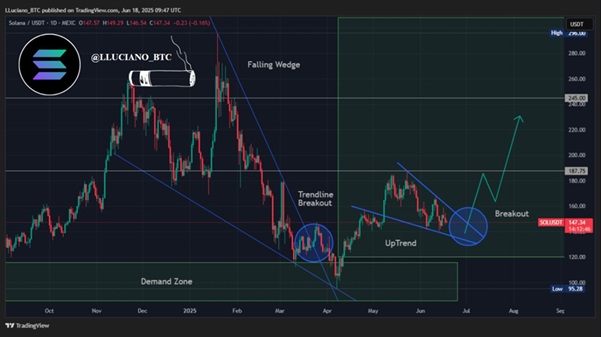
Solana is also attracting attention as it forms a bullish pattern on the charts. After a period of correction, Solana broke out of a falling wedge near the $125 mark. It then rallied toward $187 before entering another descending wedge. The price is currently consolidating just below wedge resistance at around the price of $147.

Source:X

In the event Solana rises again, the initial resistance will be at $187. This was a high resistance in the past and could cause immediate selling. A breakout of $187 will move the price higher to $245. Over and above that, bulls might target the former cycle high of $290. However, the rally depends on good volume and positive sentiment.

On the downside, Solana has support between $95 and $120. This zone has consistently attracted buyers. Moreover, it could serve as a safety net in case of a pullback.

Conclusion

Solana is exhibiting technical strength and can rally back to former highs should the market continue to be favorable. Nevertheless, RXS will launch with the advantage of sound fundamentals, robust presale demand, and actual use cases. 

Although Solana might wait until breakout confirmation before the next move, RXS may steal the show and achieve rapid growth and mainstream usage. As a trader interested in buying at an early stage, Rexas Finance offers a reasonable chance to beat the performance of Solana.


For more details about Rexas Finance (RXS), visit the links below:

Website: https://rexas.com/

Twitter/X: https://x.com/rexasfinance

Telegram: https://t.me/rexasfinance