DD
MM
YYYY

PAGES

DD
MM
YYYY

spot_img

PAGES

Home Blog Page 1007

The Brent Crude Surge To $77.45 Highlights A Fragile Balance

0

Brent crude’s 1% rise to $77.45, a high not seen since January, signals tighter energy markets, likely driven by supply concerns or demand optimism. This uptick is fueling inflationary pressures on global energy and food prices, as higher oil costs ripple through production and transportation.

Meanwhile, European stock indexes and U.S. equity futures are sliding, possibly reflecting investor unease over inflation risks or fears of tighter monetary policy to curb it. The interplay suggests markets are grappling with growth concerns against a backdrop of rising commodity costs.

The 1% rise in Brent crude to $77.45, a high since January, and the corresponding drop in European stock indexes and U.S. equity futures point to significant economic implications and a deepening divide in market dynamics. Higher Brent crude prices directly increase energy costs, which cascade into higher transportation and production expenses. This fuels inflation, particularly for energy-intensive industries and food supply chains, where transport costs are significant.

Consumers may face higher prices for goods and services, squeezing household budgets, especially in lower-income regions. Rising oil prices could prompt central banks, like the Federal Reserve or European Central Bank, to tighten monetary policy to curb inflation. Higher interest rates could further pressure equity markets, as seen in the declining European indexes and U.S. futures, by increasing borrowing costs and dampening corporate earnings.

Energy Sector vs. Broader Market: The energy sector may see short-term gains from higher oil prices, benefiting producers and related industries. However, broader markets, particularly tech and consumer discretionary sectors, are likely weighed down by inflation fears and potential rate hikes, as reflected in the falling equity indexes.

Emerging markets, heavily reliant on imported oil, face greater strain from rising energy costs, potentially widening economic disparities with developed nations. Food price inflation could exacerbate social unrest in vulnerable regions, while wealthier economies may better absorb the shock but still face growth slowdowns.

Energy companies and oil-producing nations (e.g., OPEC members) stand to gain from higher Brent prices, while energy-intensive industries (e.g., manufacturing, airlines) and consumers bear the cost. This creates a divide between sectors and regions profiting from oil price spikes and those facing margin compression or reduced purchasing power.

Wealthier nations with stronger currencies and energy reserves can mitigate the impact of rising oil prices, while emerging markets with weaker currencies face heightened inflation and trade balance pressures, deepening global economic inequality. Investors in energy stocks or commodities may see gains, but consumers face higher costs at the pump and in grocery stores. This divide fuels tension between market optimism in certain sectors and broader economic pessimism.

Short-term market reactions (falling equities) reflect fears of inflation and policy tightening, but long-term implications depend on whether oil prices stabilize or continue climbing. Persistent high prices could accelerate the shift to renewables, while short-term reliance on fossil fuels entrenches energy cost pressures.

Energy price spikes boost inflation and strain equities, while deepening divides between sectors, regions, and economic stakeholders. Markets are signaling caution, with falling indexes reflecting broader growth concerns. Monitoring OPEC decisions, geopolitical risks, and central bank responses will be key to understanding whether this divide widens or narrows.

BlackRock Strengthens Ethereum’s Credibility

0

BlackRock, the world-famous asset manager, has made a significant move by investing $48.4 million to purchase 19,070 Ethereum (ETH). This places the company not only among the top asset managers but also among the leading institutional players recognizing the legitimacy of cryptocurrency.

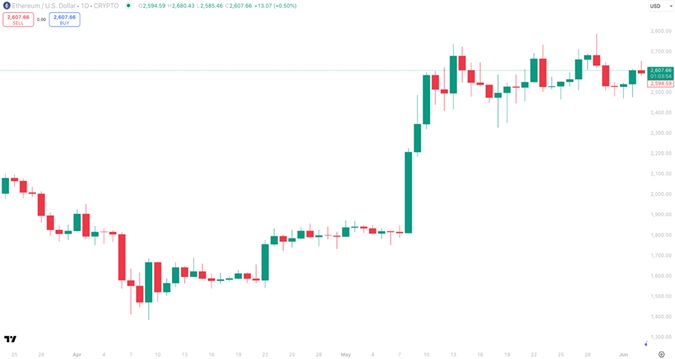
This purchase signals growing confidence from BlackRock in blockchain technology and the Ethereum project specifically. Despite a volatile market, Ethereum remains attractive, with the ETHUSD chart consistently trending upward since May.

This acquisition comes as Ethereum seems to be stabilizing after a period of intense price fluctuations. For BlackRock, this is a diversification strategy, marking its entry into a second major cryptocurrency after Bitcoin.

More than a simple purchase, this move delivers a strong message to the rest of the market. BlackRock’s involvement could inspire similar actions from other institutional players, reinforcing what is already a relatively stable and burgeoning asset class. And BlackRock’s interest also sets the scene for developing new, financial derivatives backed by ETH, which is another solid step toward establishing a robust digital financial infrastructure.

Nevertheless, hurdles remain, especially around regulations and continued market volatility. Even so, BlackRock’s decision implies that cryptocurrencies in general and Ethereum in particular are positioning themselves as strategic assets in traditional investment portfolios. If this trend persists, Ethereum is poised to play a central role in tomorrow’s finance, situated at the intersection of technological innovation and large-scale capital investment.

This shift also indicates a broader transformation in wealth preservation strategies. While gold has traditionally been the ultimate safe-haven asset, Bitcoin is now emerging as its digital counterpart. Bitcoin’s not alone, though, as Ethereum has also started to make its way into the portfolios of high-profile institutions. Other digital assets, such as Solana (SOLUSD) — known for its high-speed blockchain infrastructure — and XRP (XRPUSD), which has gained traction for cross-border payments, are also being re-evaluated by institutional investors. Their increasing adoption lends Ethereum its own aura of legitimacy and suggests the rise of a second major digital asset. All of this may portend the start of a new era where digital asset class coexists with — or even rivals — traditional inflation hedges.

How America Builds – Lesson As Meta Assemblies AI Talent for the Grand AI Battle

0

Meta’s Mark Zuckerberg is shopping and assembling the talent for the grand AI battle of the 21st century. After spending $14.3 billion primarily to get the founder of Scale AI, it has also brought another group: “The most recent targets include Daniel Gross, co-founder of Safe Superintelligence—the secretive AI startup launched by former OpenAI co-founder Ilya Sutskever—and Nat Friedman, former GitHub CEO and longtime AI investor.”

The AI talent wars are on, and Meta CEO Mark Zuckerberg is leaving no stone unturned. Meta was in talks to acquire search startup Perplexity, Bloomberg reports, citing anonymous sources, before investing $14.3 billion in Scale AI and hiring founder Alexandr Wang last week. It also made a bid to buy the $32 billion AI startup Safe Superintelligence before successfully poaching CEO Daniel Gross, according to CNBC, citing anonymous sources. Ex-Github CEO Nat Friedman is also joining Meta, which is targeting rival AI talent with massive bonuses.

Good People, I truly admire how Americans run businesses: it is either you win or you go home. That is why none of the sports here has space for silver or bronze. Simply, the only trophy is GOLD. And in this AI age, everyone is looking to win GOLD.

Africa must learn how to build.  I am personally jealous of how Americans (and Chinese) evaluate risks in the way they do in business. How do you pay someone $100 million salary for something you are not sure will work? How do you spend and spend and your investors do not panic?

Safe Superintelligence was launched in 2023 by Sutskever after his dramatic exit from OpenAI. Publicly here, I had asked him to make space for our community for $5m. Unfortunately, you needed at least $100m to join the party. Today, that company is valued at $32 billion, and it has no product yet!

Nigeria and Africa, we must pursue KNOWLEDGE and ensure our own Mark, Sutskever, etc are discovered. We need them for a chance to compete in the future. That is why we must have a university with zero tuition, zero fees, etc so that every genius can be educated with no barrier. I have asked NUC to waive the onerous requirements of a 100 hectare-built campus for a license (do you expect investors to build a campus before a license?).

If they do that, some people will come with specialized campuses (not open learning which is structured for teaching with no research) and deliver impacts.

A Look Into Coinbase’s Payments Framework For Merchants

0

Coinbase has introduced a crypto payments framework for merchants, primarily through its Coinbase Commerce and Coinbase Payments platforms, designed to simplify and enhance onchain payment solutions. Coinbase Commerce is a platform that enables merchants to accept cryptocurrency payments seamlessly.

Key features include: Merchants can accept payments in cryptocurrencies like Bitcoin, Ethereum, DAI, Litecoin, Dogecoin, Bitcoin Cash, USD Coin (USDC), Tether USD, ApeCoin, and Shiba Inu, as well as MATIC and Wrapped Ether (WETH) on Polygon. Payments are instantly converted to USDC to mitigate volatility risks. Funds are received directly in the merchant’s wallet, ensuring fast, error-free transactions with real-time validation for immediate customer assurance.

A 1% transaction fee is charged, with no chargebacks, reducing operational costs compared to traditional payment methods. Offers simplified onboarding and pre-built integrations with platforms like WooCommerce, Shopify, Primer, and Jumpseller. Merchants can start accepting payments in minutes. In 2023, Coinbase updated Commerce with an open-source Onchain Payment Protocol, standardizing payments across Base, Ethereum, and Polygon networks for a seamless, reliable experience.

Supports payments from customers worldwide, eliminating foreign exchange fees and enabling transactions via various wallets (e.g., Coinbase Wallet, MetaMask, Phantom). Announced on June 18, 2025, Coinbase Payments is a stablecoin-focused payment stack built for commerce platforms, with a significant partnership with Shopify. Designed for payment service providers (PSPs), marketplaces, and commerce platforms, it enables instant, 24/7 USDC payments globally without blockchain complexity.

It’s live with Shopify, allowing millions of merchants to accept USDC on Coinbase’s layer-2 network, Base. The platform abstracts blockchain complexities, offering a modular stack with APIs for authorization, capture, refunds, ledgering, and subscriptions. It uses open-source smart contracts for secure, scalable transactions.

Merchants face no additional setup, and payments settle in local fiat currency or USDC with zero fees. Shopify offers 1% cashback to USDC-paying customers in the U.S. (starting later in 2025). Developed with Shopify, this protocol supports features like delayed capture, tax finalization, and refunds, integrating seamlessly with existing order and fulfillment systems.

Initial rollout began with select Shopify merchants in June 2025, with broader access planned later in the year. In December 2024, Coinbase partnered with Triple-A, enabling Coinbase users to pay at Triple-A’s merchant network (e.g., fashion, luxury, travel, gaming), enhancing payment convenience.

Coinbase Business: Set to launch later in 2025, this platform will offer startups and small businesses a crypto operating account for payments, asset management, and automated workflows, further supporting merchant adoption.

Market Impact: Stablecoins processed $30 trillion in settlements last year, with 3x year-over-year growth, signaling rising demand. Over half of Fortune 500 companies are building onchain, and one-third of small businesses use crypto, underscoring the relevance of Coinbase’s framework.

Regulatory Considerations: Coinbase is not registered with the U.S. SEC or CFTC, and merchants are advised to consult advisors before adopting crypto payments due to market volatility and regulatory uncertainties.

Security: Coinbase Commerce exchange uses seed phrase recovery for secure transactions. Merchants can opt for self-managed accounts (non-custodial, using a 12-word seed phrase) or Coinbase-managed accounts.

Limitations: No sandbox/test environment is available for Commerce, and fiat withdrawals to business bank accounts are limited to Coinbase-managed plans.

The Nobitex Attack Amplifies Tensions In An Already Volatile Israel-Iran Relationship

0

The Israeli-linked hacking group Gonjeshke Darande, also known as Predatory Sparrow, claimed responsibility for a cyberattack on June 18, 2025, targeting Nobitex, Iran’s largest cryptocurrency exchange. The attack reportedly drained approximately $81.7 million in assets across multiple blockchain networks, including Tron and Ethereum. The hackers sent the stolen funds to “vanity burn addresses” (e.g., “TKFuckiRGCTerroristsNoBiTEX” and “0xffFFfFFffFFffFfFffFFfFfFfFFFFfFfFFFFDead”), effectively destroying the proceeds to send a message rather than profiting from them.

Gonjeshke Darande accused Nobitex of being used by the Iranian regime to evade sanctions and finance terrorism. They also threatened to release Nobitex’s source code and internal data within 24 hours, urging users to withdraw remaining funds to avoid further losses. This follows their earlier attack on June 17, 2025, which disrupted Iran’s state-owned Bank Sepah, accused of funding Iran’s military and terrorist proxies. The group’s actions are part of a broader escalation in cyberwarfare amid ongoing Israel-Iran hostilities, with no official Israeli government acknowledgment due to its policy of ambiguity in such operations.

Some X posts, like one from an Iranian user (@Saeedshmhmdi), expressed frustration, claiming the attack harmed ordinary citizens trying to earn a living, highlighting the broader impact on Iranian civilians. However, these posts are not verified evidence and reflect individual sentiments. The attack’s scale and the deliberate burning of funds underscore a strategic intent to disrupt Iran’s financial infrastructure, aligning with Gonjeshke Darande’s history of targeting critical Iranian systems, such as gas stations and steel mills, in response to perceived Iranian aggression.

Implications of the Attack

The cyberattack by Gonjeshke Darande on Nobitex, Iran’s largest cryptocurrency exchange, carries significant implications across geopolitical, economic, and societal dimensions. The attack is a bold escalation in the shadow war between Israel and Iran, showcasing Israel-linked groups’ advanced cyber capabilities. It follows a pattern of tit-for-tat cyberattacks, with Iran previously targeting Israeli infrastructure (e.g., water systems) and Israel responding with disruptive operations like this one.

By targeting a financial hub like Nobitex, the attack aims to weaken Iran’s economic resilience, particularly its ability to bypass sanctions via cryptocurrency. This aligns with broader Israeli efforts to counter Iran’s regional influence, including its support for groups like Hezbollah and Hamas. Israel’s lack of official acknowledgment maintains strategic ambiguity, allowing it to avoid direct retaliation while signaling strength. However, Iran may respond with cyberattacks or physical operations, further destabilizing the region.

The loss of $81.7 million in assets cripples Nobitex and undermines trust in Iran’s crypto ecosystem, which many Iranians use to navigate sanctions and hyperinflation. The threat to leak Nobitex’s source code could lead to further vulnerabilities and user withdrawals, potentially collapsing the platform. Iran has relied on cryptocurrencies to circumvent Western sanctions. This attack disrupts that strategy, forcing reliance on less secure or more costly alternatives, which could strain the regime’s financial operations.

While the burned funds were sent to dead addresses, the attack highlights vulnerabilities in crypto exchanges, potentially spooking investors globally and prompting tighter regulations. Many Iranians use Nobitex for legitimate purposes, such as preserving wealth against a devalued rial. The attack’s collateral damage risks alienating ordinary citizens, as seen in X posts like @Saeedshmhmdi’s, which lament the impact on individuals unaffiliated with the regime.

Iran’s government may exploit the attack to rally domestic support, framing it as foreign aggression against civilians. Conversely, the hackers’ claim of targeting a regime-linked platform could resonate with anti-Iranian sentiment in Israel and allied nations. Destroying the stolen assets rather than profiting sets a precedent for ideologically driven cyberattacks, prioritizing disruption over financial gain. This could inspire similar tactics by other state or non-state actors.

The potential release of Nobitex’s internal data could expose user identities, endangering dissidents or ordinary Iranians while providing intelligence to Israel and its allies. The Iranian government’s narrative often paints cyberattacks as foreign plots, but civilians bear the brunt, as seen in user complaints on X. This fuels resentment toward the regime for failing to protect critical infrastructure or for provoking such attacks through its policies.

Iran’s crypto community, which includes tech-savvy youth and middle-class investors, faces losses that may push them toward riskier platforms or black-market alternatives. Meanwhile, regime loyalists may advocate for stricter controls, widening the gap between modernizers and hardliners. Israel’s technological edge in cyberattacks contrasts with Iran’s reliance on proxies and conventional threats. This asymmetry frustrates Iran, as it struggles to respond effectively in cyberspace while facing domestic pressure to retaliate.

Gonjeshke Darande’s claim of targeting regime-linked terrorism financing clashes with Iranian claims of victimhood. Each side uses the attack to reinforce its narrative, alienating any chance of de-escalation. The attack aligns with Western efforts to isolate Iran economically, but risks pushing Iran closer to allies like Russia, who may offer cybersecurity assistance. This deepens the global divide between U.S.-led and anti-Western blocs.

The hack underscores crypto’s dual-use potential (e.g., sanctions evasion vs. legitimate finance), fueling debates over regulation. Pro-crypto advocates argue for decentralization to prevent such attacks, while regulators may push for centralized oversight. The Nobitex attack amplifies tensions in an already volatile Israel-Iran relationship, with risks of retaliatory cyberattacks or kinetic responses.

Economically, it disrupts Iran’s sanction-evasion efforts but at the cost of civilian trust in its financial system. Societally, it widens the gap between Iran’s regime and its people, while globally, it reinforces ideological and technological divides. The burning of proceeds signals a new era of cyber warfare focused on destruction over profit, with unpredictable ripple effects.

Israel Conducted Strike On Nuclear Facilities Near Arak and Natanz

Israel conducted targeted strikes on nuclear-related facilities near Arak and Natanz, aiming to disrupt Iran’s nuclear program. The Arak heavy water reactor, though reported as inactive by the International Atomic Energy Agency (IAEA), is capable of producing plutonium, a potential nuclear weapons material. Natanz, Iran’s primary uranium enrichment site, suffered damage to its above-ground infrastructure, though underground facilities may remain intact.

Israel justified these strikes as preemptive, citing Iran’s progress toward weapons-grade uranium enrichment (reportedly at 60% purity, close to the 90% needed for a bomb) and its perceived existential threat. The IAEA confirmed no radiation leaks at either site, but the strikes have set back Iran’s nuclear capabilities by months, not years.

Iranian Missile Attack on Soroka Hospital: Iran retaliated with a ballistic missile barrage, one of which directly hit Soroka Medical Center in Beersheba, southern Israel, on June 19, 2025. The strike caused extensive damage to the hospital’s surgical wing, though it was preemptively evacuated, resulting in 71 minor injuries and no fatalities. Iran claimed the missile targeted an adjacent Israeli military intelligence site, not the hospital, but Israeli officials condemned the attack as a deliberate war crime. This event has fueled Israel’s narrative of Iran’s intent to harm civilians, intensifying calls for retaliation.

Israel’s Defense Minister, Israel Katz, vowed to intensify strikes on “strategic targets” in Iran, describing Iran’s Supreme Leader Ayatollah Ali Khamenei as a “modern Hitler” who “cannot continue to exist.” This rhetoric, coupled with Prime Minister Benjamin Netanyahu’s commitment to “exact the full price” from Tehran, signals a likely continuation of Israel’s air campaign. Israel’s military has already demonstrated significant capabilities, striking over 100 targets in Iran, including nuclear sites, missile silos, and air defenses, while killing senior military commanders and nuclear scientists.

Israel’s strikes have damaged but not destroyed Iran’s nuclear infrastructure. The underground facilities at Natanz and Fordow remain challenging targets, potentially requiring U.S. assistance (e.g., bunker-busting bombs) to neutralize. Iran’s nuclear ambitions, whether peaceful or military, are a long-standing flashpoint, and these attacks may push Tehran to accelerate its program or harden its defenses.

The conflict risks drawing in Iran’s proxies (e.g., Hezbollah, Houthis) and other regional players. A Houthi missile from Yemen landed in the West Bank, and Iran has threatened to target countries aiding Israel’s defense. Russia’s offer to mediate and the G7’s focus on the crisis at their summit indicate global concern.

President Trump is weighing whether to join Israel’s campaign, with a decision expected within two weeks. While the U.S. has denied direct participation in Israel’s strikes, it has provided defensive support (e.g., intercepting Iranian missiles) and is under pressure to act, given Iran’s nuclear advancements. Diplomatic efforts, including U.S.-Iran talks via Oman, have stalled, with Iran refusing negotiations until Israel halts its attacks.

The Soroka Hospital strike underscores the conflict’s toll on civilian infrastructure. In Iran, strikes have killed 224 people (including civilians) and wounded over 1,200 since June 13, while Israel reports 24 deaths and 390 injuries. The targeting of hospitals, even if unintentional, violates international humanitarian law, escalating moral and political tensions.

The cycle of strikes and counterstrikes benefits hardliners on both sides. Israel’s preemptive strategy assumes Iran’s nuclear program is an imminent threat, yet Iran denies weaponization intent, and the IAEA has not confirmed a weapons program. Meanwhile, Iran’s missile attacks, even if aimed at military targets, risk civilian casualties, reinforcing Israel’s justification for escalation. Both nations’ actions bypass diplomatic channels, undermining efforts like the 2015 JCPOA nuclear deal, which the U.S. abandoned in 2018. External powers, particularly the U.S., face a dilemma: intervene and risk a wider war, or restrain Israel and potentially embolden Iran.

The conflict is poised to intensify unless diplomatic intervention or mutual restraint prevails, both of which seem unlikely given current rhetoric. The Middle East remains a tinderbox, with global powers increasingly drawn into the fray. If you’d like a deeper dive into specific aspects (e.g., military capabilities, nuclear technical details, or U.S. policy), let me know.