DD
MM
YYYY

PAGES

DD
MM
YYYY

spot_img

PAGES

Home Blog Page 12

SpaceX’s SPCX Shares Hit New All-Time Low of $110 Amid Growing Investor Concerns

0

SpaceX’s publicly traded shares under the ticker SPCX have fallen to a new all-time low of $110, marking another challenging chapter for one of the world’s most closely watched aerospace companies.

The decline reflects mounting investor concerns over broader market conditions, execution risks, and uncertainty surrounding the company’s future growth trajectory.

While SpaceX remains a global leader in commercial space exploration, satellite communications, and reusable rocket technology, the latest share price movement highlights that even industry pioneers are not immune to shifts in market sentiment.

The drop to $110 comes during a period of increased volatility across both technology and aerospace stocks. Investors have become more cautious as higher interest rates, slowing economic growth, and geopolitical tensions continue to weigh on high-growth companies.

Businesses with ambitious long-term investment strategies often experience greater pressure during uncertain market cycles, as investors increasingly prioritize profitability and stable cash flows over future growth potential.

SpaceX has built its reputation by consistently pushing the boundaries of space innovation. Through its Falcon rocket family, Starlink satellite internet constellation, and ongoing Starship development program, the company has transformed expectations for the commercial space industry.

Its reusable rocket technology has significantly reduced launch costs while creating new opportunities for government agencies, private businesses, and international customers.

Despite these achievements, investors remain focused on the substantial capital required to maintain SpaceX’s ambitious roadmap. Projects such as Starship testing.

Starlink expansion, deep-space exploration, and future Mars missions demand billions of dollars in continued investment. While these initiatives could unlock enormous long-term value.

They also increase financial risk, particularly during periods of tighter capital markets. Another factor contributing to the stock’s weakness is uncertainty surrounding revenue growth.

Although Starlink continues expanding globally and launch demand remains healthy, analysts are closely monitoring whether these businesses can generate sufficient profits to justify the company’s long-term valuation.

Competition within satellite internet services, launch providers, and emerging space technology firms is also becoming more intense, placing additional pressure on future earnings expectations.

Investor psychology has played a significant role in the recent decline. Financial markets often react strongly to negative momentum, with declining prices encouraging further selling as traders attempt to minimize losses.

This creates a cycle where weak sentiment can temporarily outweigh the company’s underlying fundamentals. Long-term investors, however, may interpret the current valuation differently, viewing lower prices as an opportunity if they remain confident in SpaceX’s technological leadership.

The broader space industry itself remains positioned for significant expansion over the coming decade.

Governments are increasing investments in national space programs, commercial satellite deployments continue to accelerate, and demand for secure global communications infrastructure is expected to grow.

SpaceX remains one of the few companies with the engineering expertise, operational experience, and launch capacity to capitalize on these long-term trends. Near-term challenges cannot be ignored.

Regulatory approvals, successful Starship milestones, competitive pressures, and macroeconomic conditions will all influence investor confidence in the months ahead.

Markets will closely watch upcoming operational updates to determine whether SpaceX can maintain its pace of innovation while demonstrating stronger financial performance.

SPCX’s fall to a record low of $110 serves as a reminder that market valuations are influenced by both company performance and broader economic sentiment. While the current decline reflects heightened caution among investors.

SpaceX’s long-term outlook will depend on its ability to convert technological leadership into sustainable revenue growth, operational efficiency, and consistent shareholder value.

As history has shown, innovative companies often experience periods of significant volatility before their long-term vision is fully realized.


Robinhood Explores Partnership With Crypto.com to Expand Prediction Markets

1

Robinhood is reportedly in talks with Crypto.com to integrate prediction market contracts into its trading platform, marking another significant step in the convergence of traditional fintech, cryptocurrency, and event-based financial products.

If finalized, the partnership could strengthen Robinhood’s ambitions to become a broader financial marketplace while providing millions of users with access to blockchain-powered prediction markets.

Prediction markets allow participants to buy and sell contracts based on the outcome of future events. These events can range from elections and economic indicators to sporting competitions, entertainment awards, and even cryptocurrency price movements.

Instead of simply placing a wager, traders purchase contracts that reflect the probability of a specific outcome occurring, with prices fluctuating as market sentiment changes.

Robinhood adding prediction markets represents a natural extension of its mission to democratize access to financial products. The company has already transformed retail investing by offering commission-free stock trading, cryptocurrency investing, options trading, and retirement accounts.

Introducing prediction market contracts would diversify its offerings even further, enabling users to express market views on real-world events through regulated financial instruments.

Crypto.com has steadily expanded beyond its origins as a cryptocurrency exchange. The platform now offers a wide range of financial services, including digital asset trading, payment solutions, staking, derivatives, and institutional products.

Its expertise in blockchain infrastructure and digital asset settlement could provide Robinhood with the technological backbone needed to support efficient and scalable prediction market trading.

The timing of these discussions is notable. Prediction markets have gained renewed popularity over the past two years as investors increasingly seek alternative ways to participate in global events.

Advances in blockchain technology have also improved transparency, liquidity, and settlement efficiency, making decentralized and tokenized prediction markets more attractive to both retail and institutional participants.

A collaboration between Robinhood and Crypto.com could significantly expand the visibility of prediction markets. Robinhood serves millions of active users, many of whom are already familiar with trading stocks, exchange-traded funds, options, and cryptocurrencies.

Integrating prediction contracts into the same interface could dramatically lower the barrier to entry for new users while increasing trading activity across event-based markets.

The move also reflects a broader trend toward financial platform consolidation.

Rather than offering isolated products, leading fintech companies increasingly aim to become comprehensive financial ecosystems where users can manage investments, payments, savings, digital assets, and speculative products within a single application.

Prediction markets fit neatly into this vision by combining elements of investing, forecasting, and market intelligence. Regulatory considerations will remain central to any potential rollout.

Prediction markets often operate within complex legal frameworks because certain contracts may resemble gambling or derivatives depending on their structure and jurisdiction.

Both Robinhood and Crypto.com would need to ensure compliance with relevant financial regulations and licensing requirements before launching such products at scale.

If an agreement is reached, the partnership could intensify competition across the prediction market industry. Existing platforms have demonstrated growing demand for event-based trading, particularly during election cycles, major sporting events, and macroeconomic announcements.

Robinhood’s extensive retail customer base could accelerate mainstream adoption and encourage other brokerages and exchanges to develop similar offerings.

Robinhood’s reported discussions with Crypto.com signal the continuing evolution of digital finance. As blockchain technology becomes increasingly integrated into mainstream financial services, products once considered niche are entering the portfolios of everyday investors.

Whether the partnership is finalized or not, the talks underscore the growing importance of prediction markets as a new frontier in financial innovation, blending real-world information, market efficiency, and digital asset infrastructure into a rapidly expanding investment category.

Egypt’s Fincart Secures $2.8 Million Seed Funding to Expand AI-Powered E-Commerce Platform Across MEA

0

Egypt-based logistics and e-commerce technology startup Fincart has raised $2.8 million in a seed funding round to accelerate the growth of its AI-powered shipping and operations platform across the Middle East and Africa.

The funding round was co-led by Launch Africa Ventures and Antler, with participation from Yango Ventures, Five35 Ventures, Bluestream Capital, Hi2 Global, Kalahari Venture Capital, and several other regional investors.

The newly secured capital will be used to further enhance Fincart’s technology platform, expand its team, strengthen strategic commercial partnerships, and accelerate its expansion across key markets in the Middle East and Africa.

Speaking on the round, Fincart’s co-founder and chief executive officer Mostafa Masry said,

“With our strategy focused on strengthening the e-commerce ecosystem, this investment will enable us to deepen our partnerships, enhance our AI-powered platform, expand our infrastructure, and accelerate our growth across Africa and the Middle East”.

Also commenting, accounting manager at Fincart Mohamed Elafndy said,

“Proud moment for Fincart. Having been part of this journey as Accounting Manager for the past two years, I’ve watched Fincart grow from an ambitious idea into a platform that’s redefining how e-commerce merchants manage shipping, access financing, and scale across the Middle East and Africa.

“This funding marks a new chapter, and I couldn’t be more excited for what’s ahead as we expand into new markets and continue building the largest integrated courier network in the region.”

The raise comes 18 months after Fincart’s undisclosed pre-seed round and coincides with the startup’s pivot from a logistics management platform into an AI-powered operating system for e-commerce merchants.

According to the company’s CEO, the pivot was driven by merchants’ reliance on a myriad of software to manage shipping, customer support, marketing, and payments.

Notably, the recent investment secured, underscores growing investor confidence in technology solutions that improve operational efficiency and financial access for e-commerce businesses in emerging markets.

Founded in 2023 by Mostafa Masry and Nihal Ali, Fincart was established to address a critical challenge facing the rapidly growing e-commerce sector in Egypt and the wider Middle East and North Africa (MENA) region.

The founders observed that despite the industry’s strong growth, merchants were losing significant revenue due to unreliable shipping services, fragmented customer support, and limited operational tools for scaling their businesses.

To solve these challenges, Fincart developed an AI-powered end-to-end operating platform designed to help e-commerce businesses improve sales, streamline deliveries, and enhance customer support.

Rather than offering a single solution, the company provides merchants with a comprehensive operating system that simplifies logistics and optimises day-to-day operations.

Fincart’s mission is to help e-commerce merchants unlock new revenue opportunities by eliminating operational inefficiencies.

Through access to one of Africa’s largest courier networks and data-driven solutions such as its Instant Cash Out service for cash-on-delivery (COD) payouts, the company aims to empower the next generation of direct-to-consumer (D2C) brands to compete more effectively in an increasingly digital marketplace.

Since its launch, Fincart has attracted a growing portfolio of customers, including leading brands such as Decathlon, Carina, and In Your Shoe.

The company reports achieving fourfold year-over-year growth, driven by its focus on transforming logistics challenges into improved customer experiences, stronger retention, and sustainable business growth.

AI Background Screening Market to Reach $9.7 Billion by 2035

0

Artificial intelligence is rapidly changing the way that organizations assess risk and verify identities. A new report has been released that forecasts the rapid growth of background screening with AI.

Identity Verification Is Expanding Across Industries

AI-verification technology is being embraced in almost every industry that handles sensitive customer information or that operates under strict requirements.

Banks and financial institutions use AI to perform KYC checks and AML checks before accounts are opened. Fintech firms rely on automated verification to streamline digital onboarding, and cryptocurrency exchanges use AI to verify customers, mobile transactions, and behavior.

Online gaming and gambling providers use particularly advanced verifications, which range from geolocation to multi-step log-ins, payment analysis, and anti-fraud tools to identify duplicate accounts. Security measures also help regulate the current welcome offer for new players, ensuring that the offer is not claimed twice and to make sure that the requirements are met.

Other sectors include retail and eCommerce platforms, which invest heavily in fraud detection, using artificial intelligence to analyze payment methods, consumer behavior, purchasing patterns, and more.

It’s becoming evident that organizations are not relying on a single identity check. Instead, platforms are combining technology to build risk profiles before approving a customer or applicant. Depending on the sector, systems may analyze government-issued identification.

Source: Pexels

Compliance Is Fuelling Technological Advancements

New reports have identified that the banking, financial services, and insurance sectors are the largest end-user market. This accounts for 34.9% of adoption.

Larger enterprises represent around two-thirds, reflecting high hiring volumes and broader regulatory obligations. As more and more organizations digitize their recruitment processes and onboarding. AI-powered background screening is set to become an important part of digital infrastructures.

Rather than replacing manual checks, there are now intelligent risk management systems that are capable of recruiting faster while meeting complex requirements. Latest data shows that the market generated US$1.6 billion in 2025 and is expected to grow to US$1.9 billion in 2026. This translates to a growth rate of 19%.

Some of the latest advancements include OCR (optical character recognition), natural language processing, and machine learning, which can analyze large amounts of data in a matter of seconds. Reports have found that retrieval and document parsing accounts for 42.8% of the market, as it’s an effective way to break down large amounts of data into smaller, more manageable chunks.

Hybrid working in particular, combined with international recruitment and contract-based employment, has helped to make background screening more complicated than ever. Companies are now in the position where they have to verify applications across different jurisdictions while ensuring they meet local laws too. AI has a big role to play here, as it can identify inconsistencies while ensuring that everything complies with privacy laws.

AI also allows organizations to standardize reports faster when compared to traditional manual screening. Pre-employment screening remains the largest application and accounts for 76% of the market.

As digital hiring becomes the norm, the AI background screening market will grow even more, which could change the way people are onboarded.

AI Isn’t Replacing Marketing Communicators

0

Artificial intelligence has become one of the most discussed topics in marketing communications. Scroll through LinkedIn today and it becomes clear that marketing leaders are no longer debating whether AI matters. They are discussing how to use it effectively, responsibly, and strategically. Yet beneath the excitement lies a more important conversation about the changing nature of marketing itself.

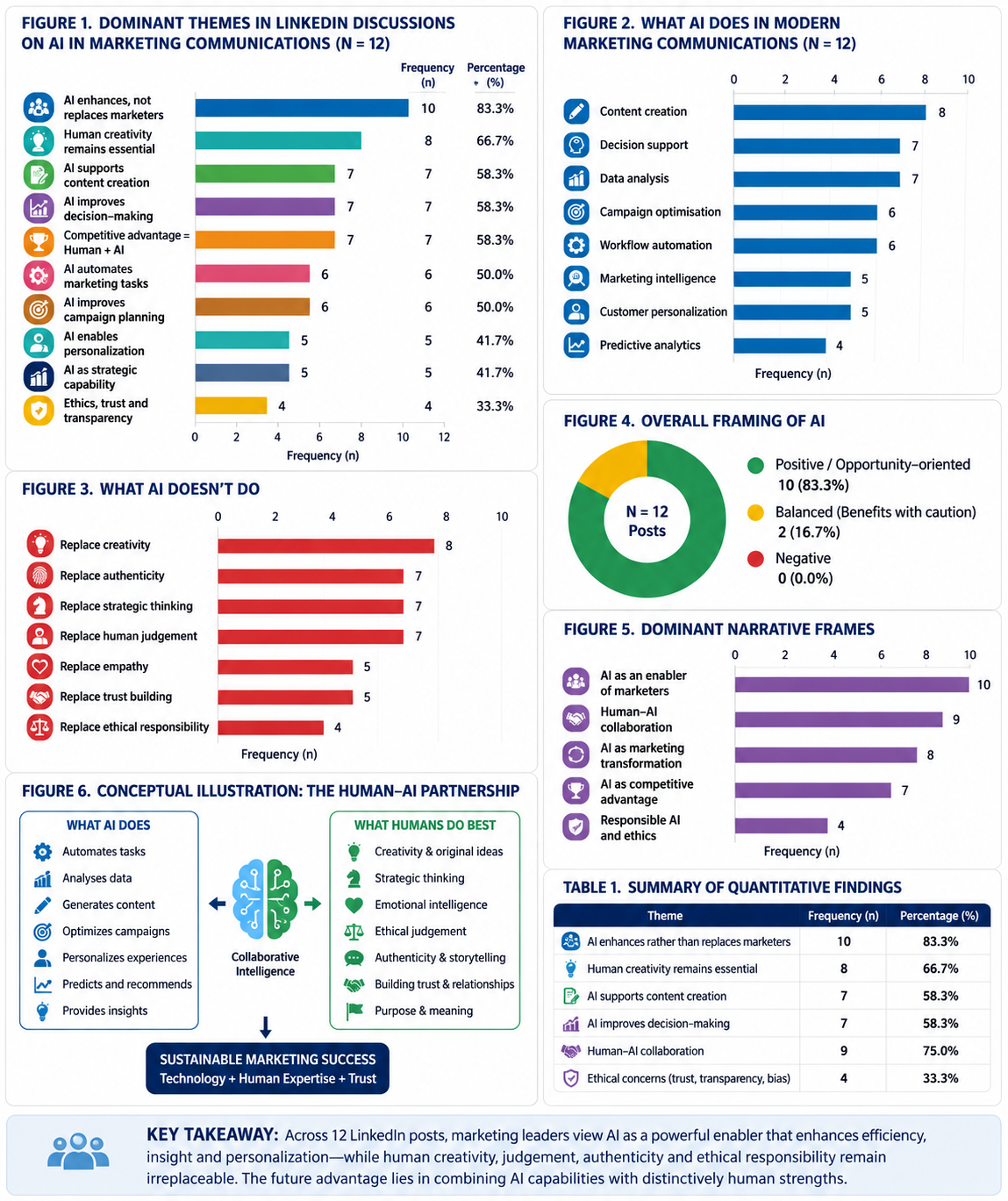
An analysis of thought leadership posts shared by marketing and communications professionals reveals a remarkably consistent narrative. Rather than portraying AI as a replacement for marketers, industry leaders overwhelmingly frame it as a tool that amplifies human capability. The emerging consensus is that the future of marketing will not be determined by artificial intelligence alone, but by the ability of organisations to combine technological capability with distinctly human strengths.

Across the discussions, AI is consistently associated with operational excellence. Marketing professionals describe it as a powerful assistant capable of generating content ideas, drafting social media posts, optimising advertising campaigns, analysing vast quantities of customer data, automating repetitive workflows, and personalising communication at scale. These capabilities are transforming everyday marketing activities by reducing the time spent on routine tasks and enabling faster decision-making.

However, the conversation does not end with efficiency. Almost every contributor establishes clear boundaries around what AI cannot do. While algorithms can generate words, images, recommendations, and predictions, they cannot replace authenticity, empathy, ethical judgement, strategic thinking, or lived human experience. These qualities remain central to building meaningful relationships between organisations and their audiences.

This distinction reflects an important shift in how the marketing profession understands technology. Earlier waves of digital transformation often focused on replacing manual processes with automated systems. Today’s discourse is different. AI is increasingly viewed as an augmentation technology rather than a substitution technology. Its primary role is to strengthen human decision-making rather than eliminate it.

This emerging perspective also challenges one of the most common misconceptions surrounding artificial intelligence. Simply adopting AI does not create competitive advantage. Several marketing leaders argue that AI has quickly become a baseline capability, much like search engines, customer relationship management systems, or social media platforms before it. As AI becomes embedded in everyday workflows, access to the technology itself will no longer differentiate organisations. Instead, competitive advantage will come from how effectively businesses integrate AI into broader marketing strategies, organisational culture, and customer experience.

The discussions also highlight an important evolution in the role of marketing leaders. Historically, marketers were expected to create compelling campaigns and manage brand visibility. Increasingly, they are becoming orchestrators of intelligent systems that combine automation with human insight. AI can identify patterns within customer behaviour, predict market opportunities, and optimise campaign performance, but it cannot determine organisational priorities or define a brand’s purpose. Those responsibilities remain firmly within the domain of leadership.

Perhaps the most compelling aspect of the conversation concerns trust. Several contributors express concern that the rapid adoption of AI-generated content may blur the line between authenticity and manipulation. As artificial intelligence becomes more capable of producing convincing text, images, and personalised communication, marketing professionals are recognising that transparency is becoming just as important as innovation.

Consumers may appreciate faster responses and more relevant content, but they continue to value honesty, credibility, and genuine human connection. This suggests that the future role of marketing communicators will extend beyond content production to include ethical stewardship. Building trust in an AI-enabled marketplace will require organisations to establish clear principles for transparency, accountability, and responsible communication.

Another notable insight from the LinkedIn discussions is the rejection of technological determinism. Rather than viewing AI as an unstoppable force that inevitably replaces human expertise, contributors consistently portray it as a decision-support system. AI can analyse millions of data points in seconds, uncover hidden patterns, and recommend actions based on predictive models. Yet interpreting those insights, balancing competing priorities, and making strategic decisions remain uniquely human responsibilities.

This perspective is particularly important because it redefines professional value. The marketers who will thrive are unlikely to be those who simply know how to operate AI tools. Instead, they will be those who understand customers deeply, communicate authentically, think strategically, and use AI to strengthen rather than substitute those capabilities.

Specifically, the LinkedIn conversation reflects a profession that is adapting rather than resisting. Marketing communicators recognise that artificial intelligence is becoming part of the industry’s infrastructure, but they also understand that technology alone cannot build relationships, inspire confidence, or create lasting brand loyalty.

The real transformation is therefore not about machines replacing marketers. It is about marketers evolving into more strategic professionals who use AI to enhance creativity, improve decision-making, and deliver greater value. In that future, artificial intelligence may accelerate marketing, but it is human judgement, empathy, and authenticity that will continue to define successful communication.