DD
MM
YYYY

PAGES

DD
MM
YYYY

spot_img

PAGES

Home Blog Page 120

Odds of a December Rate Cut in U.S. Jump to Over 80%

0

Market odds for the U.S. Federal Reserve implementing an interest rate cut at its December 9-10, 2025, FOMC meeting have indeed risen sharply in recent days, surpassing 80% for at least a 25 basis point (bps) reduction.

This shift reflects evolving comments from key Fed officials, mixed economic data amid a government shutdown delaying key reports, and trader sentiment captured in tools like the CME FedWatch.

New York Fed President John Williams, a key FOMC influencer, indicated on November 21 that the central bank has “scope to lower borrowing costs in the near term,” boosting cut expectations. Fed Governor Christopher Waller followed on November 24, calling a December cut “appropriate” due to a softening labor market, while downplaying recent strong jobs data as likely to be revised lower.

San Francisco Fed President Mary Daly also shifted to support a cut. These remarks counterbalanced earlier hawkish notes from officials like Boston’s Susan Collins, who highlighted resilient demand and inflation risks.

Delayed September jobs data released mid-November showed 119,000 jobs added—stronger than expected—but the unemployment rate ticked up to 4.4%. Inflation edged to 3% annually, creating tension between the Fed’s dual mandates.

With October and November data still pending due to the shutdown, policymakers are relying on proxies like ADP payrolls and the Beige Book due November 26, tilting sentiment toward easing to support employment.

Odds flipped from ~30% just a week ago post-jobs data to over 80% now, driving gains in equity futures like the Nasdaq 100 up 0.46% premarket on November 24. A cut would lower the federal funds rate to 3.50%-3.75%, following prior reductions in September and October.

Current Probabilities from CME FedWatch based on 30-Day Fed Funds futures prices, here’s the implied probability distribution for the target rate post-December meeting. 75-82% primarily a 25 bps move, up from 32% on November 20 and 67% chance of a hold on November 21.

These are market-implied odds, not official Fed views. FOMC minutes from October showed division, with “several” favoring a cut and “many” preferring a pause. Firms like Deutsche Bank and Citigroup still call for a cut but label it a “close call,” while J.P. Morgan and Standard Chartered now forecast a hold, citing data gaps raising misinterpretation risks.

The Federal Reserve’s Beige Book, scheduled for release on November 26, 2025, at 2:00 p.m. ET, provides a qualitative snapshot of U.S. economic conditions across its 12 districts, covering roughly October through early November.

Released two weeks before the December 9-10 FOMC meeting, it holds outsized influence this cycle due to government shutdown delays in key quantitative data like October CPI/PPI and jobs reports.

Without those hard numbers, the Beige Book’s anecdotal insights—from business contacts on hiring, spending, manufacturing, and prices—could tip the scales on whether the Fed opts for a 25 bps cut current odds ~80%, a pause, or more aggressive easing.

Historically, Beige Books have swayed market expectations by ~10-20 percentage points in cut probabilities when they diverge from prior data trends, as seen in the October 2025 edition that reinforced easing by highlighting “slight” employment gains and “moderate” price rises.

Based on recent Fed speeches, private surveys like ISM manufacturing at 48.5 in October, signaling contraction, and district anecdotes. Modest expansion overall, with services holding up but manufacturing softening in the Midwest and Southeast due to auto sector woes and export weakness.

Employment: Stable to slightly cooling, with wage growth at pre-pandemic levels ~3-4% but hiring pauses in tech and retail amid consumer caution.

Prices: Easing to low-moderate 2-3% YoY, though sticky in housing and food; districts like New York and Dallas may flag persistent shelter costs.

Mixed—resilient in essentials but waning in discretionary as holiday outlook dims. Likely “cautiously optimistic,” aligning with the October book’s summary of “modest growth” and no recession signals, but with more emphasis on labor softening to support Fed doves like Waller.

Analysts from ING and Guggenheim anticipate it will “greenlight” further cuts by underscoring balanced risks, potentially solidifying the pivot to neutral rates in 2026. However, hawkish surprises could echo the divided FOMC from October minutes.

The Beige Book’s district-by-district granularity could amplify or mute recent dovish shifts from officials like Williams and Daly. These draw from how past Beige Books moved markets, e.g., the July 2025 report’s “sluggish” tone boosted September cut odds by 15 points.

Counters recent official dovishness; stocks dip 0.5%, 10Y Treasury yield rises 5 bps. Revives January hold debates. A dovish-leaning Beige Book would likely lock in the third consecutive 25 bps cut, lowering the fed funds rate to 3.50-3.75% and signaling 1-2 more in 2026 amid 2% inflation targets.

It could also ease USD pressure DXY down ~0.3-0.5% and lift risk assets, per recent patterns. Conversely, a hawkish tilt might highlight data gaps’ risks, prompting Powell to stress “wait-and-see” in his December presser.

Watch for phraseology shifts: “slight” vs. “modest” growth or “easing” vs. “stable” prices often correlate with policy pivots. Post-release, odds could recalibrate within hours, with traders parsing the summary for FOMC voting clues.

A no-cut scenario could pressure stocks, but Waller emphasized the Fed’s data flexibility. Watch upcoming releases like the Beige Book and private payrolls for further shifts—odds could swing again before the meeting. If enacted, this would mark the third straight cut, signaling a pivot toward neutral policy in 2026.


Galaxy Digital Explores Liquidity Market Making for Polymarket and Kalshi

0

Galaxy Digital, the crypto-focused investment firm led by Mike Novogratz, is reportedly in advanced discussions to serve as a liquidity provider and market maker for two leading prediction market platforms: Polymarket a decentralized crypto-based platform and Kalshi a regulated U.S.-based exchange.

This move comes amid explosive growth in the prediction markets sector, which has amassed over $42.4 billion in cumulative trading volume since 2020, with a current market size estimated at around $9 billion.

By stepping in as a market maker, Galaxy would help ensure tighter spreads and deeper order books on these platforms, making it easier for traders to bet on real-world outcomes like elections, economic data, sports events, or cultural trends.

Polymarket and Kalshi currently dominate the space, handling billions in bets—Polymarket alone saw over $3.3 billion in volume during the 2024 U.S. election cycle. Prediction markets are gaining traction as “truth serums” for gauging public sentiment, with integrations into mainstream tools like Google Finance and even NHL betting partnerships.

Galaxy’s involvement could bridge traditional finance and crypto, positioning these markets as reliable barometers for everything from inflation forecasts to pop culture winners. While Polymarket operates on blockchain and has faced U.S. scrutiny, Kalshi is CFTC-regulated, allowing fiat bets.

Galaxy’s entry could help navigate these waters, especially as U.S. regulators warm to prediction markets post-elections. No formal agreements have been announced yet, but sources indicate talks are progressing quickly, potentially launching services in early 2026.

This aligns with Galaxy’s strategy to expand beyond spot trading into derivatives and niche markets. Mike Novogratz, views blend optimism about long-term adoption with pragmatic caution on short-term volatility.

He’s emphasized macro factors like Federal Reserve policy, institutional inflows, and regulatory clarity as major drivers, while noting the market’s current “sluggish” phase due to rebalancing by long-term holders.

Novogratz has refined his BTC forecasts multiple times this year, adjusting for economic realities like potential Fed dovishness under a new chair post-Jerome Powell’s term. He’s skeptical of ultra-bullish calls but sees upside from policy shifts.

Market consolidation after earlier gains; lighter leverage and slower institutional activity. Expects a rebound but not explosive highs without “crazy stuff” like premature Trump influence on the Fed or quick passage of the CLARITY Act (crypto market structure bill).

A highly dovish Fed appointment could trigger a “megacycle.” This would boost liquidity but risk U.S. economic stability and Fed independence. BTC could replace gold as a store of value with sustained adoption from institutions, nations, and younger generations. Driven by fiat debasement and BTC’s role as “digital gold.”

Novogratz is particularly bullish on ETH, viewing it as undervalued with strong utility in DeFi and staking. He’s highlighted emerging “ETH treasury” strategies by public companies as a growth catalyst.

Expects ETH to outperform BTC in the next 3–6 months, breaking above $4,000 by year-end from current levels around $3,000–$3,500. Reasons include a “really short” market low supply, powerful narratives around decentralization, and new ETH-holding corporates like SharpLink Gaming ($SBET).

Solana (SOL): Heavy Galaxy exposure; sees growth in new ecosystems but warns smaller players may struggle for “oxygen” as majors consolidate.

Hyperliquid (HYPE): Calls perp equity trading a “big idea” for leverage-hungry crypto users; predicts ecosystem boom.

Novogratz frames 2025’s crypto rally as powered by AI integration, eroding trust in traditional finance, and policy wins. Total market cap hit $4T earlier this year but has cooled.Institutional Adoption: “Institutions are here” – balance sheet buyers like BTC/ETH treasuries injecting billions.

Expects banks’ entry via new regs to accelerate this; crypto treasuries have “peaked” but will evolve into diversified reserves like ReserveOne. USD stablecoins will reinforce dollar dominance; FX markets could become “stablecoin markets” in under 5 years. Galaxy backs MiCAR-compliant euro stablecoins like EURAU.

Bi-partisan wins like the recent market structure bill are “huge”; full CLARITY Act passage could unleash “tremendous participation.” A dovish Trump-era Fed is the “biggest bull catalyst,” but risks inflation.

Galaxy’s pivoting BTC mining to AI data centers up to 2.5GW; AI drove much of 2025’s rally, with miners finding “better returns in AI than crypto.” Short-term “wet blanket” from holder diversification; needs retail “cavalry” and $BTC retake of $91K for momentum.

Global trust erosion post-GFC vibes underpins the bull case – “stay long crypto.” Novogratz’s track record is mixed – he nailed institutional inflows but missed some 2021–2024 calls.

Overall, he’s “long-term greedy” on crypto as a hedge against fiat debasement and a builder of the next financial system. For Galaxy ($GLXY) specifics, he stresses 2030+ horizons in crypto and AI.

Nasdaq-Listed Biotech Firm Enlivex Raises $212M for RAIN Token Treasury Strategy

0

Enlivex Therapeutics (NASDAQ: ENLV), a microcap biopharmaceutical company focused on immunotherapy treatments, announced plans to raise $212 million through a private investment in public equity (PIPE) deal to implement a pioneering “Digital Asset Treasury” (DAT) strategy centered on the RAIN token.

The funds will be used to build a corporate treasury holding RAIN, the native token of Rain, a decentralized prediction market platform built on blockchain technology that allows users to bet on real-world events like elections or sports outcomes.

This marks one of the first instances of a publicly traded company shifting significant treasury reserves into a crypto-based prediction market asset, blending traditional biotech with Web3 finance.

The announcement triggered a massive surge in RAIN’s price, which jumped over 120% in the past 24 hours, reflecting heightened investor interest in prediction markets amid growing mainstream adoption.

Enlivex, which has a market cap under $50 million and is developing treatments for sepsis and solid tumors, emphasized that this move won’t detract from its core biotech operations but will diversify its balance sheet.

The PIPE involves institutional investors, with closing expected soon, potentially signaling a broader trend of TradFi firms exploring crypto treasuries.

San Francisco Thief Poses as Delivery Driver in $11M Crypto Heist

In a brazen home invasion, a thief disguised as a delivery worker tricked his way into a residence in San Francisco’s upscale Mission Dolores neighborhood and fled with a victim’s cellphone, laptop, and approximately $11 million worth of cryptocurrency.

The suspect, described as a Black male in his 30s wearing a hoodie and carrying a fake delivery box, rang the doorbell around 10 a.m., claiming to have a package for the homeowner.

Once inside, the intruder quickly overpowered the resident, grabbed the devices, and accessed the crypto wallets—likely using the phone or laptop to transfer the funds before escaping on foot.

The exact type of cryptocurrency stolen (e.g., Bitcoin, Ethereum) hasn’t been disclosed, but the theft highlights ongoing vulnerabilities in self-custody setups where hardware like phones and laptops hold private keys.

No arrests have been made, and the San Francisco Police Department (SFPD) is investigating, urging residents to verify delivery personnel and use multi-factor authentication for crypto assets. This incident echoes rising crypto-related burglaries in the Bay Area, where thieves target high-value holders using public data from social media or blockchain explorers.

RAIN is a decentralized prediction market platform built on blockchain primarily Berachain, an EVM-compatible Layer-1 using Proof-of-Liquidity consensus. It lets users create and trade binary outcome markets on virtually any real-world event — elections, sports, crypto prices, weather, news headlines, etc. — using crypto as collateral.

Anyone can create a market by paying a small fee in $RAIN.  “Will Donald Trump win the 2028 U.S. Presidential Election?” (Yes/No outcome). The creator sets resolution source (e.g., official election results, CoinGecko price at a specific time, etc.).

When a market is created, two ERC-20 tokens are minted: YES shares. NO sharesInitially priced near 0.50 each total liquidity = $1 per share pair. Users buy YES or NO shares with USDC the main trading pair.

If you think the answer is YES, you buy YES shares. If the event happens, each YES share redeems for $1; NO shares become worthless and vice versa. RAIN uses a custom constant-function AMM similar to Polymarket’s, but optimized for Berachain.

Liquidity providers deposit USDC and earn trading fees + $RAIN token rewards. The more liquidity, the tighter the spreads and the larger the bets the market can handle. After the event ends, a decentralized oracle currently UMA’s optimistic oracle integrated on Berachain confirms the outcome.

Winning shares (YES or NO) can be redeemed 1:1 for USDC. Losing shares become worthless. Nasdaq-listed Enlivex (ENLV) is raising $212M to hold $RAIN as corporate treasury. Trading fees (0.5–1%) partially buy back & burn $RAIN or go to treasury.

Liquidity providers and top traders receive $RAIN emissions very high APRs right now to bootstrap liquidity. $RAIN holders will vote on protocol parameters, oracle security, etc. Enlivex’s $212M raise is essentially a giant bet that holding $RAIN will outperform cash or BTC on their balance sheet.

RAIN is essentially “Polymarket on steroids” for the Berachain ecosystem: same prediction-market mechanics, but with a high-emission native token that rewards participation and has attracted massive speculative interest especially after the Enlivex news.

It’s still very early launched mid-2025, highly volatile, and heavily driven by token incentives right now, but it’s one of the fastest-growing prediction market platforms in crypto as of November 2025.

CBN Holds MPR at 27% as Doubts Grow Over Credibility of Nigeria’s Inflation Data

0

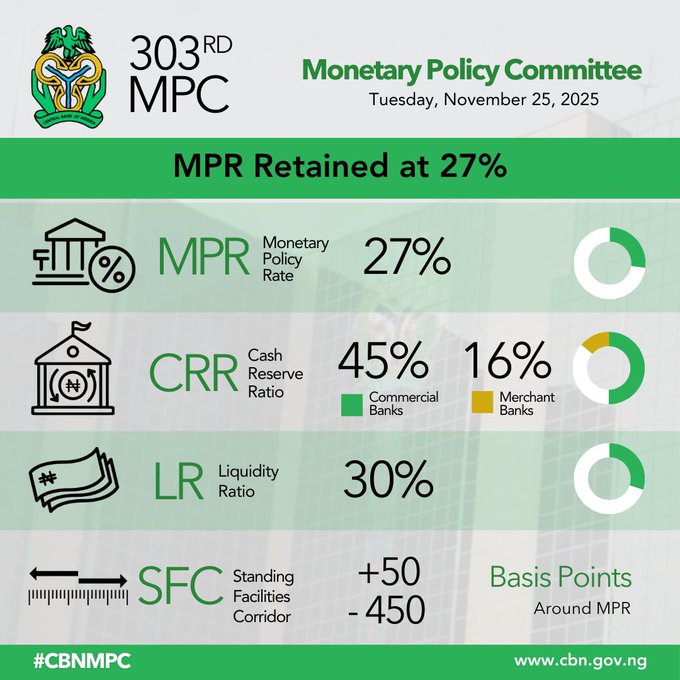
The Central Bank of Nigeria has kept the Monetary Policy Rate at 27 percent, a decision that has stirred fresh debate over the credibility of the inflation numbers published by the National Bureau of Statistics.

The MPC meeting in Abuja ended with all major policy levers unchanged, maintaining the aggressive tightening stance that has defined recent monetary decisions.

The hold on the benchmark rate came only days after the NBS announced that Nigeria’s inflation had eased to the mid-16 percent range. That announcement triggered widespread expectations that the MPC would take the first step toward loosening rates, especially since inflation had supposedly dropped far below the 27 percent policy rate. Instead, the committee froze every knob on its dashboard, signaling that the bank either sees risks that the public cannot yet see or doubts the data placed before it.

This tension has been brewing for months, but Monday’s outcome pushed it into open conversation. Analysts argue that if the NBS figures were considered reliable by the apex bank, the MPC would have begun cutting the policy rate to bring the interest environment closer to the inflation curve. Instead, the CBN maintained the MPR and preserved the architecture of its tightening regime.

Economist Kelvin Emmanuel, who has repeatedly questioned the credibility of the NBS numbers, did not mince words.

“NBS says inflation rate is dropping but the MPC has held the MPR at 27% and someone who’s dancing to be noticed at the Villa is coming to tell you that the reason CBN has refused to cut rates to align inflation to interest yield curve is because they are avoiding an inverted yield curve. Play politics with everything including statistics,” he said.

The move by the MPC has therefore added to the growing sentiment that monetary authorities may be privately discarding the NBS inflation reports when making policy decisions. Several analysts point to the gap between the lived reality of Nigerians—where food prices refuse to drop—and the official numbers that suggest significant easing.

Meanwhile, policy parameters around liquidity and banking operations were also left untouched. The Cash Reserve Ratio remains at 45 percent for commercial banks and 16 percent for merchant banks, with the 75 percent CRR on non-TSA public sector deposits still in place. The Liquidity Ratio stays at 30 percent. The CBN also adjusted the standing facilities corridor to plus 50 and minus 450 basis points around the MPR, tightening overnight borrowing conditions while widening the discount window on deposits.

The bank’s decision signals that it is not yet convinced that domestic cost pressures have settled at a level safe enough for easing, regardless of what is printed in the monthly inflation bulletins. It also suggests that stability in the FX market and a clearer trend in price movement remain the bank’s priority, even as businesses and consumers continue to grapple with elevated borrowing costs.

With this hold, the CBN has again placed a bet on caution in an environment where inflation, FX volatility, and weak production still shape economic decisions.

$1B Target in Sight: BlockDAG’s $436M+ Presale, Beat Vesting, & New Leadership Surpass DOGE and AVAX Momentum

0

Crypto momentum in 2025 is shifting toward verifiable execution and structural upgrades rather than short-term hype. Dogecoin (DOGE) has regained traction following Bit Origin’s $500 million acquisition plan, yet technical resistance limits its recovery. Avalanche (AVAX) remains under pressure despite its upcoming Granite upgrade, showing how major networks struggle to sustain growth amid liquidity contraction.

In contrast, BlockDAG (BDAG) is accelerating with precision. The now active Beat Vesting program boosts every buyer’s BDAG allocation at the same price, tightening supply and reinforcing value integrity. With over $436 million raised in presale so far and new leadership arriving from Ethereum and Cardano, BlockDAG’s upgraded framework targets a $1 billion launch market cap, redefining how the 2025 top crypto coins landscape rewards transparency, structure, and long-term accountability over hype-driven speculation.

DOGE Price Outlook Shows Fragile Recovery Signs

Dogecoin (DOGE) trades near $0.1588, gaining 2.4% daily but remaining below its MA-20 ($0.1708), MA-50 ($0.1972), and MA-200 ($0.2089), a structure confirming lingering bearish bias. Despite technical weakness, sentiment received a boost after Bit Origin announced a planned $500 million DOGE acquisition to strengthen utility and mainstream adoption. Trading volumes surged over 43%, and whale accumulation continued, yet oscillators such as MACD and ADX still favor sellers.

On shorter timeframes, RSI (40.9) and CCI (–95.6) suggest consolidation between $0.145 and $0.165, with breakout potential below 20%. Analysts consider DOGE’s current stabilization a staging area rather than a reversal; its recovery path depends on renewed liquidity inflows from large holders.

While the coin maintains its top-ten ranking by market cap, the DOGE price outlook remains cautiously neutral. Until structural strength returns above $0.179, DOGE is likely to lag behind infrastructure-driven plays among 2025’s top crypto coins.

AVAX Trend Signal Weakens Despite Upgrade Plans

Avalanche (AVAX) continues to test market patience, trading at $14.21, down 1.3% on the day and trending below all major EMAs. The Avalanche (AVAX) trend signal remains bearish, as the 20-EMA ($14.46), 50-EMA ($14.69), 100-EMA ($15.07), and 200-EMA ($15.68) all slope downward. RSI (38.9) reflects weakening momentum, and a drop below $13.90 could push AVAX toward $13.20 before any rebound.

Despite this, development advances continue, Polkadot-style governance refinements and the Granite upgrade aim to improve settlement speed and fee efficiency. Yet these technical positives arrive amid sustained DeFi contraction and $1.48 million in recent net outflows.

Traders await post-upgrade performance metrics before committing new capital. For now, AVAX is confined to $14–$15, with upside dependent on renewed DeFi engagement. Though fundamentally strong, Avalanche’s momentum remains compressed, leaving it trailing execution-led ecosystems such as BlockDAG within the evolving top crypto coins landscape.

BlockDAG Beat Vesting and New Leadership Drive $1B Goal

BlockDAG (BDAG) is steering the 2025 top crypto coins narrative with one of the most decisive presale transformations in recent history. The introduction of Beat Vesting has reshaped the entire value framework, buyers now receive more BDAG at the same price, instantly amplifying allocation strength while constraining active circulation, fueling both demand momentum and long-term investor confidence. This upgrade reinforces market trust and supply integrity, paving the way for a projected $1 billion launch market cap.

Currently priced at $0.0078 in Batch 33, BlockDAG has surpassed $436 million in presale with only 4.1 billion coins remaining before its February 10, 2026 close. This structure merges fairness with strategic scarcity, ensuring that every presale phase aligns with a stronger, more stable launch profile.

Adding to this momentum, two industry veterans, an early Ethereum core founder and a former senior Cardano executive, will officially join BlockDAG’s team next week, marking a leadership evolution aligned with institutional growth. This shift moves BlockDAG beyond promotional mechanics into engineered scalability and executional depth.

Beat Vesting doesn’t just improve token distribution; it defines a new standard for equitable crypto economics. As presales mature, BlockDAG stands alone in converting structural innovation into measurable market value, solidifying its place among 2025’s most credible, performance-driven contenders in the top crypto coins category.

Wrapping Up

The divide across 2025’s top crypto coins underscores a new market reality. Dogecoin faces limits turning sentiment into sustainable growth, while Avalanche continues balancing technical upgrades against broader liquidity strain. In contrast, BlockDAG (BDAG) advances with structured precision, its Beat Vesting rollout, $436 million presale milestone, and incoming leadership from Ethereum and Cardano marking a shift from presale promise to scalable execution.

This evolution defines BDAG’s clear path toward a $1 billion launch market cap, proving that verified structure and leadership depth now drive value more than volatility. As liquidity moves toward projects built on transparency and accountability, BlockDAG stands as the benchmark for infrastructure-first progress, illustrating that in 2025, measurable delivery, not hype, will determine which contenders dominate the next growth phase.

Presale: https://purchase.blockdag.network

Website: https://blockdag.network

Telegram: https://t.me/blockDAGnetworkOfficial

Discord: https://discord.gg/Q7BxghMVyu