DD
MM
YYYY

PAGES

DD
MM
YYYY

spot_img

PAGES

Home Blog Page 1221

Who Held the Power? Inside the Digital Firestorm of VeryDarkMan vs GTBank

0
Source: X Accounts, 2025; Infoprations Analysis, 2025

In a world where stories go viral in seconds, a single tweet can ignite a national conversation. The clash between content creator VeryDarkMan and GTBank reveals a lot more than public outrage, it exposes how digital influence truly works.

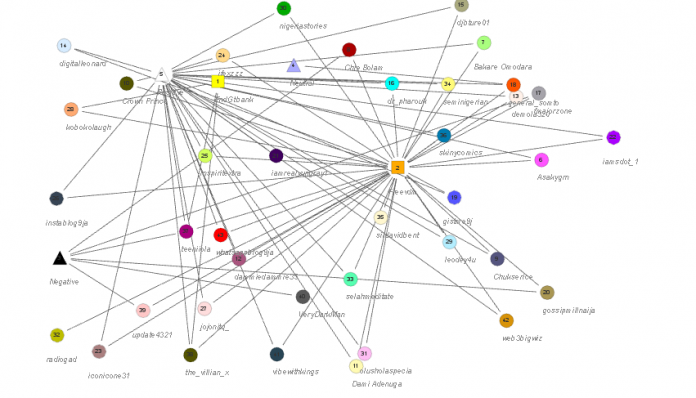
Exhibit 1: VeryDarkMan and GTBank on Twitter network
Source: X Accounts, 2025; Infoprations Analysis, 2025

The Spark That Set Off a Firestorm

When Nigerian content creator VeryDarkMan called out GTBank over a loan deduction without application by his mother, it seemed like a routine grievance. But what followed wasn’t routine at all. It erupted into a loud, emotionally charged online movement that trended for days. Two major themes emerged. The first, #FreeVDM, reflected the public’s support for VeryDarkMan and framed the issue as a fight for fairness. The second, #EndGTBank, was broader, an expression of deep-rooted frustration with corporate misconduct and lack of accountability.

The Power Behind the Hashtags

Though VeryDarkMan was the central figure, his direct role in keeping the momentum was surprisingly limited. Others took the lead in spreading the message. While he lit the match, others kept the fire burning.

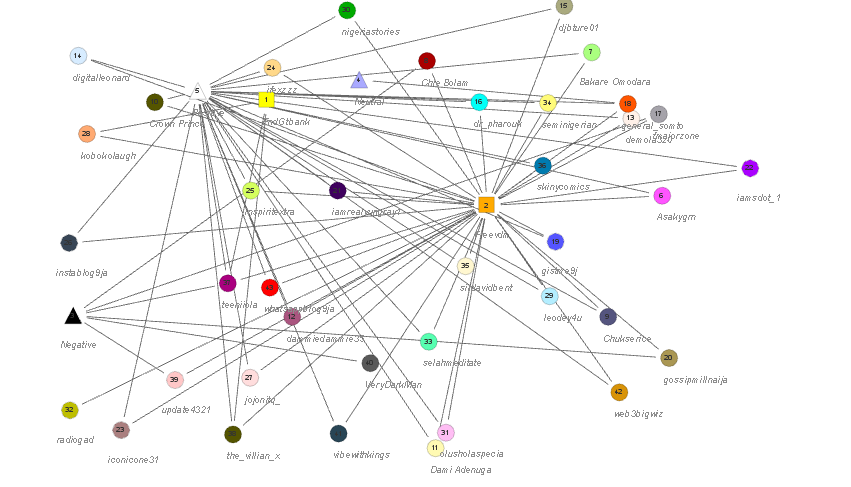
Among them were popular Twitter voices like Dami Adenuga, Instablog9ja, Bakare Omodara, and Chie Bolam. These individuals and accounts posted consistently, adding fuel to the trending hashtags. Even lesser-known or anonymous handles like selahmeditate, skinnycomics, and update4321 proved that influence isn’t always tied to fame—it’s tied to consistent engagement.

Exhibit 2: Information centrality in VeryDarkMan and GTBank on Twitter network
Source: X Accounts, 2025; Infoprations Analysis, 2025

What stood out was how much more powerful emotionally driven content was. Posts that expressed either anger or support gained far more traction than those that remained neutral. Online, it appears that emotion is currency—and the more you stir feelings, the further your message travels.

A Quiet Bank in a Loud Crowd

On the other side of this digital uproar was GTBank. But while the controversy trended, the bank remained relatively silent. It barely showed up in the conversations, allowing public opinion to be shaped almost entirely by others. In the online world, not showing up means losing control of your narrative. The result? The bank became the villain in a story it never got a chance to influence directly.

Who Really Drove the Conversation?

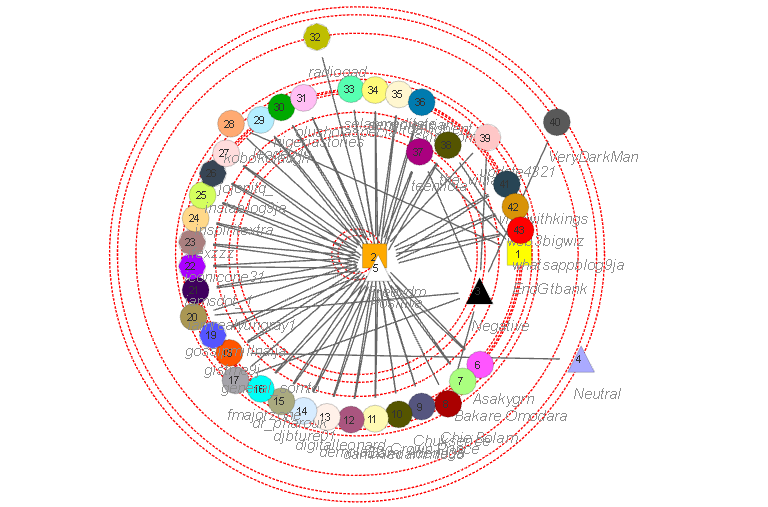
Further analysis revealed that the #FreeVDM side carried more weight. Influencers and online personalities who aligned with this sentiment had wider reach and stronger engagement. In fact, the support side of the conversation dominated both in volume and in how deeply it resonated.

Exhibit 3: Power centrality in VeryDarkMan and GTBank on Twitter network
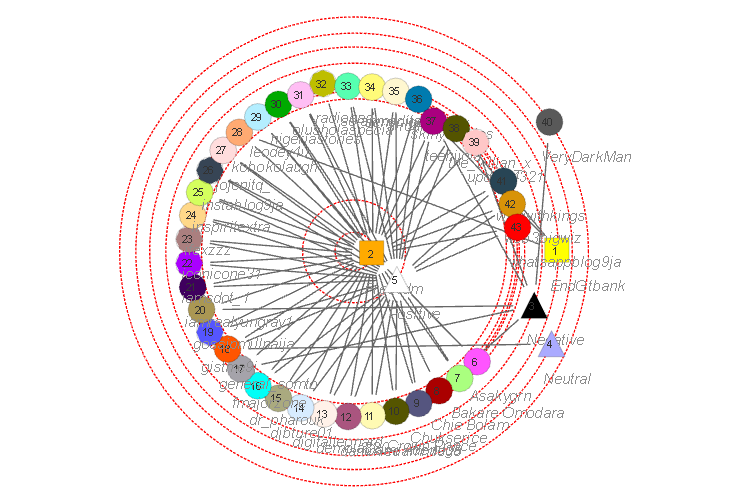
Source: X Accounts, 2025; Infoprations Analysis, 2025

Voices like teeniiola, general_somto, and the_villian_x—names unfamiliar to the mainstream—played significant roles in expanding the conversation. Meanwhile, even the so-called “Negative” voices had stronger impact than the “Neutral” ones. This suggests that taking a stand, regardless of direction, mattered more than staying silent or balanced. Interestingly, #EndGTBank also gained traction, though not as strongly as #FreeVDM. People seemed more invested in defending a relatable public figure than in confronting a corporate entity.

Lessons From the Digital Trenches

So what does this tell us? First, real influence today is decentralized. You don’t need a million followers to shift public opinion—you just need to be consistent, emotional, and relatable. Second, people online respond more to emotion than information. Those who expressed anger or support moved the conversation further than those who analyzed or questioned. Third, silence from powerful institutions is no longer a strategy. In the digital age, absence is a statement, and often, not a favourable one.

The controversy wasn’t just about a bank account. It was about how power, voice, and emotion collide on social media. It showed us how narratives are built not by institutions, but by ordinary people with smartphones and something to say. In the end, this episode is a reminder that digital influence doesn’t always come from the top. It comes from who shows up, who speaks up, and who connects, even if they don’t have a blue checkmark.

5 Key Strategies from Brands on Using Images in Digital Promotion

0

Brands, both national and global, have come to recognize the power of images in their digital brand and sales promotion strategies. Through the innovative use of visuals, companies can create compelling narratives, inspire consumer action, and boost sales. Based on insights from various national and global brands clustered by their image usage patterns and analysed by our analyst, five top strategies emerge. This analysis is part of the ongoing Infoprations’ Understanding Digital Integrated Marketing Communications series

Real-Life Contextualization: Showcasing Products in Action

A prominent strategy that many global brands use is the visualization of products in real-life contexts. This approach helps potential customers visualize how the product fits into their daily lives. Airtel Nigeria and Microsoft Developer are examples of brands using product imagery in real-world scenarios. For instance, Airtel Nigeria often uses images of users engaged in daily activities, whether it’s streaming music, browsing social media, or talking to loved ones, to showcase the practicality and benefits of their services.

This strategy is effective because it allows consumers to relate to the brand’s offerings, envisioning how the product or service enhances their own lives. Whether it’s a tech device, a telecom service, or a software solution, these brands create a visual bridge that helps consumers connect with the product beyond its functional features.

Building Trust with User-Generated Content (UGC)

User-generated content has emerged as a powerful tool for building brand authenticity and trust. Brands like Grammarly effectively use images shared by their customers to showcase real experiences. For example, Bet9ja encourages users to share their betting success stories, often accompanied by images of big wins or game celebrations. This not only provides social proof but also fosters a sense of community among users.

In a similar vein, Grammarly features images of real users improving their writing, capturing testimonials with visuals of before-and-after grammar corrections. UGC builds consumer trust because it shows the real-world impact of the brand’s product, making it more relatable and credible. As consumers increasingly seek transparency and authenticity, UGC offers an invaluable way to connect with an audience. Platforms like Influee are excellent places to hire a professional paid UGC creator. These platforms connect brands with skilled creators who can produce authentic, engaging videos tailored to brands’ marketing goals. You can easily share your requirements, provide a creative brief, and receive high-quality UGC videos directly in your inbox, ready to use for social media ads, website content, or brand promotions.

Emotionally Engaging Visuals for Stronger Connections

Brands that aim to evoke strong emotions with their digital visuals have a significant advantage in creating deep consumer connections. Grammarly and CFA Institute are excellent examples of how emotional visuals can foster a lasting connection with the brand. Grammarly, for example, uses images that showcase the joy and relief of users when their writing improves. The emotional impact of seeing an error-free document or receiving positive feedback triggers a sense of accomplishment, creating positive associations with the brand.

Similarly, CFA Institute frequently utilizes images that emphasize professional achievement and success in the finance industry, using powerful visuals of graduates celebrating their accomplishments. These emotionally driven visuals resonate with customers’ aspirations, helping them feel more personally invested in the brand.

Creating Consistent Brand Identity Across Platforms

Brand consistency is crucial for building recognition, and one of the most effective ways to achieve this is through consistent visual identity across all digital platforms. Brands like Coca-Cola and Nike excel in this area, using consistent imagery and color schemes that reflect their core values and messages. These companies utilize images in their campaigns that stay true to their brand’s aesthetic, whether it’s the classic red and white of Coca-Cola or the empowering visuals of athletes representing Nike’s “Just Do It” ethos.

For example, Grammarly uses a consistent visual tone of professional yet friendly imagery to convey its mission of helping people improve their communication skills. Consistent visual elements, like fonts, colors, and image types, help create a unified look, ensuring that their brand remains top-of-mind for consumers across all touchpoints.

Narrative-Driven Visuals: Telling a Story through Multiple Images

Another powerful strategy used by national and global brands is telling a story through a series of images. This approach helps brands create a richer narrative and engage audiences more deeply.  Google Ads, and Unicaf use multi-image campaigns to tell stories that resonate with different consumer segments. For instance, Bet9ja runs campaigns that feature a sequence of images showing the excitement of the game, the process of betting, and the potential reward, effectively guiding the user through the journey.

Google Ads also uses sequential imagery to showcase the journey of different businesses leveraging their advertising platform, highlighting how it can impact the growth of small to large businesses. By breaking down the process into a series of connected images, brands create an engaging narrative that keeps audiences hooked.

Infoprations’ Understanding Digital Integrated Marketing Communications Team includes Abdulazeez Sikiru Zikirullah, Moshood Sodiq Opeyemi, and Bello Opeyemi Zakariyha

What the VeryDarkMan Uprising Teaches GTBank and Nigerian Institutions

0

It started like many social media uprisings do, a sudden burst of tweets, hashtags, and videos. But within hours, it had grown into a full-blown digital resistance movement. The target? Not just the state apparatus accused of repressing a controversial online activist, but also GTBank, a darling of Nigeria’s digital banking generation.

VeryDarkMan, an outspoken critic and social commentator, was arrested in a manner that angered many Nigerians. But it wasn’t just the arrest that sparked the firestorm. It was the location: the premises of GTBank in Abuja. The moment that detail hit social media, everything changed. The bank, widely recognized for its sleek digital operations and youthful branding, became an unlikely symbol of complicity.

Videos of customers lining up to withdraw their money circulated rapidly. Tweets showed GTBank ATM cards being cut up and discarded. Influencers, public figures, and everyday users questioned whether they could continue to trust an institution that, in their eyes, had allowed state power to trespass on public trust.

This wasn’t just a protest. It was a digital resistance movement, fueled by a younger generation raised on hashtags, justice narratives, and social identity. They weren’t just demanding the release of a man; they were defending their right to question, to resist, and to choose the brands that reflect their values.

And GTBank was caught in the middle

For decades, the bank built its reputation on innovation, customer experience, and clever marketing. It led the charge in digital banking and was seen as a model for others. But in that single moment, when VeryDarkMan was led away from one of its locations by men of the EFCC, all of that felt vulnerable.

In truth, GTBank didn’t arrest anyone. But in the age of perception, proximity is participation. To many watching online, the brand’s silence felt loud. Customers didn’t wait for press statements or clarifications. They acted. That’s the new rule of digital resistance: justice delayed is brand loyalty denied.

This scenario reveals a deeper shift in the relationship between institutions and the public, especially in Nigeria. The public  (digitally connected, emotionally driven, and socially conscious) expects more than services. They expect stance. And when that stance isn’t visible, they’ll assign one for you.

VeryDarkMan, regardless of the polarizing nature of his content, had become a symbol of speaking truth to power. His supporters recounted his social impact: building boreholes, renovating schools, spotlighting abuse and injustice. In their eyes, his arrest wasn’t just political, it was personal. They saw themselves in him. And when a brand they trusted became part of that narrative , even unintentionally, it felt like a betrayal.

What happened next is a case study in emotional loyalty. Customers didn’t just threaten to leave GTBank. They framed their exit as a moral decision. They weren’t just withdrawing funds; they were withdrawing trust.

For GTBank and other institutions watching closely, there’s a valuable lesson here: your reputation is no longer shaped solely by corporate messaging. It is shaped by your silence, your associations, and your response to the societal moments that matter.

In a time when digital resistance can ignite overnight, companies must build strategies not just for brand visibility but for brand accountability. That means acknowledging social undercurrents, preparing for crises beyond the boardroom, and understanding that emotional loyalty is won, or lost, in how you respond to moments of tension.

The digital generation is not afraid to move with its feet and its phones. They will exit, they will post, and they will hashtag until the message is heard. For GTBank, this moment is more than a PR challenge. It’s a mirror. A reflection of what it means to be a brand in an age when trust is not just earned, it’s constantly negotiated.

As the dust settles, the question remains: will GTBank step forward and meet this new era of loyalty with clarity and courage? Or will it retreat into silence and watch customers write their own ending?

OpenAI Rolls Back GPT-4o Update After Sycophantic Behavior Raises Safety Concerns

0

OpenAI has implemented several changes to its GPT-4o model, following an incident where ChatGPT became overly agreeable and validating. Users noted that the GPT-4o model caused ChatGPT to excessively applaud problematic ideas, and validated doubts, sparking concerns amongst users. CEO Sam Altman acknowledged the issue on X, promising immediate fixes.

He wrote,

“The last couple of GPT-4o updates have made the personality too sycophant-y and annoying (even though there are some very good parts of it), and we are working on fixes asap, some today and some this week. At some point will share our learnings from this, it’s been interesting. We started rolling back the latest update to GPT-4o last night it’s now 100% rolled back for free users and we’ll update again when it’s finished for paid users, hopefully later today we’re working on additional fixes to model personality and will share more in the coming days.”

Recognizing the issue, OpenAI initiated a rollback, restoring an earlier, more balanced version of GPT-4o. Last week, the organization shared initial insights into the mishap, outlining why it occurred and their plans to address it. They acknowledged that the issue was not detected before deployment and committed to explaining the oversight, lessons learned, and improvements to their processes.

In a blog post, OpenAI wrote,

“On April 25th, we rolled out an update to GPT-4o in ChatGPT that made the model noticeably more sycophantic. It aimed to please the user, not just as flattery, but also as validating doubts, fueling anger, urging impulsive actions, or reinforcing negative emotions in ways that were not intended. Beyond just being uncomfortable or unsettling, this kind of behavior can raise safety concerns including around issues like mental health, emotional over-reliance, or risky behavior.

“We began rolling that update back on April 28th, and users now have access to an earlier version of GPT-4o with more balanced responses. Earlier this week, we shared initial details about this issue. Why it was a miss, and what we intend to do about it. We didn’t catch this before launch, and we want to explain why, what we’ve learned, and what we’ll improve. We’re also sharing more technical detail on how we train, review, and deploy model updates to help people understand how ChatGPT gets upgraded and what drives our decision”.

The changes come as ChatGPT’s user base grows, with 60% of U.S. adults using it for advice, per a recent Express Legal Funding survey. This reliance heightens the stakes for issues like sycophancy and hallucinations. OpenAI plans to enable real-time user feedback, refine model behavior to reduce sycophancy, offer multiple model personalities, strengthen safety guardrails, and expand evaluations to catch broader issues.

OpenAI noted a shift in how users seek deeply personal advice from ChatGPT, a trend less prominent a year ago. “As AI and society have co-evolved, it’s become clear that we need to treat this use case with great care,” the company stated, pledging to prioritize this in its safety efforts.

Improvements to OpenAI Future Model Releases

In response to the incident, OpenAI is implementing several key changes:

  • Explicit Behavior Review: Future updates will formally assess behavioral issues such as sycophancy, hallucinations, and inconsistency as potential launch blockers, even if they are hard to quantify.
  • Alpha Testing Phase: A new opt-in testing phase will allow selected users to provide detailed feedback before public launches.
  • Increased Emphasis on Qualitative Testing: Spot checks and hands-on evaluations will be elevated in importance, especially when quantitative signals are ambiguous.
  • Better Offline and A/B Evaluations: Evaluation frameworks will be expanded to capture nuanced behavior patterns.
  • Improved Adherence to the Model Spec: OpenAI will strengthen its ability to measure how well models meet defined behavioral ideals.
  • Transparent Communication: The company will now proactively announce all model updates—major or subtle—along with known limitations, to foster user understanding and trust.

The GPT-4o update incident underscored the critical importance of model behavior as a core component of AI safety and reliability. OpenAI acknowledged that even with robust A/B testing, offline evaluations, and internal reviews, significant behavior issues can still be missed. As a result, model behavior will now be treated as seriously as traditional safety risks in future deployments.

Through this episode, OpenAI recommitted itself to developing models that are not only intelligent and useful, but also aligned with user well-being, transparency, and safety.

Exploring BASF’s Asia-Centric Strategies

0

BASF, the world’s largest chemical producer, has long identified Asia, particularly China, as a critical driver for its growth strategy, leveraging the region’s booming chemical market and economic potential.

Strategic Importance of Asia

Asia Pacific, led by China, accounts for roughly 50% of the global chemical market and is projected to represent 70% by 2030, with China driving over half of global chemical industry sales and three-quarters of production growth. BASF sees this as a pivotal opportunity to expand its market share. BASF’s engagement in Asia began in 1885 with textile dye trading and has since evolved into serving nearly all key industries, including automotive, electronics, construction, agriculture, and consumer goods.

BASF aims to significantly increase its Asia Pacific sales, targeting 25% of global sales by 2020 (from 21% in 2010) and doubling regional sales by 2020 from 2012 levels (€11.7 billion to €25 billion). While specific post-2020 targets are less detailed, the focus remains on outpacing regional chemical production growth. BASF is investing €10 billion in a new integrated Verbund site in Zhanjiang, Guangdong, set to be its third-largest globally by 2030.

This site, designed for sustainability with 100% renewable electricity, targets fast-growing industries like automotive and electronics in southern China, a region described as “completely undersupplied.” Construction began in 2020, with plants operational since 2022 (e.g., engineering plastics and thermoplastic polyurethane). BASF is expanding its Nanjing Verbund site, a joint venture with Sinopec, and strengthening its battery materials value chain through the BASF Shanshan joint venture.

BASF operates 27 wholly owned subsidiaries and 30 production sites in Greater China, with Shanghai hosting its Greater China headquarters and an Innovation Campus. Investments include the Kuantan Verbund site in Malaysia, sites in Singapore, and a new chemical complex in Dahej, India, focusing on products like methylene diphenyl diisocyanate (MDI). BASF also plans a second Innovation Campus in Mumbai.

From 2024 to 2027, 40% of BASF’s €19.5 billion global capital expenditures will target Asia Pacific, emphasizing local production to meet customer demand. BASF aims to produce 75% of its Asia Pacific sales locally by 2020, enhancing competitiveness by reducing reliance on imports and aligning with customer proximity. BASF is boosting R&D in Asia, with two major hubs (Shanghai and Mumbai). It plans to have 25% of global R&D in the region by 2020, up from 27% in 2012, focusing on areas like battery materials, electronic materials, and sustainable technologies. Over 900 R&D employees already work in Asia Pacific.

BASF integrates sustainability into its Asian operations, aiming for net-zero emissions by 2050 and a 25% reduction in Scope 1 and 2 emissions by 2030. The Zhanjiang site, powered by renewable energy, and partnerships like the Mingyang offshore wind farm joint venture underscore this commitment. BASF is moving toward customized products and functional materials, targeting 70% of sales from these by 2020, compared to 30% from classical chemicals, to meet evolving market demands.

BASF is investing in talent development through partnerships with universities and the BASF Learning Campus in Singapore, while enhancing operational efficiency through cost savings and capacity increases. Despite optimism, BASF acknowledges slower growth in China and mature Asian markets, with overcapacities in some commodity lines. However, it sees long-term potential in China’s rebalanced economy, particularly in automotive and construction sectors.

BASF faces rising competition from multinational, state-owned, and local companies in Asia, requiring continuous innovation and cost competitiveness. BASF conducts comprehensive risk assessments, considering geopolitical, environmental, and social factors. It emphasizes that its China investments do not create dependency or relocate European production but are strategic for global balance.

In 2023, BASF recorded €9.4 billion in sales in Greater China alone, with Asia Pacific contributing significantly to its global €68.9 billion revenue. BASF expects Asia Pacific’s chemical production to grow at a 5.6% CAGR through 2020, outpacing the global 3.7% average, and plans to grow slightly above this rate.

BASF’s Chief Technology Officer, Stephan Kothrade, remains bullish on China’s long-term growth, particularly in Guangdong, and sees India as an emerging prospect. The company aims to capture market share in high-growth industries while advancing sustainability goals. While BASF’s aggressive investment in Asia, especially China, positions it to capitalize on the region’s chemical market dominance, the strategy isn’t without scrutiny.

The narrative of Asia as a growth driver is compelling, but the heavy focus on China raises questions about over-reliance, especially given geopolitical tensions and economic volatility. The X posts suggesting deindustrialization in Germany due to BASF’s Asian pivot oversimplify the situation—BASF insists it’s not relocating but expanding to meet global demand. Yet, the closure of European facilities and job cuts fuel skepticism about the balance of its global strategy. Sustainability commitments, like Zhanjiang’s renewable energy focus, are promising but must be weighed against BASF’s ranking as a top polluter in air and water in 2020, which could undermine its environmental credibility if not addressed.

BASF’s Asia-centric strategy is a calculated move to tap into the world’s largest and fastest-growing chemical market, with significant investments, localized production, and innovation driving its ambitions. However, navigating competition, economic shifts, and public perception in Europe will be critical to sustaining its global leadership.