DD
MM
YYYY

PAGES

DD
MM
YYYY

spot_img

PAGES

Home Blog Page 13

Ripple’s (XRP) $10 Dream in 2025 Dies as New Coin Below $0.003 Takes Over as the Best Crypto to Buy Now

0

The crypto market is entering a brutal phase for altcoins, and XRP is at the center of the breakdown. Its long-awaited push toward $10 looks more distant than ever, especially after today’s decisive crack below the $2.00 support.  Meanwhile, a new presale coin, Little Pepe (LILPEPE), priced under $0.003, is capturing market attention as a high-momentum opportunity with 2025 upside that XRP can no longer promise. As confidence drains from older alts, early-stage meme coins with real ecosystems are quickly becoming the dominant narrative. Below, we break down why XRP’s situation is turning from concerning to critical, and why many investors are now redirecting capital into Little Pepe’s fast-moving presale.

XRP’s $10 Narrative Falls Apart as Price Crashes Below $2.00

XRP’s drop today wasn’t just another red candle; it was a structural breakdown. The chart sliced under the $2.00 support, a level bulls absolutely needed to defend. On-chain data confirms that 42% of XRP holders purchased around $3, meaning a significant block of holders is now sitting on 40%+ losses. That’s the exact kind of pressure that triggers capitulation during weak market conditions.
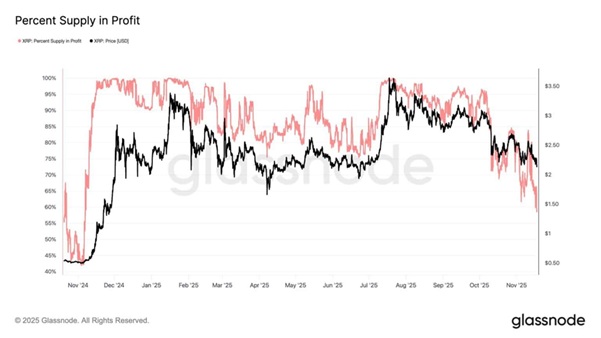

XRP Holders’ Percent Supply in Profit | Source: Glassnode

Sentiment is already terrible, altcoins are bleeding across the board, and Bitcoin’s dominance is climbing to 58.45%, indicating that investors are fleeing alts altogether. Even Bitwise’s new spot XRP ETF listing on NYSE Arca, something that should have been a bullish catalyst, failed to provide any lift. Instead, whales dumped 190 million XRP in 24 hours, a clear rejection of the bullish ETF narrative. Everything now points to the same conclusion: the $10 dream isn’t just delayed; it’s slipping out of reach.

Technical Breakdown Suggests More Pain Ahead

Today’s candle sent XRP to a fresh low, briefly bouncing back from a small demand pocket at $1.94. The wick shows buyers are attempting to defend the level, but the pressure remains heavy and emotional. XRP’s RSI collapsing near 18 tells you the market is massively oversold, often the precursor to a temporary relief move.
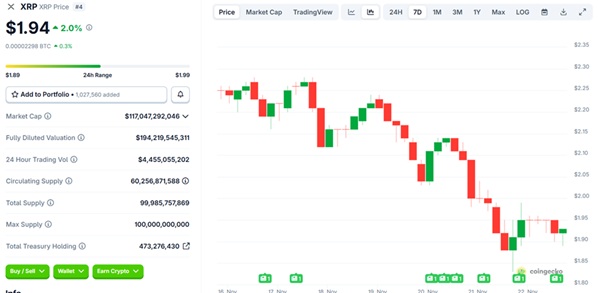

XRP Price Chart | Source: CoinGecko

Bulls can still push the XRP price above $2 if the current level holds. However, if XRP fails to maintain this zone, the next liquidity magnet is around $1.90, and that level could easily become a trapdoor for a deeper slide. Currently, the entire structure is teetering between a brief bounce and a full continuation breakdown, and momentum is leaning toward weakness unless buyers step in with force.

Little Pepe Surges as Investors Rotate Into High-Growth Low-Cap Plays

With XRP struggling, traders are pivoting toward early-stage tokens that offer explosive upside with minimal capital required. That’s where Little Pepe (LILPEPE) has separated itself from the rest of the pack. Priced under $0.003, this meme-powered ecosystem is building on a sniper-bot-resistant EVM Layer 2, delivering zero buy/sell tax, near-zero trading fees, and a meme-exclusive launchpad that will roll out post-launch. The presale has already raised over $27.6 million, with more than 16.7 billion tokens sold, confirming intense demand from retail investors. Stages are selling out rapidly, and LILPEPE now sits on CoinMarketCap with a confirmed $0.003 launch price and a $300 million market cap at listing.  Add the CertiK audit, strict vesting (0% at TGE with a 3-month cliff), and high staking APY, and it becomes clear why investors view LILPEPE as the safer high-reward play compared to bleeding large caps. The crypto market isn’t showing a nice picture of legacy tokens. Currently, attention is focused on fresh legs with enough fuel to run.

Why Analysts Say LILPEPE Could Be the Top Crypto to Buy in 2025

Ripple’s $10 dream is fading, but the opportunity for a new breakout project is emerging. Little Pepe’s fundamentals position it as one of the few meme coins capable of delivering a massive 2025 run. Analysts point to three core reasons:

  • Low entry price below $0.003 makes early multiples realistic
  • Layer 2 infrastructure gives it utility that older meme coins never had
  • Presale momentum mirrors early-stage SHIB and PEPE before their exponential rallies

With retail liquidity rotating and altcoins struggling, LILPEPE is becoming the clear favorite for traders searching for the next notable upside wave. XRP’s breakdown may be painful, but it’s also revealing where the real opportunity is now.

For more information about Little Pepe (LILPEPE) visit the links below:

Website: https://littlepepe.com

Whitepaper: https://littlepepe.com/whitepaper.pdf

Telegram: https://t.me/littlepepetoken

Twitter/X: https://x.com/littlepepetoken

$777k Giveaway: https://littlepepe.com/777k-giveaway/

Happy Birthday, Ifeoma

0

It is Christmas, a day we remember the beginning of that journey from miry clay to pastures of hope and redemption for the birth of our Christ Jesus. In our family, it is also a special day as we celebrate my best friend and wife, Ifeoma, on her birthday.

I celebrate her uncommon grace in managing everyone with grace and love: “2pm, there is an early dismissal for [son]. I will remind you again at 1:45pm.” Yes, she makes sure nothing important slips through the cracks even though she has more important daily tasks, seeing her patients. Ifeoma is an accomplished professional woman, the first proofreader of my best work, and the finest project manager I know. She makes me better every day.

A true scholar with five academic degrees, she balances intellectual excellence with an unalloyed commitment to family and a deep respect for the divine institution of marriage. In a world that often demands trade-offs, Ifeoma has shown me that purpose, professionalism, and partnership can coexist. I am a village boy, and she treasures a union with this villager! Thanks.

This year, she did something that touched me deeply and for which I will publicly thank her. When my mother had a fall and was not making rapid progress with treatment in Nigeria, Ifeoma left the United States to bring her here for better care. She then took weeks of leave to ensure that the surgery and recovery went well. She joined the operating room. After what can only be described as a God-directed scientific miracle in an American hospital, with everything successful, she traveled again, quietly living out the testimony of a virtuous woman. A selfless and uncommon devotion so much that my mother noted that Christmas truly sent her son multiple blessings.

It was during a layover in Europe that I asked for this photo to be taken, just to check if she was still smiling. And yes, she was, still smiling, still strong. Baby, thank you. Tochi, Emeka, and I appreciate you deeply.

Good People, join me in wishing her a happy birthday and many more years filled with grace, wisdom, and good health. She is the endless love of my life, and Ovim’s special gift to this village boy from Ovim. And let me also add Merry Christmas from our family to yours.

PZ Cussons Nigeria Swings to N37.9bn PBT in H1 2025 as FX Gains, Asset Sales Drive Turnaround

0

PZ Cussons Nigeria Plc has reported a sharp return to profitability in its unaudited results for the half year ended 30 November 2025, posting a pre-tax profit of N37.9 billion.

This marks a significant reversal from the N5.5 billion pre-tax loss recorded in the corresponding period of 2024, underscoring the scale of the recovery achieved within one year.

The turnaround was supported largely by a strong second-quarter performance, with Q2 pre-tax earnings of N16.3 billion, alongside a combination of stronger revenue, foreign exchange gains, a surge in other income, and a steep reduction in finance costs. Together, these factors helped restore profitability after a difficult prior year marked by currency losses and high borrowing costs.

For the six-month period, revenue rose to N127.9 billion, representing a year-on-year increase of 32.59% from N96.4 billion. The growth was driven by sustained demand across the company’s Hygiene, Baby, Beauty, Food & Nutrition, and Electricals segments, suggesting that consumer demand for its core brands remained resilient despite broader macroeconomic pressures.

Cost of sales climbed to N93.6 billion, up 34.80% year on year, reflecting higher input and operating costs. Even so, gross profit expanded to N34.2 billion, a 26.91% increase, indicating that the company was able to preserve margins to a large extent while growing volumes and revenue.

Operating performance improved markedly. Selling and distribution expenses rose sharply to N11.6 billion, an increase of 46%, largely in line with higher sales activity and distribution costs. Administrative expenses, however, edged down slightly to N8.02 billion from N8.08 billion in the prior period, offering some cost stability.

A major boost came from foreign exchange movements. PZ Cussons Nigeria recorded an FX gain of N8.6 billion, reversing the N15.1 billion loss suffered in the same period of 2024, a swing that significantly altered the earnings profile. In addition, other income surged to N14.7 billion, up more than fourteenfold year on year. Most of this was driven by a N14.2 billion profit on the disposal of fixed assets, supplemented by rental income of N412.7 million and scrap sales of N150.3 million.

These developments helped operations swing decisively from a N3.3 billion loss in the first half of 2024 to an operating profit of N37.9 billion in the current period.

On the financing side, the company benefited from a sharp reduction in borrowing costs. Finance costs were cut to N473.7 million from N2.7 billion a year earlier, while interest income stood at N431.4 million. This easing of finance expenses provided further support to earnings, allowing the group to convert operating gains into a strong bottom-line performance.

After accounting for income tax of N16.4 billion, profit after tax came in at N21.4 billion, confirming the strength of the rebound.

The balance sheet also showed signs of stabilization. Total assets increased to N179.4 billion, up 6.23% from N168.9 billion in the prior period. Inventories stood at N66.2 billion, while cash and cash equivalents rose to N45.5 billion, providing improved liquidity. Total equity rebounded to N4 billion from a negative position of N17.3 billion previously, reflecting the impact of the return to profitability.

Retained earnings remained in negative territory at N18.2 billion, but this represented a significant improvement from the N38.7 billion loss recorded earlier. On the liabilities side, total obligations were reduced to N175.3 billion from N186.2 billion, pointing to some deleveraging during the period.

On the equities market, the improved financial performance has been reflected in investor sentiment. PZ Cussons Nigeria shares have returned 93.42% year to date on the Nigerian Exchange as of the close of trading on 23 December 2025, placing the stock among the stronger performers on the bourse this year.

Overall, the half-year results point to a decisive reset for PZ Cussons Nigeria, with earnings recovery driven not only by revenue growth but also by currency gains, asset disposals, and lower finance costs. The sustainability of this performance will likely depend on how much of the improvement can be maintained beyond one-off income and how the company navigates cost pressures and currency dynamics in the second half of the financial year.

Nigeria’s Fiscal Strain Deepens as H1 2025 Deficit hits N5.7tn Amid Weak Revenue and Rising Borrowing

0

Nigeria recorded a fiscal deficit of about N5.7 trillion in the first six months of 2025, underscoring the persistent strain on public finances as revenue continues to lag far behind expenditure, even as government borrowing intensifies.

Data from the Q1 and Q2 2025 Budget Implementation Reports released by the Budget Office of the Federation show that while deficits came in below budgeted projections for both quarters, they were substantially higher than levels recorded in the same period of 2024. The figures point to a widening structural gap between what the government earns and what it spends, leaving borrowing as the primary tool for keeping the budget afloat.

In the first quarter of 2025, the Federal Government posted a fiscal deficit of N3.04 trillion. Although this was N481.81 billion, or 13.67 percent, lower than the projected quarterly deficit of N3.53 trillion, it more than doubled the N1.47 trillion deficit recorded in Q1 2024. Financing for the shortfall relied overwhelmingly on domestic borrowing, which accounted for N3.30 trillion, supplemented by N57.16 billion from privatization proceeds and N70.11 billion from multilateral and bilateral project-tied loans.

The second quarter showed a slight moderation. The fiscal deficit for Q2 2025 stood at N2.66 trillion, which was N865.14 billion, or 24.52 percent, below the projected N3.53 trillion for the quarter. This also marked an improvement from the N3.17 trillion deficit recorded in Q2 2024. Even so, borrowing remained central to financing, with domestic sources contributing N2.80 trillion.

External financing played a much larger role in the second quarter than in the first. Multilateral and bilateral project-tied loans surged to N1.60 trillion, alongside N7.76 billion in privatization proceeds. The Budget Office said the Q2 deficit translated to a deficit-to-GDP ratio of 2.64 percent, which is within Nigeria’s 3 percent ceiling and below the ECOWAS convergence threshold.

Taken together, the two quarters bring Nigeria’s total fiscal deficit for the first half of 2025 to about N5.7 trillion. While the fact that the deficits were below projections offers some relief, the absolute size of the shortfall highlights the depth of the country’s fiscal imbalance. The government continues to spend far more than it earns, with limited progress in closing the revenue gap.

A major driver of the deficit remains weak revenue performance, particularly from oil. Despite year-on-year improvements, actual oil receipts fell far short of budget assumptions in both quarters. In Q1 2025, gross oil revenue stood at N4.55 trillion, representing a massive N8.21 trillion shortfall, or 64.35 percent, from the prorated quarterly target of N12.76 trillion. While this was N1.20 trillion higher than the N3.35 trillion recorded in Q1 2024, it still exposed the fragility of oil-dependent revenue planning.

Gross non-oil revenue in Q1 also underperformed, coming in at N4.71 trillion, which was N1.34 trillion, or 22.18 percent, below the quarterly estimate of N6.05 trillion. After statutory deductions, net distributable revenue to the federal, state, and local governments stood at N8.06 trillion, a shortfall of N8.79 trillion, or 52.16 percent, from projections.

In the second quarter, oil revenue edged up slightly to N4.77 trillion but remained deeply below expectations, missing the quarterly target by N7.99 trillion, or 62.62 percent. Compared with Q2 2024, oil revenue rose by N1.59 trillion, reflecting a 33.33 percent increase, but the improvement was not enough to meaningfully change the fiscal picture.

Non-oil revenue showed mixed signals. Gross non-oil revenue in Q2 rose to N4.46 trillion, recording a positive variance of N404.26 billion, or 6.68 percent, above projections. Even with that improvement, net distributable revenue for all tiers of government reached N9.85 trillion, still N7.01 trillion, or 41.58 percent, below budget expectations.

The Budget Office attributed the persistent revenue gaps to ongoing challenges in the oil sector, including production constraints, price volatility, and structural inefficiencies in revenue remittance. These weaknesses continue to undermine budget assumptions, even as oil revenue shows modest year-on-year gains.

The pressure on public finances is being compounded by rising expenditure demands, particularly debt servicing and recurrent spending. With borrowing increasingly skewed toward domestic sources, concerns are growing about debt sustainability, higher interest costs, and the potential crowding out of private sector credit if revenue mobilization does not improve in the second half of the year.

The situation also builds on an already fragile fiscal position. Nigeria’s fiscal deficit rose sharply to N13.51 trillion in 2024, exceeding targets and breaching the Fiscal Responsibility Act 2007 deficit-to-GDP limit, according to earlier reports. That backdrop makes the continued build-up of deficits in 2025 especially worrying for policymakers and investors alike.

While the government has leaned more on concessional external loans to manage financing costs and support capital projects, the data suggests that borrowing alone cannot resolve the underlying imbalance. Without stronger and more reliable revenue streams, particularly from oil and non-oil sources, fiscal pressures are likely to persist.

As the year winds down, the report of the second half of 2025 will test whether recent improvements in non-oil revenue can be sustained and whether oil sector reforms translate into better collections. For now, the first-half numbers paint a clear picture: Nigeria’s fiscal challenges remain deeply rooted, with deficits narrowing against projections but widening against economic reality.

Nvidia Moves to Swallow Groq in $20bn Cash Deal, Signaling New Phase of AI Chip Consolidation

0

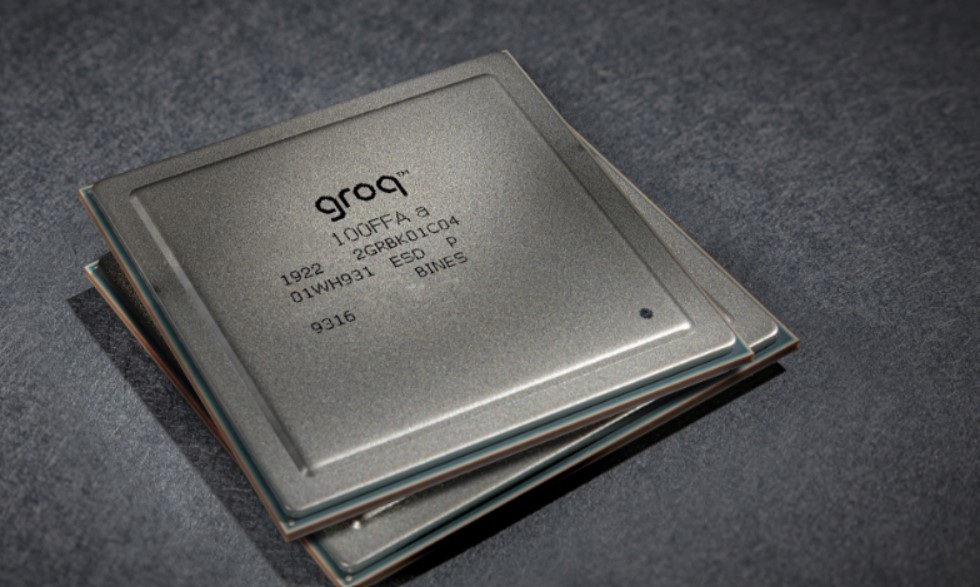
Nvidia has agreed to acquire Groq, a fast-rising designer of high-performance artificial intelligence accelerator chips, in a $20 billion all-cash deal that would rank as the largest acquisition in the chipmaker’s history, according to Alex Davis, chief executive of Disruptive, which led Groq’s most recent funding round.

Davis said the transaction came together rapidly, catching even long-time backers by surprise. Groq raised $750 million just three months ago at a valuation of about $6.9 billion, underscoring both the pace of capital inflows into the AI hardware space and the sharp premium Nvidia is now willing to pay to lock in strategic assets.

Investors in that September round included BlackRock, Neuberger Berman, Samsung, Cisco, Altimeter, and 1789 Capital, where Donald Trump Jr. is a partner. Groq is expected to formally notify its investors of the agreement later on Wednesday. The deal covers Groq’s core assets, though its early-stage Groq Cloud business is excluded, Davis said.

For Nvidia, the scale of the acquisition marks a clear departure from its historical playbook. The company’s biggest prior deal was the $7 billion purchase of Israeli networking specialist Mellanox in 2019. Since then, Nvidia’s balance sheet has ballooned alongside the AI boom. At the end of October, the company reported $60.6 billion in cash and short-term investments, up from $13.3 billion in early 2023, giving it the financial firepower to pursue transformative acquisitions without tapping the debt markets.

Groq, founded in 2016, has positioned itself as a specialist in inference-focused AI accelerators, chips designed to speed up the process by which large language models generate outputs once they are trained. With demand for inference capacity surging as AI systems move from experimentation to deployment, Groq has been targeting revenue of $500 million this year. Davis said the company was not seeking a buyer when Nvidia made its approach.

Groq’s roots trace back to Google’s internal AI hardware efforts. The company was founded by a group of former engineers, including chief executive Jonathan Ross, one of the creators of Google’s tensor processing unit, or TPU. TPUs have emerged as one of the few credible alternatives to Nvidia’s graphics processing units for certain AI workloads, particularly within Google’s own ecosystem.

In its initial SEC filing in late 2016, announcing a $10.3 million fundraising, Groq listed Ross alongside Douglas Wightman, an entrepreneur and former engineer at Google X, the company’s “moonshot factory.” Since then, Groq has steadily built a reputation for architectural efficiency and performance, attracting attention from both hyperscalers and investors hunting for ways to reduce reliance on Nvidia’s dominant GPU platform.

The proposed acquisition would therefore carry strategic weight beyond pure scale. By absorbing Groq, Nvidia would be neutralizing a potential rival in inference acceleration while folding its technology and talent into Nvidia’s own roadmap. It would also strengthen Nvidia’s grip on a market that is shifting from training-heavy workloads to inference at scale, a transition expected to define the next phase of AI infrastructure spending.

The deal also fits into a broader pattern of aggressive ecosystem investment by Nvidia. As its cash pile has grown, the company has backed a range of AI-linked ventures, from energy and data-center specialist Crusoe to model developer Cohere. It has also expanded its stake in CoreWeave, the AI-focused cloud provider that has been preparing for a public listing this year.

In September, Nvidia said it intended to invest up to $100 billion in OpenAI, with the startup committing to deploy at least 10 gigawatts of Nvidia products. While a formal agreement has yet to be announced, the scale of the proposed investment highlighted Nvidia’s willingness to anchor itself at every layer of the AI stack. That same month, Nvidia disclosed plans to invest $5 billion in Intel as part of a partnership, an unexpected alignment between two long-time rivals amid intensifying competition with Asian chipmakers.

Groq’s sale also comes as other AI chip startups reassess their paths. Cerebras Systems, another high-profile player known for its wafer-scale processors, pulled its planned initial public offering in October after raising more than $1 billion in a private funding round. In an SEC filing, Cerebras said it did not intend to proceed with the offering “at this time,” without giving a reason, though the company later told CNBC it still aims to list when conditions allow.

Taken together, these moves point to a market entering a new phase. The early wave of AI chip startups promised alternatives to Nvidia’s hardware dominance. Now, with Nvidia’s valuation, cash reserves, and strategic urgency at record levels, consolidation is accelerating.

If completed, the Groq acquisition would send a message that Nvidia is no longer content to simply supply the picks and shovels of the AI gold rush. It is increasingly intent on owning the mine.