DD
MM
YYYY

PAGES

DD
MM
YYYY

spot_img

PAGES

Home Blog Page 13

Glencore Wins Court Approval to Pursue $236 Million Claim Against Collapsed Prax Refinery

0

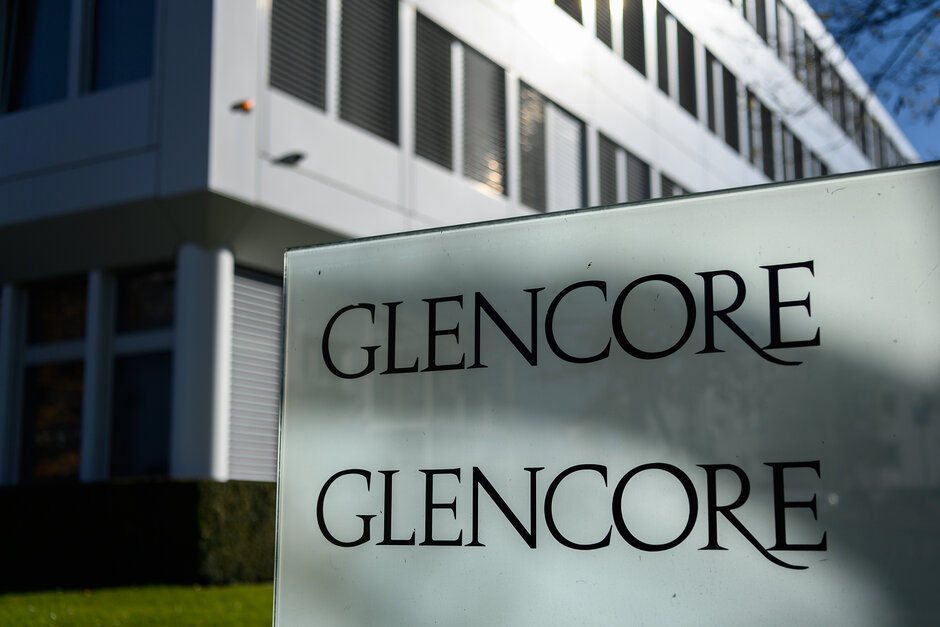
Commodities trader Glencore has won permission from London’s High Court to pursue a claim worth about $236 million against the collapsed Prax Lindsey refinery, opening another legal front in the fallout from the insolvency of the northern England oil business.

The London-listed company is seeking to recover crude oil it supplied to Prax before the refinery’s collapse last year, or the traceable proceeds from crude that was subsequently refined and sold. Because Prax Lindsey Oil Refinery Limited is in liquidation, Glencore needed approval from the High Court before it could bring the claim.

Judge William Trower granted that permission on Monday, rejecting an objection from the Official Receiver, which is overseeing the liquidation.

The ruling does not establish that Glencore is entitled to recover the full amount it is seeking. Instead, it allows the trader to pursue its case and attempt to identify crude oil or proceeds that can legally be traced to the supplies it provided.

The dispute centers on the 113,000-barrel-per-day Lindsey refinery, which supplied about 10% of the UK’s petrochemical needs before Prax’s collapse. The refinery was eventually acquired by US refiner Phillips 66 following a prolonged sale process earlier this year.

Glencore was the refinery’s exclusive crude supplier until Prax collapsed. The trader argues that it supplied crude based on representations by Prax’s former chief executive, Winston Soosaipillai, about the financial condition of the business.

The case is connected to allegations surrounding a £738 million ($987.6 million) securitization facility involving Prax companies. Glencore alleges that Soosaipillai fraudulently misrepresented Prax’s financial position and that the wider financing arrangement involved at least £334 million of fictitious invoices.

Soosaipillai is also facing separate litigation brought by administrators of the wider Prax group. Lawyers representing him in that case declined to comment on Glencore’s latest proceedings.

Soosaipillai has previously denied allegations of dishonesty. In a statement to the Financial Times in June, he said he had “always acted in good faith” to protect the refinery and described allegations of dishonesty as “untrue and offensive.”

The High Court ruling underpins the complexity of recovering commodities after they have moved through an industrial supply chain. Glencore is not simply seeking payment from an insolvent company. It is attempting to establish that specific crude oil, or money generated from that crude, can still be identified within assets controlled by the liquidators.

That development may really matter because crude supplied to a refinery is transformed through the refining process into multiple petroleum products. Once those products have been sold and proceeds have moved through different accounts, establishing a direct connection to the original commodity can become considerably more difficult.

Judge Trower acknowledged that Glencore could face difficulties tracing crude that had already been refined. But he concluded that the trader had “a seriously arguable case” that at least some of the relevant assets could be traced.

The decision therefore gives Glencore an opportunity to test its proprietary claims in court, rather than simply competing with other creditors for a share of whatever assets remain in the Prax estate.

The case is also part of the wider financial fallout from Prax’s collapse. The refinery was a significant industrial asset, but its failure has generated disputes involving commodity suppliers, lenders, administrators and other parties seeking to establish claims over assets and transactions that preceded the insolvency.

For Glencore, the stakes extend beyond an ordinary unpaid commodity invoice. If the company can establish a proprietary claim over identifiable crude or its proceeds, it could potentially recover assets ahead of creditors whose claims are limited to the general insolvency estate.

The next stage is expected to focus on tracing the crude and determining whether the evidence supports Glencore’s claim over particular assets. The High Court has allowed the case to proceed, but the eventual recovery will depend on what Glencore can establish through that process.


Australia’s Firmus Targets $5 Billion IPO as AI Data Centre Boom Tests Investor Appetite

0

Australian data center operator Firmus is preparing to launch what could become one of the largest initial public offerings in the country’s history, seeking to raise A$7 billion ($5 billion) as investors pour capital into the infrastructure needed to support the global artificial intelligence boom.

According to a term sheet reviewed by Reuters, Firmus plans to begin its institutional bookbuild on October 6 and close it on October 7, with the company’s prospectus expected to be lodged on October 8. Retail investors will be able to bid for shares from October 12 to October 19, while trading on the Australian Securities Exchange is scheduled to begin on October 22.

The offering would rank as the second-largest IPO in Australian history, behind Telstra’s A$10 billion listing in 1997. It would also rank as the world’s fourth-largest IPO so far this year, according to Dealogic data.

The scale of the proposed listing makes Firmus an important test of how investors are valuing companies that provide the physical infrastructure required for AI computing. The sector has attracted enormous investment as technology companies race to secure data centre capacity, power and advanced computing equipment, but concerns are growing over whether the pace of spending can be sustained.

Firmus, founded in 2019 by Oliver Curtis, Tim Rosenfield and Jonathan Levee, could raise as much as A$7.7 billion if an over-allotment option, or greenshoe, is exercised. The option would allow the company to raise an additional A$500 million.

The founders will remain subject to escrow arrangements after the listing, according to an investor presentation reviewed by Reuters. Only 10% of their shares would be released after one year, followed by a further 39.9% after two years.

The lock-up structure limits the amount of founder-held stock that can immediately enter the market, potentially providing greater visibility over the company’s shareholder base during the early stages of its life as a public company.

Firmus currently operates two data centers in Australia and Singapore and has another five facilities under development across the Asia-Pacific region. The expansion comes as demand for computing infrastructure accelerates alongside the rapid deployment of AI models and applications.

Data centers have become one of the biggest beneficiaries of the AI investment cycle. The growth of large language models and AI agents requires substantial computing capacity, creating demand not only for chips but also for facilities capable of housing and powering them.

That demand has helped turn data center capacity into a scarce infrastructure asset. Operators are competing for access to electricity, land, and network connections, while technology companies are increasingly signing long-term agreements to secure capacity before new facilities are completed.

But the same expansion that has created an opportunity for operators such as Firmus is generating a growing set of constraints.

Data centers consume large amounts of electricity and, depending on their cooling systems, significant quantities of water. Communities in Australia and other markets have been pushing back against new developments over concerns about their impact on local power grids, water supplies and surrounding areas.

Firmus itself has faced local opposition to planned projects in Australia, highlighting a central problem for the sector: securing financing may be easier than securing the physical resources and community support needed to turn that financing into operational capacity.

The company is also entering public markets at a time when some technology executives and investors are questioning the durability of the AI infrastructure boom. Billions of dollars are being committed to new facilities on the assumption that demand for AI computing will continue to grow rapidly, but the economics ultimately depend on technology companies continuing to spend heavily on training and running capable models.

The situation has resulted in a different risk profile from conventional infrastructure. Data centers can have long operating lives, but the pace of AI development means the type, location, and scale of computing demand can change rapidly.

Therefore, Firmus’ IPO is expected to provide a market test of whether the infrastructure layer of the AI economy can command valuations comparable to the technology companies driving demand for it.

The proposed offering also shows how the AI investment cycle is broadening beyond semiconductor manufacturers and software developers. Capital is increasingly flowing into the physical systems required to support AI, including data centers, power generation, cooling infrastructure and specialized computing facilities.

Firmus’ Asia-Pacific expansion gives it exposure to that broader trend, while also placing the company in markets where access to electricity and suitable land can become constraints on development.

The size of the IPO means its performance after listing could become an important signal for other companies seeking to raise capital for AI-related infrastructure. Industry analysts believe a strong reception would demonstrate that public-market investors remain willing to finance large data center expansion programmes even as concerns about AI spending grow. A weaker reception could make it harder for other infrastructure operators to raise money at the valuations they have been targeting.

However, the immediate challenge for Firmus is to convince investors that its growth plans are supported by durable demand rather than simply by the current surge in AI spending.

The company’s planned October 22 listing will put that question directly to the market. Its success will depend not only on how quickly AI demand grows, but on whether Firmus can convert that demand into long-term contracts, operating capacity and returns while navigating the difficult competition for power, land and public acceptance.

Paramount Weighs $1.5 Billion California Production Investment to Advance Warner Bros. Deal

0

Paramount Skydance is discussing a package of concessions with California officials that could include a $1.5 billion investment in film and television production in the state, as the company seeks to overcome one of the final legal obstacles to its proposed $110 billion acquisition of Warner Bros. Discovery.

The Wall Street Journal reported Sunday, citing people familiar with the negotiations, that Paramount and California Attorney General Rob Bonta’s office have discussed a range of measures that could form part of a settlement with California and 11 other states suing to block the deal.

The talks underscore the scale of concessions Paramount may need to offer to secure regulatory clearance for a transaction that would combine two major Hollywood studios and a broad portfolio of television networks and other media assets.

Among the measures under discussion is a commitment to invest $1.5 billion in production in California, according to the Journal. The parties have also discussed keeping Paramount’s and Warner Bros.’ studio lots in the state rather than selling either property.

California believes the production commitment could provide a direct economic argument for allowing the merger to proceed, particularly as the state competes with other jurisdictions for film and television activity. For Paramount, such an investment could form part of a broader effort to demonstrate that consolidation would not come at the expense of the state’s production industry.

The proposed agreement could also include penalties if Paramount fails to meet an earlier commitment to produce 30 movies a year following the merger. One possible remedy discussed is the divestiture of Paramount’s stake in Miramax, the film studio behind movies including “Pulp Fiction” and “No Country for Old Men,” the Journal reported.

Other possible concessions include selling some cable channels and establishing a board to help protect CNN’s editorial independence after the merger.

The discussions remain confidential, and no settlement has been announced.

“Potential settlement talks are confidential. We cannot confirm or deny whether settlement talks are occurring or their alleged substance,” a spokesperson for the California attorney general told Reuters.

California and 11 other states sued in July to stop the transaction, arguing that the combination would create a media company with excessive power to raise prices for movies and television.

The lawsuit represents one of the last major hurdles facing Paramount CEO David Ellison as he pursues the acquisition. Reuters reported last week that Paramount and the states could reach a settlement as soon as this weekend, with independent monitoring of CNN content and commitments on theatrical releases among the terms being considered.

The breadth of the reported concessions points to the central challenge facing the transaction: Paramount is not simply seeking approval for a conventional corporate acquisition. It is attempting to combine two major entertainment businesses at a time when regulators and policymakers are closely examining the effects of consolidation across media.

The proposed production investment is significant because it would turn part of the regulatory negotiation into a commitment to maintain economic activity in California. Keeping the studio lots in the state would similarly limit the possibility that a combined company could rationalize its physical production footprint after the merger.

The potential concessions also extend beyond employment and production. Possible restrictions on cable assets and safeguards around CNN’s editorial independence indicate that regulators are examining the transaction through several different lenses, including competition, media ownership and the future of news operations.

Paramount’s willingness to consider such measures will ultimately depend on whether the concessions are sufficient to resolve the states’ concerns without undermining the economic rationale for the acquisition.

Ellison has stated that consolidation is necessary to strengthen Paramount’s position in an increasingly competitive entertainment market. The proposed combination would bring together Paramount’s film and television operations with Warner Bros. Discovery’s Warner Bros. studio and extensive television properties.

The settlement talks therefore represent more than a final regulatory negotiation. They are also a test of how much economic, operational, and editorial control Paramount is prepared to sacrifice to create a larger Hollywood company.

Until an agreement is reached, however, the reported measures remain proposals under discussion rather than binding conditions of the transaction.

Tokenized Deposits and Real-World Assets Become Big Tech Priorities

0
platform financial services banks

The cryptocurrency industry is entering a phase in which adoption is increasingly being shaped not only by crypto-native companies, but by the world’s largest technology platforms and governments.

Two developments this week illustrate that transition: Apple and Google are recruiting talent with expertise in stablecoins, tokenized deposits and blockchain infrastructure, while Russia’s Finance Ministry expects another 10 million people to enter the crypto market by 2027.

Apple’s signal is particularly interesting because it comes from the payments side of the business.

The company posted a financial-product strategy position connected to Apple Pay, with knowledge of stablecoins, tokenized deposits and blockchain technology listed among the preferred qualifications. The role involves evaluating financial-product structures, commercial models and potential partnerships.

That does not mean Apple is preparing to issue an Apple stablecoin, but it does show that blockchain-based money has entered the strategic conversation around consumer payments. Google’s approach is different.

Its Hong Kong-based Web3 architect position is focused on Google Cloud and institutional customers across Asia-Pacific. The role specifically references real-world-asset tokenization, stablecoin payment networks, tokenized deposits and digital-asset custody.

In other words, Google appears to be building expertise around the infrastructure that banks, exchanges, custodians and financial institutions could use rather than announcing a consumer cryptocurrency of its own.

That distinction matters. Job postings are evidence of where companies are developing capabilities, not confirmation of products that will eventually reach consumers. The combined hiring activity suggests that stablecoins and tokenization are becoming part of mainstream financial technology architecture rather than remaining isolated within the crypto sector.

Russia provides a different measure of the same transformation: users. Deputy Finance Minister Ivan Chebeskov said on September 21 that approximately 20 million Russians currently hold digital assets, with investments estimated at about 3.7 trillion rubles. The ministry expects another 10 million users to join by 2027.

If that projection materializes, Russia could have roughly 30 million crypto participants, although the precise number of unique users remains difficult to establish because activity is divided between domestic and foreign platforms.

The growth projection comes as Russia moves toward a formal regulatory framework. Legislation establishing rules for digital currencies and digital-rights markets took effect on September 1, 2026, including requirements for intermediaries involved in exchanging digital currencies and operating digital-asset infrastructure.

Russia’s emerging framework also illustrates the complicated relationship between governments and crypto. Digital assets are being brought closer to formal financial supervision while their use as ordinary domestic payment instruments remains restricted.

At the same time, cross-border applications and investment activity are receiving greater regulatory attention. The developments point toward a broader evolution of crypto. Adoption is increasingly about infrastructure, payments, tokenized assets and regulated access, rather than simply speculation over individual tokens.

Apple is examining the strategic implications for consumer finance. Google is strengthening institutional blockchain infrastructure. Russia is preparing for millions of additional users.

The important question for the next stage of the industry may therefore be less about whether crypto becomes mainstream and more about which parts of the financial system become tokenized first.

Stablecoins, tokenized deposits and real-world assets could become the bridges connecting traditional finance with blockchain networks, while companies and governments compete to determine the architecture of that transition.

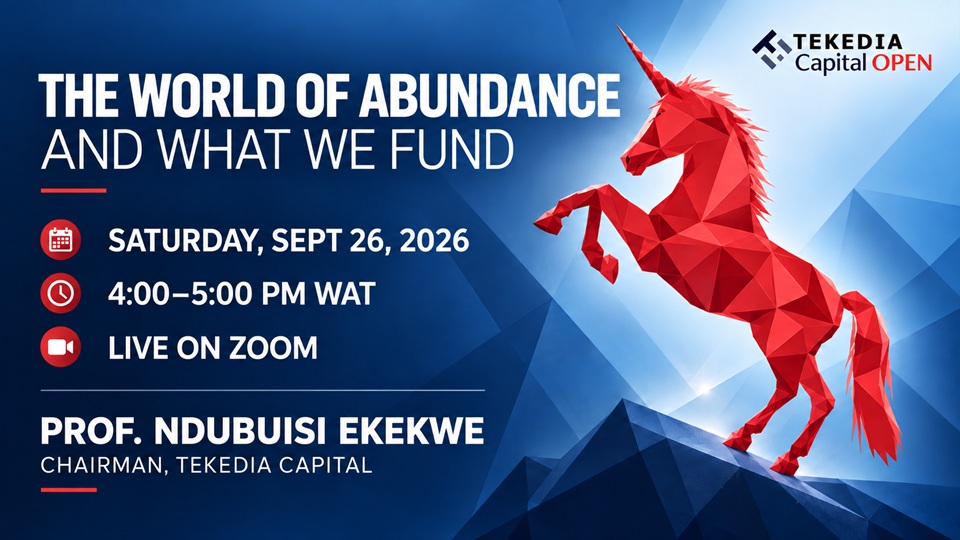
The World of Abundance and What We Fund – Tekedia Capital Open – Sept 26th, 4pm WAT

0

The world is full of abundance. Humanity exists on a positive continuum, improving asymptotically over time, even when the instantaneous states may appear otherwise. Yes, frictions are everywhere, and we live with them daily. But as better companies emerge and evolve, many of those frictions are progressively overcome.

How do we overcome frictions in markets? We build companies. Companies organize the factors of production around the three pillars of people, processes and tools. Through those pillars, they create products and services. Those products and services become forces that overcome market frictions and unlock new possibilities.

Yet much of the world’s abundance remains latent. To discover and unlock it, we need systems. From the Pythagorean postulation that the universe can be understood through numbers, humanity has continued to build systems to make sense of numbers which provide clarity on our world. Yes, better computational systems provide deeper understanding of our world.

At Tekedia Capital, we are looking for founders who can build the defining systems of the 21st century, unlock latent opportunities, advance shared prosperity and restore the dignity of humanity.

Last quarter, OpenAI acquired our portfolio company TensorPool; Vercel acquired Better Auth, and Baseten acquired Blaxel. We also expect another portfolio company to go public soon.

Join me at Tekedia Capital OPEN as we discuss how we identify and invest in companies in this age of abundance. This quarter, we are investing in about 20 companies, supporting founders building the future.

  • Event: Tekedia Capital Open
  • Topic: The World of Abundance And What We Fund
  • Date: Saturday, Sept 26, 2026
  • Time: 4pm – 5pm WAT
  • Zoom link (free and open) here


About Tekedia CapitalTekedia Capital offers a specialty investment vehicle (or investment syndicate) which makes it possible for citizens, groups and organizations to co-invest in innovative startups and young companies in Africa and around the world. Capital from these investing entities is pooled together and then invested in a specific company or companies. Contact: capital@tekedia.com to join.