DD
MM
YYYY

PAGES

DD
MM
YYYY

spot_img

PAGES

Home Blog Page 132

Ifo Institute Notes That 8% of German Companies Are Currently in “Critical Situation”

0

A recent survey conducted by the Munich-based Ifo Institute, reveals that approximately 8% of German companies are currently in a ‘critical situation’, where they fear for their very existence.

This marks a slight increase from 7.3% in October 2024, indicating growing economic pressures amid Germany’s ongoing recession. 8.1% of firms reported fearing for their survival, up from the previous year.

The survey highlights deteriorating sentiment, with many companies citing high energy costs, supply chain disruptions, and weak global demand as major factors. Manufacturing and export-oriented industries are hit hardest, aligning with Germany’s broader economic contraction GDP shrank 0.3% in 2023 and shows no strong rebound in 2025.

This data is part of the ifo Business Climate Index, which polls thousands of German executives monthly on their assessments of current conditions and future expectations. Germany has been grappling with a prolonged crisis since 2022, exacerbated by the energy shock from the Russia-Ukraine war, inflation peaking at 8% in 2022, and intense competition from Chinese manufacturers in sectors like automotive and renewables.

Only 25.8% of companies report being hampered by lack of skilled workers, the lowest in three years, though this remains a drag on growth. Unions like IG Metall have seen membership drop 8% since 2016, amid rising disputes over job cuts in auto giants like Volkswagen planning 35,000 layoffs by 2030.

27% of firms anticipate AI leading to an average 8% headcount reduction over the next five years, particularly in industry. 90% of organizations face shortages in security roles, heightening risks in a tense geopolitical environment.

ifo President Clemens Fuest described the economy as “increasingly falling into crisis,” urging structural reforms to boost competitiveness. While not all sectors are equally affected—services show some resilience—the overall outlook remains cautious, with forecasts for mild contraction in 2025.

Germany’s manufacturing sector, which accounts for about 19-20% of GDP and employs roughly 7 million people, is bearing the brunt of the broader economic challenges highlighted in the ifo Institute’s November 2025 survey.

While the overall figure of 8.1% of companies in a “critical situation” fearing for their existence applies economy-wide, manufacturing firms are disproportionately affected, with estimates suggesting 10-15% in severe distress due to export dependency and structural vulnerabilities.

This sector has seen output decline by over 12% from its February 2023 peak, marking the deepest contraction since the 2008 financial crisis. The manufacturing downturn is driven by a mix of cyclical and structural factors, exacerbating the recession that began in 2022

Sharp drop in industrial output, with no rebound in sight. Energy-intensive subsectors (e.g., chemicals, metals) hit hardest. August 2025: -4.5% monthly decline largest in 3+ years. Annual contraction: 2.0% in 2024, projected 1-2% further drop in 2025.

ifo Business Climate Index for manufacturing at multi-year lows, with pessimistic outlooks dominating. November 2025: Worsened due to order shortages; capacity utilization at 78.2% vs. 83.3% long-term average.

Resurgent shortages in semiconductors, rare earths, and electronics, amid geopolitical tensions. Affects auto, machinery, and green-tech; tied to China export restrictions. Rising layoffs and furloughs, despite slight easing in skilled worker shortages.

DIHK Survey: 30% of industrial firms cutting staff in 2025; only 11% hiring. Volkswagen’s 35,000 job cuts by 2030 accelerated; overall sector risks 100,000+ losses. Weak foreign demand, especially from China; post-pandemic shift from goods to services hurts exporters.

Exports down 4.5% in past 6 months; China sales for autos fell 20-30%. Automotive and machinery lead declines; EVs offer some offset but lag in adoption. <4 million units in 2024 from 5.6M in 2017; further drop projected. Major output falls; pharma and electronics also down sharply.

Post-Russia-Ukraine war, gas prices remain 2-3x pre-2022 levels, eroding competitiveness in energy-intensive industries (e.g., chemicals down 10-15%). This has led to “creeping deindustrialization,” with firms relocating to the US or Asia for cheaper energy.

China’s “Made in China 2025” initiative has flooded markets with low-cost EVs and machinery, capturing 30%+ of Germany’s traditional auto export share. US tariff threats under a potential Trump administration add risks, potentially costing €10-20B in exports.

High bureaucracy €65B annual compliance cost, aging workforce; 700,000+ vacancies, and stagnant productivity down 0.5% annually stifle investment. Public infrastructure underinvestment near OECD bottom compounds this.

ifo President Clemens Fuest warns of a “structural crisis” in manufacturing, with investment reluctance deepening the slump. While services show resilience, the sector’s woes risk spilling over to neighbors like Austria and the Netherlands via supply chains.

Forecasts point to 0.1-0.5% GDP contraction in 2025, with manufacturing dragging growth to near-zero or negative. Recovery hinges on ECB rate cuts, US-China trade stabilization, and domestic reforms like deregulation and energy subsidies.

Firms are adapting via “China-for-China” strategies like VW’s local EV partnerships, but this risks IP leakage. Long-term, boosting R&D in AI and green tech could offset losses, though experts like the BDI call for radical steps to avert the longest postwar downturn.
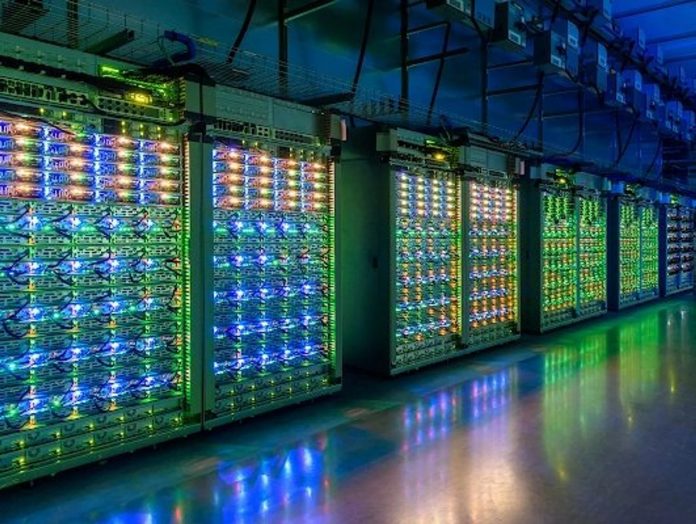
AI Data Centers Contributions to U.S. GDP Growth Outpace U.S. Consumer Spending 

0

In recent economic analysis. Harvard economist Jason Furman crunched the numbers from U.S. Bureau of Economic Analysis data and found that investments in information-processing equipment and software largely tied to AI data centers made up just 4% of total U.S. GDP in the first half of 2025.

Yet, those same investments drove roughly 92% of the period’s GDP growth. Excluding them, annualized GDP growth would have limped along at a mere 0.1%—a virtual standstill that economists often flag as recession territory, especially amid slowing job growth and weakness in consumer spending, manufacturing, and services.

The surge stems from massive capital expenditures by Big Tech on AI infrastructure scale of spending. Companies like Microsoft, Google (Alphabet), Meta, and Amazon poured nearly $370 billion into capex in 2025 alone, much of it on servers, GPUs, and data center builds.

Goldman Sachs estimates global AI-related spend hit $200 billion this year, with U.S. data center construction reaching a record $40 billion annualized rate in mid-2025. This isn’t just hardware—it’s software, R&D, and power/grid upgrades too.

Renaissance Macro Research noted in August that AI data center contributions to GDP growth outpaced U.S. consumer spending typically ~70% of GDP for the first time ever. Other sectors dragged: Manufacturing and real estate saw outright declines.

Retail and services added little, with job creation cooling sharply, unemployment claims hit a 4-year high in recent months. Consumer credit is flashing yellow delinquencies rising, and without the tech boom, the Federal Reserve might have cut rates further to stave off contraction—potentially averting recession but risking higher inflation elsewhere.

S&P Global pegs data centers and high-tech as responsible for ~80% of private domestic demand growth in H1 2025; without it, the economy flatlines. It’s a classic “jobless recovery” vibe: GDP looks robust Q3 now tracking 4.2% annualized per Atlanta Fed, but the gains are K-shaped—concentrated in tech hubs and elite firms, not broadly shared.

Data centers employ few ongoing workers mostly construction-phase jobs, limit wage-driven consumption spillovers, and strain resources—electricity demand could double by 2028, driving up bills 6-7% yearly and emissions already 2% of U.S. total.

Morningstar warns AI capex now exceeds the dot-com peak relative to GDP, needing $2 trillion in annual revenue by 2030 to justify current: ~$20 billion. Bubble fears are real—53% of investors see one brewing.

Furman himself notes that absent the AI boom, we’d likely see lower rates and energy costs, spurring ~half the lost growth elsewhere. The data center boom is a lifeline keeping recession at bay, but it’s propping up a patient with underlying issues.

The energy crunch is reshaping the AI and tech economy in profound ways, turning what was once a frictionless growth story into a high-stakes balancing act. Data center power demand is projected to more than double globally to 945 TWh by 2030—equivalent to Japan’s entire electricity consumption today—with AI driving the lion’s share.

In the US, this could translate to an 8% average rise in household electricity bills by 2030, spiking to 25% in hotspots like Virginia. Wholesale prices near data centers have already jumped up to 267% since 2020, fueling $9.3 billion in capacity cost hikes in markets like PJM.

For Big Tech, $800 billion in 2025 data center commitments from Alphabet, Amazon, Meta, Microsoft, and OpenAI risk ballooning into capex overruns if grid delays persist, potentially delaying ROI and throttling the $370 billion hyperscaler spend.

On the flip side, this scarcity is birthing a $580 billion global data center market by 2025, with AI claiming 27% share by 2027, redirecting trillions toward infrastructure. Utilities are filing for $30 billion in rate hikes, but the real winner? A projected 36 GW US power shortfall by 2028, sparking M&A and investments in everything from natural gas to batteries.

Without mitigations, this could shave 1-2% off US GDP growth annually through blackouts and higher costs, per RAND estimates. Markets are pivoting hard: chip stocks like Nvidia may face “power-limited” ceilings, with Jensen Huang warning of electricity as the new bottleneck—data centers could hit 40% of net new US demand by 2030.

Utility and energy plays are surging—Constellation Energy (CEG) up 50% YTD on nuclear restarts, while renewables like NextEra (NEE) and battery firms (e.g., Fluence, FLNC) eye 23% CAGR in storage needs.

But speculation is rife: Sam Altman called out an “AI bubble” in August, and utilities like Constellation are tempering hype, warning of overstated loads. Geopolitically, China’s edge in manufacturing and energy could erode US AI leadership if transformers and generation lag—Elon Musk flagged this as a “worrying” long-term risk.

AI infra stocks could dip 20-30% on permitting snarls, but energy innovators SMRs, advanced solar might 5x as demand quadruples to 1,600 TWh by 2035. If AI delivers transformative productivity as optimists bet, it could broaden out. If not, we’re borrowing from tomorrow’s growth today.

Chips Are No Longer the Headache But Electricity s to Sustain Data Centers

0

What started as a frenzy over insatiable demand for AI chips think Nvidia’s meteoric rise on the back of GPU shortages has morphed into acute anxiety over whether the power grids can keep up with the data centers gobbling up those chips.

By late 2025, the narrative has flipped: chip supply chains are stabilizing thanks to massive investments from TSMC, Intel, and others, but energy constraints are emerging as the real bottleneck, threatening to cap AI’s explosive growth.

Early 2024-early 2025 worries: Markets were laser-focused on demand outstripping supply for advanced semiconductors, especially Nvidia’s H100 and Blackwell GPUs.

Hyperscalers like Microsoft, Amazon, and Google were queuing up billions in capex, driving Nvidia’s market cap past $3 trillion at its peak. Fears of a “chip famine” dominated earnings calls and analyst reports.

As fabs ramped up like TSMC’s Arizona and Taiwan expansions hitting full stride, supply eased. Global semiconductor capacity grew ~15% YoY, per SEMI data, outpacing even AI-driven demand forecasts. Now, the chatter is about overcapacity risks if AI hype cools—echoing the 2022 crypto bust.

Nvidia itself dipped 10% in Q3 2025 on whispers of softening enterprise orders. The real plot twist is power. AI data centers aren’t just hungry for chips; they’re voracious for electricity—training a single large language model can guzzle as much as a small city’s annual usage. Goldman Sachs now forecasts global data center power demand surging 165% by 2030 from 2023 levels, hitting 92 GW by 2027 alone.

In the US, it’s set to account for nearly half of all electricity demand growth through 2030, outpacing manufacturing sectors like steel and cement combined. This isn’t abstract: utilities filed for $30 billion in rate hikes in H1 2025 to cover grid upgrades, passing costs to households and small businesses.

Data centers consumed 26% of Virginia’s electricity in 2023; by 2025, states like Iowa (11%) and Oregon (11%) are hitting similar walls. In PJM’s market serving 13 states, they drove a $9.3 billion capacity price spike for 2025-26.

Transmission delays—tied to permitting, supply chains, and NIMBYism—mean new capacity lags demand by 3-5 years. An October 2025 Sunrun survey found 80% of Americans fretting over AI-driven bill hikes, with 60% more concerned than excited about the tech.

Water scarcity is another flashpoint: cooling systems in arid spots like Georgia are prompting 33% rate jumps. Big Tech’s 2025 capex hit $370 billion (Microsoft, Alphabet, Meta, Amazon), but ROI is questioned if power shortages delay rollouts.

OpenAI’s 10 GW data center pact with Nvidia? It needs NYC’s summer peak load—good luck securing that amid blackouts. Stocks like Constellation Energy tanked 20% in January on feasibility doubts. AI training/inference boom; hyperscaler capex.

Grid capacity limits; $580B global data center spend in 2025. Double to 100 GW by 2028; 2% of global electricity by 2030. Geopolitical (e.g., Taiwan tensions); overbuild if AI plateaus. Rate hikes, $30B US in H1 2025; fossil fuel reliance worsening emissions.

Markets aren’t panicking yet—data center vacancy rates plunged to 6.6% globally in Q1 2025, signaling demand’s still red-hot—but the energy wildcard could trigger volatility. Expect more M&A in utilities and a nuclear renaissance.

Microsoft and others inked deals to restart plants like Three Mile Island, while small modular reactors (SMRs) could deliver 300 MW per site by 2030. They’re 90% of queued projects, but intermittency means gas/coal bridges the gap, clashing with net-zero goals.

Efficiency gains via Nvidia’s GB200 chips hitting 130 kW/rack densities might shave 20-30% off demand, but not enough to dodge the crunch. In short, chips were the accelerator; energy’s the brake.

If grids don’t scale and policy helps—Trump’s pro-build stance could fast-track permits but tariffs hike costs, we might see AI growth throttled, hitting semis harder than expected.

Bullish on utilities and nuclear plays, cautious on pure chip bets. What’s your take—energy the ultimate AI limiter?

DOGE May 15x, But Ozak AI’s 100x Path Is What Traders Are Watching

0

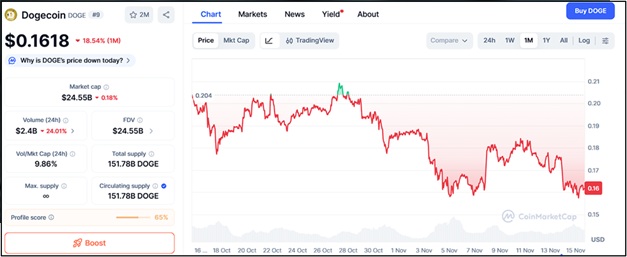
Dogecoin continues to ride a wave of renewed optimism as analysts forecast a potential 15x rally heading into the following bull segment. Trading around $0.1618, DOGE remains one of the most powerful meme coins available on the market thanks to its huge network, liquidity depth, and capability to spark viral market actions.

Yet, despite the bullish outlook, many investors are moving their attention toward Ozak AI (OZ)—a high-upside AI-pushed token whose early-stage positioning and hastily expanding surroundings suggest capability for a 100x boom. As investors search for the biggest winners of the imminent cycle, Ozak AI is rising as the top project with its effective mixture of application, innovation, and momentum.

Dogecoin and Ozak AI

Dogecoin’s price around $0.1618 highlights solid market consolidation, supported with the aid of enthusiastic network participation and ongoing meme-market tailwinds. Resistance stages sit at $0.1720, $0.1855, and $0.1980, each representing zones wherein upward momentum has historically slowed. Support stays reliable at $0.1530, $0.1460, and $0.1395, regions where DOGE buyers constantly step in to protect the fashion.

Analysts agree that a 10x–15x surge is possible during peak bull market conditions, especially if DOGE recaptures the cultural energy seen in previous cycles. However, its large and growing market cap makes extreme exponential gains increasingly difficult. This limitation is pushing traders to explore early-stage tokens like Ozak AI, where low valuation, utility depth, and rapid adoption create far more powerful upside potential.

Ozak AI (OZ)

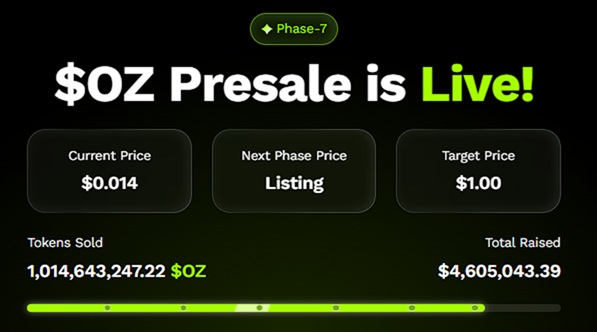
Ozak AI (OZ) is quickly becoming the centerpiece of the AI–crypto narrative thanks to its blend of prediction agents, autonomous trading tools, and real-time data intelligence systems. OZ  presale success has been remarkable, with over 1 billion tokens sold and more than $4.5 million raised, showing strong conviction from early investors. Unlike many emerging tokens that rely solely on hype, Ozak AI is backed by real technological partnerships with Perceptron Network, HIVE, and SINT—giving it access to high-speed 30 ms signals, trust-based data verification systems, cross-chain analytics, and voice-enabled AI agents.

These integrations position Ozak AI as a serious contender in the emerging decentralized AI landscape. Analysts believe its utility-driven ecosystem could become essential for traders, developers, and data platforms, creating the conditions for a massive surge once token listings and product rollouts begin.

Why Traders Believe Ozak AI Has a Clearer Path to 100x Than DOGE

Dogecoin thrives on excitement, but Ozak AI’s advantage lies in long-term viability and deep real-world functionality. Traders watching market sentiment identify three major reasons Ozak AI appears far more likely to deliver 100x potential:

  • Early-stage asymmetry: Ozak AI is still in its presale phase, making exponential growth far more achievable than DOGE’s mature market cap allows.
  • AI sector dominance: AI remains the strongest narrative in tech—and Ozak AI sits at the center of the crypto–AI convergence.
  • Real utility vs. meme speculation: Prediction agents, automated signals, cross-chain intelligence, and voice-enabled AI tools give Ozak AI lasting relevance.

Because of this, traders seeking life-changing gains are increasingly positioning early in Ozak AI rather than relying solely on meme-driven momentum.

Meme Hype vs. Artificial Intelligence

Dogecoin’s 15x potential still appeals to thousands of traders seeking fast gains, but the market’s smartest strategists are looking deeper. With AI accelerating globally and blockchain infrastructure evolving, Ozak AI offers a transformative opportunity that aligns with the most powerful trends of the next decade.

DOGE may still rally hard, but Ozak AI’s 100x path is what traders are truly watching—making it one of the most hyped and promising projects in the early stages of the 2025 bull run.

About Ozak AI

Ozak AI is a blockchain-based crypto venture that offers a technology platform that focuses on predictive AI and advanced records analytics for financial markets. Through machine learning algorithms and decentralized network technologies, Ozak AI permits real-time, correct, and actionable insights to help crypto fanatics and companies make the precise choices.


For more, visit:

Website: https://ozak.ai/

Telegram: https://t.me/OzakAGI

Twitter: https://x.com/ozakagi

Coinbase Derivatives Expands 24/7 Futures Trading to Multiple Altcoins

0

Coinbase’s derivatives arm, regulated by the U.S. Commodity Futures Trading Commission (CFTC), has announced plans to roll out round-the-clock (24/7) trading and “perp-style” futures contracts for a selection of popular altcoins.

This expansion builds on their existing 24/7 offerings for Bitcoin (BTC) and Ethereum (ETH) futures, aiming to provide U.S.-based retail and institutional traders with greater access to leveraged derivatives in a compliant environment.

Perp-style” futures are long-dated futures contracts specifically designed to behave almost exactly like the perpetual futures (perps) that dominate offshore exchanges like Binance, Bybit, OKX, etc., but they are structured to comply with U.S. regulations.

The move comes amid growing demand for perpetual futures, which now dominate over 75% of global crypto derivatives volume. Trading is slated to begin in early December 2025. Specific exact dates haven’t been confirmed, but this follows a pattern of phased rollouts seen in prior Coinbase futures updates.

The initial batch covers 11 assets, with a focus on established layer-1 tokens and meme coins. High-throughput blockchain platform. Perp-Style Futures. These are long-dated contracts up to 5-year expirations designed to closely track spot prices, offering leverage while adhering to CFTC rules.

Unlike traditional offshore perpetuals, they include built-in funding mechanisms to prevent divergence from underlying assets. Full 24/7 access, including weekends, with a brief weekly maintenance window e.g., Fridays 5-6 PM ET. Vary by asset, 1,000 ADA per contract, allowing for flexible position sizing.

0% maker / 0.03% taker fees on Coinbase Advanced Trade, plus up to 5.1% USDC rewards on collateral balances. Open to eligible U.S. users via Coinbase Derivatives Exchange; non-U.S. clients can access via Coinbase International for similar products.

This expansion follows earlier 2025 launches, such as 24/7 trading for SOL, XRP, and ADA in June, and the debut of U.S. perpetual-style BTC/ETH futures in July. It positions Coinbase as a leader in regulated crypto derivatives, competing with platforms like Kraken while capturing more of the $3+ trillion global derivatives market.

The announcement, reported by The Block on November 21, 2025, has sparked buzz on X, with traders highlighting potential volatility boosts for DOGE and SHIB amid broader market dips like DOGE down ~6% and SHIB down ~5% as of late November 21.

Perpetual futures enable hedging, speculation, and leverage without expiration pressures, but they carry high risk—especially for volatile assets like meme coins. This could drive increased trading volume (e.g., SOL futures already hit 23,000+ contracts post-launch) and attract institutional interest, though traders should note CFTC safeguards like position limits.

Coinbase is also integrating non-crypto futures like gold, oil, equities indices, signaling a push toward diversified, always-on markets. Coinbase lists contracts that expire far in the future (e.g., December 2029 or even 5-year contracts). Because the expiration is so distant, they trade almost identically to a true perpetual.

Funding rate keeps the price glued to spot. Every few hours usually every 4 or 8 hours, the exchange calculates the difference between the futures price and the actual spot price. If futures trade above spot ? longs pay shorts encourages selling futures, pushes price down.

If futures trade below spot ? shorts pay longs encourages buying futures, pushes price up. This is exactly how Binance/Bybit perps work. You can hold forever, when the current contract gets close to expiry, Coinbase automatically rolls your position into the next long-dated contract at no extra cost, so you never have to “close and reopen.”

Leverage + margin

You still only put up a small fraction of the position value which is initial margin. For most of these altcoin contracts, retail leverage is capped around 10–20× by CFTC rules much lower than the 100× you see offshore. Example: Trading DOGE Perp-Style Futures on Coinbase Spot DOGE price = $0.35

You open a 100,000 DOGE long position at $0.351 with 10× leverage. Initial margin required ? $3,510 instead of $35,100 notional. Every 4 hours, a funding rate is calculated. If the average premium stays positive, you pay a tiny amount to shorts; if DOGE moons and futures go to a discount, you collect funding.

Coinbase creates almost the identical economic experience while staying fully compliant. Bottom Line Perp-style futures = the closest thing U.S. traders can legally get to the 24/7, high-leverage perpetual contracts everyone uses on offshore exchanges — just with CFTC oversight, lower max leverage, and USD settlement.