DD
MM
YYYY

PAGES

DD
MM
YYYY

spot_img

PAGES

Home Blog Page 1346

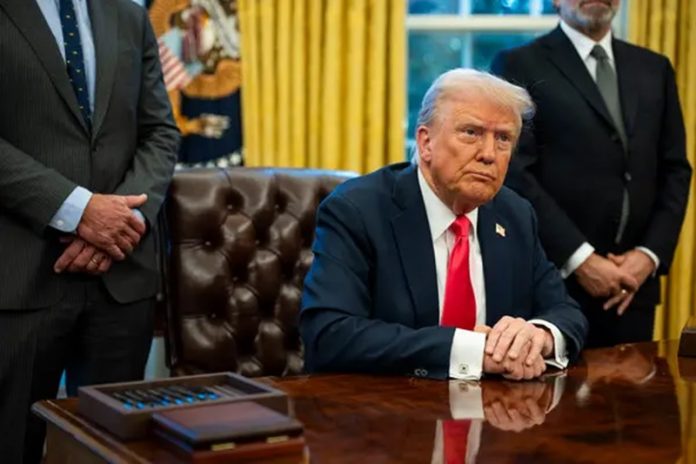
Trump’s Economic Approval Hits Record Low Amid Concerns Over Tariffs, Inflation and Spending

0

President Donald Trump is facing the lowest economic approval ratings of his presidency, according to the latest CNBC All-America Economic Survey, as discontent grows over his administration’s handling of inflation, tariffs, and federal spending.

The downturn in sentiment is not just among Democrats but also showing cracks within his independent support base and even some corners of the Republican bloc.

The poll, conducted from April 9 to 13 with a sample size of 1,000 American adults and a margin of error of ±3.1%, found that 55% of respondents disapprove of Trump’s economic performance, while just 43% approve — the first time he has received a net negative economic rating during his presidency.

This erosion of support marks a reversal from the boost in economic optimism that accompanied his reelection. The public outlook has since shifted markedly toward pessimism. Nearly half (49%) now believe the economy will worsen in the coming year, the most negative reading since 2023. Only 38% say it’s a good time to invest, compared to 53% who believe it is not — a significant reversal from the optimism seen following Trump’s reelection victory.

Even more concerning for the administration, the economic outlook among independents, a key demographic in Trump’s reelection bid, has soured. Their approval of his economic handling has dropped 23 points compared to the average during his first term. Democrats, meanwhile, remain overwhelmingly disapproving, with a net negative margin of 90 points, significantly worse than during Trump’s previous tenure.

Trump’s blue-collar support, once one of his strongest economic constituencies, has also seen erosion. While still showing majority approval, disapproval among this group has increased by 14 points. It underscores growing discomfort even among voters who largely backed his trade and manufacturing policies.

Tariffs and Inflation Fuel Discontent

One of the primary drivers of the downturn in sentiment is Trump’s renewed tariff strategy. Americans disapprove of across-the-board tariffs by a 49% to 35% margin. Majorities believe tariffs are harmful to American workers, inflation, and the broader economy. This is particularly significant because tariffs have become a hallmark of Trump’s economic vision.

Among Republicans, support for tariffs remains, but even here the gap is narrowing. While Republicans still approve by a 59-point margin, that number is 20 points lower than their 79% net approval of Trump himself — showing tariffs are less popular than the president within his own party.

Democrats reject the tariffs by a resounding 83-point margin, and independents disapprove by 26 points, reinforcing that the policy is struggling to win broader appeal.

This unease is reflected in the broader assessment of Trump’s inflation performance. Just 37% of respondents approve of how he’s handling inflation, while 60% disapprove — the worst among all the issues polled. Even among Republicans, his strongest supporters, approval of inflation has dipped to 58%, the lowest net positive among the surveyed topics.

Additionally, 57% of respondents believe the U.S. is either already in or about to enter a recession, up from just 40% last March. A small but notable 12% believe the country is already in a recession.

Spending, Markets, and Partisan Divides

Federal government spending is another point of contention. A narrow majority — 51% — disapprove of Trump’s handling of public expenditure, compared to 45% who approve. This aligns with growing anxiety about rising deficits under his administration, despite his promises to rein in government waste.

On foreign policy, Trump also suffers a net negative: 42% approve versus 53% disapprove, with much of the disapproval tied to concerns over international economic relations.

“Donald Trump was reelected specifically to improve the economy, and so far, people are not liking what they’re seeing,” said Jay Campbell of Hart Associates, the Democratic partner on the CNBC survey.

Micah Roberts, the Republican pollster for the survey, agreed that the issue is not just economic data but public perception.

“We’re in a turbulent, kind of maelstrom of change when it comes to how people feel about what’s going to happen next. The data suggest more than ever that it’s the negative partisan reaction that’s driving and sustaining discontent,” he said.

Interestingly, while Americans overwhelmingly see countries like Canada, Mexico, Japan, and the EU as economic partners rather than threats — and view them more favorably than they did during Trump’s first term — the exception remains China. The country is still seen as an economic threat by a 44% to 35% margin, worse than in 2019.

The Bright Spot of Immigration

If there’s one area where Trump finds some solace, it’s immigration. His handling of the Southern border enjoys a 53% to 41% approval margin, while deportation policies are backed by 52% of Americans. Notably, he garners 22% support from Democrats on border policy — his highest cross-party approval.

He also edges out a slim majority among independents on the issue of deportations, which could help him maintain support in swing states where immigration remains a hot-button topic.

Despite Trump’s dip in economic approval, Democrats have yet to capitalize significantly. On the congressional ballot, the public remains nearly evenly split: 48% prefer Democratic control, while 46% favor Republicans. These figures are virtually unchanged from the March 2022 survey, showing that while the president may be losing ground, it is not automatically translating into Democratic gains.

The Implications of Trump’s Push to Use Tariff Revenue to Purchase Bitcoin

0

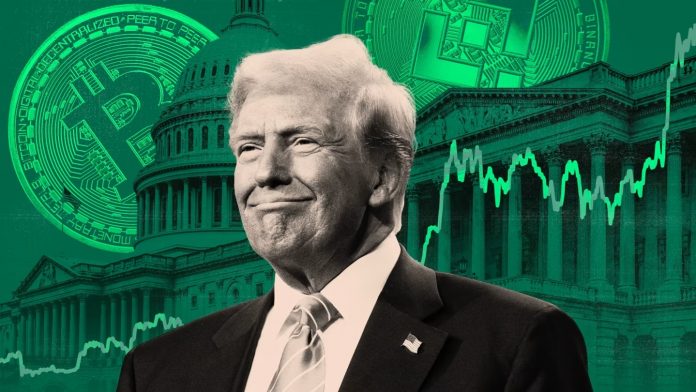
The Trump administration has explored using tariff revenue to purchase Bitcoin for a U.S. Strategic Bitcoin Reserve, as part of a broader strategy to expand national cryptocurrency holdings without increasing taxpayer burden. Bo Hines, Executive Director of the President’s Council of Advisers on Digital Assets, confirmed in an April 2025 interview with Anthony Pompliano that the administration is considering various budget-neutral methods, including tariff revenue and revaluing Treasury gold certificates (currently valued at $43 per ounce, far below the market price of over $3,200).

This aligns with President Trump’s March 2025 executive order to establish the reserve, initially stocked with seized Bitcoin, and Senator Cynthia Lummis’ Bitcoin Reserve Act of 2025, which proposes acquiring 1 million BTC over five years. Hines emphasized that “everything’s on the table” to maximize Bitcoin acquisition, likening it to gold reserves. However, the proposal has drawn criticism. Some economists, like George Selgin, argue that both tariffs and a Bitcoin reserve are flawed ideas, with tariffs acting as a consumer tax that could disproportionately harm low-income households estimated at $3,800 per year by Yale’s Budget Lab.

Critics also highlight Bitcoin’s volatility—its price dropped 10% to below $78,000 after Trump’s tariff announcement in April 2025, though it later recovered to around $86,000—and question the appropriateness of government investment in a speculative asset. Tariff revenue projections of $3.3 trillion over a decade, per the Tax Policy Center are also considered optimistic, potentially insufficient for ambitious plans like tax cuts or deficit reduction alongside Bitcoin purchases. Despite these concerns, the crypto industry sees the move as a bullish signal, potentially boosting market confidence if implemented.

Government purchases of Bitcoin (potentially 1 million BTC over five years, as proposed in the Bitcoin Reserve Act) could drive up Bitcoin’s price, increasing market capitalization and liquidity. This might stabilize its value but also risks creating a bubble if demand outpaces supply. The crypto market has already shown sensitivity, with a 10% price drop to $78,000 after Trump’s tariff announcement in April 2025, though it later rebounded to $86,000.

Tariffs, projected to generate $3.3 trillion over a decade, act as a consumption tax, raising costs for U.S. consumers (estimated $3,800 annually for low-income households). Diverting this revenue to Bitcoin purchases could limit funds for other priorities like tax cuts or deficit reduction, potentially exacerbating inflationary pressures if consumer prices rise without offsetting relief.

Using volatile tariff revenue for a speculative asset like Bitcoin introduces fiscal uncertainty. Critics argue this could undermine confidence in U.S. financial management, especially if Bitcoin’s value crashes. Revaluing Treasury gold certificates to fund purchases, another proposed method, could also distort monetary policy if not carefully managed. A national Bitcoin reserve might signal a diversification away from the U.S. dollar, potentially weakening its status as the world’s reserve currency over time, especially if other nations follow suit with crypto reserves.

The plan appeals to pro-crypto voters and industries, aligning with Trump’s campaign promises to make the U.S. a “Bitcoin superpower.” However, it faces opposition from traditional economists and fiscal conservatives who view tariffs and Bitcoin investments as risky. This could deepen partisan divides, with critics like George Selgin calling the combination a “lose-lose.”

Proposals like Senator Lummis’ Bitcoin Reserve Act require Congressional approval, which may face resistance due to concerns over funding mechanisms and economic impacts. The administration’s reliance on executive actions (e.g., the March 2025 order) may bypass some gridlock but risks legal challenges. The policy strengthens ties with the crypto sector, which has gained political clout. Industry leaders see it as a bullish signal, potentially lobbying for further pro-crypto policies, but this could alienate voters wary of corporate influence.

A U.S. Bitcoin reserve could position the country as a leader in cryptocurrency adoption, countering nations like China, which has banned crypto trading but holds significant gold reserves. It may prompt other countries to create their own crypto reserves, reshaping global financial systems. High tariffs e.g., 25% on Canada and Mexico, 10% on China to fund Bitcoin purchases could strain trade relations, risking retaliatory tariffs and supply chain disruptions. This might weaken U.S. alliances while escalating economic conflicts with adversaries.

Holding Bitcoin could enhance U.S. financial resilience against sanctions or dollar-based restrictions, as Bitcoin operates outside traditional banking systems. However, it might also embolden adversarial nations to accelerate de-dollarization efforts using crypto or other assets. U.S. government backing could legitimize Bitcoin as a global asset class, encouraging institutional adoption but also increasing regulatory scrutiny to prevent fraud and market manipulation.

Bitcoin price surges could disproportionately benefit early adopters and wealthy investors, exacerbating inequality, especially if tariff-funded purchases raise consumer costs for lower-income households. A strategic reserve might spur blockchain and crypto infrastructure development in the U.S., fostering innovation but also raising energy consumption concerns due to Bitcoin mining’s environmental impact.

While the policy could cement U.S. leadership in the crypto space and boost market confidence, it risks economic instability, trade conflicts, and political polarization. The success hinges on balancing fiscal prudence with bold innovation, navigating volatile markets, and addressing consumer impacts from tariffs.

Ford Motor Company Halts Shipments to China

0

Ford Motor Company halted shipments of SUVs, pickup trucks, and sports cars to China due to retaliatory tariffs of up to 150% imposed by China in response to U.S. import taxes. The affected models include F-150 Raptors, Mustangs, Michigan-built Bronco SUVs, and Kentucky-made Lincoln Navigators. Ford confirmed the suspension, stating, “We have adjusted exports from the U.S. to China in light of the current tariffs.” Shipments of U.S.-built engines and transmissions to China continue, and the China-made Lincoln Nautilus is still exported despite tariffs.

Ford, which produces 80% of its U.S.-sold vehicles domestically, is better positioned than some competitors but may raise vehicle prices if tariffs persist, according to an internal memo. The Center for Automotive Research estimates that 25% tariffs on automotive imports could cost automakers $108 billion in 2025. The Wall Street Journal first reported the halt, citing sources familiar with the matter.

Ford’s suspension of SUV, pickup, and sports car exports to China due to 150% tariffs is estimated to cause a $900 million profit loss from lost sales in a major market, based on $330 million revenue from 5,500 vehicles. Tariffs on imported parts (25%) and vehicles like the Maverick and Bronco Sport from Mexico will raise production costs. Even U.S.-assembled vehicles, such as the F-150, rely on 40-60% imported parts, increasing costs by an estimated $5,000 per vehicle. The Center for Automotive Research projects a $108 billion cost escalation for U.S. automakers in 2025.

Analysts have cut Ford’s 2025 earnings per share forecast by 63%, reflecting higher costs and potential sales drops. Morningstar maintains Ford’s fair value at $16 per share, modeling tariffs for nine months. Ford warned dealers of potential price hikes starting June 2025 if tariffs persist, with estimates of 5% increases for U.S.-made vehicles and 15-20% for imported models. This could reduce demand, further squeezing profits.

Ford’s “From America, for America” employee pricing discounts aim to maintain sales, leveraging its 80% U.S. production to mitigate tariff impacts. However, reduced margins and fewer discounts may still hurt profitability. Ford CEO Jim Farley noted that prolonged tariffs could wipe out billions in industry profits, with Ford facing significant losses if tariffs extend beyond weeks.

Despite Ford’s relatively strong position due to high domestic production, reliance on imported parts and lost China sales pose substantial risks. Profit declines are expected to be steep unless tariffs are eased or supply chains are restructured, which could take years and billions in investment. 25% tariffs on imported vehicles and automotive parts from all countries except Canada, effective from early 2025. Additional 100% tariffs on electric vehicles (EVs) from China, though Ford has minimal exposure here. Tariffs apply to critical components like batteries, steel, and aluminum, increasing costs for U.S.-assembled vehicles.

Impact on Costs

Ford vehicles, even those assembled in the U.S., rely on 40-60% imported parts (e.g., from Mexico, Asia). The Center for Automotive Research estimates a $5,000 per-vehicle cost increase due to part tariffs. Ford’s Mexican-built Maverick pickup and Bronco Sport SUV face direct 25% vehicle tariffs, potentially raising prices by 15-20%. Total industry cost escalation projected at $108 billion in 2025, with Ford bearing a significant share due to its scale.

Ford warned dealers of price hikes starting June 2025, with U.S.-made vehicles potentially rising 5% and imported models 15-20%. Higher prices risk reduced demand, especially for price-sensitive segments like compact trucks and SUVs. Ford’s “From America, for America” discount program aims to offset demand drops but compresses profit margins.

China’s Retaliatory Tariffs

Up to 150% tariffs on U.S.-built vehicles, targeting Ford’s high-margin SUVs (Bronco, Lincoln Navigator), pickup trucks (F-150 Raptor), and sports cars (Mustang). Implemented in response to U.S. tariffs, effective early 2025. Ford halted shipments of affected models to China, its second-largest market, resulting in an estimated $900 million profit loss from 5,500 vehicles ($330 million in revenue).

Continued exports of U.S.-built engines, transmissions, and China-made Lincoln Nautilus face tariffs, reducing profitability. Lost sales in China weaken Ford’s competitive position against domestic Chinese automakers and tariff-exempt rivals. Long-term absence from China could erode brand presence, requiring costly re-entry efforts.

Analysts slashed Ford’s 2025 earnings per share by 63%, reflecting higher costs and lost China sales. Morningstar’s fair value estimate remains $16 per share, assuming tariffs last nine months. Imported parts tariffs increase production costs across Ford’s lineup, even for its 80% U.S.-produced vehicles. Supply chain restructuring to reduce reliance on imports could cost billions and take years, with no immediate profit relief.

Price hikes to offset tariffs may reduce sales volume, while discounts to maintain demand cut margins. Ford’s high-margin F-Series trucks, critical to profits, face cost pressures from imported components, threatening a key revenue driver. Ford CEO Jim Farley warned that prolonged tariffs could erase billions in industry profits, with Ford’s exposure amplified by its reliance on trucks and SUVs. The Center for Automotive Research estimates a $7,000 per-vehicle profit hit for U.S. automakers under sustained tariffs.

Ford is exploring increased domestic sourcing, but retooling supply chains is slow and capital-intensive. Continued engine and transmission exports to China suggest selective cost absorption to maintain some market presence. Ford’s stock dropped 35.2% year-over-year, reflecting investor concerns over tariff-driven profit declines. This highlight fears of margin erosion and long-term competitiveness, with some investors betting on tariff relief or Ford’s adaptability.

Ford’s 80% U.S. production gives it an edge over rivals like Stellantis (50% U.S. production) but imported parts exposure limits advantages. Competitors like Toyota, with more localized supply chains, may face less severe impacts, pressuring Ford’s market share. Relocating parts production to the U.S. or Canada could mitigate tariffs but requires $10-20 billion in industry investment, per analyst estimates. Ford’s existing U.S. manufacturing base (e.g., Michigan, Kentucky plants) provides a foundation but not full insulation.

Higher vehicle prices could shift demand to smaller, cheaper models or competitors, squeezing Ford’s truck-heavy portfolio. Inflationary pressures from tariffs may further erode consumer purchasing power, amplifying sales risks. Tariff duration remains unclear. A nine-month scenario is modeled, but extension into 2026 could double profit losses. Potential exemptions for Canada under USMCA may shift Ford’s sourcing strategy, though Mexico’s exclusion complicates this.

The tariffs impose immediate profit hits through lost China sales ($900 million), higher production costs ($5,000 per vehicle), and potential demand declines from price hikes. Ford’s 2025 earnings face a 63% downgrade, with long-term risks to market share and competitiveness unless tariffs ease or supply chains adapt.

Enugu Plans 135km Rail Line to Link South-East Cities With Onne Port as Part of Logistics Hub Vision

0

The Enugu State Government has announced an ambitious plan to develop a 135.5-kilometer state-owned standard gauge rail line designed to connect Enugu with key South-East cities and link them directly to the Onne Port in Rivers State.

The project, if realized, could significantly reposition the state as a logistics hub, offering an alternative export corridor to Lagos.

The State Commissioner for Transportation, Dr. Obi Ozor, who disclosed the plan on Afia TV’s Enugu Kwenu program on Friday, said the rail network would be a strategic move toward regional integration, economic acceleration, and export-led growth.

Dr. Ozor confirmed that a full feasibility study for the Enugu rail network and the South-East corridor has already been completed. The state is currently engaging with Chinese companies and the Nigerian Railway Corporation on the technical aspects while holding financing talks with potential investors.

Details of the Route

The 135.5km standard gauge line will start from Enugu and move through Ugwuoba into Anambra State, connecting cities such as Awka and Onitsha. From there, it will run through the Amechi Idodo axis of Ebonyi State, link Umuahia in Abia and Owerri in Imo State via Nkanu West and Isiagu, before terminating at the Onne Port in Rivers State.

“As part of turning Enugu State into a hub, rail is a critical part of that to enable the movement of agro commodities from wherever their sources are to the port for export and earning of foreign exchange. We have a lot of wealth locked underneath our soil, such as coal. We need to exploit them to be able to generate a lot of revenue, and rail is critical to it,” Dr. Ozor said.

The commissioner stressed that the rail line will support both cargo and passenger services, not only decongesting traffic from Nigeria’s overwhelmed Lagos ports but also boosting trade across the South-East and South-South.

Part of a Bigger Transport Agenda

The rail plan is one piece of a larger transport framework that includes the development of an inland container terminal and a new market station within the Holy Ghost Transport Terminal in Enugu. According to Dr. Ozor, the market station will be located between Terminals 1 and 2 and will serve as a key node for cargo handling.

“We’re developing a major inland container port that will process agro-commodities for the South-East and even the North-East. It’s about giving our economy the infrastructure it needs to compete,” he said.

He noted that the Federal Government is also extending its narrow gauge rail from Aba to Enugu, a separate 24-month plan, but emphasized that Enugu’s project is a standalone, state-owned initiative tailored to fit the region’s development priorities.

Regional Integration Urged Amid Eastern Port Push

The announcement comes at a time when stakeholders and infrastructure experts are calling on the leadership of the South-East and South-South to begin integrating their economies through an interconnected rail network—particularly as momentum grows around the push to decongest Lagos by expanding the eastern ports, including Onne, Calabar, and Port Harcourt.

There is growing consensus that rail development is essential to the success of that eastern maritime strategy. However, experts warn that the current state of regional disconnection will make it difficult for any single state to achieve such ambitions alone.

Yet so far, only Enugu State has publicly announced a concrete plan. While other states in the region—Anambra, Abia, Imo, Ebonyi, Rivers—have expressed broad support for infrastructure development, there have been no specific announcements on rail projects tied to a regional corridor or to the Onne Port.

This lack of coordinated effort, experts argue, could undercut the effectiveness of any single-state investment, especially given that rail requires contiguous territory to function optimally across state lines.

China’s Broader Role

Enugu’s rail plan is also emerging at a time when China is looking to deepen its infrastructure footprint across Africa. Amid a growing trade fallout with the United States, most recently marked by Washington’s imposition of tariffs up to 145% on Chinese electric vehicles, Beijing has intensified efforts to forge new commercial relationships across Asia and Africa.

Chinese President Xi Jinping has embarked on a renewed diplomatic and trade tour of several Asian countries in recent weeks, aiming to lock in new agreements that align with China’s Belt and Road ambitions. The focus has shifted toward deepening engagement with African subnational governments as a way of bypassing central government bottlenecks.

In this context, Enugu’s direct negotiation with Chinese companies and openness to foreign infrastructure capital fits into the broader geopolitical realignment. China, already heavily involved in Nigeria’s national railway infrastructure, may see Enugu’s state-level initiative as a model for replicable subnational partnerships.

If successful, the project could serve as a model for other subnational governments to drive their own rail infrastructure, particularly in the face of delays and funding constraints at the federal level.

Dr. Ozor reiterated the state’s commitment to seeing the project through. “This is a defining moment. It’s not just about rail. It’s about changing how we move goods, how we trade, and how we think about our future as a region,” he said.

However, many believe that whether that vision can be fully realized depends not only on Enugu’s resolve but on whether other states in the Southeast and South-South are willing to join in a coordinated rail development plan before the window of opportunity closes.

With the Crypto Market Nearing Utility Season, Now Could be a Good Time to Swap Dogecoin for This Coin for 18903% Gains

0

Rexas Finance (RXS) emerges as a leading utility coin in the current transformative season of the crypto market. RXS represents an attractive investment opportunity because it focuses on real-world assets (RWA) while solving trillion-dollar market liquidity problems and can deliver an exceptional 18,903% return. RXS has gained substantial market interest before its presale ends because it has accumulated more than 50,000 holders and plans to launch at $0.25 on June 19, 2025.

RXS Disrupts Crypto & Finance—91.65% Sold as Investors Bet on Real-World Asset Tokenization!

The crowded cryptocurrency market features Rexas Finance (RXS) as a distinctive project because it focuses on tokenizing real-world assets. RXS stands apart from Dogecoin meme coins because of its practical value in connecting blockchain technology to traditional financial markets. RXS transforms the crypto landscape through its RWAs-based approach because it resolves long-standing liquidity problems in massive financial sectors like real estate and commodities. RXS presale tokens have gained massive success through their 91.65% sales completion rate from the 500 million total supply. The sale of 458,240,181 tokens from the 500 million total supply has generated $47,648,494 from the $56 million target. The increasing market demand for RXS demonstrates its ability to transform conventional financial structures. The growing demand creates strong predictions that RXS token prices will achieve exceptional highs.

RXS Poised for 18,903% Surge—The Utility Token Set to Outshine Dogecoin!

The crypto community and celebrity promoters propelled Dogecoin to fame before it lost its position as a leading meme coin. Dogecoin faces significant challenges because the market now prioritizes utility projects while Dogecoin lacks essential use value. RXS provides a solid use case because it specializes in tokenizing RWAs. Investors who want to grow their wealth over the long term should consider RXS as an alternative because it provides sustainable value rather than short-term speculation.

RXS demonstrates strong investment potential through its anticipated 18,903% value increase. The utility token RXS enters the market at $0.25 and benefits from the support of more than 50,000 holders, who position it to benefit from increasing utility token demand. The CertiK audit provides the RXS token with additional credibility by showing investors that it meets high security and reliability standards.

https://twitter.com/rexasfinance/status/1857692542290059502

Final Chance to Buy RXS at $0.20—Presale Nears Completion Before June 19 Listing!

RXS is entering its last presale stage at Stage 12, which represents the ultimate period for investors to purchase tokens before the official listing. The current stage offers investors access to RXS tokens at $0.200 to benefit from the expected price increase following the official listing. The presale achieved success because investors believe in RXS’s mission and practical applications. Early investors who buy RXS tokens before its June 19, 2025, listing on significant platforms CoinMarketCap and CoinGecko can expect substantial returns as the tokens will be priced at $0.25. The near completion of the presale demonstrates that potential investors must hurry to acquire their stake in this pioneering project.

RXS Leads the Utility Coin Revolution—Bringing Real-World Adoption to Crypto!

Utility coins represent a transformative period in the development of cryptocurrencies. RXS is one of many tokens driving the industry shift toward practical use cases beyond trading speculation. The evolution of blockchain technology will establish utility coins as essential elements for driving widespread industry adoption and innovation. RXS demonstrates the market trend by delivering solutions that standard financial systems have been unable to resolve. The utility coin market recognizes RXS as a leader because it provides asset tokenization alongside improved liquidity. RXS serves as a dual investment vehicle and adoption platform, promoting blockchain technology adoption at large.

Conclusion

The crypto market transitions toward utility-based growth, and RXS emerges as its leading representative of this shift. RXS offers unprecedented growth because it combines real-world asset tokenization with solutions for trillion-dollar market liquidity problems. Dogecoin holders who want to trade up to a valuable token with lasting potential should consider this opportunity due to its projected 18,903% increase.


Website: https://rexas.com

Whitepaper: https://rexas.com/rexas-whitepaper.pdf

Twitter/X: https://x.com/rexasfinance

Telegram: https://t.me/rexasfinance