DD
MM
YYYY

PAGES

DD
MM
YYYY

spot_img

PAGES

Home Blog Page 14

SpaceX Soars Past $2tn on Record IPO, Propelling Elon Musk to World’s First Trillionaire Status

0

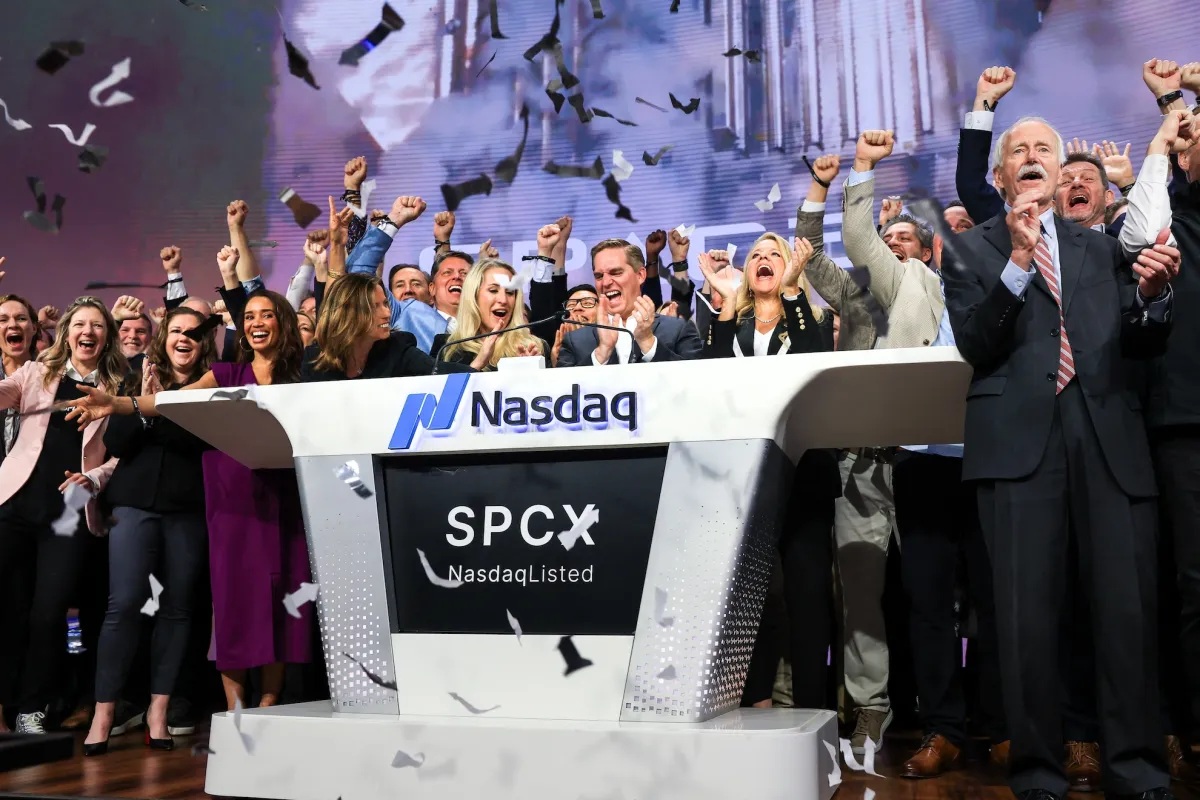
SpaceX opened for public trading on Friday at $150 per share under the ticker SPCX, quickly surging above $160 and pushing its market capitalization beyond $2 trillion in one of the most anticipated and largest initial public offerings in history.

The debut not only shattered records but also cemented Elon Musk’s status as the world’s first trillionaire, with his combined stakes in SpaceX and Tesla pushing his net worth above $1.1 trillion according to Reuters calculations based on company filings.

Musk and SpaceX President and COO Gwynne Shotwell symbolically rang the opening bell, Musk from Texas and Shotwell from the Nasdaq in New York, marking a watershed moment for a company founded in 2002 with little more than ambition.

The IPO earlier raised a record $75 billion at an initial $1.75 trillion valuation, with strong early demand reflecting investor enthusiasm for Musk’s vision of multiplanetary expansion intertwined with artificial intelligence infrastructure.

The Reuters calculations based on company filings show Musk’s holdings in SpaceX alone are worth approximately $866 billion. Combined with his interests in Tesla and other ventures, his net worth is projected to exceed $1.1 trillion following the public debut, making him the first person to cross the trillion-dollar threshold.

“The second richest person has been hovering around $300 billion, so about less than one-third of what Musk can potentially be worth tomorrow,” said Forbes Wealth deputy editor Matt Durot.

“And only one other person, (Oracle founder) Larry Ellison, has ever been worth $400 billion.”

While the milestone illustrates the extraordinary concentration of wealth created by the AI and technology boom, it also highlights investor confidence in Musk’s ability to identify and dominate emerging industries.

Unlike traditional aerospace companies, SpaceX is being valued not only on its launch business but on a broad portfolio spanning satellite communications, artificial intelligence, cloud infrastructure, and future space-based computing systems.

Ahead of the listing, Musk used a JPMorgan livestream to outline the company’s next phase of expansion.

He revealed that SpaceX has been cash-flow positive since approximately 2015 and said the decision to go public was driven by the need to finance an ambitious new growth cycle.

“We wanted to raise capital for a significant growth phase,” Musk said.

Among the company’s priorities are plans to deploy more than 100,000 satellites in orbit, dramatically expanding its Starlink communications network while building artificial intelligence data centers in space. Those projects form part of a broader strategy to position SpaceX as a central player in both the AI economy and future space infrastructure.

The company’s ambitions extend far beyond rockets.

While SpaceX was originally founded as a reusable launch company, its most profitable operation today is the Starlink satellite internet business, which has become a major source of recurring revenue and global connectivity.

The company’s transformation accelerated earlier this year when SpaceX acquired Musk’s AI venture, xAI. The transaction folded xAI’s assets into SpaceX, including its data centers, Grok AI models, the Grok chatbot platform, and the social media network X, formerly known as Twitter. The integration effectively created a combined aerospace, communications, and artificial intelligence conglomerate, giving investors exposure to several of the fastest-growing segments of the technology sector through a single company.

The listing also represents a significant shift in how investors value long-term technology platforms. According to SpaceX’s prospectus, the company has accumulated a total deficit of $41.3 billion since its founding. Yet investors have largely looked beyond historical losses and focused instead on future opportunities in satellite communications, AI infrastructure, defense technology, and commercial space services.

Shotwell, the operational architect behind Musk’s grand strategies, told CNBC just before the roadshow that the decision felt right now, despite earlier uncertainty.

“I wasn’t sure we would go public. It actually feels like the right time now,” she said.

She emphasized that staying private had allowed the company to pursue long-horizon goals without quarterly pressure. With roughly 22,000 full-time employees, Shotwell oversees everything from rocket production to Starlink scaling and the recent integration of xAI.

“Elon jokes that we make the impossible, we just make it late,” she said. “Look at our track record. We do really difficult things. We do bring them to product level.”

That track record has helped drive demand levels rarely seen in public markets. The offering attracted overwhelming interest from institutional and retail investors alike, bolstering a belief that SpaceX could become one of the dominant infrastructure providers of the AI era.

The company’s debut is also expected to influence a wave of forthcoming technology listings. Market participants are closely watching the performance of SpaceX ahead of anticipated IPOs from frontier AI firms, including OpenAI and Anthropic. A strong performance could strengthen confidence in the market’s ability to absorb mega-cap technology offerings, while validating the extraordinary valuations currently being assigned to leading AI companies.

Beyond the numbers, however, the IPO highlights the unique position Musk occupies in business and popular culture. Few corporate leaders have become as influential or as polarizing.

From reusable rockets that slashed launch costs to Starlink’s global connectivity and now orbital data centers, SpaceX has repeatedly turned “impossible” into operational reality, albeit often later than initially promised. Supporters view his willingness to pursue audacious goals as evidence of visionary leadership.

Robinhood Hit by Record Trading Surge as SpaceX Debut Sparks Frenzy Across Markets

0

The blockbuster stock market debut of SpaceX has delivered more than a windfall for investors and founder Elon Musk. It is rapidly becoming a critical test case for the next generation of artificial intelligence listings, with Wall Street closely watching what the company’s record-breaking performance could mean for upcoming IPOs from OpenAI and Anthropic.

Trading platform Robinhood said Friday it experienced “record-breaking” traffic after SpaceX shares began trading on the Nasdaq, underscoring the extraordinary investor appetite surrounding what has become the largest initial public offering in history.

The brokerage disclosed that some customers experienced latency and intermittent disruptions as trading volumes surged, although the company said its systems recovered quickly.

The rush was triggered by SpaceX’s explosive market debut. Shares opened at $150 and quickly surged above $160, pushing the company’s valuation beyond $2 trillion within minutes of trading. The rally cemented Musk’s position as the world’s first trillionaire and demonstrated the willingness of investors to pay premium valuations for companies positioned at the intersection of artificial intelligence, advanced computing, aerospace infrastructure, and next-generation communications.

Within the first hour alone, roughly 263 million shares changed hands, representing about $42 billion in trading value. Such turnover is extraordinary even by the standards of the world’s largest technology listings and highlights the scale of demand that has built around Musk’s business empire.

What makes the surge even more remarkable is that only about 4% of SpaceX’s shares were made available to public investors through the IPO. The limited float created a supply-demand imbalance that intensified buying pressure and amplified price movements.

The debut represents far more than a successful listing for one company, as it has effectively become a referendum on investor enthusiasm for the broader artificial intelligence ecosystem.

For months, investors have debated whether the valuations attached to leading AI companies can be justified. OpenAI was last valued at about $852 billion in private markets, while Anthropic recently reached a valuation of approximately $965 billion. Both companies have confidentially filed for public offerings, setting up what could be another historic wave of technology listings.

The concern among bankers and institutional investors has been whether public markets would absorb such enormous valuations after years of aggressive AI spending and growing questions about long-term returns.

SpaceX’s reception appears to have eased many of those fears.

The offering attracted demand that reportedly exceeded $250 billion, more than three times the amount of stock being sold. That level of oversubscription suggests investors remain eager to gain exposure to companies viewed as leaders in transformative technologies, even at elevated valuations.

Market participants now see SpaceX as a leading indicator for AI IPOs. If investors are willing to support a $2 trillion valuation for a company whose future growth depends heavily on ambitious projects such as orbital AI data centers, satellite-based computing networks, and next-generation artificial intelligence infrastructure, confidence could increase that OpenAI and Anthropic will also secure strong demand when they eventually begin trading.

The successful launch also provides a blueprint for how future AI listings may be marketed. Companies are emphasizing their potential role in building foundational infrastructure for the AI economy, rather than focusing solely on current earnings. SpaceX has promoted its plans to deploy tens of thousands of satellites, construct orbital computing systems, and develop space-based AI infrastructure. OpenAI and Anthropic are similarly positioning themselves as providers of the core technologies expected to underpin future economic growth.

The implications extend beyond the AI sector.

A strong performance from SpaceX could reignite a broader IPO market that has struggled in recent years with higher interest rates, economic uncertainty, and investor caution. Technology bankers have noted that successful mega-listings often create a ripple effect, encouraging private companies to accelerate their own plans to go public.

That possibility is particularly significant given the pipeline of AI-related companies waiting in the wings. Beyond OpenAI and Anthropic, firms such as Perplexity and a growing number of AI infrastructure startups are expected to seek public market access over the coming years.

For Robinhood and other retail-focused brokers, the trading frenzy shows how investors are playing an increasingly influential role in shaping major market debuts. The combination of social media enthusiasm, AI excitement, and Musk’s personal brand created one of the most heavily followed public offerings in financial history.

Geopolitical De-escalation Sends US Stock Market to New Heights

0

The U.S. stock market experienced a remarkable surge as investors welcomed reports of progress in peace negotiations, adding an estimated $1.15 trillion in market value in a single trading session. The rally reflected a powerful combination of renewed optimism, reduced geopolitical risk, and growing confidence that a period of heightened global uncertainty may be easing.

As markets reacted positively to diplomatic developments, major equity indices climbed sharply, demonstrating once again how sensitive financial markets are to changes in the global political landscape. For months, investors have navigated an environment characterized by geopolitical tensions, concerns about military escalation, and uncertainty surrounding global economic stability.

These risks have weighed heavily on market sentiment, encouraging investors to seek safer assets such as government bonds, gold, and cash. However, the emergence of credible peace talks signaled the possibility of de-escalation, prompting a rapid shift in investor behavior. Capital quickly flowed back into equities as traders reassessed the likelihood of worst-case scenarios.

The gains were broad-based, with technology, industrial, financial, and consumer discretionary sectors leading the advance. Technology companies, which often benefit from improving economic confidence and stronger investment activity, saw significant buying pressure.

Industrial firms also gained as investors anticipated that a more stable geopolitical environment could support global trade, manufacturing, and infrastructure spending.

Financial institutions benefited from expectations of stronger economic activity and increased market participation. Market analysts noted that geopolitical stability plays a critical role in shaping investor expectations. Peace talks reduce uncertainty, improve business confidence, and encourage long-term investment planning.

Companies are more willing to expand operations, hire workers, and pursue growth initiatives when the risk of conflict diminishes. As a result, equity valuations often rise as investors factor in improved earnings prospects and lower risk premiums. The addition of $1.15 trillion in market capitalization represents more than just a short-term reaction.

It highlights the enormous amount of capital that remains on the sidelines during periods of uncertainty and how quickly sentiment can change when positive developments emerge. Investors who had adopted defensive positions rushed back into risk assets, creating a powerful upward momentum across the market.

The rally also underscores the interconnected nature of modern financial markets. Peace negotiations in one region can have far-reaching implications for energy prices, supply chains, trade routes, and inflation expectations worldwide. Reduced geopolitical tensions often lower fears of supply disruptions and economic shocks, creating a more favorable environment for businesses and consumers alike.

Despite the optimism, market participants remain cautious. Peace talks are often complex and can encounter setbacks before producing lasting agreements. Investors understand that negotiations may take time and that unexpected developments could still influence market direction. The market’s strong response demonstrates a growing belief that diplomacy may succeed in reducing tensions and supporting economic stability.

Looking ahead, traders and analysts will closely monitor further developments in the negotiations, as well as upcoming economic data and corporate earnings reports. Sustained market gains will likely depend on whether positive diplomatic momentum continues and whether broader economic fundamentals remain supportive.

The $1.15 trillion increase in U.S. stock market value serves as a powerful reminder of the role sentiment plays in financial markets. While earnings, interest rates, and economic indicators remain important, investor confidence can change rapidly when geopolitical risks begin to fade.

For now, the prospect of peace has provided markets with a strong catalyst, fueling one of the most significant rallies in recent memory and reinforcing the belief that stability remains one of the most valuable assets in the global economy.

Robinhood and Coinbase Partner With Twitter to Enable SpaceX Exposure

0

In a development that highlights the growing convergence of social media, finance, and digital assets, Twitter has reportedly introduced native trading access for SpaceX-related investments through partnerships with Robinhood and Coinbase.

The move marks another step toward transforming social platforms from communication hubs into comprehensive financial ecosystems where users can consume information and act on investment opportunities without leaving the app.

The integration allows users discussing SpaceX, one of the world’s most closely watched private companies, to access trading-related services directly from Twitter. By leveraging Robinhood’s retail investing infrastructure and Coinbase’s expertise in digital asset markets, the platform aims to streamline the investment process and reduce friction between market discovery and execution.

SpaceX has long been one of the most sought-after investment opportunities among retail investors. Despite its private status, interest in the company continues to grow due to its dominance in the commercial space industry, successful satellite deployment business through Starlink, and ambitious plans for interplanetary exploration.

Until recently, gaining exposure to SpaceX was largely restricted to institutional investors, venture capital firms, and accredited investors.

New trading mechanisms and tokenized representations have begun changing that dynamic, opening access to a broader audience. Twitter’s decision to integrate trading functionality reflects a broader trend in the financial technology sector. Social media platforms increasingly recognize that financial conversations generate significant engagement.

Discussions about stocks, cryptocurrencies, and private companies often trend globally, creating opportunities for platforms to facilitate transactions alongside content consumption. Instead of requiring users to switch between multiple applications, integrated trading creates a seamless experience that keeps engagement within a single ecosystem.

Robinhood’s participation is particularly significant given its strong presence among retail investors. The brokerage became a household name during the retail trading boom and continues to attract younger investors seeking simple and mobile-friendly investment tools. Coinbase, meanwhile, brings extensive experience in digital asset infrastructure and tokenized financial products.

The two firms provide complementary capabilities that could support innovative investment offerings tied to SpaceX and other private-market opportunities. The announcement also underscores the increasing importance of tokenization in modern finance.

Tokenized assets allow traditional investments to be represented digitally on blockchain infrastructure, potentially enabling greater accessibility, transparency, and liquidity.

If SpaceX exposure is offered through tokenized instruments, it could represent a major milestone in bringing private-market investments to mainstream audiences. Such developments may eventually extend to other high-profile private companies that have historically remained inaccessible to everyday investors.

However, the initiative is not without challenges. Regulatory scrutiny remains a key consideration whenever private-company exposure, tokenized securities, or social-media-driven investing intersect. Financial regulators worldwide continue to evaluate how digital investment products should be classified, monitored, and protected.

Ensuring transparency, investor protection, and compliance will be critical to the long-term success of any such offering. Market observers also note that integrating trading directly into social platforms could amplify both opportunities and risks.

While investors gain easier access to markets, they may also face increased exposure to speculation, viral trends, and emotionally driven decision-making. Responsible product design and investor education will therefore play an important role in maintaining market integrity.

Twitter’s integration of SpaceX trading through Robinhood and Coinbase signals a new chapter in the evolution of digital finance. By combining social engagement, real-time information, and investment access within a single platform, the initiative reflects the broader transformation of how individuals discover, evaluate, and participate in financial markets.

Coinbase Introduces USDE Vault Amid Rising Stablecoin Regulation in the US

0

Coinbase’s latest product expansion—introducing a Clarity Act-compliant USDE vault in partnership with Ethena alongside the rollout of “Coinbase for Agents”—signals a structural shift in how regulated digital assets and autonomous financial systems are expected to converge in the United States.

Rather than positioning itself purely as a trading venue, Coinbase is increasingly evolving into a compliance-first financial infrastructure layer for both institutional capital and machine-driven agents. At the center of this development is USDE, Ethena’s synthetic dollar instrument issued by Ethena Labs.

USDE is designed to maintain dollar parity through crypto-native collateral and delta-hedging strategies rather than relying on traditional fiat reserves.

By integrating a Clarity Act-compliant vault structure, Coinbase is effectively wrapping this synthetic asset inside a regulatory-grade custody and reporting framework aligned with emerging U.S. digital asset legislation expectations.

This move is significant because it attempts to bridge the gap between decentralized synthetic dollar systems and the compliance requirements demanded by U.S. regulators and institutional allocators. From Coinbase’s perspective, this is a continuation of its broader institutionalization strategy.

Coinbase has steadily expanded from retail brokerage services into custody, derivatives, staking, and tokenization infrastructure. The introduction of regulated vault products for synthetic dollars allows Coinbase to position itself as a compliant gateway for yield-bearing stable-value instruments—an increasingly competitive segment as tokenized cash equivalents gain traction in global markets.

The second pillar of the announcement—Coinbase for Agents—is arguably more forward-looking. This initiative appears designed to support autonomous AI agents and algorithmic entities that can hold, deploy, and manage capital within pre-approved compliance boundaries.

In practice, this could allow software agents to interact with on-chain and off-chain financial systems under identity, permissioning, and risk constraints defined by Coinbase’s infrastructure layer.

The implication is that financial access is no longer exclusively human-centric; instead, capital management becomes partially delegated to machine agents operating under programmable guardrails.

This aligns with a broader industry transition where AI systems are increasingly expected to interact directly with financial rails, from executing trades to managing treasury operations. By embedding compliance logic into agent-facing financial infrastructure, Coinbase is attempting to preemptively solve one of the core regulatory concerns.

How autonomous systems can participate in markets without creating unaccountable or untraceable financial activity. The combination of a regulated USDE vault and agent-enabled financial tooling also reflects a convergence between two macro trends: the tokenization of real-world financial instruments and the rise of AI-driven economic actors.

In this framework, stable-value crypto assets like USDE become programmable cash layers, while agent infrastructure becomes the execution layer that deploys this capital in real time.

If successful, Coinbase’s dual launch could mark an early blueprint for what a hybrid financial system looks like in practice—one where regulated exchanges are no longer passive marketplaces but active intermediaries between human capital, synthetic dollar systems, and autonomous agents.

The model will likely face scrutiny around systemic risk, regulatory clarity, and the reliability of synthetic dollar peg mechanisms under stress conditions. Coinbase is signaling that the next phase of crypto infrastructure will not be defined solely by asset listing or trading volume, but by how seamlessly compliant digital money and autonomous financial intelligence can operate within the same ecosystem.