DD
MM
YYYY

PAGES

DD
MM
YYYY

spot_img

PAGES

Home Blog Page 1452

Adam Smith’s “Invisible Hand”, The Missing “Port” in Modelling Trade Deficits/Gains

0

In 1776, Scottish economist and philosopher, Adam Smith, wrote the masterpiece, ‘The Wealth of Nations’- actually ‘An Inquiry into the Nature and Causes of the Wealth of Nations”. By coincidence, the United States Declaration of Independence was adopted the same year, making the American colonies independent.

America has since evolved to dominate the old British Empire. The Yankees figuratively were discipled by Dr. Smith who believed in the free market, and made his argument that ‘capitalism’ will benefit mankind than any other economic structure. He laid this foundation at the onset of industrial revolution and provided the basic mechanics for modern economics.

Smith made his case about the ‘invisible hand’ and why monopoly, and undue and unfettered government regulations, or interference, in market and industry must be discouraged. He believed that prudent allocation of resources cannot happen when states dominate and over interfere.

In that old time, America farmers could grow cotton but would not process it. It must be sent to England where it would later be imported into the U.S. as a finished product (Africa, sounds familiar?). Understanding that this decision was not due to lack of processing ability, you will appreciate Smith’s argument that the market must be free.

His theses were clear and were very influential; they provided the same level of fulcrum to Economics as Isaac Newton’s Mathematica Prinicipia did for Physics. While reading Smith’s book and understanding the time frame it was written, one cannot but appreciate the intellectual rigour in that piece. Before technology penetrated at scale across the regions of the world, he noted that all nations could compete at par in agricultural productivity.  The reason was absence of division of labor in any subsistence farming system in the world. A farmer does everything on the farm and is not an expert in most. Discounting fertile land, rain and other factors that could help farmers, all the farmers, from Africa to plantations in Alabama, the level of productivity was similar.  Why? No specialization was employed in the farming business at the time.

Fast track forward when the industrial revolution set forth. The British Empire became an engine of wealth creation through automation. It was a quintessential period of unrivalled human productivity which resulted in enormous wealth created. Technology not only helped to speed up process execution, it also helped to create a framework for division of labor.

Interestingly, Smith had noted that except for agriculture where productivity was flat because of lack of division of labor, other industries were doing just fine. And in those industries, there were organized structures which enabled division of labor. For instance, in the construction industry, there were bricklayers, carpenters, painters, and so on; but a farmer was a farmer.

As you read through Wealth of Nations and observe the 21st century, you will see the impacts of technology. Technology has changed economic structures and created new market adaptation rules with new species like artificial intelligence promising large scale disruption in industries.

Simply, it will be difficult to separate the health of any modern economy from its technology. It goes beyond the wealth of that nation to its survivability. The most advanced nations are the technology juggernauts while the least developing economics barely record any technology penetration impact at the productivity quotient. For the latter, it is like still living in the pre-industrial age Smith discussed on agriculture and division of labor where processes were inefficient.

Perhaps this explains the efficiency of the developed world in both the public and private arenas. The more technologies they diffuse, the more productive they become. In other words, show me the technology and I will tell you where the nation stands in the league of countries. The invention of steam engine changed the world and powered the industrial revolution, and the invention of transistor transformed the 20th century, and is fueling the new innovation century.

Yes, major scientific and mathematical breakthroughs seed great countries. From the old Babylon, Roman Empire, and Pharaoh’s Egypt to the modern America, knowledge has always ruled the world. You cannot separate better harvest at the banks of River Nile from the mastery of geometry which Egyptians played significant roles. Some old wars had been won by developing constructs that enabled efficient transportation of soldiers to battleground.  In short, knowledge won for nations even when everything was about physical goods. But what happens in the digitizing world?

Adding Internet Port to Seaport, Landport, Airport in Modelling Trade Deficits/Gains

In the realm of global trade measurement, a paradigm shift is underway as traditional frameworks grapple with the transformative impact of digitalization on economies worldwide. Historically centered on physical goods, international trade is now increasingly shaped by intangible services and software in the 21st century. This evolution necessitates a reevaluation of how we measure trade balances, moving beyond conventional metrics to encompass the full spectrum of economic activities in today’s interconnected world.  That Adam Smith did not include this digital construct does not mean we cannot redesign the measurement system.

Recent events, such as trade negotiations between the US and the world, underscore the urgency for updated methodologies that accurately capture the complexities of modern trade relationships. When we posit that Nigeria enjoys a trade surplus with the United States, we fail to understand that even though within the physical business space, measured at airports, seaports and landports, where Nigeria could be exporting more through our crude oil to record a trade surplus with the almighty America when we rarely import much, we could be flatly wrong. Why? If you include “internet ports” besides those seaports, landports and airports, Nigeria records significant deficits since from software to movies, from global banking services to social media and data services, Nigeria exports nothing but “imports” most from the US.

Largely, as countries navigate this new landscape, key themes emerge around the significance of services, data, cloud computing and software in shaping global trade balances. The rise of digital products has not only blurred traditional boundaries but also posed challenges in accurately assessing trade dynamics. With technology continuing to drive change at an unprecedented pace, nations must recalibrate so that trade deficits and surplus must be done in a comprehensive way to avoid distortions which could severely affect already beaten down economics which are recording TRADE DEFICITS via the internet ports with leading economies.

Solana Whales Are Rotating Into This Hidden Altcoin After Its Massive Beta Launch

0

Solana buyers now look forward to a swift price recovery following the token’s recent upward climb.

Yet, RCO Finance is stealing the market spotlight after announcing a new $7.5 million investment. Read on to see why experts say RCO Finance will become one of the top crypto presales of 2025.

Solana Records a Strong Turnaround in the Past Week

Solana investors are excited over its recent price increase in the past few days. Several altcoin projects like Solana have faced strong bearish sentiments in the past few months.

Donald Trump’s recent move to ease international tariffs has helped improve market sentiment, reducing sell-offs across riskier assets like altcoins.

Data from CoinMarketCap shows that Solana is now trading at $139.66, after a 4.94% increase in the past week. Following Solana’s growth, investors have changed their predictions for the token, saying it might return to the $170 region.

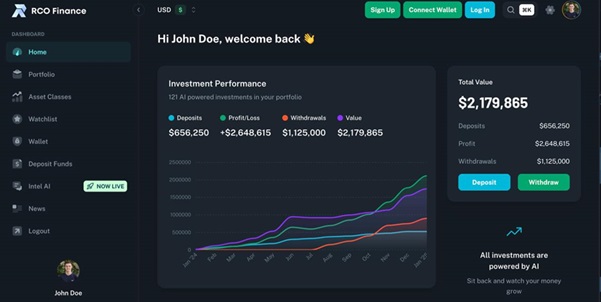
While Solana’s upward trend has rekindled interest, some traders believe the real opportunity lies elsewhere. A growing number are now turning to RCO Finance—an AI-powered altcoin project that has gained over 285,000 users despite being in its beta phase.

RCO Finance Unveils New Trading Tools as AI Investing Surges in Popularity

As AI reshapes every sector, from healthcare to finance, investors seek platforms that harness automation to deliver tangible results. RCO Finance is emerging as a top choice—thanks to its innovative suite of AI-powered trading tools designed for today’s dynamic markets.

RCO Finance provides a robust trading ecosystem that combines intelligent automation, diverse asset access, and user-friendly tools. The platform’s trading tools and strategies work for both beginner and expert traders, a factor that is now drawing institutional investors to the RCO Finance ecosystem.

Unlike many investing platforms, RCO Finance grants access to diverse markets, allowing investors to complete trades across stocks, cryptocurrencies, ETFs, tokenized real estate, and commodities, all within a unified dashboard.

This allows them to diversify effectively without needing multiple platforms. RCO Finance’s AI trading dashboard also comes with real-time investment analytics alongside features that allow traders to track profits, deposits, withdrawals, and total account value.

Other features include dynamic line charts and optimized navigations. Later on, this dashboard will be expanded to include personalized AI recommendations via the intel chart.

Beyond broad market access and an intuitive trading dashboard, RCO Finance offers smart portfolio management alongside an AI-powered trading bot named Robo Advisor. This cutting-edge AI bot can help generate custom portfolio strategies for traders by having them complete simple Q&A processes.

Whether you prefer high, medium, or low risk, RCO Finance’s AI investment advisor can help you tailor a strategy based on income growth and capital preservation. Another advantage of belonging to the RCO Finance ecosystem is access to its demo trading features.

Traders can now participate in a risk-free simulated trading environment and enjoy access to all asset classes while using real-time data. RCO Finance’s live demo environment allows users to place orders, track positions, and simulate trading strategies using real-time data.

The upcoming upgrade will introduce leaderboards and crypto-funding options, letting users compare manual and AI-generated trades side-by-side. By offering this service, RCO Finance allows demo users to see how a managed portfolio would behave based on their preferences.

In addition to its dynamic trading features, RCO Finance also offers lucrative benefits for passive investors.

Those seeking long-term yield can stake $RCOF and earn up to 86% APY for contributing to liquidity in the platform’s ecosystem. They will also enjoy lower trading fees and cashback rewards for keeping RCOF tokens in their wallets.

Security remains central to the RCO Finance ecosystem. Built on SolidProof-audited smart contracts and featuring a strict no-KYC policy, the platform ensures secure and anonymous participation.

RCO Finance Draws More Investor Interest

Currently, in beta, RCO Finance’s user base has surged to over 290,000 investors as traders have rushed to capitalize on its AI-powered trading features.

RCO Finance has also attracted a $7.5 million buy-in from a top-class venture firm, a move that experts say shows the rapid fame of RCO Finance in institutional investment circles.

Top Crypto Coins: RCO Finance Vs Solana

RCO Finance has been hailed as a game-changer in the crypto market, saying it is poised to open up the investment landscape with AI technology. Over $14.7 million has already been raised through its presale, with the RCOF token priced at $0.130 in stage 6.

By the next stage, RCOF’s value will grow to $0.150. After reaching the $0.40–$0.60 range, RCOF will be listed. Following its growing institutional investor interest and user signups, analysts say RCOF is poised to surge in the coming months.

This makes now the best time to capitalize on its projected 12,000% growth potential, which could take a $1,000 investment today to over $120,000 by March 2026.

As investors migrate away from meme coins toward real-world utility tokens, RCO Finance is quickly becoming a preferred alternative. Join RCO Finance today and secure your spot in the future of AI-based trading.

For more information about the RCO Finance (RCOF) Presale:

Visit RCO Finance Presale

Join The RCO Finance Community

OpenAI Wants Chrome, and It’s Not Just About the Browser: DOJ Trial Highlights Looming Power Swap Between AI and Search

0

As the U.S. Department of Justice moves into the remedy phase of its antitrust trial against Google, a clear picture is beginning to emerge, one that suggests a dramatic shift in the balance of power within the tech industry.

What’s at stake is not just a browser or search engine, but control over the very future of the internet. OpenAI, an artificial intelligence firm that only recently rose to prominence with the launch of ChatGPT, now appears to be positioning itself as the next great search behemoth, just as Google seeks to become a dominant force in artificial intelligence.

At the heart of this pivot is Chrome, the world’s most widely used browser. The DOJ argues that Google’s ownership and integration of Chrome have allowed it to illegally entrench its dominance in the search market—sidelining competition and cutting off user choice. The government wants to dismantle that structure. One of its boldest proposals is to force Google to divest Chrome entirely.

During testimony at the trial this week, Nick Turley, OpenAI’s head of product for ChatGPT, didn’t mince words. When asked whether his company would be interested in buying Chrome, he replied with a confident “Yes, we would, as would many other parties.” It’s a statement that made clear OpenAI’s broader ambitions go far beyond chatbots and language models.

While the trial continues to deliberate whether Google should be compelled to relinquish Chrome, OpenAI is already eyeing what comes next: transforming the browser into a gateway for AI-powered search and web experiences. The company, which is deeply partnered with Microsoft but clearly not content to rely solely on Bing’s infrastructure, appears to be laying the groundwork for a new search ecosystem—one that bypasses the traditional blue links and instead uses generative AI to answer questions, recommend content, and even act on behalf of the user.

Turley told the court that OpenAI had previously asked Google to license its search API. A leaked email presented during the trial revealed that OpenAI had argued such a deal would allow it to build a significantly better product. But Google, worried about losing its edge in search, rejected the offer.

This isn’t just a corporate dispute—it’s a signal.

OpenAI is pushing forward to become a search powerhouse at the very moment that Google is leaning into AI to redefine its own future. The roles, in many ways, are reversing. Where Google once reigned unchallenged in search, OpenAI is now the one building out that domain. Meanwhile, Google is investing heavily in AI development through its Gemini platform—previously Bard—and embedding AI tools throughout its services.

Just last month, Google announced it would integrate generative AI responses directly into traditional search results, a move that is meant to counter the growing influence of AI-first tools like ChatGPT and Perplexity AI. Google is also racing to close the innovation gap in large language models, seeking to reclaim attention in a field where OpenAI has gained both mindshare and market share.

Through Gemini, Google aims to bring AI to Gmail, Docs, Maps, and even Search itself—turning its services into dynamic platforms where AI understands user needs, interprets queries more contextually, and anticipates what users want before they finish typing. It is, in effect, trying to reimagine itself in the mold of OpenAI.

Against this backdrop, many industry observers now believe the DOJ’s antitrust probe may mark a pivotal turning point in this transformation.

If Google is forced to divest key assets like Chrome or to make its search index accessible to competitors, it will weaken the foundation that has sustained its dominance for two decades. This would create space for rivals like OpenAI to not only challenge Google’s supremacy in AI but also build a rival search empire on their own terms.

That future is not far-fetched

OpenAI has already begun recruiting top-tier browser engineers, including former Google developers Ben Goodger and Darin Fisher, both instrumental in building Chrome during its early days. The company is rumored to be working on a Chromium-based browser of its own, but owning Chrome outright would fast-track its strategy, giving it an install base in the billions and near-instant access to web-scale user data—essential for training and refining AI agents.

An “AI-first” Chrome, under OpenAI’s control, would likely bake ChatGPT into every corner of the browsing experience, acting not only as a search assistant but as a decision-making tool. It would represent the browser’s most radical evolution since its inception—moving from a passive information portal to an intelligent co-pilot.

However, even with its own AI investments, Google may not be able to stop the momentum. The very antitrust scrutiny it now faces was sparked by its aggressive moves to protect its search monopoly—multi-billion dollar deals with Apple, Samsung, and others to keep Google as the default engine on devices worldwide. That strategy is now under threat, and so is the empire built on it.

If Judge Amit Mehta ultimately rules in favor of the DOJ’s remedies, it would not just disrupt Google’s current business—it might usher in a new paradigm where the lines between browser, search engine, and AI assistant blur completely. In that future, the players that dominate AI could also dominate search, reversing the decades-long dominance Google has enjoyed.

A New Digital Power Map

In effect, we’re witnessing what many analysts now describe as a trade-off of dominance. OpenAI, once a research lab, is maturing into a search and browser competitor. Google, once king of search, is fighting to reinvent itself as an AI leader. And the DOJ’s antitrust probe may be the inflection point that allows or forces that evolution to happen.

Should Chrome be sold, and should OpenAI or another AI-native company take over, the story of web search would no longer be told in keywords and ranking algorithms. Instead, it would be told through prompts, responses, and AI agents that can interact with the digital world on our behalf.

The future of the internet may no longer be about who owns the most links—it may be about who owns the smartest assistant. And that’s a future the DOJ trial is now helping to define.

IMF Lowers Nigeria’s 2025 Growth Forecast to 3.0%, Warns of Deep-Rooted Economic Risks

0

The International Monetary Fund (IMF) has downgraded its growth projection for Nigeria in 2025 to 3.0 percent, a modest outlook that falls short of the Federal Government’s 4.6 percent estimate in the 2025 budget.

The revision, released Tuesday in the IMF’s latest World Economic Outlook, trims 0.2 percentage points off its earlier October 2024 forecast of 3.2 percent, citing weaker oil prices and lingering structural challenges.

The report, which examines global and regional economic trends, also sees Nigeria’s growth slowing further to 2.7 percent in 2026—a trajectory that casts doubt on the sustainability of the country’s ongoing economic recovery despite recent policy overhauls.

The Fund’s projection is at odds with figures released by Nigeria’s National Bureau of Statistics (NBS), which reported that the country’s economy grew by 3.84 percent in real terms in Q4 2024. That figure marked a noticeable uptick from both Q3 2024 and the same quarter a year earlier. The NBS attributed this acceleration to a modest rebound in the non-oil sector, improved agricultural output, and stronger performance in services.

Still, the IMF’s caution stems from broader vulnerabilities—chief among them inflation, unemployment, and a deepening food crisis.

Reforms Recognized, But Their Impact Remains Uneven

In its separate staff report following a recent visit to Nigeria, the IMF Mission led by Axel Schimmelpfennig acknowledged that President Bola Tinubu’s administration has taken “important steps” to correct years of macroeconomic instability. Among the reforms lauded were the scrapping of fuel subsidies, a liberalized foreign exchange regime, and halting the Central Bank of Nigeria’s deficit financing for the federal government—measures aimed at restoring fiscal and monetary discipline.

But while these policies have earned praise from international institutions, they have yet to deliver tangible benefits to most Nigerians.

“Gains have yet to benefit all Nigerians as poverty and food insecurity remain high,” the IMF cautioned, flagging the risk that prolonged hardship could undermine public support for the reforms and slow down implementation.

In March 2025, inflation climbed to 24.23 percent—driven largely by food and transport costs. Although the CBN has taken an increasingly hawkish stance, raising interest rates and tightening liquidity to combat inflation, the Fund warned that price pressures remain deeply embedded, especially in the context of widespread poverty and weak purchasing power.

A Regional Standout, But Not Out of the Woods

Nigeria’s 3.0 percent forecast puts it ahead of regional rivals like South Africa, which is expected to grow just 1.0 percent in 2025 and 1.3 percent in 2026. The average growth for sub-Saharan Africa is pegged at 3.8 percent in 2025 and 4.2 percent in 2026.

Still, Nigeria’s position isn’t secure. The IMF noted that the country’s outlook was downgraded due to softening oil revenues, a critical source of foreign exchange, and unresolved fiscal imbalances.

“Among the larger economies, the growth forecast in Nigeria is revised downward by 0.2 percentage point for 2025 and 0.3 percentage point for 2026, owing to lower oil prices,” the report noted.

Across emerging markets, countries in Asia are expected to grow at an average of 4.5 percent in 2025, while the United States is forecast to grow at 1.8 percent, and advanced economies more broadly at 1.4 percent.

CBN Commended for Data-Driven Approach

The IMF expressed support for the Central Bank of Nigeria’s new leadership and its “data-dependent” approach to monetary policy. The Fund described the strategy as appropriate for navigating Nigeria’s complex inflation dynamics and external vulnerabilities.

Since assuming office, the CBN governor, Yemi Cardoso, has moved to restore investor confidence and credibility, raising the benchmark interest rate several times. However, with inflation continuing to bite, especially for food and transport, households remain under pressure.

For the Tinubu administration, the challenge lies in converting technical reforms into meaningful gains for Nigerians. The disconnect between macroeconomic indicators and lived realities continues to haunt policy credibility.

While the reforms may have won Abuja some applause abroad, the true test remains at home—where millions are still waiting for the promises of economic recovery to translate into affordable food, jobs, and stability.

OpenAI Announces Interest to Purchase Google Chrome if Forced to Sell

0

Artificial intelligence firm OpenAI has announced interest in purchasing Google Chrome if forced to sell by the US Department of Justice (DOJ).

OpenAI executive Nick Turley in a court hearing on Tuesday, disclosed that acquiring Chrome would allow OpenAI to offer an incredible experience and introduce users into what an AI-first browser looks like.

Turley had been called by the Justice Department to testify as part of a trial aimed at determining what business practices Google must modify after a judge found the company monopolized the online search market. The Justice Department has asked that Google be forced to divest Chrome.

Recall that OpenAI has reportedly considered working on a web browser to compete with Chrome. Last year November, the potential browser, which could incorporate OpenAI’s ChatGPT, is said to have been shown in prototype or design form to companies such as Conde Nast, Redfin, Eventbrite, and Priceline. The company went as far as hiring ex-Google developers Ben Goodger and Darin Fisher, who worked on the original Chrome project, several months ago.

Meanwhile, the U.S. Department of Justice (DOJ) has continued to intensify its antitrust case against Google, suggesting that the tech giant sell its Chrome browser to curb its monopolistic hold on online search. Justice Department lawyer David Dahlquist said that the company should also be forced to help rival search engines that it has unfairly kept out of competition.

“This is the time for the court to tell Google and all other monopolists who are out there listening, and they are listening, that there are consequences when you break the antitrust laws,” Dahlquist said. Notably, Government lawyers have also made their case in opening statements, saying that Google should be forced to sell Chrome, its web browser, which pushes people to the Google search engine.

Google has countered the lawsuit, with the company lawyers stating that any remedies should only consider the company’s deals with companies such as Apple, Mozilla, and Samsung to make it the default search engine for smartphones and other devices. “Google won its place in the market fair and square,” said company attorney John Schmidtlein, according to NBC News.

According to the Justice Department, the Google search engine is used for nearly 90% of web searches, but the company disputes that number. Google has not offered Chrome for sale. However, if forced to sell Chrome due to the ongoing antitrust trial, the implications would be far-reaching for Google, the browser market, the tech industry, and internet users.

Meanwhile, prosecutors have raised concerns that Google’s search monopoly could give it advantages in AI, and that its AI products are another way to lead users to its search engine. Google has pointed to competition among companies offering generative AI products, such as Meta Platforms, Opens New Tab, and Microsoft.

Notably, the tech giant argues that the DOJ’s proposals, including divestiture of Chrome, exceed the scope of the case and could harm its competitiveness. A Bloomberg analyst estimates Chrome’s value at over $15 billion, underscoring the high stakes. Judge Mehta is expected to decide on remedies by August 2025.

Google plans to appeal the ruling that it holds a monopoly. The beginning of the high-stakes trial provided a glimpse into the generative AI race, where Big Tech companies and startups are vying to build up their apps and gain users.