DD
MM
YYYY

PAGES

DD
MM
YYYY

spot_img

PAGES

Home Blog Page 1461

A Look Into Trump’s Non-Tariff Cheating List

0

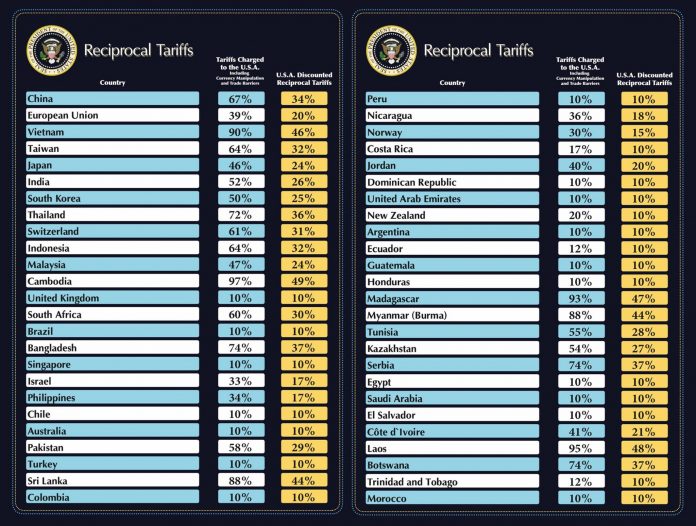
President Donald Trump shared an eight-point “non-tariff cheating” list on Truth Social, targeting trade practices he claims harm U.S. interests. Posted on Easter Sunday, the list highlights methods allegedly used by trading partners to gain unfair advantages, potentially straining diplomatic and trade relations. This move followed his April 9 announcement of a 90-day pause on sweeping reciprocal tariffs for most countries, except China, amid negotiations with over 75 nations. The list includes:

Accusing countries of devaluing currencies to boost exports and make U.S. goods costlier abroad. Claiming VATs act as tariffs by taxing imports while refunding exports, creating an uneven playing field. Selling goods abroad at prices lower than domestic markets or production costs. Providing financial support to exporters, distorting market competition.

Citing examples like the EU’s ban on genetically engineered corn as barriers to U.S. exports. Referencing Japan’s alleged “bowling ball test” to block U.S. cars, a claim Trump made in 2018. Intellectual property violations that harm U.S. businesses. Routing goods through third countries to evade U.S. tariffs.

Trump’s list aligns with his broader trade agenda, emphasizing reciprocity and reducing the U.S. goods trade deficit, which he declared a national emergency on April 2, 2025, under the International Emergency Economic Powers Act. He argues these non-tariff barriers are as damaging as tariffs, if not worse, and aims to pressure trading partners to negotiate fairer terms. The announcement coincided with heightened U.S.-China trade tensions, with tariffs on Chinese goods escalating to 145% after Beijing’s retaliatory 125% duties.

The list sparked market reactions, with gold prices surging 3.5% per ounce within an hour, reflecting demand for safe-haven assets. Bitcoin and Ethereum rose 2.2% and 1.8%, respectively, while gold-backed cryptocurrencies like Tether Gold saw a 25% trading volume spike. Critics, including economists like Kent Jones, argue Trump’s focus on trade deficits oversimplifies imbalances, which often stem from comparative advantages rather than “cheating.”

Some note the U.S. also employs non-tariff barriers, like quotas, complicating the narrative. The World Trade Organization can adjudicate genuine trade violations, but Trump’s formula—based on trade deficits rather than evidence of cheating—has drawn skepticism for lacking economic validity.

Trump’s administration imposed tariffs starting with a 10% levy on Chinese goods on February 1, 2025, escalating to 20% by March 4, 54% by April 2, and reaching 145% by April 9, following China’s retaliatory tariffs of up to 125%. These tit-for-tat measures have led to a near-total freeze in bilateral goods trade, with the World Trade Organization (WTO) estimating an 80% drop in U.S.-China merchandise trade in 2025.

Trump’s “non-tariff cheating” list, posted on April 20, 2025, accuses China of practices like currency manipulation, export subsidies, and intellectual property theft. This aligns with his broader narrative of addressing trade imbalances, though critics argue it oversimplifies economic dynamics. China counters that U.S. tariffs infringe on its sovereignty and demands structural economic changes. The tariffs are projected to cost U.S. households an average of $1,243 annually and reduce after-tax income by 1.2%. Imports are expected to fall by $800 billion (23%) in 2025, with global trade declining by 1.5% and GDP growth slowing to 2.2%.

China’s economy, already facing a slowdown, is shifting toward domestic demand and diversified export markets, reducing reliance on the U.S. from 19.8% of exports in 2018 to 12.8% in 2023. Trump’s strategy aims to isolate China by negotiating tariff deals with other nations, but Beijing is countering with diplomatic outreach, forging trade ties with Vietnam, Malaysia, and others. China’s leaders believe their economy is resilient enough to endure prolonged trade disruptions, while Trump’s approach risks alienating allies like Japan and South Korea, who face high U.S. tariffs.

The trade war threatens to split the global trading system into U.S.- and China-led blocs, with Southeast Asian nations hedging toward China. Tensions also risk spilling into military and diplomatic arenas, particularly over issues like Taiwan and critical minerals, where China has restricted exports to the U.S. Both sides show little willingness to de-escalate. Trump insists on Xi Jinping initiating talks, while China vows to “fight to the end,” leveraging its economic resilience and global partnerships. The standoff is causing market volatility, with U.S. businesses facing supply chain disruptions and higher costs.

Financial Modeling and Business Valuation | Tekedia Mini-MBA

0

How much is that company worth? How do you know how much you should sell that startup? How do you model how much you should pay for that business? Join us today as we discuss “Financial Modeling and Business Valuation” at Africa’s finest business program for the mastery of entrepreneurial capitalism. At Tekedia Mini-MBA, our product is Knowledge.

Meanwhile, we have opened registration for the June edition here

Dollar Weakens Further as Trump’s Clash with Fed Sparks Market Turmoil; Gold Surges Past $3,500 in Flight from U.S. Assets

0

The U.S. dollar plunged to its lowest level in three years on Monday, deepening a slide that has unsettled global markets and sent investors scrambling for safer assets, particularly gold, which surged past $3,500 an ounce for the first time in history.

The ICE U.S. Dollar Index, a benchmark that measures the strength of the greenback against a basket of six major currencies, fell to 97.92 before settling slightly higher at 98.38 by mid-day trading. This marked its lowest level since March 2022, according to data from FactSet.

The sharp decline in the dollar comes amid intensifying concerns over President Donald Trump’s open confrontation with the Federal Reserve. Investors were rattled after Trump renewed his attacks on Fed Chair Jerome Powell, referring to him as “Mr. Too Late” and “a major loser” in a post on Truth Social. The president’s continued undermining of the central bank’s independence, combined with reported efforts by White House officials to explore the legality of removing Powell, has created a crisis of confidence among investors and market participants.

“We’re seeing a clear signal from the market that it doesn’t like even the idea that the president might try to remove the Fed chair,” said Krishna Guha, vice chairman at Evercore ISI, during an appearance on CNBC’s Squawk Box on Monday. “There has been some loss of confidence in U.S. economic policy making in recent weeks. We’ve seen that in this very odd combination of upward pressure at times on longer-term bond yields combined with a weaker dollar. That suggests global investors pulling capital out of the U.S.”

The political brinkmanship has pushed global investors to reassess their exposure to U.S. assets, triggering an exodus that has accelerated over the past several weeks. Business leaders are increasingly voicing concern that the current trajectory is sending all the wrong signals about America’s economic stability and institutional coherence.

“Gold is not just any commodity, it’s money,” said Peter Schiff, Chief Economist and Global Strategist at Euro Pacific Capital. “Under normal circumstances gold does not move the way it is now. It’s already up another $58 tonight [Monday], trading above $3,483. This is the end of the U.S. dollar’s dominance. Life in America is about to change in ways few can imagine.”

The rally in gold, long considered a refuge during economic uncertainty, has been dramatic. Spot prices breached the $3,500-per-ounce mark early Tuesday, up from $2,623 at the start of the year. Analysts now believe the metal could push past $4,000 in the coming weeks, noting the pace at which it broke the $3,000 barrier was already unprecedented.

Historically, during periods of market turmoil, investors have turned to U.S. dollars and Treasuries. But this time, with Washington itself at the center of the storm, many are abandoning traditional havens in favor of gold and other non-U.S. assets. The dollar’s weakness has been accompanied by sharp drops in major stock indexes, with Wall Street continuing to bleed.

On Monday, the Dow Jones Industrial Average fell by nearly 1,000 points — a 2.5% decline — making it one of the worst single-day losses in recent months. The index is now on track to record its worst April performance since 1932, deepening anxieties that the political conflict in Washington is evolving into a broader financial crisis.

Other major currencies gained sharply against the dollar. The euro rose 1.3%, while both the Japanese yen and Swiss franc advanced as traders moved to unwind dollar holdings. Treasury yields also fell as prices rose, reflecting rising demand for government bonds even as questions swirl about the long-term credibility of U.S. fiscal and monetary policy.

Andy Laperriere, head of U.S. policy at Piper Sandler, warned clients in a note that the president’s behavior could continue to roil markets.

“We are looking at a president who is determined to turn Washington upside down,” Laperriere wrote. “Investors who ignored Trump’s own words proclaiming higher tariffs were ill-served by doing so. Likewise, it would be a mistake to brush aside Trump’s own words and actions on these other issues.”

While Trump’s supporters argue that the president is simply pushing for accountability and better economic results, the markets are reacting to what appears to be an erosion of institutional guardrails. The Fed, traditionally an apolitical actor charged with safeguarding monetary stability, has now been dragged into a battle that could redefine its role.

Thus, the dollar’s decline, the record-setting rally in gold, and the red ink across stock markets suggest investors are bracing for more instability in the weeks ahead. While Washington remains embroiled in political wrangling, Wall Street is signaling that the price of unpredictability may already be showing up in the balance sheets of global portfolios.

Google Challenges DOJ Breakup Lawsuit, Argues That it Would Harm America’s Economy And Technological Leadership

0

Tech giant Google is challenging the U.S. Department of Justice’s (DOJ) lawsuit, arguing that its remedies are outdated and harmful, amid fierce competition and innovation from services like China’s DeepSeek.

This comes after an August ruling against the tech giant, that it holds a monopoly in internet search. The DOJ is pushing for Google to divest its Chrome browser and share search data with competitors. Google argues that such a move would undermine U.S. innovation and national security in the escalating global AI race, particularly against China’s DeepSeek.

In a blogpost titled, “DOJ’s sweeping remedies would harm America’s economy and technological leadership,” Google warned that the DOJ’s proposals would hamstring AI development and subject Google’s products to government oversight, stifling America’s tech leadership. “We are in a fiercely competitive global race with China”, Google’s Vice President of regulatory affairs, Lee Anne Mulholland wrote, emphasizing Google’s role in advancing AI breakthroughs like the Transformers architecture, foundational chatbots like ChatGPT, Perplexitu, and Anthropic.

Part of the blog post reads,

“We have long said that we disagree with the Court’s decision in the case and will appeal. But first, the Court must decide what remedies best address its liability decision. At trial, we will show how DOJ’s unprecédented proposals go miles beyond the Court’s decision and would hurt America’s consumers, economy, and technological leadership:

  • DOJ’s proposal would make it harder for you to get to services you prefer. People use Google because they want to, not because they have to. DOJ’s proposal would force browsers and phones to default to search services like Microsoft’s Bing, making it harder for you to access Google.
  • DOJ’s proposal to prevent us from competing for the right to distribute Search would raise prices and slow innovation. Device makers and web browsers (like Mozilla’s Firefox) rely on the revenue they receive from search distribution. Removing that revenue would raise the cost of mobile phones and handicap the web browsers that you use every day.
  • DOJ’s proposal would force Google to share your most sensitive and private search queries with companies you may never have heard of, jeopardizing your privacy and security. Your private information would be exposed, without your permission, to companies that lack Google’s world-class security protections, where it could be exploited by bad actors.
  • DOJ’s proposal would also hamstring how we develop Al, and have a government-appointed committee regulate the design and development of our products. That would hold back American innovation at a critical juncture. We’re in a fiercely competitive global race with China for the next generation of technology leadership, and Google is at the forefront of American companies making scientific and technological breakthroughs.
  • DOJ’s proposal to split off Chrome and Android – which we built at great cost over many years and make available for free — would break those platforms, Kurt businesses built on them, and undermine security. Google keeps more people safe online than any other company in the world Breaking off Chrome and Android from our technical, security, and operational infrastructure would not just introduce cybersecurity and even national security risks, but also increase the cost of your devices.”

The DOJ’s demands come as Google faces multiple antitrust challenges, including a recent loss in a case over illegal monopolies in online advertising. The current three-week trial, ending May 9, will determine the consequences of the August search monopoly verdict, with Judge Amit Mehta’s ruling expected in August.

Google plans to appeal, arguing that the DOJ’s measures exceed the court’s decision and threaten consumers, the economy, and U.S. tech dominance. Google defends Chrome as a critical tool for web access, noting its open-source code benefits competitors. Sharing search data, it claims, poses cybersecurity and national security risks while raising device costs.

The DOJ, backed by state attorneys general, insists that Google’s practices continue to shield its monopoly, even as search intersects with Al technologies like ChatGPT. Notably, witnesses from ChatGPT and Perplexity will testify, underscoring the overlap between search and Al.

As the trial unfolds, Google must balance portraying itself as vital to U.S. innovation without appearing so dominant that it stifles competition. The outcome could reshape the internet, potentially dethroning Google as the default gateway to online information, in a case, the DOJ likens to the historic breakups of AT&T and Microsoft.

The SOL/ETH Pair Hits ATH on Its Weekly Close

0

The SOL/ETH trading pair has hit a new all-time high on its weekly close, as reported recently. According to available data, the ratio reached a peak of around 0.081, driven by Solana’s price increasing by approximately 10% while Ethereum’s price dropped by a similar margin over the past week. This marks a significant milestone, with the ratio rising from 0.058 at the start of the year, reflecting a nearly 40% increase.

The SOL/ETH pair hitting a new weekly all-time high carries several implications for the crypto market, particularly for Solana and Ethereum ecosystems. The surge in SOL/ETH reflects stronger bullish sentiment for Solana relative to Ethereum. Investors may perceive Solana as outperforming Ethereum in the short term, potentially driven by its faster transaction speeds, lower costs, or growing DeFi and NFT ecosystems. This could attract more capital to Solana-based projects.

A rising SOL/ETH ratio suggests capital may be rotating from Ethereum to Solana. Traders and investors might be reallocating funds, betting on Solana’s scalability and ecosystem growth over Ethereum’s established but more expensive network. This could pressure Ethereum’s price or market share in DeFi and dApps. Solana’s outperformance highlights intensifying competition among Layer 1 blockchains. If Solana continues to gain ground, it could challenge Ethereum’s dominance in smart contracts and DeFi, pushing Ethereum to accelerate upgrades like Pectra to maintain its edge.

Solana’s network reliability remains a concern due to past outages. A high SOL/ETH ratio might overheat speculative interest, increasing volatility if network issues resurface. Conversely, Ethereum’s slower price action could signal caution among investors awaiting clarity on upgrades or macroeconomic factors. For traders, the SOL/ETH ATH could signal opportunities in pair trading or longing Solana against Ethereum. However, a potential mean reversion might occur if Ethereum regains momentum post-upgrade or if Solana faces technical setbacks.

A strong SOL/ETH ratio could boost altcoin confidence, signaling a potential “altseason” where other Layer 1s or Ethereum competitors also rally. This might dilute Ethereum’s market cap share but lift overall crypto market activity. Monitor on-chain data (e.g., TVL, transaction volume), network stability, and Ethereum’s upgrade progress for clues on whether this trend persists. Sentiment suggests Solana’s momentum is strong, but Ethereum’s fundamentals and institutional backing remain robust, so the ratio’s trajectory isn’t guaranteed.

The SOL/ETH pair hitting a new weekly ATH, L2 solutions are particularly relevant for Ethereum, as they address its high gas fees and slower transaction speeds—factors that may contribute to Solana’s relative outperformance. Below are the implications and dynamics of L2 solutions in this scenario. Ethereum relies heavily on L2s to scale its network while preserving decentralization and security. Key L2 solutions include:

Optimistic Rollups (e.g., Arbitrum, Optimism): Assume transactions are valid unless challenged, offering lower costs and high throughput. Arbitrum leads with over $30 billion in TVL, processing thousands of TPS compared to Ethereum’s ~15 TPS. ZK-Rollups (e.g., zkSync, Starknet): Use zero-knowledge proofs for instant validation, prioritizing security and efficiency. These are gaining traction for DeFi and payments.

Solana’s native high throughput (65,000 TPS) and low fees ($0.00025 per transaction) give it an edge over Ethereum’s base layer (~$1–$10 gas fees). However, Ethereum L2s like Arbitrum or Optimism can match or beat Solana’s costs (e.g., ~$0.01–$0.10 per transaction) and achieve comparable speeds, potentially narrowing Solana’s advantage. L2s keep users and developers within Ethereum’s ecosystem by offering cheaper alternatives to the mainnet. This could slow capital flight to Solana, as dApps and users migrate to L2s instead of competing L1s.

Rising L2 adoption (e.g., Arbitrum’s TVL surpassing many L1s) strengthens Ethereum’s overall network effect. If L2s capture more DeFi, NFT, and gaming activity, Ethereum’s fundamental value could stabilize, potentially capping SOL/ETH’s upward momentum. Ethereum’s upcoming Pectra upgrade (expected 2025) will enhance L2 interoperability and reduce costs further (e.g., via EIP-4844 proto-danksharding). This could make Ethereum + L2s more competitive against Solana, impacting the SOL/ETH ratio.

Solana’s architecture prioritizes high throughput on its base layer, reducing the immediate need for L2s. However, Solana has explored L2-like solutions to address congestion and enhance scalability. Projects like Eclipse are exploring rollups on Solana to handle specific use cases like gaming or DeFi.

Solana’s lack of reliance on L2s simplifies its user experience, appealing to developers and users frustrated by Ethereum’s multi-layer complexity. This supports SOL/ETH’s upward trend. If Solana’s network faces congestion or outages (as seen in 2022–2023), L2-like solutions may become critical. Failure to scale effectively could weaken Solana’s position, allowing Ethereum’s L2 ecosystem to regain ground.

Solutions like Neon EVM blur the lines between Solana and Ethereum, potentially reducing tribalism and stabilizing the SOL/ETH ratio as interoperability grows. If Ethereum’s L2s successfully scale DeFi, gaming, and NFTs, they could counter Solana’s narrative as the “faster, cheaper” chain, potentially reversing SOL/ETH gains. Ethereum’s L2s attract developers with robust tooling and EVM compatibility, while Solana’s single-layer approach appeals for simplicity. The SOL/ETH ratio may reflect which ecosystem captures more dApp innovation.

L2 success could bolster Ethereum’s long-term value proposition, tempering Solana’s short-term outperformance. Conversely, if Solana integrates L2-like solutions without compromising its UX, it could sustain its edge. Ethereum’s L2 solutions are critical to closing the scalability gap with Solana, potentially stabilizing or reversing the SOL/ETH ratio if adoption accelerates. Solana’s native performance gives it a current advantage, but its long-term position depends on network reliability and potential L2-like innovations. Watch L2 TVL, transaction volumes, and Ethereum’s Pectra upgrade progress for shifts in this dynamic.