DD
MM
YYYY

PAGES

DD
MM
YYYY

spot_img

PAGES

Home Blog Page 1591

Forget Saylor’s Prediction of Bitcoin (BTC) Reaching $13M in 20 Years, Here Are 4 Coins to Build a $13M Portfolio in Just 2 Years 

0

Bitcoin’s hypothetical climb to $13 million per coin over two decades has sparked debates, but waiting 20 years feels impractical for investors chasing rapid growth. Instead, four cryptocurrencies—PEPE, DOGE, XRP, and Rexas Finance (RXS)—are gaining attention as potential shortcuts to million-dollar portfolios. While meme coins like PEPE and DOGE ride market volatility, and XRP banks on legal clarity, RXS stands apart by merging blockchain innovation with real-world asset tokenization. Rexas Finance has already surged 580% during its presale, raising over $47.6 million ahead of its 2025 launch. Here’s why RXS is eclipsing traditional predictions and reshaping crypto investment strategies.

Pepe Coin’s Volatile Momentum

Pepe Coin is making waves with a 5% weekly gain, defying broader market slumps. Analysts highlight PEPE’s resilience, noting its bounce from critical support levels while Bitcoin struggles near $84K. Technical indicators like the MACD hint at upward momentum, with experts predicting a 100% surge if PEPE breaks the $0.000008 resistance. Despite bullish charts, PEPE remains a high-risk bet, tethered to meme coin trends and speculative trading. Its lack of tangible utility leaves long-term viability in question, especially as investors seek assets anchored to real-world value.

Dogecoin’s Cyclical Hopes

Dogecoin mirrors its 2017 price pattern, fueling speculation of a June breakout toward $1. Analysts point to a 119-day consolidation phase, aligning with historical cycles that preceded past rallies. Technical tools like the RSI and MACD signal growing bullish momentum, yet DOGE’s reliance on social sentiment and celebrity endorsements casts doubt. While its community-driven appeal persists, Dogecoin’s absence of functional use cases limits its appeal next to projects solving real-world financial challenges.

XRP’s Legal Liftoff 

XRP is buzzing as the SEC-Ripple lawsuit nears its end, with analysts like Egrag Crypto forecasting a $5–$6 surge. A resolution could validate XRP’s legitimacy, attracting institutional interest and ETF possibilities. However, regulatory gray areas linger, and the altcoin’s 3-year stagnation tests investor patience. Even a rally to $10—as some predict—may not offset the risks tied to prolonged legal uncertainties, making XRP a cautious play in a market craving stability.

Rexas Finance: Bridging Real Assets and Blockchain 

While PEPE, DOGE, and XRP juggle speculation, Rexas Finance (RXS) is redefining crypto utility by tokenizing real-world assets (RWAs). With global markets like real estate and gold exceeding $500 trillion, RXS unlocks fractional ownership—imagine owning a piece of a Paris apartment or a Dubai hotel from your smartphone. Rexas Finance is transforming how assets are owned. By digitizing real estate, commodities, and art, RXS lets users buy, sell, or trade fractions of high-value properties instantly. This isn’t futuristic—it’s operational, with RXS’s Quickmint Bot enabling instant asset tokenization. Coupled with AI-driven tools like GenAI for market predictions and AI Shield for fraud detection, Rexas ensures security and simplicity in every transaction.

The RXS Ecosystem: Beyond Tokenization 

Rexas isn’t stopping at asset digitization. Its Launchpad empowers entrepreneurs to fund projects through token sales, while the Estate platform offers a marketplace for trading RWAs. The Token Builder allows anyone—even non-coders—to create asset-backed tokens in minutes. With staking pools offering 22.5% of the token supply as rewards, RXS incentivizes long-term holding, stabilizing its economy. Already listed on CoinMarketCap and CoinGecko, RXS is eyeing top-tier exchanges post-launch, ensuring liquidity and global reach.

Presale Dominance and $1M Giveaway

Rexas Finance’s presale has become a phenomenon, jumping from $0.03 to $0.20 as Stage 12 nears completion. Over 91.6% of the 500 million presale tokens have sold out, with a confirmed listing price of $0.25. Early buyers could see 50x gains if RXS hits its projected $10+ target. The team’s decision to bypass VCs for a public presale underscores its community focus, further boosted by a live $1 million giveaway. Twenty winners will each claim $50,000 in RXS, amplifying FOMO as the presale’s final stage closes.

Why Rexas Finance Outshines the Rest 

Meme coins and legal-dependent assets pale next to RXS’s concrete solutions. CertiK-audited smart contracts ensure trust, while its real-world integrations offer stability rare in the crypto market. With $47.6 million raised and a 2025 launch pending, Rexas isn’t predicting the future—it’s building it. Analysts peg RXS for a $7–$10 surge post-launch, turning modest presale investments into life-changing returns.

Securing Your Spot in the RWA Frontier 

Bitcoin’s distant predictions fade as Rexas Finance delivers immediate, transformative potential. While PEPE, DOGE, and XRP hinge on hype and hope, RXS anchors gains in the multi-trillion RWA market. The presale’s final stage offers a last-chance entry before exchange listings and price surges. For investors eyeing a $13 million portfolio, RXS isn’t just an option—it’s the blueprint.


For more information about Rexas Finance (RXS) visit the links below:

Website: https://rexas.com

Win $1 Million Giveaway: https://bit.ly/Rexas1M

Whitepaper: https://rexas.com/rexas-whitepaper.pdf

Twitter/X: https://x.com/rexasfinance

Telegram: https://t.me/rexasfinance

Trump’s Tariff War Escalates as China Hits Back with 84% Levies on U.S. Imports

0

The Trump administration’s years-long obsession with forcing American manufacturing to return home, especially its push for a U.S.-made iPhone, is colliding head-on with the hard realities of international trade and global supply chains.

That dream received a symbolic boost this month as President Trump ratcheted up tariffs on Chinese imports, pushing levies above the 100% mark. But just as swiftly, China has responded with its own counterpunch—slapping steep new tariffs on American goods, escalating the trade war into dangerous territory for both countries and the global economy.

According to China’s Office of the Tariff Commission of the State Council, tariffs on U.S. goods will surge to 84%, up from 34%, effective April 10.

The announcement, translated and released Wednesday, comes a day after the U.S. tariff hike took effect, raising import taxes on Chinese goods to 104% following an additional 50% increase ordered by Trump in response to Beijing’s initial retaliatory move on April 2.

China’s foreign ministry over the weekend slammed the Trump administration’s latest tariffs.

“By taking such action, the United States defies the fundamental laws of economics? and market principles, disregards? the balanced outcomes achieved through multilateral trade negotiations, ignores the fact that the U.S. has long benefited?substantially from international trade, and weaponizes tariffs to exert maximum pressure for selfish interests,” it said.

The tit-for-tat escalation is not only threatening to choke trade between two of the world’s biggest economies, but it’s also throwing a wrench into the Trump administration’s push to bring high-tech manufacturing, including the iPhone, back to American soil. As the White House dials up its protectionist policies, Apple is accelerating a quiet exit from China—not to the United States, but to India, where the cost and scale of production still make economic sense.

Still, Trump continues to tout the idea of Apple manufacturing iPhones in the U.S. as a core piece of his “America First” economic platform. Speaking at a rally earlier this week, Trump said: “We’re bringing it all back. Apple, too. We’re not going to rely on China anymore.”

The administration’s narrative has been amplified by aides like Press Secretary Karoline Leavitt, who cited Apple’s $500 billion domestic investment pledge as proof that homegrown iPhone production is within reach.

But industry experts warn that manufacturing iPhones in the United States, far from being a patriotic triumph, would result in disastrous economic consequences for Apple and its customers. Not only would iPhones become dramatically more expensive—possibly over $2,000 apiece according to some analyses—but the U.S. lacks the industrial infrastructure and labor ecosystem required to match the efficiency and scale of Apple’s Chinese operations.

Apple, recognizing that the U.S.–China trade war is unlikely to ease soon, has been quietly shifting more of its supply chain to India. With labor and production costs second only to China, India offers a practical alternative for Apple, which has already begun assembling new iPhone models in the country through contract manufacturers like Foxconn and Pegatron. Analysts say Apple aims to produce as much as 25% of its global iPhone supply in India by 2026.

The economic shockwaves of the escalating trade war are already being felt. The Office of the U.S. Trade Representative noted that the U.S. exported $143.5 billion worth of goods to China in 2024 while importing $438.9 billion—a massive trade imbalance that Trump has long vowed to correct. Yet instead of narrowing the gap, the tariff war appears to be deepening economic uncertainty.

Global markets have not taken kindly to the latest blows. On Tuesday, the S&P 500 slid to its lowest level in over a year, down nearly 20% from its peak and officially entering bear market territory. In Asia, South Korea’s Kospi Index followed suit, while stocks in Shanghai and Hong Kong have plunged since the U.S. unveiled its April 2 tariff offensive.

U.S. Treasury Secretary Scott Bessent, in an interview with Fox Business, remained defiant.

“It’s unfortunate that the Chinese don’t want to negotiate, because they are the worst offenders in the international trading system,” he said. “They have the most imbalanced economy in the history of the modern world. This escalation is a loser for them.”

But for many U.S. industries, especially agriculture and manufacturing, the pain is already tangible. China’s tariffs are expected to hit U.S. farmers and exporters hard, many of whom rely heavily on the Chinese market for sales of soybeans, pork, and machinery. And for companies like Apple, the trade war is further complicating already strained global logistics.

The Trump administration’s earlier tariffs—imposed in part under the banner of stopping fentanyl inflows—had already included countries like Canada and Mexico, creating frictions with even longstanding U.S. allies. But with China now taking an unyielding stance and global markets in freefall, the administration’s economic nationalism is being tested like never before.

Tinubu Overrules NNPCL, Reinstates Naira-for-Crude Policy as Oil Prices Plunge and Economic Fears Deepen

1

In a strategic reversal of the Nigerian National Petroleum Company Limited’s (NNPCL) decision, President Bola Tinubu’s administration has reinstated the naira-for-crude oil policy, describing it as a cornerstone initiative intended to protect the country’s economy from mounting external shocks.

The federal government’s move comes against the backdrop of tumbling oil prices, now hovering around $60 per barrel—a drop triggered by the escalating global tariff war orchestrated by U.S. President Donald Trump, which has rattled energy markets and worsened fears of a global slowdown.

In a meeting held Tuesday with stakeholders including the Dangote Refinery and top oil and fiscal authorities, the Minister of Finance and Coordinating Minister for the Economy, Wale Edun, affirmed that the naira-for-crude scheme “remains in effect” and is “not a temporary measure.” Rather, he emphasized that it is a long-term economic directive of the Tinubu administration aimed at ensuring Nigeria’s energy security, boosting local refining, and insulating the nation from the volatile swings of the international oil market.

A day later, the Ministry of Finance posted an official statement on its X handle reinforcing the government’s position. The post disclosed that the Technical Sub-Committee on the Crude and Refined Product Sales in Naira initiative convened to assess progress and address implementation bottlenecks.

The committee is chaired by Edun, with Federal Inland Revenue Service (FIRS) Chairman Zacch Adedeji leading the technical sub-group. Also in attendance were NNPCL’s Chief Financial Officer, Dapo Segun; representatives from Dangote Petroleum Refinery; officials from the Nigerian Upstream Petroleum Regulatory Commission (NUPRC), the Nigerian Midstream and Downstream Petroleum Regulatory Authority (NMDPRA), the Central Bank of Nigeria (CBN), the Nigerian Ports Authority (NPA), and the African Export-Import Bank (Afreximbank). The Committee’s Secretary, Hauwa Ibrahim, was also present.

“The stakeholders reaffirmed the government’s continued commitment to the full implementation of this strategic initiative, as directed by the Federal Executive Council (FEC),” the ministry stated. “The Crude and Refined Product Sales in Naira initiative is not a temporary or time-bound intervention, but a key policy directive designed to support sustainable local refining, bolster energy security, and reduce reliance on foreign exchange in the domestic petroleum market.”

Triggered by Oil Crash and Economic Peril

The timing of the government’s announcement is no coincidence. Oil prices, Nigeria’s fiscal lifeline, have dipped to around $60 per barrel in recent weeks due to escalating trade tensions and retaliatory tariffs between the U.S. and China, intensified by Trump’s renewed push for economic confrontation. The decline has sparked alarm in oil-dependent economies like Nigeria, where revenue from crude accounts for over 70% of government earnings and more than 90% of foreign exchange inflows. It also comes against the backdrop of the $75 per barrel oil benchmark for Nigeria’s 2025 budget.

Even more troubling is a stark warning issued by investment bank Goldman Sachs, which cautioned that crude prices could fall below $40 per barrel in the near term if market instability continues. Such a scenario would spell disaster for Nigeria, which is already struggling with a widening budget deficit, soaring inflation, and a currency crisis. Analysts say a further plunge in oil revenue could severely compromise the government’s ability to finance capital projects and maintain critical public services.

“The real panic will start when Brent drops below $60. What has come below $60 so far is Western Texas Intermediate (WTI) — a heavy crude grade that’s $4-5 cheaper than the lighter grade Brent (that Nigeria’s blends are benchmarked with). Also surprised that the $23.1bn net foreign exchange reserves that the CBN claimed it has, is not coming to save the Naira at such critical time,” Kelvin Emmanuel, an energy analyst, said.

Against this backdrop, it is believed that the naira-for-crude policy is being resurrected as a buffer against the looming oil shock. The initiative allows the NNPCL to sell crude oil to local refineries, most notably the $20 billion Dangote Refinery—in naira, rather than in U.S. dollars. Government officials believe this will help conserve foreign reserves, reduce demand for hard currency, and ease pressure on the naira, which has suffered a sharp depreciation in years.

“The initiative remains in effect and will continue for as long as it aligns with the public interest and supports national economic objectives,” the ministry said.

The Fallout, the Reversal, and the New NNPCL Board

The policy was first introduced in July 2024 by the Federal Executive Council as part of broader reforms to localize the petroleum market and reduce Nigeria’s dependency on imported dollar-priced fuel. Under the scheme, NNPCL was directed to sell crude to local refineries in naira, to stabilize fuel prices and prevent imported inflation.

But in March 2025, the NNPCL, under the now-sacked Mele Kyari, abruptly declared the deal a six-month pilot program, stating that it had expired. This triggered an immediate halt in naira-denominated product sales by the Dangote Refinery, which warned that continuing to sell fuel in naira while buying crude in dollars would create an unsustainable mismatch.

Within days, the ripple effects were felt across the country. Petrol pump prices surged from about N860 to N1,000 per liter. Consumers groaned under the weight of the price hike, and economists warned of cascading effects on the transportation, food, and manufacturing sectors.

Some believe that the chaos, among other reasons, prompted swift action from President Tinubu, who fired Kyari along with the entire NNPCL board. In their place, he appointed a new 11-member board, naming Bashir Ojulari as Group Chief Executive Officer and Ahmadu Kida as Non-Executive Chairman. The move was widely interpreted as a signal of the president’s determination to reset the course of Nigeria’s energy policy.

Economic Lifeline or Mere Stopgap?

While the resumption of naira-for-crude sales is expected to bring short-term relief, particularly by keeping pump prices from spiraling further, experts caution that insufficient crude oil supply by the NNPCL remains a challenge that could limit how far the policy can go in addressing the deeper economic issues. The state-owned oil company has struggled to meet its crude supply obligation to Dangote Refinery – a development attributed to poor oil output and too many forward sale agreements.

However, in the face of a possible sub-$40 oil environment and a currency that’s already lost significant value this year, the government sees the initiative as a crucial tool for defending its fragile economy. According to fiscal analysts, the deal could relieve Nigeria’s central bank of significant pressure in managing dollar demand, while offering local refineries a cheaper source of crude.

Solana Price Prediction: What Analysts Are Secretly Saying About SOL and This New Viral Altcoin

0

Analytical opinions about Solana price predictions in April 2025 focus on whether the blockchain giant can bounce from its recent minimum yearly levels.

Solana looks to have kick-started its comeback during a period of market instability which has resulted from macroeconomic factors such as tariff wars combined with regulatory challenges.

Institutional investors who have offered bullish Solana price predictions are now also betting on a new Defi coin that is creating opportunities for new cross-border solutions to grow. Researchers observe SOL’s ability to maintain its market momentum while studying if this new Defi project will become the most profitable crypto asset of 2025.

Solana Price Predictions: Can SOL Break $160 Again?

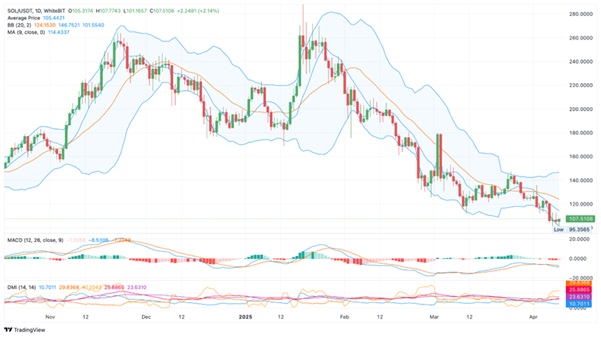
Solana price prediction for April suggests the asset can experience a relief rally following its recent bounce from $95 to $111. Analysts highlight the bullish divergence on Solana’s daily chart as the big indication of the move to the upside.

This divergence, characterized by lower lows in price and higher lows in RSI-14, has prompted traders to go long on SOL despite expectations of further downside volatility in the coming weeks.

Popular Elliot Wave commentators believe Solana is now beginning its “B” move—a corrective rally in the A-B-C pattern—that could push prices to $160–$200 before the asset resumes its broader downtrend.

For this uptrend to materialize, though, Solana must breach critical resistance levels at $120 and $140. Falling below these levels instead could send SOL retouching support at $95 or even falling as low as $90 in the worst-case scenario.

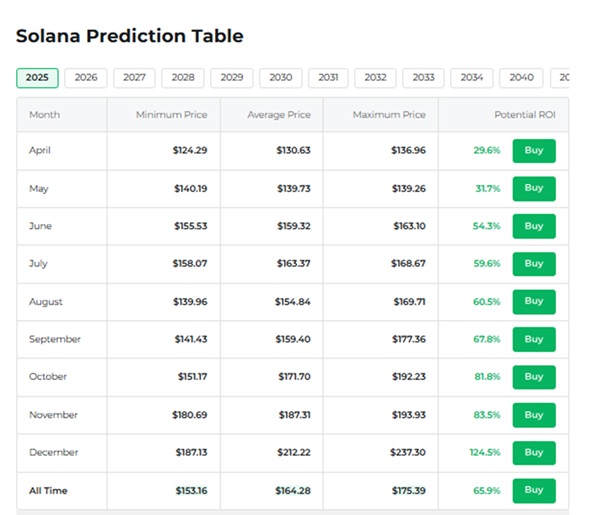
Long-term Solana price predictions remain split, with some analysts predicting an average price of $237 by the end of 2025, while others warn of potential dips due to macroeconomic pressures.

Remittix Presale Achievement Fosters Optimism Amid Regulatory Frenzy

Remittix presale has been among 2025’s highest-profile crypto events, with RTX tokens consistently selling out at each stage of its top ICO. This blazingly quick fundraising feat has seen 527 million tokens sold, amounting to over $14.4 million.

The presale success is driven by a series of innovative features that distinguish Remittix from the rest. Among them, Its Payfi tech featuring near zero-fee microtransactions is optimized for unbanked clients.

This allows transfers under $5 and head-to-head competition with established providers like Wise. Consequently, many investors are foreseeing potential 50x returns on RTX listing on top exchanges like Binance and Coinbase.

The intersection of path-breaking technical expertise, strong presale performance and competitive staking incentives is an indicator of the project’s potential to gain ground with entrenched market leaders like Ripple in the race for financial inclusion.

While regulatory obstacles persist for coins like Ripple, Remittix’s partnership progress with local Remittance systems across over 40 countries  has brought rest of mind to its stakeholders.

With robust up-front support and transparent use-case advantages, Remittix is in a good position to leverage the growing demand for secure, low-cost and convenient financial services in a more globalized world.

Why Remittix Is Perfect For The Future

In the long term, analysts are sure Remittix can translate its presale popularity into sustainable operational growth. The coming months will be crucial as the Defi company works towards securing strategic partnerships and finalizing its mainnet launch.

Remittix will be successful in addressing regulatory concerns and has demonstrated strong commitment to reaching its development milestones. Analysts say with this momentum, Remittix will not only disrupt traditional financial models but also redefine digital payments across the world. Join now and don’t get left out!

Discover the future of PayFi with Remittix by checking out their presale here:

Website: https://remittix.io/

Socials: https://linktr.ee/remittix

What’s Fueling Nexchain’s Momentum? AI, Blockchain, and a $0.022 Token You Can Still Catch

0

Linking AI and Blockchain for a Smarter Tomorrow

Blockchain is getting better, and exciting new ideas are changing the scene. A key development is adding artificial intelligence (AI) to blockchain systems. Nexchain.ai, a leading Layer-1 blockchain, is pushing this change by bringing together AI and decentralization. This creates a fast, advanced network. With its current presale, Nexchain offers a unique investment opportunity for those interested in the next stage of Web3 development.

Discovering Nexchain.ai: A New Chapter in Blockchain

Nexchain.ai uses AI to tackle problems like scalability, security, and flexibility, issues that traditional networks like Bitcoin (BTC) and Ethereum (ETH) have faced. Nexchain stands apart by using AI-driven smart contracts and an adaptive process for decision-making, speeding up transactions and improving efficiency.

Its structure combines Proof-of-Stake (PoS) with AI methods that enhance agreements and ensure smooth cross-chain operation. Using sharding and Directed Acyclic Graphs (DAG), Nexchain can process over 400,000 transactions every second, while keeping transaction costs low, around $0.001 each.

Boosting Blockchain Efficiency with AI

Nexchain.ai is more than just a blockchain; it continuously improves itself with AI, which helps in:

  1. Network Management – AI adapts block sizes and resource allocation for top performance.
  2. Fraud Prevention – Machine learning detects suspicious activities by analyzing patterns.
  3. Predictive Insights – AI forecasts congestion and trends, aiding in smart decisions.
  4. Automated Governance – AI assists in evaluating proposals and optimizing processes.
  5. Data Exchange – Users can securely handle and monetize AI data within the Nexchain system.

These features make Nexchain a versatile platform, benefiting developers, companies, and investors.

Nexchain Presale: High-Reward Opportunity for Early Backers

Nexchain’s presale is a chance to invest in a promising project before it launches. With a total token supply of 2.15 billion NEX, the sale is set up as follows:

  • Hard Cap: $50 million

  • Soft Cap: $20 million

  • Minimum Contribution: $10

  • Accepted Currencies: BTC, ETH, BNB, SOL, USDT, USDC, and more

Early investment brings benefits like discounted prices and exclusive rewards. With past hits like Solana (SOL) and Polygon (MATIC), Nexchain’s presale might offer significant returns for early investors, setting them up for growth.

Reasons to Invest in Nexchain: Market Insights

The blockchain world is quickly evolving, and AI-driven networks are gaining importance. Nexchain stands out by merging top-tier blockchain features while solving their issues. Nexchain’s AI use leads the competition, marking it as one of the most innovative blockchain projects. As the digital economy grows, demand for fast, smart, and collaborative networks will rise, positioning Nexchain well for sustained success.

Beyond Finance: Real-World Uses of Nexchain.ai

Nexchain’s AI-enhanced blockchain supports a variety of sectors, including:

  • Finance

Using AI for fraud detection, trading, and smart contract improvements in DeFi.

  • Healthcare

Secure data-sharing for patient records and research.

  • Supply Chain

Real-time monitoring and forecasts for logistics.

  • Internet of Things (IoT)

Reliable, speedy data transfer for connected devices.

  • Decentralized AI Services

Building and monetizing AI on a shared network.

By facilitating cross-sector adoption, Nexchain lays the groundwork for AI-integrated Web3 applications, increasing its future value.

Making Plans for Future

Nexchain has a solid growth plan, including:

  • Improving AI Layers – Constant upgrades to smart contract intelligence.
  • Cross-Chain Expansion – Building more links with major blockchain ecosystems.

  • Developer Ecosystem Expansion – Providing tools and APIs for easier AI integration.

  • Listing on Exchanges – Planning to launch on platforms like Coinbase, Bybit, OKX, KuCoin, and others.

The project’s goals align well with the global trend of investing in artificial intelligence, just like companies such as Microsoft, NVIDIA, and BlackRock. As the interest in smart blockchain systems grows, Nexchain is in an excellent position to become a key player in the AI-Web3 sector.

Nexchain.ai: Next Step in AI-Driven Blockchain

Nexchain.ai offers quick transactions, low costs, and AI-based security, and can connect with various blockchain systems, marking a significant advancement in blockchain technology. For those looking to invest in opportunities with high growth, Nexchain’s presale is a strategic way into the expanding AI-blockchain market.

As the industry increasingly moves towards AI-enhanced solutions, Nexchain’s innovative methods ensure its importance in the future of decentralized technology. Do not miss out on joining a major leap in Web3 development.


You can take advantage of the ongoing presale to help you gain exposure to one of the top AI crypto projects before it launches on major exchanges. See below for the presale link and the official website for interested parties. Here are the links to the social media pages:

https://x.com/Nexchain_ai

Facebook https://www.facebook.com/Nexchain_ai

Instagram https://www.instagram.com/Nexchainai/

Medium https://medium.com/@Nexchain

Coinmarketcap  https://coinmarketcap.com/community/profile/NexchainAI/