
DD
MM
YYYY

PAGES

DD
MM
YYYY

spot_img

PAGES

Home Blog Page 16

The Umunneoma Economics

3

Thank you, Dr. Reuben Abati, for mentioning this Ovim village boy and for referencing my Harvard Business Review work on the Umunneoma Economics of the Igbo Apprenticeship System, in your show.

Let me also use this moment to explain this economic framework more clearly, so that as people study Adam Smith’s classical economics, Confucian economic philosophy in China, and other schools of thought, they can also add Umunneoma Economics, literally, the economics of good brethren, to their intellectual toolkit.

It is a framework rooted in community, reciprocity, and shared prosperity, where enterprise is not just about individual accumulation but about lifting others as you climb. In Umunneoma Economics, wealth creation is intertwined with obligation: you succeed, and you return to enable another; you rise, and you pull a brother or sister up. That is the logic behind the Igbo apprenticeship system and the cooperative spirit that rebuilt communities after devastation.

So yes, alongside the invisible hand of Adam Smith and the moral order of Confucius, there is also the visible hand of community, Umunneoma, where trust, mentorship, and shared destiny become factors of production.


Umunneoma Economics, explained by Ndubuisi Ekekwe in a seminal Harvard Business Review project, is a business philosophy rooted in the traditional African (specifically Igbo) concept of shared prosperity and community support, captured by the maxim “onye aghana nwanne ya” (do not leave your brethren behind). It is a model of stakeholder capitalism that contrasts with traditional Western shareholder capitalism focused on individual accumulation and market dominance.

Key tenets of Umunneoma Economics include:

  • Shared Prosperity: The core idea is that success should be measured by the quantifiable support provided to stakeholders and the community, rather than by absolute market dominance or building individual conglomerates.
  • Poverty Prevention: The system aims to prevent poverty by mass-scaling opportunities for everyone, ensuring that wealth accumulation lifts the entire community.
  • Co-opetition (Cooperative Competition): Participants in the system “co-opetitively participate to attain organic economic equilibrium”. This involves major participants funding their competitors, surrendering market share, and enabling the formation of livable economic clusters.
  • The Igbo Apprenticeship System (IAS): Umunneoma economics is largely an articulation of the successful Igbo Apprenticeship System (known locally as Igba-Boi), which is considered responsible for the rapid economic recovery and wealth accumulation in Southeast Nigeria after the 1970 Biafran War.
  • Focus on Stakeholders: Unlike shareholder capitalism which prioritizes investor returns, Umunneoma economics focuses on the welfare and rise of all stakeholders (employees, community members, and even competitors).

This economic philosophy has gained recognition as a viable framework for a more equitable world, aligning with emerging discussions on stakeholder capitalism.

On literacy rates:

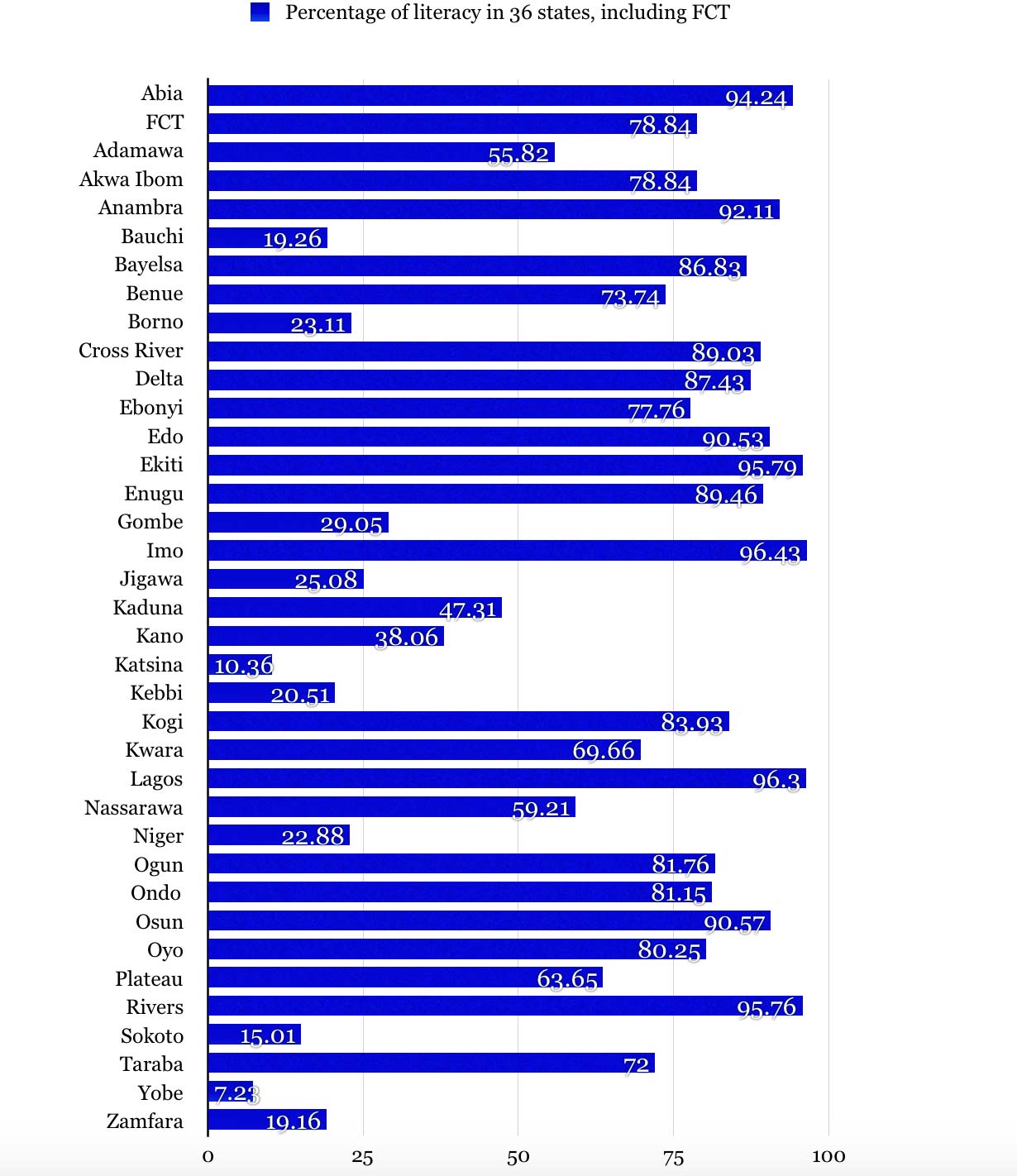
Dr. Abati, let me address the point on literacy rates. The facts are these: using official government data, South-East Nigeria has consistently done well in literacy rates. Abia, Imo, and Anambra have for years recorded literacy levels of above 90%. Enugu is in the high 80s, while Ebonyi is slightly below 80%. These are among the strongest literacy outcomes in Nigeria by geopolitical zone, and they would not have been possible if boys are not enrolled in schools!

Therefore, the thesis that Umunneoma Economics has negatively affected male-child enrollment is not supported by data. The evidence points in the opposite direction. (See data here: https://www.tekedia.com/yobe-states-7-23-literacy-rate-and-digital-transformation/)

That said, I concede one historical nuance. In the 1970s and 1980s, male-child enrollment in parts of the South-East was indeed lower than female enrollment. But that was not because education was devalued. It was because The Greatest Generation, Igbo men and women who engineered the rebuilding after the Biafra War, made a strategic choice.

They challenged young males to move into enterprise, using the apprenticeship system as a vehicle to escape the miry clay in the Igbo Nation, and to prevent a vicious cycle of poverty. It was a deliberate economic reconstruction strategy. I have spoken with some of these men, and many confirmed that the reconstruction was “war” and the boys were tasked to fight it through the markets.

By the late 1980s, that phase had largely run its course. And from the early 1990s, as Igbos began integrating fully into Nigeria’s capital formation system (visible via investments and properties across Lagos, Abuja, and beyond), male literacy rebounded strongly. Since then, literacy rates in the South-East, including for males, have remained among the highest in the country.

In short, history must be read with data and context. And on literacy, the numbers speak clearly.
CPPE Sees Nigeria Entering Growth Phase in 2026, With 4.5% GDP Growth Following Stabilization Gains

0

Nigeria is poised to move from a period of macroeconomic stabilization to a phase of stronger economic growth in 2026, according to a new outlook by the Centre for the Promotion of Private Enterprise (CPPE), which projects GDP growth of between 4.0 and 4.5 percent next year.

The projection is contained in CPPE’s latest report, Review of the Nigerian Economy in 2025 and Outlook for 2026, which argues that reforms implemented over the past year have begun to yield measurable results, setting the stage for a gradual but more durable expansion.

According to the report, 2025 marked a clear turning point in Nigeria’s economic trajectory. Dr. Muda Yusuf, CPPE’s Chief Executive Officer, said the combination of exchange-rate stability, easing inflation, and improved investor sentiment helped pull the economy out of the volatility that defined earlier reform phases.

“With reform momentum sustained, Nigeria is expected to transition more decisively from stabilization to growth,” Yusuf said.

One of the most significant stabilizing factors highlighted was currency performance. Throughout much of 2025, the naira traded within a relatively narrow band of N1,440 to N1,500 per U.S. dollar. Periodic appreciation episodes helped restore confidence among businesses, reduced uncertainty around pricing and planning, and eased imported inflation pressures, particularly for manufacturers and traders dependent on foreign inputs.

Inflation also slowed sharply over the year. CPPE noted that headline inflation fell from 24.48 percent in January to 14.45 percent by November, driven by improved exchange-rate predictability, better supply conditions, and some moderation in food prices. The report stated that consumer sentiment improved as the prices of several food items and imported goods recorded outright declines, offering modest relief to households after a prolonged cost-of-living squeeze.

Business conditions mirrored these gains. The NESG–Stanbic IBTC Business Confidence Index remained in positive territory for most of 2025, reflecting stronger corporate sentiment. According to CPPE, several firms that recorded losses in 2024 returned to profitability in 2025, supported by lower foreign exchange losses, better cost management, and more stable operating conditions.

However, the report draws a clear distinction between stabilization gains and deeper structural strength, particularly on the fiscal side. CPPE described federal government fiscal performance in 2025 as weak, noting that heavy debt-service obligations continued to constrain budget execution. Oil-sector underperformance compounded the problem, with revenue targets missed despite optimistic budget assumptions.

The 2025 budget was based on an oil price of $75 per barrel and production of 2.06 million barrels per day. Actual outcomes, CPPE said, were significantly lower, with average oil prices closer to $66 per barrel and production around 1.66 million barrels per day. The shortfall limited capital spending and reinforced the government’s dependence on borrowing.

In contrast, sub-national governments fared better. The report noted that many state governments recorded stronger fiscal outcomes, aided by improved liquidity, better internally generated revenue, and more effective execution of capital projects. This divergence, CPPE said, underscores the growing importance of fiscal decentralization and local revenue mobilization in Nigeria’s economic resilience.

On sectoral performance, services remained the backbone of growth, accounting for 53 percent of GDP by the third quarter of 2025. Telecommunications, financial services, trade, construction, and real estate were the main drivers, benefiting from population growth, urbanization, and digital adoption.

Manufacturing, however, continued to lag, expanding by just 1.25 percent. CPPE attributed the weak performance to persistent power supply challenges, high logistics costs, and limited access to affordable finance. Agriculture grew by 3.79 percent and contributed 31.21 percent of GDP, but insecurity, low productivity, and weak value-chain development continued to limit its export potential and broader contribution to growth.

Looking ahead to 2026, CPPE expects growth to strengthen further, led by the services sector and supported by moderating inflation. Yusuf said the slowdown in inflation could create room for gradual monetary easing, potentially lowering interest rates and stimulating private-sector investment.

Capital markets are also expected to play a larger role. CPPE pointed to the potential listing of the Dangote Refinery as a major catalyst that could deepen market liquidity, attract portfolio inflows, and strengthen Nigeria’s investment profile.

“Policy credibility remains strong, reinforcing investor confidence and capital inflows,” Yusuf said.

Still, the report cautions that the outlook is not without risks. CPPE flagged persistent insecurity affecting agriculture and logistics, volatility in oil prices and production, high power and transport costs, and mounting debt-service obligations, estimated at over N15 trillion in 2026, or about half of projected government revenue.

External factors such as geopolitical tensions, which could disrupt trade and capital flows, were also identified as potential headwinds. Domestically, CPPE warned that pre-election fiscal pressures, political uncertainty, and resistance to tax reforms could undermine revenue expectations and slow reform momentum.

In its conclusion, CPPE described 2025 as a year that delivered stability rather than prosperity, while framing 2026 as a period of cautious but tangible opportunity.

“If reform momentum is sustained and security challenges are effectively addressed, 2026 could mark the beginning of a more robust growth phase with tangible improvements in living standards,” Yusuf said.

The report comes against the backdrop of earlier concerns raised by CPPE over delays in the submission of the 2026–2028 Medium-Term Expenditure Framework. The organization has warned that such delays weaken legislative scrutiny and undermine the credibility of the budget process, noting that the Fiscal Responsibility Act requires the MTEF to be submitted at least four months before the start of a new fiscal year.

Nigeria’s Commercial Paper Market Surges Past N753bn As Reforms, Investor Appetite Reshape Capital Flows

0

Nigeria’s capital market recorded more than N753 billion in commercial paper (CP) issuances between April and October 2025, underlining the growing importance of short-term debt instruments in corporate financing.

This also signals renewed investor confidence in the country’s regulatory and macroeconomic direction.

The Securities and Exchange Commission (SEC), which disclosed the figures, said the strong issuance activity reflected deepening liquidity in the market, sustained demand from investors, and the impact of reforms aimed at strengthening market transparency and efficiency.

In a statement released on Sunday, December 28, SEC Director-General Emomotimi Agama described the commercial paper segment as one of the most active areas of the capital market during the period, providing critical funding support to companies across key sectors of the economy.

According to Agama, firms in manufacturing, agriculture, energy, and other strategic industries tapped the CP market extensively to meet short-term working capital needs, as tighter bank credit conditions and elevated interest rates pushed corporates to seek alternative funding channels.

“Commercial paper issuance remained vibrant, with over N753 billion raised to support short-term funding needs across diverse sectors,” he said, adding that the scale and frequency of the issuances point to growing sophistication among both issuers and investors.

Beyond commercial paper, the SEC said the broader debt market also recorded landmark transactions that highlighted investors’ increasing willingness to back longer-dated and thematic instruments. Agama cited the N500 billion Climate Funding Special Purpose Vehicle and the N200 billion Elektron Finance bond issuance as examples of deals that underscore rising interest in infrastructure-linked and sustainable finance products.

“These figures are not just numbers; they represent confidence in our regulatory framework and the resilience of our market architecture,” the SEC chief said, noting that the transactions reflect a shift toward more diversified capital-raising structures.

Agama explained that the strong CP performance formed part of a wider set of capital-raising activities approved by the Commission across debt, equity, and hybrid instruments between April and October. He said the market showed “remarkable depth and adaptability” during the period, reinforcing its role as a key channel for mobilizing funds to support economic expansion.

The SEC also pointed to supportive macroeconomic developments that helped shore up investor sentiment. Nigeria’s recent sovereign credit rating upgrade and its removal from the Financial Action Task Force (FATF) grey list were cited as major confidence boosters, particularly for foreign portfolio investors who have historically been cautious about regulatory and compliance risks.

“These achievements signal renewed confidence in our economy,” Agama said. “They will attract greater investment and enhance capital inflows.”

On monetary conditions, the SEC boss said easing inflationary pressures has created room for innovation across capital market products, while urging market participants to move decisively from policy discussions to practical execution.

“The time for passive observation is over. Our collective responsibility is to activate opportunities and position the market as an engine of inclusive growth,” he said.

Agama also addressed recent volatility in the equities market. In November, the Nigerian Exchange lost about N6.54 trillion in market capitalization, a sharp downturn he attributed to profit-taking ahead of the proposed 30% capital gains tax, weak sentiment around banking stocks, and broader global uncertainties. He said the market has since staged a rebound, helped by policy assurances and renewed investor confidence.

A key structural reform highlighted by the SEC is the migration of the equities settlement cycle from T+3 to T+2, a change Agama described as a landmark step that has improved liquidity and reduced counterparty risk. He said plans are already in motion to move to T+1 and, ultimately, same-day settlement under a T+0 framework.

Commercial paper, which is a short-term unsecured debt instrument typically issued for maturities of 270 days or less, has become increasingly attractive to both issuers and investors. For companies, it offers faster access to funding at competitive rates, while investors benefit from relatively high yields in a regulated environment.

The strong CP issuance comes as Nigeria’s capital market closes 2025 at a historic high. Total market capitalization stood at N149.88 trillion as of December 24, just shy of the N150 trillion mark for the first time. The growth has been driven by robust performance across equities, bonds, and exchange-traded products, supported by regulatory reforms, high domestic investor participation, and solid corporate actions.

Equities accounted for N97.89 trillion, or about 65% of total market value, while bonds contributed N51.55 trillion and ETPs added N43.20 billion. The NGX All-Share Index delivered a 49.17% year-to-date gain, placing the Nigerian Exchange among Africa’s top-performing bourses in 2025. Market turnover more than doubled over the year, driven largely by domestic retail and institutional investors seeking higher returns in a tight monetary environment.

Taken together, the SEC said the surge in commercial paper issuance, major debt deals, improving macroeconomic indicators, and ongoing market infrastructure reforms are strengthening Nigeria’s positioning as one of Africa’s most attractive investment destinations, with the capital market playing an increasingly central role in financing growth.

Air Peace CEO Warns Nigeria’s New Tax Regime Could Push Domestic Airfares Above N1 Million

0

The Chairman and Chief Executive Officer of Air Peace, Allen Onyema, has warned that domestic economy airfares in Nigeria could surge beyond N1 million from 2026, as airlines brace for the implementation of new tax reform laws that he says threaten the survival of the local aviation industry.

Speaking on The Morning Show on Arise News on Sunday, Onyema linked the potential fare spike directly to provisions in the tax reform package scheduled to take effect in January 2026. According to him, the reforms roll back key incentives introduced under the 2020 Finance Act, incentives that had offered airlines temporary relief in an already high-cost operating environment.

At the core of Onyema’s concern is the reintroduction of Value Added Tax on aircraft, spare parts, and air tickets. These items had been exempted under the 2020 Finance Act as part of efforts to stabilize Nigeria’s aviation sector, which has struggled for years with high costs, limited access to credit, and persistent foreign exchange pressures.

Onyema explained that the implications are severe. An aircraft imported at a value of around $80 million would immediately attract 7.5% VAT under the new rules, translating into billions of naira in additional costs at today’s exchange rates. He said airlines would have little choice but to pass those costs on to passengers.

“By the time you bring these things in, at the end of the day, the cost of operation will be huge,” Onyema said during the interview. “Your ticket fares will hit N1. something million soon.”

He added that Nigerian airlines lack the financial buffers to absorb new taxes, noting that borrowing costs in the country can reach as high as 35%. In his words, expecting airlines to take on additional fiscal burdens under such conditions is unrealistic and potentially destructive.

“If we implement that tax reform, Nigerian airlines could go down within three months,” he warned.

Onyema also questioned the policy direction behind taxing air transportation, citing the International Civil Aviation Organization’s annexes, which state that VAT should not be imposed on air transport services. He argued that aviation should be treated as a strategic sector that enables trade, tourism, and economic integration, not as a revenue source to be squeezed.

Beyond the looming tax changes, Onyema painted a broader picture of an industry under sustained pressure. He said Nigerian airlines face a combination of high fuel prices, multiple statutory charges, and foreign exchange constraints that significantly erode their revenue.

To illustrate the point, Onyema disclosed that for a domestic ticket priced at about N350,000, airlines retain roughly N81,000, with the balance taken up by taxes, levies, charges, and fees payable to various agencies. This, he said, undermines the narrative that airlines are profiteering at passengers’ expense.

He pushed back against frequent public criticism over high fares, arguing that Nigerian domestic ticket prices remain among the cheapest in the world when converted to U.S. dollars. Even at current levels, he said, many routes are barely viable. Flights to parts of the Southeast, in particular, often return with few passengers, leaving airlines to absorb losses.

On operational challenges, Onyema addressed complaints about flight delays and cancellations, saying many disruptions stem from factors beyond airlines’ control. These include bird strikes, inadequate airport infrastructure, and lapses by ground handling companies. He said airlines are often blamed for issues rooted in systemic weaknesses across the aviation value chain.

His comments come at a time when the wider policy environment remains uncertain. While Nigeria is preparing to implement tax reforms that could raise costs for airlines, a separate regional initiative points in the opposite direction. Under a 2024 agreement by ECOWAS member states, all air ticket taxes across the sub-region are to be abolished from January 1, 2026, with the aim of reducing fares and boosting regional connectivity.

That contrast has raised questions about how Nigeria will align its domestic tax regime with regional commitments. In 2024, data from the International Air Transport Association showed that Nigeria earned about $62 million from airline ticket taxes, part of the $1.97 billion collected across Africa. For governments facing fiscal pressures, aviation remains an attractive source of revenue, even as airlines warn of the long-term consequences.

Earlier in December 2025, Nigeria also implemented an additional $11.5 security levy under the Advance Passenger Information System, pushing total charges on international tickets to $31.50. Airlines say such incremental charges, when layered on top of each other, steadily weaken the sector.

Against this backdrop, people are asking whether regional initiatives under ECOWAS will force a rethink, easing costs and preventing the sharp fare increases Onyema now warns could be imminent.

The Lessons from the Billionaires, Make an A+ in Your Process in 2026

1

As the march to 2026 continues, I want to focus on PROCESS, the most important non-graded course in the university of life. It does not appear on any transcript, yet it determines the soul and purpose of education. Because education, at its core, is the liberation of the mind. And minds are liberated not just by content, but by the evolution of processes through which we learn, think, and act.

Across the world, a familiar question keeps coming up: why are many billionaires not the best graduating students in their classes? In the worlds of Dangote, Elumelu, Ovia, Gates, and Musk, I am confident none graduated top of their classes. Yet, they command empires. Meanwhile, Ndubuisi, who finished top of his university class, and set all-time academic records in his secondary school that remain unbroken, is not yet billionaire. Lol.

Why? Because Ndubuisi was excellent at passing the exams of classrooms, but not as great at passing the exams of markets. Simply, classrooms and markets run on different operating systems. An A in calculus does not guarantee an A in customer satisfaction for noodles. Academic grades are not destiny; at best, they are indicators of process. What truly matters is not the grade itself, but the discipline, effort, and tenacity that produced it.

Effort that earns a First Class in one university may not even secure a Second Class in another, because standards differ. In secondary school, I was not the most gifted mind, but I was relentless. What talent withheld, hard work delivered. One teacher called me “oku na egbu akwukwo”, the fire that consumes books, because if reading Modern Biology four times was the key to an A, I would light that fire.

I never apologized for being a bookworm. I was not constrained by WAEC subjects: even though I did not take Literature as a student, I acted in plays with Literature students. When Papa Iyke heard I had memorized The Lion and the Jewel (I read all the recommended books), he invited me to join. I became Lakunle, the teacher! In university, some classmates earned Bs effortlessly. I sweated for As. Effort became my equalizer. The smartest student I met at FUTO never finished first year. Brilliance without process is fragile. He missed exams out of nonchalance and was dismissed.

So, when you look at Ovia, Elumelu, Musk, Gates, and Dangote, do not look for their transcripts. Look for their processes: grit, resilience, curiosity, and the hunger to understand customers and markets. Yes, forget that connection nonsense we love to peddle in Nigeria. Connections only work when you have done the work. Ovia returned as a young man and built. Elumelu was a mid-level banker who raised money and bought a bank. Musk was an immigrant who found alpha. Unlike perfect classroom A-students like me, they developed superior market-processes to solve real problems and deliver products and services people would pay for. That is why they are billionaires.

Good People, here is the lesson: over a long horizon, a hardworking C-student often outperforms a complacent B-student, because process endures. If your process is great, even when grades stall because talent does not align with interest (for instance, you were pushed to study medicine instead of music), this world will still give you A-results somewhere.

So, as 2026 approaches, make this your daily resolution: I will score an “A+” in my PROCESS on productive things.