DD
MM
YYYY

PAGES

DD
MM
YYYY

spot_img

PAGES

Home Blog Page 1631

How AI is Transforming Payment Fraud Detection in the Fintech Industry

0

The rapid growth of digital payments has brought unprecedented convenience and opened new doors for fraudsters. Cybercriminals are evolving their tactics, making traditional security measures increasingly ineffective. As financial transactions become more seamless, so do the risks associated with fraudulent activities. Financial institutions and fintech companies are turning to artificial intelligence (AI) for a more sophisticated approach to combat this. AI-driven solutions redefine payment fraud detection, providing real-time analysis and predictive capabilities beyond conventional methods. By leveraging AI, businesses can identify fraudulent activities faster, reduce financial losses, and protect consumers from cyber threats.

The Role of AI in Fraud Prevention

The analysis capabilities of AI revolutionized fraud prevention when it came to processing unlimited data volumes beyond the speed of human analysts. AI surpasses traditional rule-based systems because it adopts changes in fraudulent patterns that mere detection parameters cannot tackle. Machine learning models display an automatic learning ability from new fraud attempts, allowing them to improve accuracy while preventing false positives.

Tested algorithms alongside deep learning approaches find hidden transaction activities through their ability to detect behavioral patterns. Computer systems track spending patterns, device behavioral data, and location data to define normal customer activities. The AI system monitors unusual banking patterns, including transactions from unknown locations, and attempted enormous withdrawals, which it then alerts for human review. The absolute real-time observation enables financial entities to prevent fraudulent transactions before they cause damage.

AI actively participates in predictive analytics operations along with its real-time detection functions. AI uses past fraud data analysis to project potential dangers and then provides organizations with intervention recommendations. This process enables organizations to enhance their security structure, thereby detecting defects that could otherwise become fraudster entry points. AI-driven detection systems undergo parallel development with fraud techniques to maintain an advantage over criminals without needing to respond after fraud occurs.

AI’s Impact on Reducing False Positives

The most significant problem in fraud detection occurs when organizations need to balance protecting users and providing them with a positive experience. Current fraud detection systems based on traditional methods produce an excessive number of incorrect alerts that mark valid transactions as suspicious. These alerts negatively affect Customers’ experience, resulting in payment declines, security check interruptions, and potential business losses. AI solves this challenge by improving accuracy and refining the risk assessment model.

Through machine learning, AI separates real anomalies from actual fraud attempts. Advanced models process multiple attributes, including transaction pattern counts, historical transaction patterns, and money flow dynamics to identify real security risks. AI-based fraud detection equipment enhances transaction security by reducing false alarms, enabling customers to complete transactions seamlessly without facing fraud attempts.

Fractionated payment fraud tools that use natural language processing (NLP) look through customer interactions, support requests, and emails for red flags of possible payment fraud. AI systems help when fraudsters pretend to be authentic users because they assist customer service representatives in avoiding unauthorized transaction approval. AI uses fraud-related linguistic patterns to safeguard financial systems without disturbing valid customer support activities.

The Future of AI in Payment Security

AI continues to develop, and its capabilities in detecting fraud will grow in forthcoming years. Deep learning and federated learning capabilities will enhance AI systems to become more innovative while operating autonomously. The AI model training method federated learning lets users train their models through distributed data while keeping their confidential details protected. Financial institutions can work together on fraud detection while safeguarding customer privacy through this system, which builds an enhanced networked protection against cyber attacks.

AI demonstrates promising advancements through its combination with blockchain technology. Blockchain operates outside of a centralized system, which adds an obstacle for manipulations from fraudsters in their attempt to modify transaction records. Simultaneously AI systems track blockchain actions to spot irregular behavior patterns. A combined blockchain-predictive AI framework demonstrates significant promise for digital security since it unifies blockchain transparency with AI analytic abilities.

The upcoming role of artificial intelligence appears decisive for regulatory compliance purposes in the industry. Under new regulations, implementing advanced fraud prevention measures has become mandatory for financial institutions, so AI automation delivers an effective solution. Through monitoring enabled by AI, companies can guarantee their compliance with both anti-money laundering (AML) and know-your-customer (KYC) regulations, which protects them from financial penalties and maintains their good reputation.

Conclusion

The fintech industry benefits from AI technology, leading to drastic changes in payment fraud detection methods. Machine learning, deep learning analytics, and predictive analysis allow AI-driven fraud detection systems to operate with high precision while delivering instant responses using minimal false detection rates. AI remains essential for fighting cybercrime since fraudulent techniques continue to adapt in their methods. Financial institutions that use AI-driven security solutions protect their customer base and develop their own resistance against new threats in the process. AI is the prominent payment security technology because it predicts and stops fraud attempts during their initial stages.

Planning a Multinational Career And Improving Your Personal Economy via Knowledge

0

How do we make our careers multinational in scope? What are the ingredients in the 21st century knowledge economy? How do you begin in the village and land in the trading halls of New York City? How can we go international in this age?

Yes, you like to give speeches which pay $$ per hour. How can you expand that business, from Lagos, Nairobi, etc to Tokyo, London, etc. You sing in the community. Any aspiration to sing for the world? The world pays the bills!

How can you run that blog from that small room in Jos, Aba, Bamako, etc – and reach the diasporas and bigger markets in Berlin, Toronto, Beijing and Atlanta? Simply, what is a multinational career in this internet age?

Join me at 7pm WAT tomorrow for Tekedia Mini-MBA Personal Economy class, focusing on Planning a Multinational Career, as we begin on how you can build your own economy, not just your company’s, Nigeria’s, or Africa’s economy. Zoom link in the board.

This is Tekedia Institute >> improving your personal economy via knowledge is part of our mission.

Nigeria’s Latest T-Bills Auction Exposes Policy Rift Between CBN and DMO

0

Nigeria’s latest Treasury Bills (T-Bills) auction has brought to light a deepening policy rift between the Central Bank of Nigeria (CBN) and the Debt Management Office (DMO). The divergence stems from contrasting approaches to managing interest rates and the broader economic strategy, with the CBN pushing for higher yields to attract foreign portfolio investors (FPIs) and stabilize the naira, while the DMO warns that elevated yields could severely inflate the nation’s debt servicing costs.

The latest T-Bills auction conducted by the CBN witnessed robust demand across all maturities, particularly the 364-day bill, which dominated investor interest. The government initially aimed to raise N650 billion but ended up allotting N830.44 billion, reflecting significant market appetite.

  • 91-Day T-Bill: The CBN offered N70 billion, received N62.57 billion in subscriptions, and allotted N61.52 billion at a stop rate of 17.00%.
  • 182-Day T-Bill: Offered at N80 billion, this bill attracted N60.05 billion in subscriptions, with N50.95 billion allotted at a stop rate of 17.75%.
  • 364-Day T-Bill: This long-tenured bill was the most sought-after instrument. With N500 billion on offer, it attracted an overwhelming N1.80 trillion in bids. The government allotted N717.97 billion, with the stop rate closing at 17.82%, a decline from the 18.50% recorded in February.

The auction not only overshot the government’s original offer by nearly N200 billion but also highlighted investors’ preference for longer-term securities amid a volatile economic environment.

Divergent Strategies: Attracting FPIs vs. Managing Debt Costs

A financial expert who preferred anonymity explained that the declining stop rate on the 364-day bill underscores the brewing policy battle between the CBN and the DMO over the appropriate pricing of government debt.

The CBN is advocating for higher rates, arguing that attractive yields are necessary to lure FPIs back into Nigeria’s fixed-income market. The apex bank sees foreign inflows as a crucial mechanism to stabilize the naira, which has remained under pressure despite several policy reforms, including the unification of exchange rates and the removal of fuel subsidies.

However, the DMO, tasked with managing Nigeria’s debt portfolio, is concerned that higher yields will translate to increased borrowing costs. With Nigeria’s public debt already exceeding N90 trillion, the agency is prioritizing debt sustainability and is wary of further exacerbating the federal government’s debt servicing obligations.

The DMO’s stance reflects broader concerns about fiscal space. Nigeria’s debt service-to-revenue ratio has consistently exceeded 80%, raising alarm about the federal government’s capacity to meet its financial obligations without sacrificing critical public services.

High Demand Driven by Refund Strategy

One significant factor contributing to the high subscription levels in the recent auction is the DMO’s strategy of issuing refunds instead of refinancing maturing debts. Typically, the government would roll over maturing T-Bills by issuing new ones of the same value.

By opting for refunds, the DMO has created a situation where investors are reinvesting their capital into new auctions, inflating subscription volumes. Analysts note that this approach, while helping manage the debt profile, also underlines the government’s liquidity management strategy amid fiscal constraints.

Compounded by the Rebasing of Nigeria’s CPI

Complicating the economic outlook further is the rebasing of Nigeria’s Consumer Price Index (CPI). The National Bureau of Statistics (NBS) recently changed the CPI base year to 2024, altering the methodology for calculating inflation.

Under the new framework, inflation for January 2025 was reported at 24.48%, a sharp decline from the 34.80% recorded in December 2024 under the old methodology. This sudden drop in inflation has introduced a new variable into the interest rate debate.

Some analysts argue that the revised CPI could justify a less aggressive monetary tightening stance from the CBN. However, others caution that the methodological change does not necessarily indicate a real decline in price pressures, particularly with persistent structural challenges such as high energy costs and supply chain disruptions.

CBN’s Monetary Policy Approach

At its Monetary Policy Committee (MPC) meeting in February 2025, the CBN decided to hold the benchmark interest rate steady at 27.50%, citing the need to assess the impact of the rebased CPI before making further policy moves.

Despite the pause, the MPC acknowledged that inflationary pressures remain a concern, highlighting the complex trade-offs facing policymakers. The committee noted that while stabilizing the naira is a priority, sustaining manageable debt servicing costs is equally critical to maintaining fiscal stability.

The CBN’s push for higher yields aligns with its broader strategy to attract FPIs and improve forex liquidity. However, the DMO’s cautionary approach indicates a pragmatic view of Nigeria’s fiscal realities, where every percentage increase in yield translates to billions in additional debt service costs.

The conflicting objectives of these institutions create uncertainty for investors, who must navigate a market where the outlook for T-Bill yields remains unclear. The rebased inflation figures add to this uncertainty, as they could influence future CBN decisions on interest rates and liquidity management.

Balancing Naira Stability and Debt Management

With the CBN maintaining a pause on rate hikes, financial experts believe the future trajectory of T-Bill yields depends on how this institutional tug-of-war plays out. If the CBN prevails, higher yields could attract foreign inflows, potentially stabilizing the naira but at the cost of higher debt service burdens.

Conversely, if the DMO’s stance gains traction, yields may remain capped, easing the debt service load but possibly limiting Nigeria’s appeal to foreign investors. This delicate balancing act will likely define Nigeria’s economic policy environment in the coming months.

The outcome of this policy debate could also impact broader market sentiment and influence decisions across financial markets, including equity, bond, and forex markets. Investors are expected to closely monitor upcoming T-Bill auctions, MPC meetings, and fiscal policy announcements to gauge the direction of Nigeria’s economic strategy and its implications for returns on government securities.

200000 Seized Bitcoins Coverts to U.S. National Bitcoin Reserve Under Trump’s Executive Order

0

On March 6, 2025, U.S. President Donald Trump signed an executive order establishing the Strategic Bitcoin Reserve, a move that converts approximately 200,000 Bitcoin (BTC)—seized by the federal government through criminal and civil forfeiture proceedings—into a national reserve asset. This action, detailed by White House Crypto and AI Czar David Sacks, positions the U.S. as a leader in digital asset strategy and fulfills Trump’s campaign promise to make America the “crypto capital of the world.” 

The reserve begins with an estimated 200,000 BTC, valued at roughly $17.5 billion at current prices (around $87,000 per BTC, per CoinMarketCap data). This figure aligns with estimates from Sacks and blockchain analytics like Arkham, which track U.S. government wallets holding seized crypto. The Bitcoin comes entirely from assets confiscated by agencies like the Department of Justice (e.g., from Silk Road, Bitfinex hacks) over the past decade, ensuring no direct taxpayer cost.

No Sales Policy: The order prohibits selling BTC from the reserve, treating it as a long-term store of value—termed a “digital Fort Knox” by Sacks—reversing prior practices where the U.S. Marshals Service auctioned off about 195,000 BTC for $366 million, missing out on $17 billion in potential value at today’s prices.

The Treasury and Commerce Departments, led by Secretaries Scott Bessent and Howard Lutnick, are authorized to develop “budget-neutral” strategies to acquire additional Bitcoin, though no immediate purchases are planned beyond seized assets. A full accounting of federal crypto holdings is required, addressing the lack of prior comprehensive audits.

U.S. Digital Asset Stockpile: Alongside the Bitcoin Reserve, the order creates a separate stockpile for other seized cryptocurrencies (e.g., ETH, XRP, Solana, Cardano), though these are not part of the BTC-focused reserve. Trump had earlier floated including these assets in a broader “Crypto Strategic Reserve,” spiking their prices on March 2, but the final order prioritizes Bitcoin alone for the strategic reserve.

Bitcoin dipped nearly 5% to $85,000 shortly after the announcement—possibly due to disappointment over no new purchases—before stabilizing at $88,000 by late March 6, per posts on X and CoinGecko data. Other crypto prices (ETH, XRP, SOL, ADA) also fell 4-8%, reflecting tempered expectations. This marks a departure from the Biden administration’s enforcement-driven crypto stance, aligning with Trump’s pro-crypto pivot since his 2024 campaign, where he received significant industry backing (e.g., $25 million from Coinbase CEO Brian Armstrong and others).

Unlike New York’s Bill A06515 (criminalizing crypto fraud) or Coinbase’s SEC hurdles with tokenized COIN, this order avoids securities classification debates by treating seized BTC as a reserve asset, not an investment vehicle. Wyoming’s crypto-friendly laws (e.g., BioNexus’s Ethereum treasury) set a state-level precedent, but this is a federal leap.

Proponents like Senator Cynthia Lummis argue a Bitcoin reserve could bolster the dollar and counter inflation, akin to gold reserves (the U.S. holds 8,133 tons worth ~$650 billion). Critics, including some X users, call it “a pig in lipstick”—a rebrand of existing holdings with no immediate buying power.

Holding 200,000 BTC (1% of the 21 million cap) signals institutional acceptance, potentially spurring adoption, though volatility risks remain (BTC hit $109,071 in January 2025 before cooling). The White House Crypto Summit on March 7, 2025, may clarify custody logistics (e.g., multisig wallets, audits) and future acquisition plans, watched closely by markets. As of now, the U.S. has repositioned its 200,000 seized Bitcoin into a strategic reserve under Trump’s directive, a historic step in crypto policy, though its full impact hinges on execution and broader regulatory evolution.

Stick With Sinking Solana or Switch to Viral $0.18 Competitor With 100x Upside? Expert Compares Options

0

Despite being a top performer in the crypto market, the Solana price has been highly volatile in recent months. Investors are now facing a tough decision: Should they continue holding the SOL token despite unpredictable movements or switch to a new competitor, DTX Exchange? The DTX token’s presale price is $0.18, which will rise to $0.36 after listing, which means investors could double their investments by getting DTX tokens during presale. Moreover, analysts predict a 100x upside for DTX once it gets listed.

Should investors watch the Solana price performance or explore this viral new competitor with a 100x upside? Let’s find out.

DTX Exchange: A Viral Competitor at $0.18 With 2X Gains

With the Solana price struggling to maintain momentum, a new competitor is gaining traction among investors. DTX Exchange, priced at just $0.18 during the presale, is going to be $0.36 after listing. This 2x surge means investors could turn $1,000 into $2,000 immediately.

DTX Exchange is a trading platform that combines regular financial markets with cryptocurrencies. It would allow users to trade over 120,000 assets, including crypto, stocks, forex, and more, all in one place. This viral competitor has already raised over $15.4 million in its presale rounds and is now in its final bonus stage due to high demand.

Moreover, with a 100x upside predicted by analysts in the coming months, DTX could be a major attraction for investors looking to double their returns.

Investors Moving Away From SOL to This 100x Surge Coin

Investors are increasingly reconsidering their positions in Solana. The SOL token’s high volatility could make it a riskier option for those seeking more predictable returns. In contrast, DTX Exchange could offer better growth potential by integrating real-world utility with blockchain technology.

One of its most important features is fractional multi-asset trading which could allow investors to diversify their portfolios by purchasing fractions of stocks, ETFs, and cryptocurrencies instead of requiring huge capital to purchase whole assets. This renders high-value investments more accessible and allows users to diversify risk across various asset classes.

The automated investment management feature could simplify long-term investing for DTX traders by enabling recurring micro-investments. Users would be able to set up small, scheduled contributions to their preferred assets for consistent portfolio growth without constant market monitoring.

These features could provide a more structured investment than Solana’s speculative nature. Upon listing, if DTX Exchange hits just 25% of the SOL token’s current market cap, its price could surge to $36, which is a 100x increase from the final $0.36 price.

Solana Price Fluctuations: A Bumpy Ride for Investors

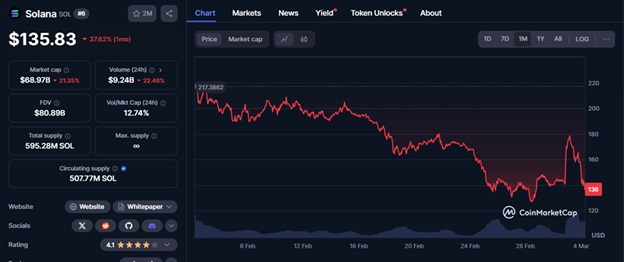
The SOL token has experienced highs and lows, making it difficult for investors to predict where it is heading. However upon the announcement by the U.S government that SOL will be included in the Crypto Strategic Reserve, the Solana price went sky high and it saw a 10% spike in one day.

However comparing its monthly performance, the SOL token continues to fall. At the time of writing, it is trading at around $135, which is over 37% below last week.

The Solana price swings are largely driven by overall crypto market volatility. High network congestion and occasional outages have raised concerns which led to decreased investor confidence and sell-offs. Profit-taking by large holders after SOL’s rally to $230 triggered further selling pressure.

Source: CoinMarketCap

The current Solana price trend shows increasing selling pressure, with key technical indicators such as moving averages signaling bearish momentum. While some analysts remain hopeful for a rebound, the constant price fluctuations make investors nervous. Many are now looking for more stable and high-growth opportunities, such as DTX Exchange, to bet on.

Final Thoughts

Solana (SOL) remains a substantial blockchain project, but the recent volatility of the Solana price is causing hesitation among investors. Many are choosing to diversify their portfolios with DTX Exchange, as it could offer a 100x potential.

Early investors can double their money as the token price will jump from $0.18 to $0.36 once it gets listed. The LIST2X promo code can boost returns even more, giving traders a chance to even quadruple their investment. So don’t miss out on buying DTX at its lowest price before it hits the open market.

Check out these links for more information about DTX Exchange:

Buy Presale

Visit DTX Website

Join The DTX Community